




North America Neonatal Jaundice Management Market
Market Size in USD Million
CAGR :
% 
 USD
211.43 Million
USD
344.70 Million
2025
2033
USD
211.43 Million
USD
344.70 Million
2025
2033
 Forecast Period Forecast Period |
2026 –2033 |
 Market Size (Base Year) Market Size (Base Year) |
USD 211.43 Million |
 Market Size (Forecast Year) Market Size (Forecast Year) |
USD 344.70 Million |
 CAGR CAGR |
% |
| Major Markets Players |
|
North America Neonatal Jaundice Management Market Size
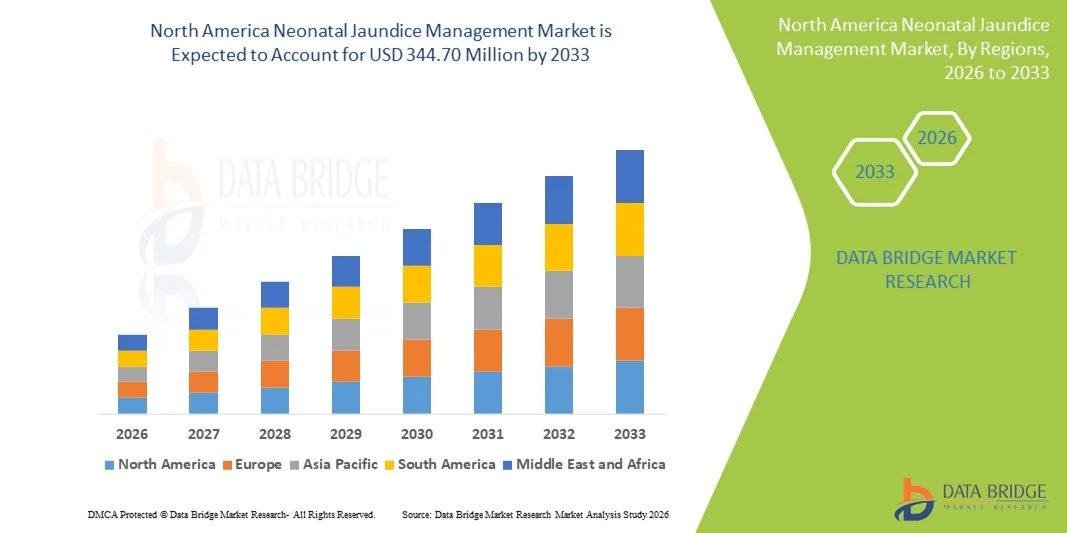
- The North America neonatal jaundice management market size was valued at USD 211.43 million in 2025 and is expected to reach USD 344.70 million by 2033, at a CAGR of 6.3% during the forecast period
- The market growth is largely fueled by the increasing prevalence of neonatal hyperbilirubinemia, strong healthcare infrastructure, high adoption of innovative diagnostic and phototherapy technologies and favorable reimbursement policies that support early intervention and effective care practices
- Furthermore, rising emphasis on improved neonatal outcomes, expanding neonatal care facilities such as NICUs, and continuous technological progress in phototherapy and monitoring systems are enhancing the quality, accessibility, and efficiency of jaundice management in both hospital and clinical settings. These converging factors are accelerating the uptake of neonatal jaundice management solutions, thereby significantly boosting the regional industry’s growth
North America Neonatal Jaundice Management Market Analysis
- Neonatal jaundice management solutions, including diagnostic tools, treatment devices, and monitoring systems, are increasingly vital components of neonatal care in both hospitals and clinics due to their role in preventing severe hyperbilirubinemia and improving newborn outcomes
- The escalating demand for neonatal jaundice management solutions is primarily fueled by the rising prevalence of neonatal hyperbilirubinemia, growing awareness among healthcare providers and parents, and a strong emphasis on early diagnosis and effective treatment to reduce complications
- The United States dominated the neonatal jaundice management market with the largest revenue share of 79.5% in 2025, characterized by advanced healthcare infrastructure, high adoption of innovative diagnostic and treatment technologies, and a strong presence of key industry players. Substantial growth is observed in hospitals and clinics, driven by continuous innovations in LED phototherapy and fiberoptic treatment devices
- Canada is expected to be the fastest growing country during the forecast period due to increasing hospital births, expanding neonatal care facilities, and rising healthcare expenditure
- Light-Emitting Diode (LED) light sources segment dominated the market with a share of 50.4% in 2025, driven by their high efficiency, low heat emission, and enhanced effectiveness in both hospital and home care settings
Report Scope and North America Neonatal Jaundice Management Market Segmentation
|
Attributes |
North America Neonatal Jaundice Management Key Market Insights |
|
Segments Covered |
|
|
Countries Covered |
North America
|
|
Key Market Players |
|
|
Market Opportunities |
|
|
Value Added Data Infosets |
In addition to the insights on market scenarios such as market value, growth rate, segmentation, geographical coverage, and major players, the market reports curated by the Data Bridge Market Research also include in-depth expert analysis, patient epidemiology, pipeline analysis, pricing analysis, and regulatory framework |
North America Neonatal Jaundice Management Market Trends
Integration of Advanced Phototherapy and Remote Monitoring
- A significant and accelerating trend in the North America neonatal jaundice management market is the growing integration of advanced LED phototherapy devices with remote monitoring systems, enhancing treatment efficiency and patient safety
- For instance, devices such as Bilisoft LED Phototherapy System allow clinicians to monitor bilirubin levels remotely while providing continuous therapy, improving convenience and reducing hospital stay duration.
- Smart phototherapy systems are increasingly incorporating features such as real-time treatment tracking, automated intensity adjustment based on bilirubin readings, and alerts for abnormal conditions. For instance, BiliChek devices can send notifications to mobile apps when treatment thresholds are reached, enabling timely interventions
- The integration of treatment and monitoring platforms allows centralized oversight of neonatal care, enabling healthcare providers to manage multiple patients efficiently while ensuring optimal treatment outcomes
- This trend towards more intelligent, connected, and efficient jaundice management solutions is fundamentally reshaping clinical expectations and driving innovation. Consequently, companies such as GE Healthcare and Natus are developing LED phototherapy devices with IoT-enabled monitoring and automated treatment protocols
- The adoption of smart, connected jaundice management devices is growing rapidly across hospitals and clinics, as healthcare providers increasingly prioritize treatment effectiveness, workflow efficiency, and improved neonatal outcomes
- Integration with electronic health record (EHR) systems allows seamless documentation, treatment tracking, and analysis of neonatal jaundice trends across healthcare facilities, enhancing decision-making and patient safety
North America Neonatal Jaundice Management Market Dynamics
Driver
Increasing Incidence of Neonatal Hyperbilirubinemia and Awareness
- The rising prevalence of neonatal hyperbilirubinemia, coupled with increasing awareness among parents and healthcare providers, is a significant driver for the heightened demand for neonatal jaundice management solutions
- For instance, in March 2025, Natus Medical introduced upgraded BiliChek systems with enhanced accuracy for non-invasive bilirubin measurement, supporting early diagnosis and timely treatment
- As healthcare providers seek to prevent severe jaundice-related complications, neonatal jaundice management devices offer precise monitoring, effective phototherapy, and timely intervention capabilities, providing clear advantages over traditional methods
- Furthermore, increasing hospital births and the expansion of NICUs are making jaundice management solutions a critical part of neonatal care, enabling better patient monitoring and improved treatment outcomes
- The convenience of portable phototherapy units, real-time bilirubin monitoring, and integrated clinical management platforms are key factors propelling adoption in hospitals and clinics, particularly in the U.S. and Canada
- Growing awareness programs by pediatric associations and government health agencies are emphasizing early jaundice detection and management, increasing adoption of advanced management solutions
- Technological advancements in non-invasive bilirubin measurement devices are driving demand, as clinicians prefer safer, faster, and more reliable diagnostic options
Restraint/Challenge
High Device Costs and Regulatory Compliance Hurdles
- The relatively high cost of advanced phototherapy and monitoring systems poses a challenge to broader adoption, especially among smaller clinics and budget-conscious healthcare facilities
- For instance, premium LED phototherapy systems with IoT-enabled monitoring can be cost-prohibitive for some hospitals, limiting accessibility despite proven clinical benefits
- Strict regulatory requirements for neonatal medical devices in North America, including FDA approvals and compliance with safety standards, create hurdles for new product introductions and slow market penetration
- In addition, concerns regarding device maintenance, calibration accuracy, and training requirements for clinical staff can impede adoption in certain healthcare settings
- Overcoming these challenges through cost-effective product development, streamlined regulatory processes, and clinician training programs will be crucial for sustained market growth
- Limited reimbursement coverage for advanced phototherapy and monitoring devices can discourage healthcare facilities from investing in newer technologies despite their clinical advantages
- Resistance to change among healthcare staff accustomed to traditional phototherapy methods may slow adoption, necessitating awareness campaigns and training initiatives
North America Neonatal Jaundice Management Market Scope
The market is segmented on the basis of management, type, technology, end user, and distribution channel.
- By Management
On the basis of management, the market is segmented into diagnosis and treatment. The Treatment segment dominated the market with the largest revenue share in 2025, driven by the high demand for effective phototherapy devices and treatment systems to prevent severe hyperbilirubinemia. Hospitals and NICUs prioritize treatment devices for their ability to reduce bilirubin levels quickly and safely, which is critical for neonatal health. The segment’s dominance is also supported by continuous innovations such as LED phototherapy and fiberoptic blankets, enhancing treatment efficiency and reducing hospital stays. In addition, government healthcare initiatives and insurance coverage often emphasize prompt treatment, further boosting adoption. Hospitals and clinics invest heavily in treatment systems as they are integral to standard neonatal care protocols.
The Diagnosis segment is anticipated to witness the fastest growth from 2026 to 2033, fueled by increasing adoption of non-invasive bilirubin measurement devices such as transcutaneous bilirubinometers. These diagnostic solutions enable early detection of jaundice, reducing the risk of complications and supporting timely intervention. Technological advancements, such as integration with electronic health records and automated monitoring, enhance accuracy and workflow efficiency. The rising awareness among parents and healthcare professionals about early jaundice detection is also driving market expansion. Rapid adoption in primary care centers and outpatient settings contributes to this growth, as clinicians prefer safer and faster diagnostic options.
- By Type
On the basis of type, the market is segmented into primary care and secondary care. The Secondary Care segment dominated the market in 2025 due to the concentration of advanced neonatal care facilities and NICUs in hospitals and specialized clinics. Secondary care centers are equipped with high-end phototherapy systems, fiberoptic devices, and integrated monitoring solutions, making them critical hubs for effective jaundice management. These facilities often handle complicated cases and premature infants requiring intensive monitoring and treatment. High patient volumes, skilled healthcare staff, and established clinical protocols further contribute to the dominance of this segment. The ongoing investment in upgrading neonatal care infrastructure supports steady revenue growth for secondary care facilities.
The Primary Care segment is expected to witness the fastest growth over the forecast period, driven by increasing adoption of portable and home-based phototherapy devices. Primary care centers and outpatient clinics are increasingly offering jaundice management services to reduce hospital stays and healthcare costs. Advancements in user-friendly, compact treatment and diagnostic devices make it feasible to treat neonates outside intensive care units. Growing awareness among parents about early jaundice detection and home care options further boosts this segment. Integration with telehealth platforms and remote monitoring systems allows primary care providers to manage neonatal jaundice efficiently, contributing to rapid growth.
- By Technology
On the basis of technology, the market is segmented into Light-Emitting Diode (LED) light sources, fluorescent, halogen, fiberoptic, and others. The LED Light Sources segment dominated the market with the largest revenue share of 50.4% in 2025 due to their high energy efficiency, low heat emission, and superior therapeutic effectiveness. Hospitals and clinics prefer LED-based devices for continuous treatment, reduced maintenance costs, and longer device lifespan. In addition, LED phototherapy systems can be integrated with monitoring technologies for automated treatment adjustments. The popularity is further driven by the availability of portable and home-use LED devices. Government support and awareness programs also encourage LED-based phototherapy adoption.
The Fiberoptic segment is expected to witness the fastest CAGR from 2026 to 2033, fueled by the growing preference for flexible, non-invasive phototherapy blankets that can be used in NICUs and home settings. Fiberoptic devices allow targeted treatment while enabling mobility of the infant, improving comfort and compliance. Technological advancements in fiberoptic light delivery and safety mechanisms are enhancing efficacy. Rising adoption in home care and outpatient facilities, along with increasing parental preference for less disruptive treatment methods, supports rapid growth. The compact design and ease of integration with existing care protocols further accelerate adoption.
- By End User
On the basis of end user, the market is segmented into hospitals, clinics, ambulatory surgical centers, home users, and others. The Hospitals segment dominated the market in 2025 due to the concentration of advanced neonatal care infrastructure, NICUs, and specialized staff. Hospitals handle a large number of neonatal patients requiring intensive monitoring and phototherapy. Investments in modern phototherapy and diagnostic devices by hospitals support high revenue generation. Hospitals also serve as referral centers for complicated neonatal jaundice cases. Government funding and insurance coverage further reinforce the dominance of hospitals as primary buyers.
The Home Users segment is expected to witness the fastest growth over the forecast period, driven by increasing adoption of portable phototherapy devices for home care. Parents are increasingly using user-friendly devices under clinical guidance to manage mild jaundice, reducing hospital stays and overall treatment costs. Integration with telehealth and remote monitoring technologies allows physicians to track treatment progress at home. Rising awareness of early jaundice management and convenience of home-based care contributes to this growth. Technological innovations enabling safe and effective home treatment further accelerate adoption.
- By Distribution Channel
On the basis of distribution channel, the market is segmented into direct tender, retail sales, and third-party distribution. The Direct Tender segment dominated the market in 2025 due to large-scale purchases by hospitals and healthcare facilities directly from manufacturers, ensuring product quality, after-sales service, and compliance with regulatory standards. Hospitals prefer direct procurement for bulk orders and long-term supply contracts. The direct tender system also allows negotiation of pricing and service packages, making it favorable for high-value phototherapy and diagnostic devices. Manufacturers leverage this channel to strengthen relationships with key healthcare institutions and drive market penetration.
The Retail Sales segment is expected to witness the fastest growth from 2026 to 2033, fueled by increasing availability of neonatal jaundice management devices through online and offline retail platforms. Parents and primary care centers are accessing phototherapy and diagnostic devices directly for home or clinic use. The growth of e-commerce platforms and awareness campaigns promoting home-based jaundice management solutions further support this segment. User-friendly, compact, and affordable devices drive adoption in retail, creating a fast-growing channel in the market.
North America Neonatal Jaundice Management Market Regional Analysis
- The United States dominated the neonatal jaundice management market with the largest revenue share of 79.5% in 2025, characterized by advanced healthcare infrastructure, high adoption of innovative diagnostic and treatment technologies, and a strong presence of key industry players. Substantial growth is observed in hospitals and clinics, driven by continuous innovations in LED phototherapy and fiberoptic treatment devices
- Healthcare providers and hospitals in the region prioritize accurate and efficient neonatal jaundice management solutions to reduce bilirubin levels safely and prevent severe complications, while parents increasingly demand early detection and treatment options for newborns
- This widespread adoption is further supported by well-established NICUs, high healthcare expenditure, a skilled neonatal care workforce, and continuous technological advancements in LED phototherapy, fiberoptic devices, and non-invasive bilirubin monitoring, making the U.S. the leading market within North America
U.S. Neonatal Jaundice Management Market Insight
The U.S. neonatal jaundice management market captured the largest revenue share of 79.5% in 2025 within North America, fueled by advanced healthcare infrastructure, high adoption of innovative phototherapy and diagnostic technologies, and increasing awareness of early jaundice detection and treatment. Hospitals and NICUs are prioritizing effective and safe management solutions, while parents increasingly demand timely interventions for newborns. The growing emphasis on reducing hospital stays through portable phototherapy devices, coupled with integration of remote monitoring and telehealth solutions, further propels the market. Moreover, continuous technological advancements in LED phototherapy, fiberoptic devices, and non-invasive bilirubin monitoring are significantly contributing to market expansion.
Canada Neonatal Jaundice Management Market Insight
The Canada neonatal jaundice management market is projected to expand at a substantial CAGR throughout the forecast period, primarily driven by increasing hospital births, expanding neonatal care infrastructure, and rising awareness among healthcare providers and parents. The demand for accurate diagnostic tools and efficient treatment systems is growing in both hospitals and clinics. Canadian healthcare facilities are focusing on early detection and effective management of neonatal jaundice, supported by government health initiatives and insurance coverage. Integration with telehealth platforms and remote monitoring further enhances the accessibility and quality of care. The market growth is also aided by continuous training and adoption of best practices in neonatal care.
Mexico Neonatal Jaundice Management Market Insight
The Mexico neonatal jaundice management market is expected to grow at a noteworthy CAGR during the forecast period, driven by increasing urbanization, rising healthcare expenditure, and growing awareness of neonatal health. Hospitals and clinics are investing in phototherapy and diagnostic devices to improve treatment outcomes and reduce complications associated with hyperbilirubinemia. The adoption of portable phototherapy devices for home and outpatient care is increasing, supporting faster recovery and reduced hospitalization. Government initiatives to improve neonatal healthcare infrastructure and awareness campaigns about jaundice detection further stimulate market growth. The integration of modern devices into clinical workflows is becoming increasingly common across neonatal care centers.
North America Neonatal Jaundice Management Market Share
The North America Neonatal Jaundice Management industry is primarily led by well-established companies, including:
- GE HealthCare (U.S.)
- Drägerwerk AG & Co. KGaA (Germany)
- Natus Medical Incorporated (U.S.)
- NeoLight LLC (U.S.)
- Koninklijke Philips N.V. (Netherlands)
- Atom Medical Corp. (Japan)
- Medela AG (Switzerland)
- Phoenix Medical Systems Pvt. Ltd. (India)
- Signify Holding (Netherlands)
- Ameda Inc. (U.S.)
- Weyer GmbH (Germany)
- Heal Force Bio‑Meditech Holdings Limited (China)
- Novos Medical Systems (India)
- Ibis Medical Equipment & Systems Pvt. Ltd. (India)
- Kay & Company (India)
- Medical Technologies & Services (Vietnam)
- Zhengzhou Dison Instrument and Meter Co., Ltd. (China)
- David Medical Device Co., Ltd. (China)
- Fanem Ltda. (Brazil)
- Neotech Medical Systems Pvt. Ltd. (India)
What are the Recent Developments in North America Neonatal Jaundice Management Market?
- In December 2025, researchers developed the mBilimeter, a smartphone‑based device using AI and imaging for non‑invasive neonatal jaundice detection, offering an accessible alternative to traditional blood tests and supporting remote bilirubin estimation
- In May 2025, a first‑in‑human pilot study demonstrated that a wearable phototherapy device is effective and safe in reducing bilirubin levels in a majority of near‑term neonates treated for hyperbilirubinemia, highlighting progress toward more flexible, parent‑friendly treatment approaches for neonatal jaundice, including potential use outside traditional hospital settings
- In March 2025, Dräger expanded its neonatal care portfolio in North America by launching BiliPredics, a predictive bilirubin analytics software that forecasts bilirubin progression up to 60 hours ahead, helping clinicians make more informed jaundice care decisions. This solution also integrates with existing neonatal screening and treatment workflows to support early intervention
- In July 2024, Konica Minolta and Picterus AS announced a strategic collaboration to enhance non‑invasive, smartphone‑based neonatal jaundice screening solutions capable of supporting early detection and broader access to care beyond traditional clinical settings
- In March 2024, Intermountain Health in the United States partnered with Picterus AS to study a new smartphone‑camera‑based technology for jaundice screening in newborns, aiming to accurately estimate bilirubin levels without painful blood draws and ultimately enable easier at‑home or clinical monitoring of neonatal jaundice
SKU-
Get online access to the report on the World's First Market Intelligence Cloud

- Interactive Data Analysis Dashboard
- Company Analysis Dashboard for high growth potential opportunities
- Research Analyst Access for customization & queries
- Competitor Analysis with Interactive dashboard
- Latest News, Updates & Trend analysis
- Harness the Power of Benchmark Analysis for Comprehensive Competitor Tracking
Research Methodology
Data collection and base year analysis are done using data collection modules with large sample sizes. The stage includes obtaining market information or related data through various sources and strategies. It includes examining and planning all the data acquired from the past in advance. It likewise envelops the examination of information inconsistencies seen across different information sources. The market data is analysed and estimated using market statistical and coherent models. Also, market share analysis and key trend analysis are the major success factors in the market report. To know more, please request an analyst call or drop down your inquiry.
The key research methodology used by DBMR research team is data triangulation which involves data mining, analysis of the impact of data variables on the market and primary (industry expert) validation. Data models include Vendor Positioning Grid, Market Time Line Analysis, Market Overview and Guide, Company Positioning Grid, Patent Analysis, Pricing Analysis, Company Market Share Analysis, Standards of Measurement, Global versus Regional and Vendor Share Analysis. To know more about the research methodology, drop in an inquiry to speak to our industry experts.
Customization Available
Data Bridge Market Research is a leader in advanced formative research. We take pride in servicing our existing and new customers with data and analysis that match and suits their goal. The report can be customized to include price trend analysis of target brands understanding the market for additional countries (ask for the list of countries), clinical trial results data, literature review, refurbished market and product base analysis. Market analysis of target competitors can be analyzed from technology-based analysis to market portfolio strategies. We can add as many competitors that you require data about in the format and data style you are looking for. Our team of analysts can also provide you data in crude raw excel files pivot tables (Fact book) or can assist you in creating presentations from the data sets available in the report.












