


North America Tumour Ablation Market Size
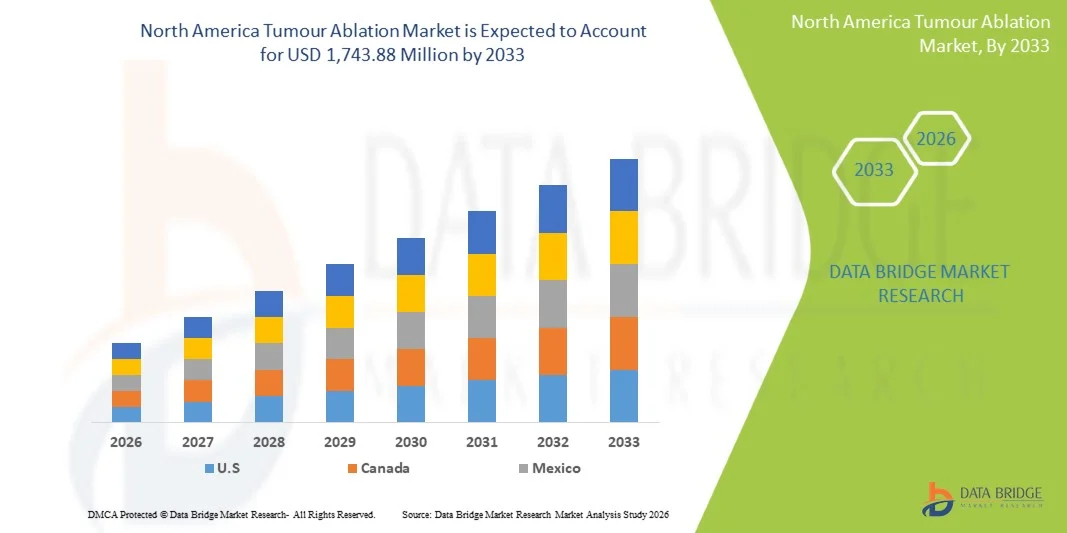
- The North America tumour ablation market size was valued at USD 784.55 million in 2025 and is expected to reach USD 1,743.88 million by 2033, at a CAGR of 10.50% during the forecast period
- The market growth is largely fueled by the increasing incidence and prevalence of cancer in the region, advancements in minimally invasive ablation technologies, and strong healthcare infrastructure that supports early and precise cancer treatment
- Furthermore, robust reimbursement frameworks, continuous regulatory approvals for next‑generation ablation systems and rising preference for outpatient and image‑guided procedures are driving demand for tumour ablation solutions as effective alternatives to traditional surgery, significantly boosting market expansion in North America
North America Tumour Ablation Market Analysis
- Tumour ablation, involving minimally invasive techniques such as radiofrequency, microwave, cryoablation, and high-intensity focused ultrasound, is becoming a critical component of cancer treatment in hospitals and specialized clinics due to its precision, shorter recovery times, and ability to target inoperable tumors
- The rising demand for tumour ablation is primarily driven by increasing cancer incidence, preference for minimally invasive procedures, advancements in ablation technologies, and growing awareness of outpatient treatment options that reduce hospitalization and improve patient outcomes
- The United States dominated the North America tumour ablation market with the largest revenue share of 75.4% in 2025, fueled by advanced healthcare infrastructure, early adoption of minimally invasive technologies, robust reimbursement frameworks, and strong presence of leading market players
- Canada is expected to be the fastest-growing country in the North America tumour ablation market during the forecast period, due to increasing healthcare expenditure, growing geriatric population, and expanding adoption of advanced cancer therapies across hospitals and specialty clinics
- Radiofrequency (RF) Ablation segment dominated the market segment with a share of 42.6% in 2025, driven by its proven efficacy, wide clinical adoption, and compatibility with both percutaneous and laparoscopic procedures
Report Scope and North America Tumour Ablation Market Segmentation
|
Attributes |
North America Tumour Ablation Key Market Insights |
|
Segments Covered |
|
|
Countries Covered |
North America
|
|
Key Market Players |
|
|
Market Opportunities |
|
|
Value Added Data Infosets |
In addition to the insights on market scenarios such as market value, growth rate, segmentation, geographical coverage, and major players, the market reports curated by the Data Bridge Market Research also include in-depth expert analysis, patient epidemiology, pipeline analysis, pricing analysis, and regulatory framework |
North America Tumour Ablation Market Trends
“Advancements Through Image-Guided and AI-Assisted Systems”
- A significant and accelerating trend in the North America tumour ablation market is the growing integration of AI and advanced imaging technologies such as CT, MRI, and ultrasound guidance, enhancing precision and procedural efficiency
- For instance, AI-assisted radiofrequency ablation systems can optimize needle placement and energy delivery, reducing procedure time and improving treatment outcomes for liver and kidney tumors
- AI integration enables predictive modeling for tumor response, personalized treatment planning, and automated monitoring during procedures. For instance, some Visicovery systems utilize machine learning to track ablation margins in real time and alert clinicians to potential incomplete ablation zones
- The combination of image-guided navigation with AI allows clinicians to perform minimally invasive procedures with higher accuracy, lower complication rates, and reduced recovery times, creating more predictable patient outcomes
- This trend towards intelligent, precise, and technology-driven ablation solutions is reshaping clinician expectations for cancer care, and companies such as Medtronic and AngioDynamics are developing AI-enabled ablation platforms with automated guidance and real-time monitoring
- The demand for tumor ablation systems integrated with advanced imaging and AI analytics is growing rapidly across hospitals and specialty clinics, as healthcare providers increasingly prioritize minimally invasive, outpatient-friendly treatment solutions
- The emergence of hybrid ablation systems that combine multiple energy modalities is offering more flexible and tailored treatment options for complex or hard-to-reach tumors
North America Tumour Ablation Market Dynamics
Driver
“Rising Cancer Incidence and Preference for Minimally Invasive Procedures”
- The increasing prevalence of cancers such as liver, lung, and kidney malignancies, coupled with the growing preference for minimally invasive treatments, is a major driver of the tumor ablation market
- For instance, in March 2025, Medtronic announced the expansion of its ablation product line with AI-assisted image-guided systems to improve efficiency and precision in liver tumor treatments
- As patients and clinicians seek alternatives to open surgery, tumor ablation offers benefits including shorter hospital stays, reduced post-operative pain, and faster recovery, increasing adoption rates
- Furthermore, strong reimbursement policies in the U.S. and technological advancements in ablation devices make these procedures more accessible and attractive to healthcare providers
- The ability to perform outpatient procedures, combined with rising awareness among patients about minimally invasive cancer therapies, is propelling the growth of tumor ablation solutions in hospitals and specialized clinics
- Growing research and clinical trials demonstrating long-term efficacy of ablation versus traditional surgical methods are boosting physician confidence and patient preference for these procedures
- Expansion of specialized cancer centers and imaging-equipped facilities in urban and suburban areas is increasing patient access to ablation technologies, accelerating market adoption
Restraint/Challenge
“Technical Complexity and Regulatory Hurdles”
- The high technical complexity and the need for specialized training to operate advanced ablation systems pose a challenge to broader adoption of tumor ablation procedures
- For instance, improper needle placement or energy delivery in inexperienced hands can result in incomplete tumor ablation or collateral tissue damage, limiting widespread clinical adoption
- Addressing these challenges through training programs, AI-assisted guidance, and standardized procedural protocols is crucial to improve clinician confidence and patient safety. In addition, regulatory approval processes for new devices and technologies can be lengthy and costly, delaying market entry
- While procedural success rates are improving, high initial investment costs for advanced ablation equipment and image-guided systems can be a barrier for smaller hospitals and outpatient centers
- Overcoming these challenges through enhanced clinician training, regulatory support, and cost-effective device solutions will be vital for sustained market growth in North America
- Limited long-term data on certain novel ablation modalities and the need for follow-up treatments may cause hesitation among providers and patients when selecting ablation over conventional surgery
- Cybersecurity and data integration concerns related to AI-assisted ablation platforms, including patient imaging and real-time monitoring systems, can hinder adoption if not adequately addressed by manufacturers and healthcare providers
North America Tumour Ablation Market Scope
The market is segmented on the basis of technology, treatment, and application.
- By Technology
On the basis of technology, the North America tumour ablation market is segmented into radiofrequency (RF) ablation, microwave ablation, cryoablation, and other technologies. The Radiofrequency (RF) Ablation segment dominated the market in 2025 with the largest revenue share of 42.6%, driven by its proven clinical efficacy, long-term adoption in hospitals, and versatility for treating liver, kidney, and lung tumors. RF ablation is widely used due to its ability to provide precise thermal destruction of tumor tissue with minimal collateral damage. Clinicians prefer RF ablation for both percutaneous and laparoscopic procedures because of its predictable energy delivery and favorable safety profile. The extensive availability of RF ablation devices and strong reimbursement policies in the U.S. further reinforce its market dominance. In addition, ongoing advancements such as multi-tined electrodes and AI-assisted planning enhance treatment precision, contributing to sustained adoption.
The Microwave Ablation segment is expected to witness the fastest growth rate of 14% CAGR from 2026 to 2033, fueled by increasing adoption in advanced cancer centers and specialty clinics. Microwave ablation offers higher intratumoral temperatures, shorter procedure times, and the ability to treat larger or multiple tumors in a single session. Its efficiency in treating liver and lung cancers, combined with growing awareness among oncologists of its benefits over conventional RF systems, is accelerating market penetration. Technological improvements, including portable microwave generators and image-guided platforms, are also driving its rapid adoption in outpatient and minimally invasive settings.
- By Treatment
On the basis of treatment, the market is segmented into percutaneous ablation, laparoscopic ablation, and surgical ablation. The Percutaneous Ablation segment dominated the market in 2025, accounting for the largest revenue share of 45%, due to its minimally invasive nature, reduced hospital stay, and suitability for high-risk or inoperable patients. Percutaneous approaches, guided by CT or ultrasound imaging, allow precise targeting of tumors while minimizing damage to surrounding tissues. Hospitals and cancer centers increasingly prefer percutaneous procedures because they can be performed under local anesthesia and reduce overall procedural costs. The ability to combine percutaneous ablation with real-time imaging and AI guidance further enhances clinical outcomes and drives adoption. Patient preference for outpatient treatment and quicker recovery times also contributes to its dominant market position.
The Laparoscopic Ablation segment is expected to witness the fastest growth at a CAGR of 13% during 2026–2033. Laparoscopic ablation allows minimally invasive access to tumors in locations difficult to reach percutaneously, such as deep liver or kidney lesions. The growing number of laparoscopic-trained surgeons and increasing adoption in specialized oncology centers are driving demand. This treatment modality offers a combination of surgical precision and minimal invasiveness, attracting both patients and clinicians who seek improved safety and efficacy. Advances in robotic-assisted laparoscopic ablation are further accelerating growth in this segment.
- By Application
On the basis of application, the market is segmented into liver cancer, lung cancer, kidney cancer, bone metastasis, and others. The Liver Cancer segment dominated the market in 2025 with the largest revenue share of 40%, driven by the high prevalence of hepatocellular carcinoma in the U.S. and Canada, and the effectiveness of ablation as a curative option for early-stage tumors. Liver ablation procedures are favored due to their minimally invasive nature, high success rates, and compatibility with both percutaneous and laparoscopic approaches. Hospitals and specialty cancer centers actively adopt liver tumor ablation because it reduces the need for open surgery and shortens recovery times. Continuous improvements in imaging guidance and AI-assisted ablation planning are further increasing adoption in this segment.
The Lung Cancer segment is expected to witness the fastest growth at a CAGR of 14% during 2026–2033. Minimally invasive lung ablation is increasingly preferred for patients ineligible for surgery due to comorbidities or age. Advancements in microwave and RF ablation technology, along with improved imaging systems for precise tumor targeting, are driving market expansion. The rising incidence of lung cancer in North America and increasing awareness among oncologists and patients about minimally invasive alternatives to lobectomy are key factors supporting rapid growth.
North America Tumour Ablation Market Regional Analysis
- The United States dominated the North America tumour ablation market with the largest revenue share of 75.4% in 2025, fueled by advanced healthcare infrastructure, early adoption of minimally invasive technologies, robust reimbursement frameworks, and strong presence of leading market players
- Patients and clinicians in the region highly value the precision, shorter recovery times, and minimally invasive nature of tumour ablation procedures, along with integration of advanced imaging and AI-assisted guidance systems for improved treatment outcomes
- This widespread adoption is further supported by strong reimbursement frameworks, growing awareness of outpatient cancer treatment options, and the availability of specialized cancer centers, establishing tumour ablation as a preferred treatment solution for liver, lung, kidney, and other solid organ tumors in both hospital and specialty clinic settings
The U.S. Tumour Ablation Market Insight
The U.S. tumour ablation market captured the largest revenue share of 75.4% in 2025 within North America, fueled by advanced healthcare infrastructure, high adoption of minimally invasive procedures, and strong presence of leading device manufacturers. Hospitals and specialty cancer centers are increasingly implementing AI-assisted and image-guided ablation systems to improve precision and patient outcomes. Rising prevalence of liver, lung, and kidney cancers, combined with favorable reimbursement frameworks, is driving clinical adoption. Moreover, the growing patient preference for outpatient procedures, shorter recovery times, and minimally invasive alternatives to surgery is significantly contributing to market expansion.
Canada Tumour Ablation Market Insight
The Canada tumour ablation market is projected to grow at a notable CAGR during the forecast period, driven by increasing healthcare expenditure, a rising geriatric population, and the adoption of advanced cancer therapies. Canadian hospitals and oncology centers are investing in microwave, radiofrequency, and cryoablation technologies to expand treatment options for patients who are ineligible for surgery. The integration of advanced imaging and AI-assisted planning enhances procedural success and patient safety. Furthermore, government initiatives promoting access to cutting-edge medical technologies and outpatient care are expected to accelerate market growth. The increasing awareness of minimally invasive cancer treatments among physicians and patients is fostering wider adoption across urban and suburban regions.
Mexico Tumour Ablation Market Insight
The Mexico tumour ablation market is expected to grow at a steady CAGR during the forecast period, driven by increasing healthcare modernization, rising cancer awareness, and growing adoption of minimally invasive treatment options. Mexican hospitals and specialty clinics are gradually implementing radiofrequency, microwave, and cryoablation technologies to improve patient outcomes and reduce hospitalization times. The expansion of medical tourism and partnerships with international device manufacturers is also contributing to technology availability. In addition, government initiatives aimed at improving access to advanced oncology treatments and enhancing outpatient care are expected to support market growth. Growing awareness among clinicians and patients regarding the benefits of minimally invasive ablation procedures, particularly for liver and kidney cancers, is fostering wider adoption in urban healthcare centers.
North America Tumour Ablation Market Share
The North America Tumour Ablation industry is primarily led by well-established companies, including:
- AngioDynamics, Inc. (U.S.)
- Boston Scientific Corporation (U.S.)
- Medtronic (Ireland)
- Abbott (U.S.)
- Merit Medical Systems, Inc. (U.S.)
- Sonacare Medical, LLC (U.S.)
- EDAP TMS S.A. (France)
- HealthTronics, Inc. (U.S.)
- Misonix, Inc. (U.S.)
- Varian Medical Systems, Inc. (U.S.)
- HistoSonics, Inc. (U.S.)
- Hologic, Inc. (U.S.)
- Siemens Healthineers AG (Germany)
- Olympus Corporation (Japan)
- Neuwave Medical, Inc. (U.S.)
- Integra LifeSciences Holdings Corporation (U.S.)
- CSA Medical, Inc. (U.S.)
- MedWaves, Inc. (U.S.)
- Endocare, Inc. (U.S.)
What are the Recent Developments in North America Tumour Ablation Market?
- In March 2025, Baird Medical’s AI Tumor Ablation Surgical Robot won the “Most Valuable Investment Award,” highlighting innovation in AI‑driven robotic ablation technology that aims to integrate multimodal thermal ablation (MWA, RF, etc.) with intelligent decision support and dynamic intraoperative optimization, underscoring the shift toward automated precision ablation system
- In December 2024, the U.S. Food and Drug Administration granted 510(k) clearance to AngioDynamics' NanoKnife® System specifically for prostate tissue ablation in intermediate‑risk prostate cancer, marking a significant expansion of its clinical use in oncological ablation beyond soft tissue applications
- In October 2024, Health Canada approved Arrayus Technologies’ MRI‑guided focused ultrasound therapy system for the ablation of uterine fibroid tissue, offering a non‑invasive ablation alternative that uses high precision acoustic energy and integrated real‑time therapy monitoring tools. This regulatory approval expands advanced ablation technology availability within Canada and sets the stage for broader oncological trial
- In March 2024, Medtronic received FDA 510(k) clearance for its OsteoCool™ 2.0 bone tumor ablation system, an upgraded radiofrequency ablation platform designed to treat painful bone metastases and benign bone tumors, enabling multiple probes for larger ablation zones and increased procedural flexibility
- In April 2023, Ethicon (Johnson & Johnson MedTech) announced the treatment of the first patient in North America under its Investigational Device Exemption (IDE) POWER study, using robot‑assisted transbronchial microwave ablation for oligometastatic lung tumors. This milestone marked a significant clinical step in advancing minimally invasive, bronchoscopic ablation techniques for metastatic and primary lung tumors

- Interactive Data Analysis Dashboard
- Company Analysis Dashboard for high growth potential opportunities
- Research Analyst Access for customization & queries
- Competitor Analysis with Interactive dashboard
- Latest News, Updates & Trend analysis
- Harness the Power of Benchmark Analysis for Comprehensive Competitor Tracking
Data collection and base year analysis are done using data collection modules with large sample sizes. The stage includes obtaining market information or related data through various sources and strategies. It includes examining and planning all the data acquired from the past in advance. It likewise envelops the examination of information inconsistencies seen across different information sources. The market data is analysed and estimated using market statistical and coherent models. Also, market share analysis and key trend analysis are the major success factors in the market report. To know more, please request an analyst call or drop down your inquiry.
The key research methodology used by DBMR research team is data triangulation which involves data mining, analysis of the impact of data variables on the market and primary (industry expert) validation. Data models include Vendor Positioning Grid, Market Time Line Analysis, Market Overview and Guide, Company Positioning Grid, Patent Analysis, Pricing Analysis, Company Market Share Analysis, Standards of Measurement, Global versus Regional and Vendor Share Analysis. To know more about the research methodology, drop in an inquiry to speak to our industry experts.
Data Bridge Market Research is a leader in advanced formative research. We take pride in servicing our existing and new customers with data and analysis that match and suits their goal. The report can be customized to include price trend analysis of target brands understanding the market for additional countries (ask for the list of countries), clinical trial results data, literature review, refurbished market and product base analysis. Market analysis of target competitors can be analyzed from technology-based analysis to market portfolio strategies. We can add as many competitors that you require data about in the format and data style you are looking for. Our team of analysts can also provide you data in crude raw excel files pivot tables (Fact book) or can assist you in creating presentations from the data sets available in the report.













