


Hepatocellular Carcinoma Drugs Market Size
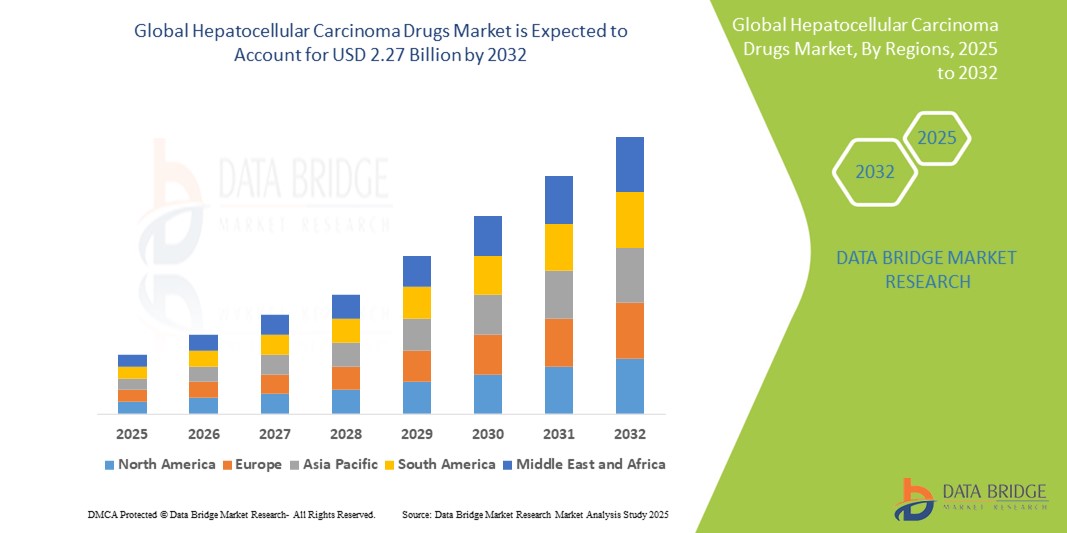
- The global hepatocellular carcinoma drugs market was valued at USD 1.21 billion in 2024 and is expected to reach USD 2.27 billion by 2032
- During the forecast period of 2025 to 2032 the market is likely to grow at a CAGR of 8.20%, primarily driven by advancements in diagnostic techniques
- This growth is driven by factors such as enhanced imaging, liquid biopsy and AI-powered diagnostic
Hepatocellular Carcinoma Drugs Market Analysis
- Hepatocellular carcinoma (HCC) drugs are therapeutic agents designed to treat the most common form of primary liver cancer. These drugs include targeted therapies, immunotherapies, and chemotherapies, playing a crucial role in improving survival rates and quality of life for patients. Available in various forms such as oral, intravenous, and injectable formulations, HCC drugs are tailored to both early-stage and advanced disease management strategies
- The market is witnessing robust growth driven by the rising global incidence of liver cancer, growing prevalence of hepatitis B infections and hepatitis C infections, and increasing cases of liver cirrhosis and non-alcoholic fatty liver disease (NAFLD)
- The HCC drugs market is undergoing rapid innovation, with a strong focus on immuno-oncology, combination therapies, and precision medicine. Pharmaceutical companies are developing novel therapies that target specific genetic markers and improve patient response rates
- For instance, major players such as Bristol-Myers Squibb and Roche are advancing checkpoint inhibitors and combination regimens such as nivolumab and atezolizumab plus bevacizumab, to provide more personalized and effective treatment solutions
- The hepatocellular carcinoma drugs market is expected to sustain its upward trajectory, fueled by continued research and development, increased investment in oncology pipelines, and rising healthcare awareness. In addition, the expansion of access to treatment in emerging markets and growing focus on patient-centric, minimally invasive therapies are likely to drive long-term market growth
Report Scope and Hepatocellular Carcinoma Drugs Market Segmentation
|
Attributes |
Hepatocellular Carcinoma Drugs Key Market Insights |
|
Segments Covered |
|
|
Countries Covered |
North America
Europe
Asia-Pacific
Middle East and Africa
South America
|
|
Key Market Players |
|
|
Market Opportunities |
|
|
Value Added Data Infosets |
In addition to the insights on market scenarios such as market value, growth rate, segmentation, geographical coverage, and major players, the market reports curated by the Data Bridge Market Research also include depth expert analysis, patient epidemiology, pipeline analysis, pricing analysis, and regulatory framework. |
Hepatocellular Carcinoma Drugs Market Trends
“Increasing Shift Towards Immunotherapies”
- One prominent trend in the global hepatocellular carcinoma drugs market is the increasing shift towards immunotherapies
- This trend is driven by the limited efficacy and significant side effects of conventional chemotherapies, coupled with the rising success of immune checkpoint inhibitors in enhancing survival outcomes. As the understanding of tumor immunology advances, pharmaceutical companies and clinicians are increasingly turning to immunotherapies to activate the body’s own immune system in fighting liver cancer more effectively
- For instance, AstraZeneca is making strides with tremelimumab combined with durvalumab, which has demonstrated improved survival in unresectable HCC cases
- The growing clinical adoption of these therapies, alongside promising results from ongoing trials, is expected to accelerate the shift toward immunotherapies as a preferred treatment pathway
- As the oncology sector advances, manufacturers are prioritizing the development of novel immunotherapy combinations, biomarker-driven patient stratification, and personalized medicine approaches. The rising demand for targeted, less toxic, and more effective cancer therapies will continue to shape innovation and investment strategies in the hepatocellular carcinoma drugs market
Hepatocellular Carcinoma Drugs Market Dynamics
Driver
“Increasing Prevalence of Liver Cancer”
- The rising global incidence of liver cancer is a key driver of growth in the hepatocellular carcinoma (HCC) drugs market. As cases of chronic liver diseases such as hepatitis B and C, alcohol-related liver damage, and non-alcoholic fatty liver disease (NAFLD) continue to rise, the demand for effective HCC treatments has significantly increased
- This increase is especially notable in aging populations, where the cumulative risk of liver disease and related complications is higher. With longer life expectancy and lifestyle-related risk factors on the rise, healthcare systems are seeing a growing number of liver cancer cases, particularly among individuals over 60 years of age
- With more patients being diagnosed at treatable stages, the demand for targeted therapies, immunotherapies, and combination treatments is accelerating across both developed and emerging markets
- Modern HCC drugs, including tyrosine kinase inhibitors and immune checkpoint inhibitors, are being integrated into treatment protocols to improve survival rates and quality of life
- These therapies are increasingly supported by government initiatives and global cancer control programs focused on reducing the impact of liver cancer
For instance,
- World Health Organization (WHO) continues to push for hepatitis elimination and cancer prevention strategies, which in turn are creating greater demand for effective HCC therapies and expanding market opportunities for pharmaceutical companies
- In the United States, rising liver cancer cases are increasing the use of drugs such as sorafenib, lenvatinib, and atezolizumab with bevacizumab in treatment protocols
- As liver cancer prevalence continues to rise, the need for innovative, accessible, and effective drug therapies will remain a core driver of growth in the hepatocellular carcinoma drugs market
Opportunity
“Increasing Strategic Collaborations Between Organizations”
- Strategic partnerships and collaborations are emerging as a major opportunity for growth in the hepatocellular carcinoma HCC drugs market. As the complexity of liver cancer treatment increases, pharmaceutical companies, biotech firms, academic institutions, and healthcare providers are joining forces to accelerate drug discovery, clinical research, and regulatory approvals
- Collaborative efforts are enabling faster development of novel therapies by pooling expertise in areas such as immuno-oncology, biomarker research, and molecular targeting. These partnerships also support clinical trial efficiency, expand geographic access, and facilitate regulatory alignment across global markets
- Joint ventures and licensing agreements are becoming especially valuable in enabling smaller biotech firms to bring innovative therapies to market in partnership with larger pharmaceutical companies that have the infrastructure for large-scale distribution and commercialization
For instance,
- Exelixis and Ipsen have collaborated on the global development and commercialization of cabozantinib for advanced HCC, helping to expand access across multiple regions
- BeiGene has partnered with Novartis to co-develop and co-market tislelizumab, an anti PD-1 antibody, in various cancer types including HCC
- As the demand for more effective and personalized HCC therapies grows, ongoing collaboration across sectors is expected to drive innovation, reduce time-to-market, and enhance patient outcomes. Strategic alliances will continue to play a critical role in shaping the future of the hepatocellular carcinoma drugs market
Restraint/Challenge
“Lack of Drug Approvals”
- Limited drug approvals continue to pose a significant challenge for the hepatocellular carcinoma HCC drugs market. Despite ongoing research and clinical trials, the number of HCC-specific therapies that receive regulatory clearance remains relatively low, slowing progress in addressing the unmet medical needs of patients
- The complex nature of liver cancer, characterized by its late-stage diagnosis, diverse etiologies, and resistance to conventional treatments, makes it difficult for many drug candidates to demonstrate meaningful clinical benefits during trials. As a result, regulatory bodies often require extensive data and longer timelines before approving new therapies
- In addition, the development of HCC drugs faces high attrition rates during clinical trials due to safety concerns, limited efficacy, and challenges in identifying suitable biomarkers. This has led to a cautious approach from both investors and developers, reducing the number of new compounds entering the approval pipeline
For instance,
- Several investigational drugs, including MET inhibitors and VEGF-targeting agents, have failed to meet endpoints in late-stage clinical trials, resulting in regulatory rejections or development discontinuation
- As regulatory requirements grow more stringent and clinical success remains elusive for many candidates, the slow pace of drug approvals continues to hinder the growth potential of the HCC drugs market. Without streamlined approval pathways, expanded biomarker validation, or greater support for early-phase research, this challenge will persist as a barrier to progress in the fight against liver cancer
Hepatocellular Carcinoma Drugs Market Scope
The market is segmented on the basis of drug class, therapy type, treatment type, route of administration, end-users, and distribution channel.
|
Segmentation |
Sub-Segmentation |
|
By Drug Class |
|
|
By Therapy Type |
|
|
By Treatment Type |
|
|
By Route of Administration
|
|
|
By End-Users |
|
|
By Distribution Channel |
|
Hepatocellular Carcinoma Drugs Market Regional Analysis
“North America is the Dominant Region in the Hepatocellular Carcinoma Drugs Market”
- North America dominates the hepatocellular carcinoma drugs market, driven by the strong presence of key pharmaceutical manufacturers, advanced healthcare infrastructure, and widespread access to innovative cancer therapies and treatment procedures
- The U.S. holds a significant share due to high disease prevalence, robust cancer screening programs, and strong adoption of novel therapeutics such as immunotherapies and targeted therapies
- Significant investment in oncology research, the availability of well-established clinical trial networks, and active participation from both public and private institutions support drug development and accelerate regulatory approvals
- With increasing patient awareness, high healthcare spending, and a growing focus on precision medicine, North America is expected to maintain its leadership position in the global hepatocellular carcinoma drugs market throughout the forecast period
“Asia-Pacific is Projected to Register the Highest Growth Rate”
- The Asia-Pacific region is expected to witness the highest growth rate in the hepatocellular carcinoma drugs market, driven by a rising incidence of liver cancer, expanding healthcare infrastructure, and increased R&D activity across the region
- Countries such as China, India, and South Korea are leading this growth, supported by a growing number of domestic biopharmaceutical companies and rising investment in oncology-focused research and development
- The region is also witnessing increased government support for cancer prevention programs, broader access to diagnostic facilities, and rising demand for innovative treatment options tailored to region-specific patient populations
- With improving access to healthcare, expanding pharmaceutical manufacturing capabilities, and strategic collaborations with global drug developers, Asia-Pacific is set to emerge as the fastest-growing market for hepatocellular carcinoma drugs during the forecast period
Hepatocellular Carcinoma Drugs Market Share
The market competitive landscape provides details by competitor. Details included are company overview, company financials, revenue generated, market potential, investment in research and development, new market initiatives, global presence, production sites and facilities, production capacities, company strengths and weaknesses, product launch, product width and breadth, application dominance. The above data points provided are only related to the companies' focus related to market.
The Major Market Leaders Operating in the Market Are:
- Exelixis, Inc. (U.S.)
- Merck & Co., Inc. (U.S.)
- AstraZeneca (U.K.)
- Bristol-Myers Squibb Company (U.S.)
- Eli Lilly and Company (U.S.)
- SillaJen, Inc. (South Korea)
- Bayer AG (Germany)
- Janssen Global Services, LLC (U.S.)
- Pfizer Inc. (U.S.)
- F. Hoffmann-La Roche Ltd (Switzerland)
- Gilead Sciences, Inc. (U.S.)
- GSK plc (U.K.)
- Takeda Pharmaceutical Company Limited (Japan)
- Eisai Co., Ltd. (Japan)
- Amgen Inc. (U.S.)
- Polaris Group (U.S.)
- Hepion Pharmaceuticals, Inc. (U.S.)
- Provectus Biopharmaceuticals, Inc. (U.S.)
Latest Developments in Global Hepatocellular Carcinoma Drugs Market
- In February 2025, Lion TCR received clearance from the U.S. Food and Drug Administration (FDA) to initiate an international multicenter Phase 2 clinical trial for its mRNA-encoded T-cell receptor (TCR)-T cell therapy product, Liocyx-M004. This regulatory milestone not only reinforces Lion TCR’s leadership in the mRNA-based TCR-T cell therapy space but also marks a significant advancement in the hepatocellular carcinoma (HCC) drugs market
- In October 2022, the U.S. Food and Drug Administration approved tremelimumab (Imjudo) in combination with durvalumab, both from AstraZeneca Pharmaceuticals, for the treatment of adult patients with unresectable hepatocellular carcinoma (uHCC). This approval marked a key milestone in the HCC drugs market, expanding the range of immunotherapy-based treatment options available for advanced-stage patients

- Interactive Data Analysis Dashboard
- Company Analysis Dashboard for high growth potential opportunities
- Research Analyst Access for customization & queries
- Competitor Analysis with Interactive dashboard
- Latest News, Updates & Trend analysis
- Harness the Power of Benchmark Analysis for Comprehensive Competitor Tracking
Data collection and base year analysis are done using data collection modules with large sample sizes. The stage includes obtaining market information or related data through various sources and strategies. It includes examining and planning all the data acquired from the past in advance. It likewise envelops the examination of information inconsistencies seen across different information sources. The market data is analysed and estimated using market statistical and coherent models. Also, market share analysis and key trend analysis are the major success factors in the market report. To know more, please request an analyst call or drop down your inquiry.
The key research methodology used by DBMR research team is data triangulation which involves data mining, analysis of the impact of data variables on the market and primary (industry expert) validation. Data models include Vendor Positioning Grid, Market Time Line Analysis, Market Overview and Guide, Company Positioning Grid, Patent Analysis, Pricing Analysis, Company Market Share Analysis, Standards of Measurement, Global versus Regional and Vendor Share Analysis. To know more about the research methodology, drop in an inquiry to speak to our industry experts.
Data Bridge Market Research is a leader in advanced formative research. We take pride in servicing our existing and new customers with data and analysis that match and suits their goal. The report can be customized to include price trend analysis of target brands understanding the market for additional countries (ask for the list of countries), clinical trial results data, literature review, refurbished market and product base analysis. Market analysis of target competitors can be analyzed from technology-based analysis to market portfolio strategies. We can add as many competitors that you require data about in the format and data style you are looking for. Our team of analysts can also provide you data in crude raw excel files pivot tables (Fact book) or can assist you in creating presentations from the data sets available in the report.












