
A clear shift toward sustainable and naturally derived materials has been observed across industries, with tannins sourced from plants such as bark, seeds, and fruits being increasingly favored for their biodegradable Nature and functional versatility. In the food and beverage industry, tannins have been utilized for their antioxidant and antimicrobial properties, supporting the extension of shelf life and the enhancement of natural flavors in teas, wines, and functional drinks. Their use has been encouraged by rising concerns over synthetic additives.
The leather and textile sectors have applied tannins as eco-friendly alternatives to chromium-based tanning agents, aligning with growing efforts to reduce environmental impact through vegetable tanning practices. In the pharmaceutical and personal care industries, tannins have been incorporated into herbal remedies, wound care products, and skincare formulations due to their anti-inflammatory and healing properties, supporting the shift toward clean and plant-based products.
Access Full Report @ https://www.databridgemarketresearch.com/reports/global-tannin-market
Data Bridge market research analyzes that the Global Tannin Market is expected to reach USD 4,305,546.27 thousand by 2032 from USD 2,516,574.67 thousand in 2024, growing with a substantial CAGR of 7.09% in the forecast period of 2025 to 2032.
Key Findings of the Study

Expansion into Nutraceuticals and Functional Foods
The expansion of tannins into nutraceuticals and functional foods is being driven by their natural origin and bioactive properties, including antioxidant, anti-inflammatory, and antimicrobial effects. These compounds are being incorporated into dietary supplements, functional beverages, and health-focused formulations aligned with clean-label and plant-based consumer preferences.
Scientific interest in the bioavailability and therapeutic potential of tannins has supported their growing use in preventive health applications, particularly in digestive health and immune support. Formulation efforts are being focused on enhancing stability, taste, and efficacy, supported by cross-industry collaborations. Favorable regulatory attitudes toward natural bioactives are further enabling market entry across diverse regions.
Report Scope and Tannin Market Segmentation
|
Report Metric
|
Details
|
|
Forecast Period
|
2025 to 2032
|
|
Base Year
|
2024
|
|
Historic Years
|
2023 (Customizable to 2018-2022)
|
|
Quantitative Units
|
Revenue in USD thousand
|
|
Segments Covered
|
By Product Type (Non-Hydrolysable (Condensed), Hydrolysable (Pyrogallol-Type Tannin), Lignosulphonates / Sulfonated Lignin and Phlorotannin), By Type (Proanthocyanidins (PAS) Or Condensed Tannins (CTS), Gallotannins (GTS), Ellagitannins (ETS) and Complex Tannins), By Source (Natural Tannin Extract and Synthetic Tannin Extract), By Function (Binding Agent, Dispersing Agent, Flocculant, Sequestering Agent, Emulsifier and Others), By Technology/Innovation (Biorefinery Processes, Circular Economy and Carbon Footprint Reduction Via Lignin Valorization and Green Chemistry in Synthetic Tannin Production), By End Use Format (Powder, Liquid and Pellets), By Application (Leather Processing, Wine Production, Wood Adhesives, Medical/Pharmaceutical, Animal Food, Tea, Coffee, Juices, Oil & Gas, Construction Chemicals & Water Treatment and Others
|
|
Countries Covered
|
China, India, Japan, South Korea, Australia, Indonesia, Thailand, Malaysia, Singapore, Philippines, New Zealand, Hong Kong, Taiwan, Rest of Asia-Pacific, U.S., Canada, Mexico, Italy, Germany, France, Spain, U.K., Russia, Turkey, Belgium, Netherlands, Switzerland, Sweden, Denmark, Norway, Finland, Rest of Europe, Brazil, Argentina, Colombia, Peru, Chile, Paraguay, Uruguay, Bolivia, Ecuador, Venezuela, Rest of South America, South Africa, Saudi Arabia, United Arab Emirates, Egypt, Israel, Bahrain, Kuwait, Oman, Qatar, Rest of Middle East and Africa
|
|
Market Players Covered
|
Balchem Corp, BASF, LANXESS, Borregaard AS, S.A. Ajinomoto Omnichem N.V., TANAC, UCL Company (Pty) Ltd, AEB Group spa, Silvateam S.p.a., Ever Srl, LAFFORT, Jyoti Dye Chem Agency, Perdomini-IOC S.p.A., UNIQUE AGRO PRODUCTS, OENOFRANCE, ATAMAN KIMYA, EXTRACT Dongen, Enartis S.r.l, Alvinesa Natural Ingredients, TANIN SEVNICA D.D., IDEA ALCHEMICA S.R.L., GREENING, W. ULRICH GmbH, Albachem, SoleChem S.R.L.among others.
|
|
Data Points Covered in the Report
|
In addition to the insights on market scenarios such as market value, growth rate, segmentation, geographical coverage, and major players, the market reports curated by the Data Bridge Market Research also include in-depth expert analysis, geographically represented company-wise production and capacity, network layouts of distributors and partners, detailed and updated price trend analysis and deficit analysis of supply chain and demand.
|
Segment Analysis
The global tannin market is segmented into seven segments based on product type, type, source, function, technology/innovation, end use format and application.
- On the basis of Product Type the market is segmented into non-hydrolysable (condensed), hydrolysable (pyrogallol-type tannin), lignosulphonates / sulfonated lignin, phlorotannin.
In 2025, the non-hydrolysable (condensed) segment is expected to dominate the market
In 2025, the non-hydrolysable (condensed) segment is expected to dominate the market with a market share of 50.98%, due to its superior antioxidant properties, greater stability, and widespread use in animal feed, leather tanning, and wine production.
- On the basis of Type the market is segmented into Proanthocyanidins (PAS) Or Condensed Tannins (CTS), Gallotannins (GTS), Ellagitannins (ETS), Complex Tannins.
In 2025, the Proanthocyanidins (PAS) segment is expected to dominate the market
In 2025, the Proanthocyanidins (PAS) segment is expected to dominate the market with a market share of 65.03%, due to its high demand in animal feed, food additives, and pharmaceutical applications, driven by its strong antioxidant, antimicrobial, and protein-binding properties.
- On the basis of Source, the market is segmented into Natural Tannin Extract, Synthetic Tannin Extract.
In 2025, the natural tannin extract segment is expected to dominate the market
In 2025, the natural tannin extract segment is expected to dominate the market with a market share of 81.66%. due to its growing demand in food, beverage, and pharmaceutical applications, driven by consumer preference for clean-label and plant-based ingredients.
- On the basis of Function, the market is segmented into Binding agent, dispersing agent, Flocculant, Sequestering agent, Emulsifier.
In 2025, the binding agent segment is expected to dominate the market
In 2025, the binding agent segment is expected to dominate the market with a market share of 32.58%. due to its extensive use in leather tanning, adhesives, and wood processing, where tannins serve as effective natural binders offering strong bonding and environmental advantages over synthetic alternatives.
- On the basis of Technology/Innovation the market is segmented into Biorefinery Processes, Circular Economy and Carbon Footprint Reduction Via Lignin Valorization, Green Chemistry in Synthetic Tannin Production.
In 2025, the biorefinery processes segment are expected to dominate the market
In 2025, the biorefinery processes segment are expected to dominate the market with a market share of 50.90%. due to its ability to sustainably extract tannins from biomass while enabling high-value co-product generation, aligning with growing demand for eco-friendly and circular production methods.
- On the basis of End Use Format, the market is segmented into Powder, Liquid, Pellets.
In 2025, the powder segment is expected to dominate the market
In 2025, the powder segment is expected to dominate the market with a market share of 74.55%. due to its longer shelf life, ease of handling and transportation, and high solubility in various industrial applications such as leather processing, winemaking, and animal feed.
- On the basis of Application, the market is segmented into Leather Processing, Wine Production, Wood Adhesives, Medical/Pharmaceutical, Animal Food, Tea, Coffee, Juices, Oil & Gas, Construction Chemicals & Water Treatment.
In 2025, the leather processing segment is expected to dominate the market
In 2025, the leather processing segment is expected to dominate the market with a market share of 56.16%. due to the extensive use of tannins in the tanning and preservation of hides, driven by growing global demand for leather goods across footwear, automotive, and fashion industries.
Major Players
Balchem Corp, BASF, LANXESS, Borregaard AS, S.A. Ajinomoto Omnichem N.V., TANAC, UCL Company (Pty) Ltd, AEB Group spa, Silvateam S.p.a., Ever Srl, LAFFORT, Jyoti Dye Chem Agency, Perdomini-IOC S.p.A., UNIQUE AGRO PRODUCTS, OENOFRANCE, ATAMAN KIMYA, EXTRACT Dongen, Enartis S.r.l, Alvinesa Natural Ingredients, TANIN SEVNICA D.D., IDEA ALCHEMICA S.R.L., GREENING, W. ULRICH GmbH, Albachem, SoleChem S.R.L.among others.
Market Developments
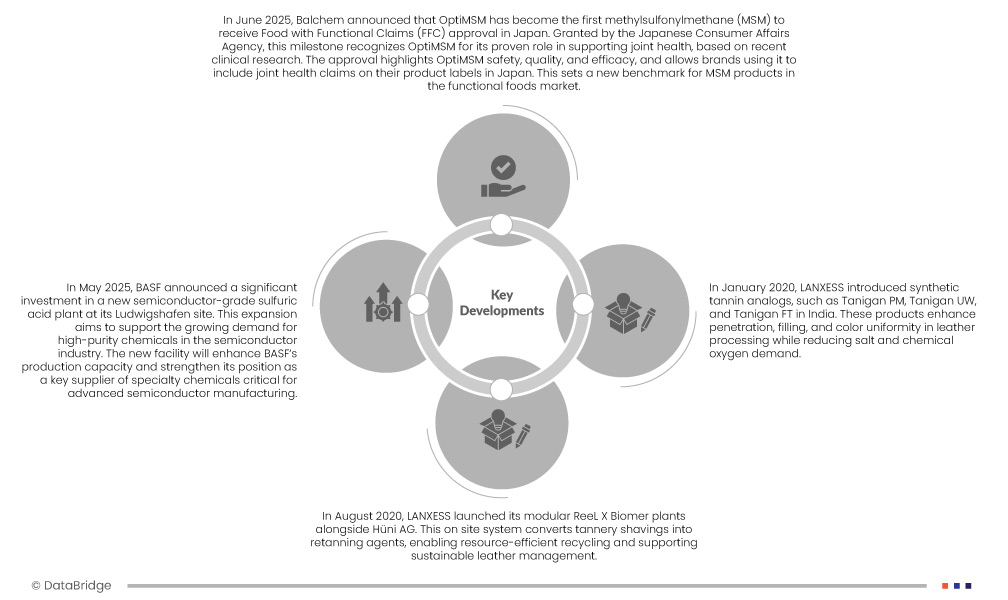
- In June, Balchem announced that OptiMSM has become the first methylsulfonylmethane (MSM) to receive Food with Functional Claims (FFC) approval in Japan. Granted by the Japanese Consumer Affairs Agency, this milestone recognizes OptiMSM for its proven role in supporting joint health, based on recent clinical research. The approval highlights OptiMSM safety, quality, and efficacy, and allows brands using it to include joint health claims on their product labels in Japan. This sets a new benchmark for MSM products in the functional foods market.
- In May, BASF announced a significant investment in a new semiconductor-grade sulfuric acid plant at its Ludwigshafen site. This expansion aims to support the growing demand for high-purity chemicals in the semiconductor industry. The new facility will enhance BASF’s production capacity and strengthen its position as a key supplier of specialty chemicals critical for advanced semiconductor manufacturing.
- In August, LANXESS launched its modular ReeL X Biomer plants alongside Hüni AG. This on site system converts tannery shavings into retanning agents, enabling resource-efficient recycling and supporting sustainable leather management.
- In January, LANXESS introduced synthetic tannin analogs, such as Tanigan PM, Tanigan UW, and Tanigan FT in India. These products enhance penetration, filling, and color uniformity in leather processing while reducing salt and chemical oxygen demand.
As per Data Bridge Market Research analysis:
For more detailed information about the Global Tannin market report, click here – https://www.databridgemarketresearch.com/reports/global-tannin-market










