


North America Disposable Peripheral Capillary Oxygen Saturation (Spo2) Sensor Market Segmentation, By Connector (Less Than 6 Pins, 6 Pins-10 Pins and More Than 10 Pins), Usage (Adult, Pediatric, Neonate, Animal and Others), Technique (Reflectance and Transflectance), Signal (Analog and Digital), Application (Finger, Ear, Foot, Toe, Multi Position, and Others), End User (Clinical, Hospital, Veterinary and Others), Sales Channel (Offline and Online)- Industry Trends and Forecast to 2033
North America Disposable Peripheral Capillary Oxygen Saturation (Spo2) Sensor Market Size
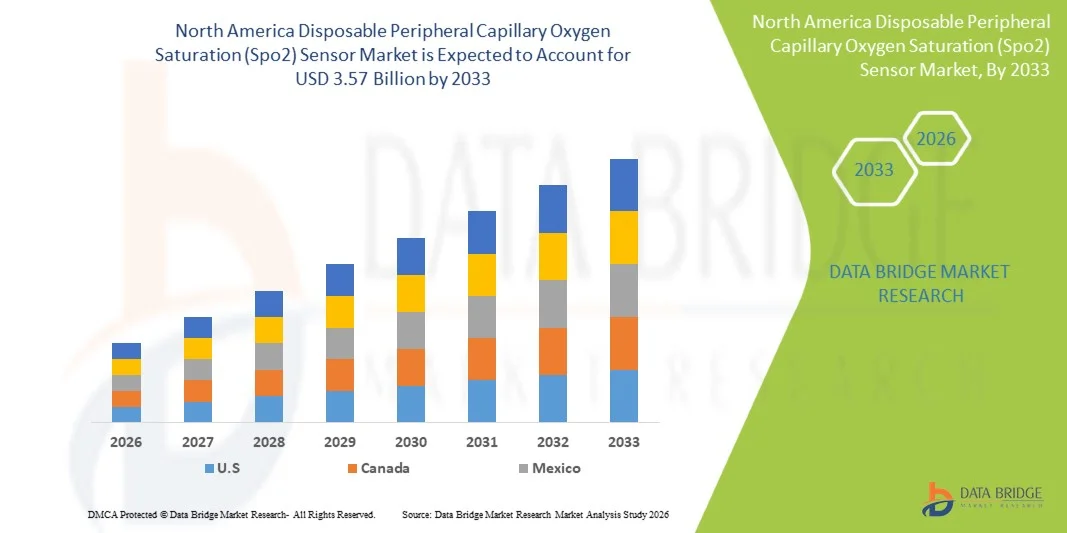
- The North America disposable peripheral capillary oxygen saturation (Spo2) sensor market size was valued at USD 1.29 billion in 2025 and is expected to reach USD 3.57 billion by 2033, at a CAGR of 13.6% during the forecast period
- The market growth is largely fueled by the rising prevalence of respiratory diseases, cardiovascular conditions, and critical care monitoring, which are driving demand for accurate and continuous oxygen saturation measurement in clinical and home-care settings
- Furthermore, increasing adoption of wearable and non-invasive monitoring devices, coupled with technological advancements in sensor accuracy, wireless connectivity, and compatibility with patient monitoring systems, is enhancing the utility of disposable SpO2 sensors. These converging factors are accelerating the uptake of disposable SpO2 sensor solutions, thereby significantly boosting the industry's growth
North America Disposable Peripheral Capillary Oxygen Saturation (Spo2) Sensor Market Analysis
- Disposable SpO2 sensors, providing non-invasive measurement of blood oxygen saturation levels, are increasingly critical components of modern patient monitoring systems in hospitals, clinics, and home-care settings due to their accuracy, convenience, and infection-control benefits
- The escalating demand for disposable SpO2 sensors is primarily fueled by the rising prevalence of respiratory disorders, cardiovascular diseases, and the growing adoption of continuous patient monitoring systems in both critical and non-critical care environments
- The United States dominated the North America disposable peripheral capillary oxygen saturation (SpO2) sensor market with the largest revenue share of 75.5% in 2025, characterized by advanced healthcare infrastructure, high healthcare expenditure, and a strong presence of leading sensor manufacturers
- Canada is expected to be the fastest-growing country in the North America disposable peripheral capillary oxygen saturation (SpO2) sensor market during the forecast period due to expanding healthcare facilities, increasing awareness of patient monitoring, and growing investments in modern medical technologies
- The Finger segment dominated the North America disposable peripheral capillary oxygen saturation (SpO2) sensor market with a market share of 45.6% in 2025, driven by its simplicity, reliability, and compatibility with a wide range of pulse oximeters and monitoring devices
Report Scope and North America Disposable Peripheral Capillary Oxygen Saturation (Spo2) Sensor Market Segmentation
|
Attributes |
North America Disposable Peripheral Capillary Oxygen Saturation (Spo2) Sensor Key Market Insights |
|
Segments Covered |
|
|
Countries Covered |
North America
|
|
Key Market Players |
|
|
Market Opportunities |
|
|
Value Added Data Infosets |
In addition to the insights on market scenarios such as market value, growth rate, segmentation, geographical coverage, and major players, the market reports curated by the Data Bridge Market Research also include in-depth expert analysis, patient epidemiology, pipeline analysis, pricing analysis, and regulatory framework |
North America Disposable Peripheral Capillary Oxygen Saturation (Spo2) Sensor Market Trends
“Enhanced Accuracy and Connectivity Through Advanced Sensor Technologies”
- A significant and accelerating trend in the North America disposable peripheral capillary oxygen saturation (SpO2) sensor market is the integration of advanced sensor technologies with wireless connectivity and real-time patient monitoring systems. This combination is significantly enhancing clinical accuracy, operational convenience, and remote monitoring capabilities
- For instance, modern finger clip SpO2 sensors now come with Bluetooth or Wi-Fi connectivity, allowing seamless integration with hospital monitoring systems and wearable devices for continuous oxygen level tracking. Similarly, sensors such as Masimo’s Rainbow SET™ provide multi-parameter monitoring, offering clinicians comprehensive data on oxygen saturation, perfusion, and hemoglobin levels in a single device
- Innovations in sensor technology are also enabling faster response times and improved signal processing, reducing motion artifacts and enhancing measurement reliability, particularly in ICU and surgical settings. Some sensors now use AI-based algorithms to adjust readings dynamically for patient movement or poor perfusion, increasing accuracy and reducing false alarms
- The seamless integration of disposable SpO2 sensors with electronic health record (EHR) systems and connected medical devices facilitates centralized monitoring across multiple patients, enabling healthcare providers to manage care more efficiently. Through a single interface, clinicians can track oxygen levels, generate alerts, and share data with remote care teams
- Miniaturization of sensors and wearable-compatible designs is becoming increasingly popular, allowing patients to monitor oxygen saturation continuously without discomfort or mobility restrictions. This trend supports home-care monitoring and chronic disease management
- This trend toward more accurate, connected, and intelligent patient monitoring is fundamentally reshaping expectations in critical care and home healthcare. Companies such as Nonin Medical and Masimo are developing advanced sensors with wireless connectivity, automated calibration, and AI-assisted accuracy optimization
- The demand for disposable SpO2 sensors with enhanced connectivity, reliability, and intelligent monitoring capabilities is growing rapidly across both hospital and home-care settings, as healthcare providers increasingly prioritize patient safety, efficiency, and data-driven decision-making
North America Disposable Peripheral Capillary Oxygen Saturation (Spo2) Sensor Market Dynamics
Driver
“Rising Healthcare Needs and Remote Patient Monitoring Adoption”
- The increasing prevalence of respiratory illnesses, cardiovascular conditions, and the adoption of continuous patient monitoring systems is a significant driver for the heightened demand for disposable SpO2 sensors
- For instance, in March 2025, Masimo announced the launch of its next-generation wireless SpO2 sensor for home and hospital monitoring, emphasizing enhanced accuracy and real-time connectivity. Such innovations by key companies are expected to drive market growth during the forecast period
- As healthcare providers and patients become more aware of the importance of oxygen saturation monitoring, disposable SpO2 sensors offer reliable, cost-effective, and infection-control-friendly solutions compared to reusable sensors
- Furthermore, the growing adoption of telehealth and remote patient monitoring, accelerated by the post-pandemic emphasis on home healthcare, is making disposable SpO2 sensors an integral component of connected healthcare systems
- Ease of use, rapid deployment, and compatibility with a wide range of monitoring devices are key factors propelling the adoption of disposable SpO2 sensors in both clinical and home-care environments
- Increasing government initiatives and healthcare programs promoting patient monitoring and home-care devices are supporting market expansion. For instance, reimbursement policies and funding for remote monitoring devices in the U.S. encourage hospitals and clinics to adopt disposable SpO2 sensors more broadly
- Strategic partnerships between sensor manufacturers and hospital systems or telehealth providers are driving faster deployment and integration of advanced SpO2 solutions, increasing accessibility and reliability of monitoring across diverse healthcare settings
Restraint/Challenge
“Sensor Accuracy Variability and Regulatory Compliance Hurdles”
- Concerns surrounding sensor accuracy in challenging conditions, such as patient movement, low perfusion, or abnormal hemoglobin levels, pose challenges to broader market adoption. Inaccurate readings can impact clinical decisions, making reliability a critical consideration
- For instance, studies have reported occasional discrepancies in readings from low-cost disposable sensors, making healthcare providers cautious in adopting them for high-risk patients
- Addressing these challenges through robust calibration, advanced signal processing, and AI-assisted accuracy algorithms is crucial for building trust among clinicians. Companies such as Nonin and Masimo emphasize rigorous testing and compliance with FDA and ISO standards in their marketing to reassure buyers
- In addition, compliance with regulatory standards, including FDA clearance and ISO certifications, can be time-consuming and costly for manufacturers, potentially delaying new product launches
- While prices for basic disposable sensors have become more affordable, premium features such as wireless connectivity, multi-parameter monitoring, and AI-assisted accuracy often come at a higher cost, which can be a barrier for smaller clinics or home-care providers
- Overcoming these challenges through advanced sensor technologies, regulatory compliance, and cost-effective solutions will be vital for sustained growth in the North America disposable peripheral capillary oxygen saturation (SpO2) sensor market
North America Disposable Peripheral Capillary Oxygen Saturation (Spo2) Sensor Market Scope
The market is segmented on the basis of connector, usage, technique, signal, application, end user, and sales channel.
- By Connector
On the basis of connector, the North America disposable peripheral capillary oxygen saturation (SpO2) sensor market is segmented into Less Than 6 Pins, 6 Pins–10 Pins, and More Than 10 Pins. The Less Than 6 Pins segment dominated the market in 2025 due to its simplicity, low manufacturing cost, and widespread compatibility with most standard pulse oximeters and monitoring devices. These sensors are preferred in hospital and home-care environments where ease of use and rapid deployment are crucial. Their compact design ensures minimal interference with patient movement, making them suitable for both adult and pediatric applications. Furthermore, this connector type is highly reliable for single-use applications, reducing the risk of cross-contamination. The demand is also supported by manufacturers producing plug-and-play sensors that require minimal technical training. Hospitals and clinics often standardize on this connector type for bulk procurement and inventory management.
The 6 Pins–10 Pins segment is anticipated to witness the fastest growth during the forecast period, driven by its enhanced data transmission capabilities and compatibility with advanced multi-parameter monitoring systems. Sensors with 6–10 pins allow integration of additional signals such as perfusion index, plethysmograph waveform, or SpO2 trends, making them increasingly attractive for ICUs and surgical centers. Growing adoption of high-accuracy monitoring devices in critical care and home-based telehealth solutions fuels this segment’s expansion. In addition, rising investment in technologically advanced disposable sensors by manufacturers ensures a steady introduction of products with this connector type.
- By Usage
On the basis of usage, the market is segmented into adult, pediatric, neonate, animal, and others. The Adult segment dominated the market in 2025 due to the high volume of adult patients in hospitals, surgical centers, and home-care settings requiring continuous or spot-check oxygen saturation monitoring. Adult SpO2 sensors are standardized in design, ensuring reliable fit across diverse finger sizes and compatibility with multiple monitoring systems. Hospitals and clinics often stock adult sensors in the highest quantities, supporting routine care, ICU monitoring, and perioperative procedures. These sensors are also widely used in remote patient monitoring programs for adults with chronic respiratory or cardiovascular conditions. Manufacturers focus on producing cost-effective, reliable adult sensors to meet large-scale demand. In addition, adult sensors benefit from the availability of multi-parameter versions capable of transmitting additional physiological data.
The Neonate segment is expected to witness the fastest growth during the forecast period, driven by increasing preterm births and the need for accurate, non-invasive monitoring in neonatal ICUs. Neonatal sensors are designed with specialized adhesives and small form factors to minimize skin irritation while providing precise oxygen saturation readings. Advances in material science and gentle, flexible designs allow safe continuous monitoring of vulnerable infants. The growth is also supported by hospitals adopting modern neonatal care protocols, where SpO2 monitoring is a standard requirement. Rising awareness among caregivers and regulatory emphasis on neonatal safety further propel the demand for this segment.
- By Technique
On the basis of technique, the market is segmented into Reflectance and Transflectance. The Reflectance segment dominated the market in 2025 due to its ability to measure oxygen saturation from various body sites such as the forehead, wrist, or chest, making it versatile for clinical and home-care use. Reflectance sensors are particularly useful in patients with poor peripheral perfusion, as they can capture accurate readings even when traditional transmission sensors fail. Hospitals prefer reflectance sensors in critical care and emergency settings for reliable monitoring under varying conditions. The design flexibility also supports integration into wearable monitoring devices for adults and children. Manufacturers continue to innovate reflectance-based disposable sensors to reduce motion artifacts and improve signal quality. Ease of use, minimal training requirements, and patient comfort contribute to the segment’s strong adoption.
The Transflectance segment is anticipated to witness the fastest growth during the forecast period, driven by its high accuracy and compatibility with multi-parameter monitors in ICUs and surgical suites. Transflectance sensors, which measure light passing through tissue, are ideal for continuous, high-fidelity monitoring of oxygen saturation and pulse rate. Growing adoption in specialized hospital settings and advanced home-care devices supports this growth. Integration with AI-assisted monitoring and cloud-connected systems further enhances their utility, especially in remote patient monitoring.
- By Signal
On the basis of signal, the market is segmented into analog and digital. The Analog segment dominated the market in 2025 due to its reliability, simplicity, and widespread compatibility with traditional pulse oximeters and clinical monitors. Analog sensors are favored in standard hospital wards and home-care environments where robust, low-cost solutions are essential. Their straightforward design allows quick replacement and minimal maintenance. In addition, analog sensors maintain consistent performance even in high-use scenarios, making them preferred for bulk procurement. Manufacturers continue to produce analog sensors due to their cost-effectiveness and broad compatibility. Hospitals benefit from the proven reliability of analog-based disposable SpO2 monitoring systems.
The Digital segment is expected to witness the fastest growth during the forecast period, fueled by the increasing adoption of advanced monitoring systems, AI integration, and remote patient monitoring devices. Digital sensors provide real-time data transmission, higher signal fidelity, and seamless connectivity with electronic health records (EHRs). The rise of telehealth and smart hospital initiatives in the U.S. and Canada accelerates the demand for digital disposable SpO2 sensors. Integration with cloud-based analytics and AI-assisted monitoring enhances predictive care, making digital sensors increasingly attractive.
- By Application
On the basis of application, the market is segmented into finger, ear, foot, toe, multi-position, and others. The Finger segment dominated the market in 2025 with a market share of 45.6%, owing to its simplicity, reliability, and universality in clinical settings. Finger sensors can be used across adults, pediatric, and neonatal patients with minimal adjustment, making them the most versatile option. Hospitals and home-care providers often standardize on finger sensors for bulk deployment. Their widespread use in ICUs, wards, and remote monitoring programs contributes to strong market demand. Manufacturers continuously improve adhesive quality, comfort, and signal accuracy to strengthen this segment. Finger sensors also support integration with multiple monitoring devices and parameters, increasing adoption in both hospital and home-care scenarios.
The Multi-Position segment is expected to witness the fastest growth during the forecast period, driven by the increasing need for flexible, accurate monitoring in patients with varying conditions and positions. Multi-position sensors can be applied to the finger, toe, or ear, providing clinical staff with versatile options for continuous monitoring. This segment benefits from innovations in material flexibility, adhesive technology, and motion artifact reduction. Hospitals and telehealth providers increasingly deploy multi-position sensors to improve patient comfort and measurement reliability. Rising adoption in ICU, surgical, and home-care setups accelerates the growth of this segment.
- By End User
On the basis of end user, the market is segmented into clinical, hospital, veterinary, and others. The Hospital segment dominated the market in 2025, driven by the high adoption of disposable SpO2 sensors across ICUs, operating rooms, emergency care units, and general wards. Hospitals prioritize disposable sensors to reduce infection risk and ensure reliable, continuous monitoring. Bulk procurement practices, established vendor relationships, and integration with advanced patient monitoring systems further contribute to dominance. High patient turnover and critical care requirements in hospitals sustain strong demand. Manufacturers often customize sensors for hospital specifications, including compatibility with multi-parameter monitors. Training simplicity and ease of replacement are additional factors supporting hospital adoption.
The Veterinary segment is expected to witness the fastest growth during the forecast period, fueled by increasing adoption of veterinary monitoring technologies and pet healthcare awareness. Disposable SpO2 sensors are increasingly used in veterinary hospitals and clinics to monitor animals during surgery or recovery. Rising investments in animal health infrastructure, including advanced monitoring systems, support segment expansion. Lightweight, flexible sensors suitable for different animal sizes enhance usability. In addition, growing awareness of pet health and veterinary care standards drives demand for specialized disposable SpO2 sensors.
- By Sales Channel
On the basis of sales channel, the market is segmented into offline and online. The Offline segment dominated the market in 2025, owing to established procurement channels in hospitals, clinics, and healthcare supply distributors. Bulk purchases, face-to-face vendor support, and immediate availability make offline channels favorable for high-volume disposable SpO2 sensor sales. Hospitals prefer offline procurement to ensure compliance with quality standards and timely delivery. Manufacturers maintain strong distribution networks to serve offline demand efficiently. Staff familiarity with procurement procedures and ability to inspect products before purchase reinforces the dominance of offline channels.
The Online segment is expected to witness the fastest growth during the forecast period, driven by increasing e-commerce adoption in medical devices, telehealth expansion, and home-care monitoring. Online channels offer convenience, wider product availability, and competitive pricing for individual caregivers and smaller clinics. Digital platforms also provide easy access to advanced disposable SpO2 sensors with detailed specifications, user reviews, and AI-assisted recommendations. The growth of online pharmacies and telehealth service providers accelerates this segment. COVID-19 and post-pandemic home-care emphasis further boosted online adoption.
North America Disposable Peripheral Capillary Oxygen Saturation (Spo2) Sensor Market Regional Analysis
- The United States dominated the North America disposable peripheral capillary oxygen saturation (SpO2) sensor market with the largest revenue share of 75.5% in 2025, characterized by advanced healthcare infrastructure, high healthcare expenditure, and a strong presence of leading sensor manufacturers
- Healthcare providers and patients in the U.S. highly value the accuracy, reliability, and infection-control benefits offered by disposable SpO2 sensors, particularly in hospitals, surgical centers, and home-care settings. These sensors are preferred for their non-invasive design, ease of use, and seamless compatibility with advanced monitoring devices and electronic health record (EHR) systems
- This dominance is further supported by the growing prevalence of respiratory and cardiovascular disorders, the increasing adoption of telehealth and remote patient monitoring, and rising awareness of the importance of real-time, data-driven patient monitoring. Disposable SpO2 sensors are now considered essential in both clinical and home-care environments
U.S. Disposable Peripheral Capillary Oxygen Saturation (Spo2) Sensor Market Insight
The United States dominated the North America disposable peripheral capillary oxygen saturation (SpO2) sensor market with the largest revenue share of 75.5% in 2025, driven by advanced healthcare infrastructure, high adoption of continuous patient monitoring systems, and rising prevalence of respiratory and cardiovascular disorders. Hospitals, surgical centers, and home-care providers increasingly prioritize disposable sensors for infection control, reliability, and ease of use. The growing trend of telehealth and remote patient monitoring further supports market expansion, enabling clinicians to track real-time oxygen saturation in chronic patients at home. Moreover, innovations such as wireless connectivity, AI-assisted accuracy optimization, and multi-parameter monitoring contribute significantly to market growth. The strong presence of major manufacturers such as Masimo, Nonin, and Covidien strengthens U.S. dominance.
Canada Disposable Peripheral Capillary Oxygen Saturation (SpO2) Sensor Market Insight
The Canada disposable SpO2 sensor market is expected to be the fastest-growing country market in North America during the forecast period. Growth is fueled by expanding healthcare facilities, increasing awareness of patient monitoring, and government initiatives promoting telehealth and remote care solutions. Hospitals and clinics are adopting modern disposable SpO2 sensors to enhance patient safety while minimizing infection risks. Rising prevalence of respiratory and cardiovascular conditions, coupled with the need for efficient ICU and home-care monitoring, drives demand. In addition, growing adoption of digital health platforms and wearable monitoring devices supports the integration of disposable sensors into connected healthcare ecosystems.
Mexico Disposable Peripheral Capillary Oxygen Saturation (SpO2) Sensor Market Insight
The Mexico disposable SpO2 sensor market is witnessing moderate growth, driven by increasing healthcare infrastructure development, rising patient awareness, and expanding hospital and clinic networks. Adoption is primarily focused on hospitals and surgical centers where infection-control practices and accurate oxygen monitoring are prioritized. Government initiatives to improve healthcare access and telehealth services are supporting market expansion. In addition, cost-effective disposable sensors and local manufacturing options make these solutions increasingly accessible to public and private healthcare providers. Integration with standard monitoring systems and the growing prevalence of chronic respiratory and cardiovascular diseases further contribute to market demand.
North America Disposable Peripheral Capillary Oxygen Saturation (Spo2) Sensor Market Share
The North America Disposable Peripheral Capillary Oxygen Saturation (Spo2) Sensor industry is primarily led by well-established companies, including:
- Masimo (U.S.)
- Medtronic (Ireland)
- Nonin (U.S.)
- GE HealthCare (U.S.)
- Koninklijke Philips N.V. (Netherlands)
- NIHON KOHDEN CORPORATION (Japan)
- Contec Medical Systems Co., Ltd. (China)
- Beurer GmbH (Germany)
- BPL Medical Technologies (India)
- Mindray Medical International Limited (China)
- Heal Force Bio Meditech (China)
- Smiths Medical (U.S.)
- Vyaire Medical (U.S.)
- Drägerwerk AG & Co. KGaA (Germany)
- Edan Instruments, Inc. (China)
- ChoiceMMed Technologies Inc. (China)
- Opto Circuits (India)
- Spacelabs Healthcare (U.S.)
- CAS Medical Systems (U.S.)
- Avante Health Solutions (U.S.)
What are the Recent Developments in North America Disposable Peripheral Capillary Oxygen Saturation (Spo2) Sensor Market?
- In January 2026, Medtronic announced positive clinical verification results for its investigational Nellcor™ pulse oximetry technology paired with intelligent processing across diverse skin tones, demonstrating improved SpO₂ accuracy a critical advancement with implications for more equitable and reliable SpO₂ monitoring across patient groups
- In May 2025, Medtronic received the FDA’s Safer Technologies Program (STeP) designation for its investigational Nellcor™ pulse oximetry technology, enabling expedited development and review of enhanced SpO₂ monitoring solutions that aim to improve accuracy and patient safety. This designation supports faster evaluation of the next-generation sensor technology in the U.S. healthcare market
- In December 2024, Movano Health announced that the U.S. Food and Drug Administration (FDA) granted 510(k) clearance for the pulse oximeter in its EvieMED Ring, a wearable ring‑style device capable of measuring blood oxygen saturation (SpO₂) and other vital signs. This clearance marks a key milestone in regulatory approval, enabling wider clinical and remote patient monitoring use for the device, and expands Movano’s ability to integrate SpO₂ sensing into wearable health and wellness ecosystems in North America
- In September 2024, Dartmouth General Hospital in Canada piloted wearable monitors that include pulse oximetry (SpO₂) as part of vital sign tracking for emergency care patients, showing how disposable and wireless SpO₂ sensors are being integrated into real clinical workflows in Canadian healthcare facilities
- In May 2022, Medtronic received FDA 510(k) clearance for the Nellcor™ OxySoft™ SpO₂ sensor, the first pulse oximetry sensor with silicone adhesive designed to stay in place longer and reduce skin trauma, enhancing clinical usability especially for fragile skin in neonatal and adult patients
SKU-
Получите онлайн-доступ к отчету на первой в мире облачной платформе рыночной аналитики

- Интерактивная панель анализа данных
- Панель анализа компании для возможностей с высоким потенциалом роста
- Доступ аналитика-исследователя для настройки и запросов
- Анализ конкурентов с помощью интерактивной панели
- Последние новости, обновления и анализ тенденций
- Используйте возможности сравнительного анализа для комплексного отслеживания конкурентов
Методология исследования
Сбор данных и анализ базового года выполняются с использованием модулей сбора данных с большими размерами выборки. Этап включает получение рыночной информации или связанных данных из различных источников и стратегий. Он включает изучение и планирование всех данных, полученных из прошлого заранее. Он также охватывает изучение несоответствий информации, наблюдаемых в различных источниках информации. Рыночные данные анализируются и оцениваются с использованием статистических и последовательных моделей рынка. Кроме того, анализ доли рынка и анализ ключевых тенденций являются основными факторами успеха в отчете о рынке. Чтобы узнать больше, пожалуйста, запросите звонок аналитика или оставьте свой запрос.
Ключевой методологией исследования, используемой исследовательской группой DBMR, является триангуляция данных, которая включает в себя интеллектуальный анализ данных, анализ влияния переменных данных на рынок и первичную (отраслевую экспертную) проверку. Модели данных включают сетку позиционирования поставщиков, анализ временной линии рынка, обзор рынка и руководство, сетку позиционирования компании, патентный анализ, анализ цен, анализ доли рынка компании, стандарты измерения, глобальный и региональный анализ и анализ доли поставщика. Чтобы узнать больше о методологии исследования, отправьте запрос, чтобы поговорить с нашими отраслевыми экспертами.
Доступна настройка
Data Bridge Market Research является лидером в области передовых формативных исследований. Мы гордимся тем, что предоставляем нашим существующим и новым клиентам данные и анализ, которые соответствуют и подходят их целям. Отчет можно настроить, включив в него анализ ценовых тенденций целевых брендов, понимание рынка для дополнительных стран (запросите список стран), данные о результатах клинических испытаний, обзор литературы, обновленный анализ рынка и продуктовой базы. Анализ рынка целевых конкурентов можно проанализировать от анализа на основе технологий до стратегий портфеля рынка. Мы можем добавить столько конкурентов, о которых вам нужны данные в нужном вам формате и стиле данных. Наша команда аналитиков также может предоставить вам данные в сырых файлах Excel, сводных таблицах (книга фактов) или помочь вам в создании презентаций из наборов данных, доступных в отчете.











