The growing adoption of cloud-based ERP in the APAC region is significantly driving market growth. Rising demand for scalable, cost-effective, and accessible business management solutions is prompting organizations across manufacturing, retail, and service sectors to migrate from legacy on-premise systems to cloud platforms. In APAC, real-time data access, process automation, and enhanced collaboration across distributed teams are becoming essential for operational efficiency. Moreover, increasing digital transformation initiatives, the need for agile decision-making, and the expansion of small and medium enterprises are accelerating the adoption of cloud ERP solutions to ensure flexibility, productivity, and business continuity.
Access Full Report @ https://www.databridgemarketresearch.com/reports/asia-pacific-erp-market
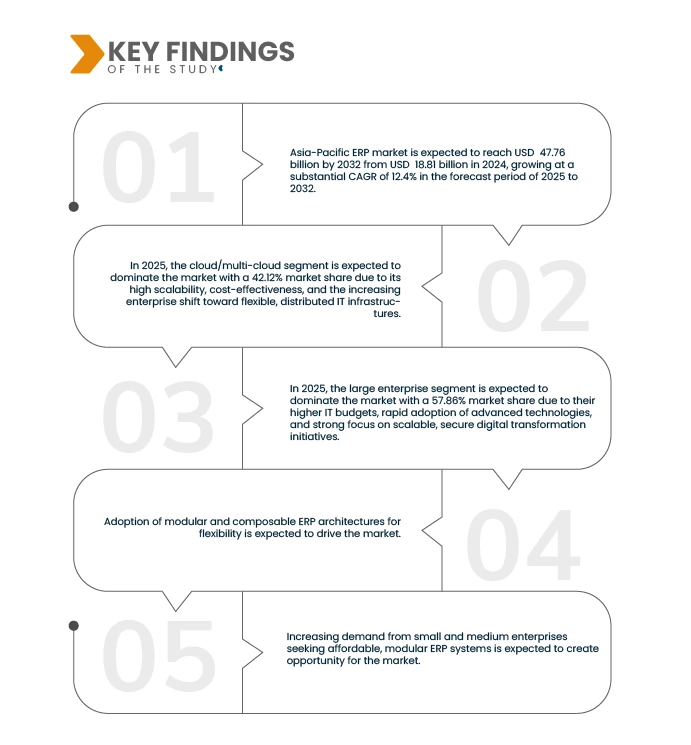
Data Bridge Market Research analyzes that the Asia-Pacific ERP Market is expected to reach USD 47.76 bilion by 2032 from USD 18.81 bilion in 2024, growing at a substantial CAGR of 12.4% in the forecast period of 2025 to 2032.
Key Findings of the Study
Growth of mobile ERP platforms enabling remote workforce connectivity
The growth of mobile ERP platforms is transforming the Asia-Pacific ERP Market by enabling seamless connectivity for remote and distributed workforces. With the rapid adoption of cloud-based and mobile technologies across Asia-Pacific, enterprises are increasingly leveraging mobile ERP applications to provide employees with real-time access to critical business data, workflows, and analytics from smartphones and tablets. This capability allows field staff, sales teams, and operational personnel to make faster decisions, update records on the go, and maintain collaboration across multiple locations, improving overall productivity. For APAC, where companies often operate across geographically dispersed regions, mobile ERP platforms reduce reliance on centralized offices, lower communication delays, and streamline operations in sectors such as manufacturing, logistics, retail, and services. Additionally, these platforms support integration with IoT devices, cloud services, and other enterprise systems, providing flexibility, scalability, and enhanced business continuity, which drives higher adoption among SMEs and large enterprises alike.
Report Scope and Market Segmentation
|
Report Metric
|
Details
|
|
Forecast Period
|
2025 to 2032
|
|
Base Year
|
2024
|
|
Historic Year
|
2018 - 2023 (Customizable 2013-2017)
|
|
Quantitative Units
|
Revenue in USD Billion
|
|
Segments Covered
|
Offering (Solution and Services), Deployment Mode (Cloud/Multi Cloud, On-Premise, Hybrid, and Two-Tier), Enterprise Size (Large Enterprise and Small & Medium Enterprise), Pricing (Subscription-Based, One-Time License, Freemium, and Others), End User (Manufacturing, Retail, BFSI, Healthcare, IT & Telecommunications, Government, Energy & Utilities, Logistics, Education, Aerospace & Defense, and Others)
|
|
Countries Covered
|
China, Japan, India, South Korea, Australia, Indonesia, Singapore, Thailand, Malaysia, Vietnam, Taiwan, Hong Kong, Philippines, New Zealand, and Rest of Asia-Pacific
|
|
Market Players Covered
|
Microsoft (United States), Oracle (United States), SAP SE (Germany), Workday, Inc. (United States), Infor (United States), Odoo (Belgium), Focus Softnet Pvt Ltd (India), HashMicro (Singapore), Sage Group plc (United Kingdom), Epicor Software Corporation (United States), Exact (Netherlands), QAD Inc. (United States), Tally Solutions Private Limited (India), Deltek, Inc. (United States), Ramco Systems (India), Zoho Corporation Pvt. Ltd (India), Acumatica, Inc. (United States), BatchMaster Software (United States), Deskera (Singapore), SYSPRO (South Africa).
|
|
Data Points Covered in the Report
|
In addition to the market insights such as market value, growth rate, market segments, geographical coverage, market players, and market scenario, the market report curated by the Data Bridge Market Research team includes in-depth expert analysis, import/export analysis, pricing analysis, production consumption analysis, and PESTLE analysis.
|
Segment Analysis
Asia-Pacific ERP market is categorized into five notable segments which are based on offering, deployment mode, enterprise size, pricing, end user.
- On the basis of offering, Asia-Pacific ERP market is segmented into solution and services
In 2025, the solution segment is expected to dominate the Asia-Pacific ERP market
In 2025, the solutions segment is expected to dominate the Asia-Pacific ERP Market with the market share of 64.66% driven by its widespread adoption, proven effectiveness across multiple industries, broad accessibility, and ability to deliver integrated business management capabilities. Its critical role in streamlining operations, enhancing productivity, and enabling data-driven decision-making continues to fuel demand across enterprises in the region.
- On the basis of deployment mode, the Asia-Pacific ERP market is segmented into cloud/multi cloud, on-premise, hybrid and two-tier
In 2025, the cloud/multi cloud segment is expected to dominate the Asia-Pacific ERP market
In 2025, the cloud/multi cloud segment is expected to dominate the Asia-Pacific ERP Market with the market share of 42.12%, driven by its scalability, flexibility, and cost-effectiveness. Its well-established infrastructure, ease of deployment, and ability to support integrated business operations across multiple industries position it as the preferred solution for enterprises seeking efficient, secure, and reliable ERP implementations.
- On the basis of enterprise size, the market is segmented into large enterprise and small & medium enterprise. In 2025, the large enterprise segment is expected to dominate the market with a market share of 57.86%
- On the basis of pricing, the Asia-Pacific ERP market is segmented into subscription-based, one-time license, freemium and others. In 2025, subscription-based segment will dominate the market with a market share of 66.74%
- On the basis of end user, the Asia-Pacific ERP market is segmented into manufacturing, retail, bfsi, healthcare, it & telecommunications, government, energy & utilities, logistics, education, aerospace & defense, others. In 2025, manufacturing segment is expected to dominate the market with a market share of 25.11%
Major Players
Data Bridge Market Research analyzes Microsoft (United States), Oracle (United States), Infor (United States), Odoo (Belgium), Focus Softnet Pvt Ltd (India) as the major market players of the Asia-Pacific ERP Market.
Market Developments
- In June 2025, QAD hosted a global event, QAD Redzone’s Champions of Manufacturing, bringing together industry leaders to showcase the company’s latest AI-powered innovations and adaptive cloud solutions for manufacturing. The event highlighted how artificial intelligence and advanced technologies are transforming ERP into a proactive system that drives faster decision-making and operational excellence. Attendees engaged in live product demonstrations, interactive labs, and real-world case studies focused on ERP, supply chain, and workforce empowerment
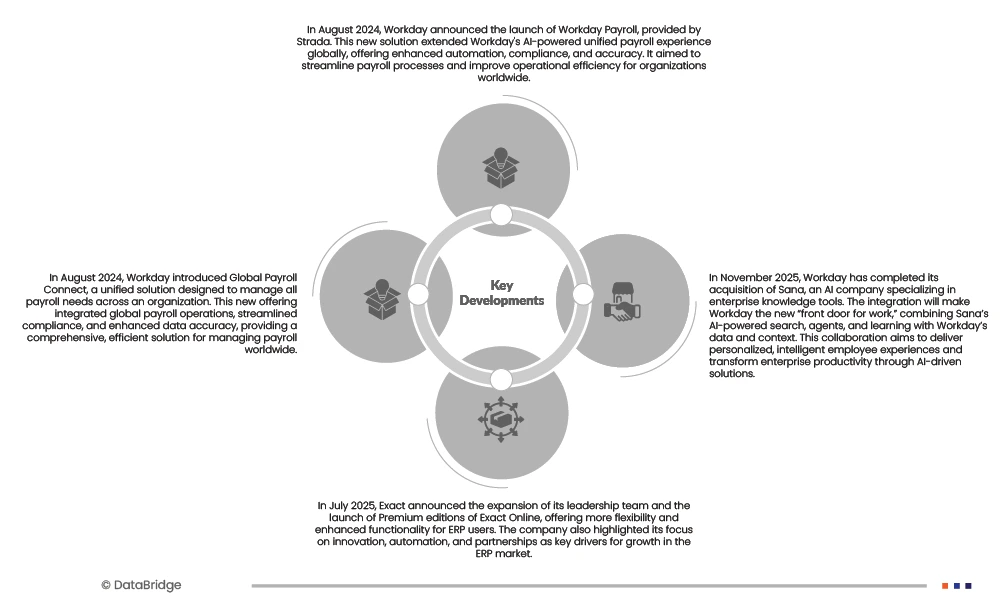
- In July 2025, Exact announced the expansion of its leadership team and the launch of Premium editions of Exact Online, offering more flexibility and enhanced functionality for ERP users. The company also highlighted its focus on innovation, automation, and partnerships as key drivers for growth in the ERP market
- In January 2025, BatchMaster ERP was implemented to enhance production efficiency and streamline operations in the pharmaceutical sector. The deployment replaced legacy systems with a modern ERP solution emphasizing automation, traceability, compliance, and improved production scheduling to support smarter manufacturing and regulatory adherence
- In September 2025, Acumatica introduced a redesigned user interface, embedded AI tools, and industry-specific enhancements. Key features include AI-powered invoice recognition, multi-company EIN support, and improved customer portal functionality
- In March 2025, Acumatica released its latest update featuring enhanced usability, AI-driven automation, and industry-specific innovations. The 2025 R1 version introduced streamlined workflows and significant improvements across manufacturing, distribution, retail, and construction modules, along with new AI-powered capabilities for anomaly detection and document recognition
Regional Analysis
Geographically, the countries covered in the Asia-Pacific ERP Market report are the China, Japan, India, South Korea, Australia, Indonesia, Singapore, Thailand, Malaysia, Vietnam, Taiwan, Hong Kong, Philippines, New Zealand, and rest of Asia-Pacific.
As per Data Bridge Market Research analysis:
China is expected to be the dominant and fastest growing country in Asia-Pacific ERP Market
China is expected to be the dominant and fastest-growing country due to strong government support, rapid industrial expansion, and increasing investments in digital and technological infrastructure.
For more detailed information about the Asia-Pacific ERP Market report, click here – https://www.databridgemarketresearch.com/reports/asia-pacific-erp-market