
The growing integration of solar energy solutions into commercial infrastructures for energy conservation and architectural optimization has led to an increase in demand for building integrated photovoltaic (BIPV) materials such as glass, which positively impacts market growth. According to a report by the US Department of Energy, building-integrated photovoltaic systems have the potential to supply up to 50% of the country's electricity needs. As the cost of photovoltaic modules continues to fall, there is an increasing demand for integrated glass yearly. Therefore, the market is anticipated to grow rapidly in the coming years due to the rising demand for these glasses that do not harm the environment.
Access Full Report at https://www.databridgemarketresearch.com/reports/global-bipv-glass-market
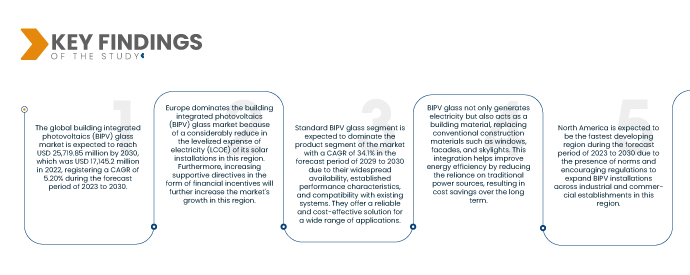
Data Bridge Market Research analyses that the Global Building Integrated Photovoltaics (BIPV) Glass Market is expected to reach USD 25,719.85 million by 2030, which was USD 17,145.2 million in 2022, registering a CAGR of 5.20% during the forecast period of 2023 to 2030. The increasing global focus on sustainability and reducing carbon emissions has driven the demand for renewable energy sources. BIPV glass offers a unique solution by seamlessly integrating solar panels into building structures, allowing for efficient generation of clean energy.
Key Findings of the Study
Favorable net-zero energy building initiatives is expected to drive the market's growth rate
Favorable net-zero energy building initiatives have become a priority for many countries and organizations aiming to achieve sustainable and energy-efficient built environments. BIPV glass is instrumental in this pursuit as it seamlessly integrates solar power generation into building structures. Utilizing BIPV glass, buildings can generate renewable energy on-site, offsetting the energy consumed and contributing to the goal of achieving net-zero energy status. This integration ensures a harmonious blend of functionality, aesthetics, and environmental responsibility in the construction industry's transition towards a more sustainable future.
Report Scope and Market Segmentation
Report Metric
|
Details
|
Forecast Period
|
2023 to 2030
|
Base Year
|
2022
|
Historic Years
|
2021 (Customizable to 2015-2020)
|
Quantitative Units
|
Revenue in USD Million, Volumes in Units, Pricing in USD
|
Segments Covered
|
Product (Standard, Coloured), Technology (Crystalline, Thin Film, Mounting Systems), Module type (Monocrystalline, Polycrystalline, Thin Film, Others), Raw Material (Crystalline Silicon, Amorphous Silicon, Organic photo Voltaic Cell, Dye Sensitized Solar Cells, Cadmium Telluride, Copper Indium Gallium Selenide, Others), Appearance (Interior, Exterior), Glazing Type (Single Module, Double Module), Applications (Atriums, Canopies, Facades, Skylight or Solar Glazing, Others), End Users (Residential Buildings, Commercial Buildings, Institutional Buildings, Infrastructural Buildings)
|
Countries Covered
|
U.S., Canada and Mexico in North America, Germany, France, U.K., Netherlands, Switzerland, Belgium, Russia, Italy, Spain, Turkey, Rest of Europe in Europe, China, Japan, India, South Korea, Singapore, Malaysia, Australia, Thailand, Indonesia, Philippines, Rest of Asia-Pacific (APAC) in the Asia-Pacific (APAC), Saudi Arabia, U.A.E, South Africa, Egypt, Israel, Rest of Middle East and Africa (MEA) as a part of Middle East and Africa (MEA), Brazil, Argentina and Rest of South America as part of South America.
|
Market Players Covered
|
Wuxi Suntech Power Co., Ltd. (China), Borosil Renewables Ltd. (India), Tesla (U.S.), TAIYO KOGYO CORPORATION (Japan), Onyx Solar Group LLC (Spain), AGC Inc. (Japan), Scheuten (Netherlands), First Solar (U.S.), SHARP CORPORATION (U.S.), GOODWE (China), Belectric (Germany), Carmanah Technologies Corp (Canada), Ertex Solar (Austria)
|
Data Points Covered in the Report
|
In addition to the insights on market scenarios such as market value, growth rate, segmentation, geographical coverage, and major players, the market reports curated by the Data Bridge Market Research also include in-depth expert analysis, geographically represented company-wise production and capacity, network layouts of distributors and partners, detailed and updated price trend analysis and deficit analysis of supply chain and demand.
|
Segment Analysis:
The global building integrated photovoltaics (BIPV) glass market is segmented on the basis of product, technology, module type, raw material, appearance, glazing type, applications and end users
- On the basis of product, the global building integrated photovoltaics (BIPV) glass market is segmented into standard, colored. Standard BIPV glass segment is expected to dominate the product segment of the market with a CAGR of 34.1% in the forecast period of 2023 to 2030 due to their widespread availability, established performance characteristics, and compatibility with existing systems. They offer a reliable and cost-effective solution for a wide range of applications.
- On the basis of technology, the global building integrated photovoltaics (BIPV) glass market is segmented into crystalline, thin film, mounting systems. Crystalline technology segment is expected to dominate the technology segment of the market with a CAGR of 35.6% in the forecast period of 2023 to 2030 due to its high level of effectiveness, dependability, and endurance. With ongoing improvements and economies of scale, crystalline technology presents a tried-and-true and reasonably priced solution for the production of solar energy.
In 2023, crystalline technology segment is expected to dominate the technology segment of the market
In 2023, crystalline technology segment is expected to dominate the technology segment of the market owing to its high efficiency, reliability, and long-term performance. With continuous advancements and economies of scale, crystalline technology offers a proven and cost-effective solution for solar energy generation with a CAGR of 35.6% in the forecast period of 2023 to 2030.
- On the basis of module type, the global building integrated photovoltaics (BIPV) glass market is segmented into monocrystalline, polycrystalline, thin film, others
- On the basis of raw material, the global building integrated photovoltaics (BIPV) glass market is segmented into crystalline silicon, amorphous silicon, organic photo voltaic cell, dye-sensitized solar cells, cadmium telluride, copper indium gallium selenide, others. Crystalline Silicon segment is expected to dominate the raw material segment of the market with a CAGR of 34.0% in the forecast period of 2023 to 2030 due to its abundance, high purity, and excellent electrical properties. It enables the production of efficient and reliable solar cells, making it a preferred choice for photovoltaic applications.
- On the basis of appearance, the global building integrated photovoltaics (BIPV) glass market is segmented into interior, exterior. Exterior segment is expected to dominate the appearance segment of the market with a CAGR of 33.3% in the forecast period of 2023 to 2030 due to its durability, weather resistance, and aesthetic appeal. It offers reliable protection and enhances the visual appeal of buildings, making it a preferred choice for architectural and construction applications.
In 2023, exterior segment is expected to dominate the appearance segment of the market
In 2023, exterior segment is expected to dominate the appearance segment of the market owing to its resilience to the elements and aesthetic appeal. It is a popular option for architectural and construction applications because it provides dependable protection and improves the aesthetic appeal of buildings with a CAGR of 33.3% in the forecast period of 2023 to 2030
- 根據玻璃類型,全球建築一體化光伏(BIPV)玻璃市場分為單模組、雙模組。由於其簡單、易於安裝和多功能性,單模組部分預計將在 2023 年至 2030 年的預測期內以 33.8% 的複合年增長率佔據玻璃類型市場的主導地位。它為將光伏技術融入建築立面提供了一種經濟高效的解決方案,可實現高效的能源生產和建築設計整合。
- 根據應用,全球建築一體化光伏 (BIPV) 玻璃市場細分為中庭、簷篷、外牆、天窗或太陽能玻璃、其他
- 根據最終用戶,全球建築一體化光伏(BIPV)玻璃市場細分為住宅建築、商業建築、機構建築和基礎設施建築。預計商業建築領域將在 2023 年至 2030 年的預測期內以 34.7% 的複合年增長率佔據市場最終用戶領域的主導地位,因為它們的能源消耗量巨大,並且透過 BIPV 玻璃安裝可以節省大量成本。它為商業空間提供了再生能源發電和提高能源效率的雙重好處。
主要參與者
Data Bridge Market Research 將以下公司認定為全球建築一體化光伏 (BIPV) 玻璃市場的主要參與者,它們是 Onyx Solar Group LLC(西班牙)、AGC Inc.(日本)、Scheuten(荷蘭)、First Solar(美國)、SHARP CORPORATION(美國)

市場開發
- 2021年,瑞士光電模組製造商梅耶博格獲得了將業務範圍擴大到BIPV系統的權利。該公司將提供屋頂太陽能電池板。在 2021 年智慧電子歐洲貿易展上,他們展示了第一批自製的太陽能瓦片。預計 2022 年下半年向客戶交付第一批產品。
- 2020年,為開拓建築外牆用有機光伏(OPV)薄膜材料市場,建築覆層製造商True Metal Solutions(TMS)與有機光伏技術及高效能光伏發電開發商NanoFlex Power Corporation(NFP)成立合資企業。
- 2020 年,據 Onyx Solar Group LLC 稱,COIMA 使用其光伏玻璃帷幕牆系統將 Gioia 22 塔改造成重要的企業地標。採用晶體矽技術來製造光伏玻璃。因此,它將產生足夠的能量來滿足 300 個住宅的典型需求。
區域分析
從地理上看,全球建築一體化光伏(BIPV)玻璃市場報告涵蓋的國家有:北美洲的美國、加拿大和墨西哥,歐洲的德國、法國、英國、荷蘭、瑞士、比利時、俄羅斯、義大利、西班牙、土耳其,歐洲其他地區,亞太地區(APAC)的中國、日本、印度、韓國、新加坡、馬來西亞、澳洲、泰國、印尼、菲律賓,亞太地區(APAC)的其他地區,沙烏地阿拉伯、阿聯酋、南非、埃及、以色列,中東和非洲(MEA)的其他地區,南美洲的巴西、阿根廷和南美洲其他地區。
根據 Data Bridge 市場研究分析:
2023-2030 年預測期內,歐洲是全球建築一體化光伏 (BIPV) 玻璃市場的主導地區
由於歐洲太陽能裝置的平準化電力成本 (LCOE) 大幅降低,歐洲在 BIPV 玻璃市場佔據主導地位。度電成本(LCOE)的下降使得太陽能更加經濟高效,推動了BIPV玻璃的普及。此外,歐洲政府以財政誘因形式提供的支持指令進一步刺激了市場成長。這些激勵措施鼓勵了BIPV玻璃系統的安裝,鞏固了歐洲在BIPV玻璃市場的領先地位。
預計2023-2030 年預測期內,北美將成為全球建築一體化光伏 (BIPV) 玻璃市場成長最快的地區
2023年至2030年間,北美預計將成為BIPV玻璃市場成長最快的地區。這可以歸因於促進工業和商業機構擴大BIPV安裝的法規和支持性規範的存在。此外,該地區還受益於積極推動創新和市場發展的大型產業參與者的強大影響力。預計這些因素將共同推動未來幾年北美 BIPV 玻璃市場的成長。
有關全球建築一體化光伏 (BIPV) 玻璃市場 報告的更多詳細信息,請點擊此處 - https://www.databridgemarketresearch.com/reports/global-bipv-glass-market










