Disposable medical devices are critical in modern healthcare, enhancing infection control by reducing cross-contamination risks. Devices such as syringes, catheters, gloves, and diagnostic kits are now standards globally. They reduce sterilization needs, streamlining clinical workflows and lowering costs. Developing countries are rapidly adopting disposable devices alongside healthcare infrastructure improvements. Regulatory bodies endorse disposable use due to patient safety benefits. Their application spans surgeries, diagnostics, and chronic disease management. Home healthcare growth further fuels demand. Disposable devices support hygiene standards but require proper waste management. Technological improvements enhance product quality and patient comfort. This widespread adoption drives substantial growth in the medical plastics market. Disposable medical devices are essential for global infection control. Polymer innovations have made these disposables both affordable and reliable, leading to increased adoption, especially in developing regions with expanding healthcare infrastructure. The use of disposables also boosts workflow efficiency and patient safety, and a continuous focus on hygiene and safety ensures strong market growth.
Access Full Report @ https://www.databridgemarketresearch.com/reports/global-medical-plastic-market
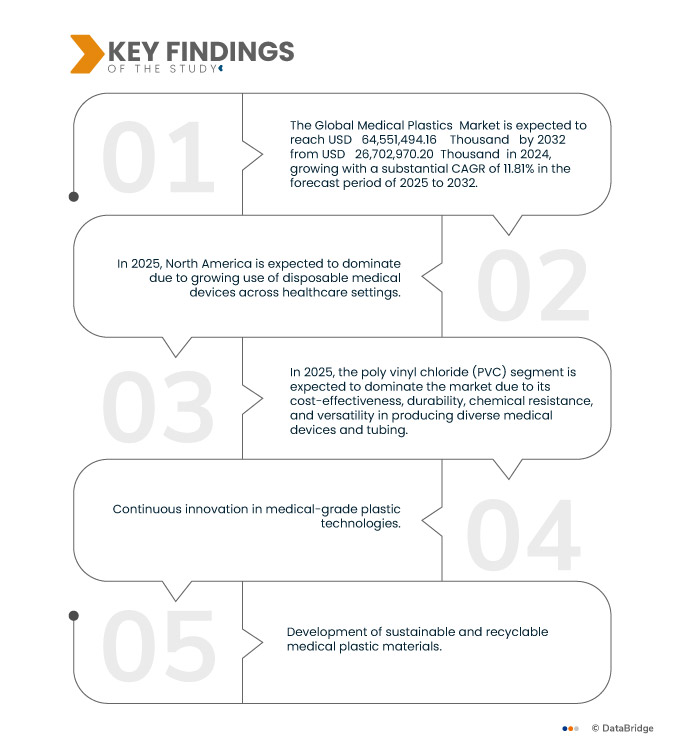
Data Bridge market research analyzes that the Global Medical Plastics Market is expected to reach USD 64,551,494.16 thousand by 2032 from USD 26,702,970.20 thousand in 2024, growing with a substantial CAGR of 11.81% in the forecast period of 2025 to 2032.
Key Findings of the Study
Continuous Innovation in Medical-Grade Plastic Technologies
Medical plastics innovation improves biocompatibility, durability, and antimicrobial properties. New polymers withstand sterilization and improve patient comfort. Antimicrobial additives reduce infections on device surfaces. Smart plastics integrate sensors for real-time patient monitoring. Biodegradable polymers are emerging for implants that dissolve after therapy. Polymer composites enhance strength and flexibility. Manufacturers invest heavily in R&D and collaborate with clinical partners. Regulatory agencies are approving more advanced polymer materials. Innovations improve imaging transparency and chemical resistance. Integration with telehealth enables remote patient care. These advancements allow development of next-generation medical devices. Continuous innovation sustains market growth. Continuous polymer innovation enhances device safety and patient comfort. Smart plastics and biodegradable polymers open new clinical applications. Collaboration between manufacturers and healthcare providers drives R&D. Regulatory support enables quicker adoption of novel materials. These innovations significantly improve medical device performance. Material advances remain a fundamental market growth factor.
Report Scope and Medical Plastics Market Segmentation
|
Report Metric
|
Details
|
|
Forecast Period
|
2025 to 2032
|
|
Base Year
|
2024
|
|
Historic Years
|
2023 (Customizable to 2018-2022)
|
|
Quantitative Units
|
Revenue in USD Thousand
|
|
Segments Covered
|
By Type/Polymer (Polycarbonate, Polypropylene, Polyethylene, Poly Vinyl Chloride (PVC), Styrenics, Polyethylene Teraphthalate Copolymer (PETG), Polymethyl Methacrylate (PMMA), Polypropylene Oxide, Polyetheretherketone (PEEK), Polyester, Polyamide, Thermoset Elastomers, Thermoplastic Elastomers, Acetal, Fluoropolymers, Biomaterials, Cellulose Based, Sulfones, Liquid Crystal Polymer and Others), By Application (Medical Devices, Medical Supplies And Consumables, Medical Devices Packaging, Implants and Others)
|
|
Countries Covered
|
U.S., Canada, Mexico, Saudi Arabia, U.A.E, South Africa, Egypt, Bahrain, Israel, Kuwait, Qatar, Oman, Rest Of Middle East And Africa, Germany, Italy, France, U.K., Netherlands, Spain, Switzerland, Belgium, Russia, Turkey, Denmark, Norway, Finland, Sweden, Rest Of Europe, China, Japan, South Korea, India, Thailand, Singapore, Malaysia, Indonesia, Australia, Philippines, New Zealand, Hong Kong, Taiwan, Rest Of Asia-Pacific, Brazil, Argentina, Rest of South America
|
|
Market Players Covered
|
SABIC (Saudi Arabia), BASF (Germany), Dow (U.S.), Mitsubishi Chemical Group Corporation. (Japan), Covestro AG (Germany), Arkema (France), Biomerics (U.S.), Cleanese Corporation (U.S.), dsm-firmenich (Switzerland), DuPONT (U.S.), Eastman Chemical Company (U.S.), Exxon Mobil Corporation (U.S.), EVONIK (Germany), Formosa Plastics Corporation, U.S.A. (U.S.), Huntsman International LLC (U.S.), INEOS (U.K.), Kraton Corporation (U.S.), Lubrizol (U.S.), Sinopec Zhenhai Refining & Chemical Company (China), Sibur Holding PJSC (Russia), Solvay (Belgium), Trinseo (U.S.), Westlake Plastics (U.S.)
|
|
Data Points Covered in the Report
|
In addition to the insights on market scenarios such as market value, growth rate, segmentation, geographical coverage, and major players, the market reports curated by the Data Bridge Market Research also include in-depth expert analysis, geographically represented company-wise production and capacity, network layouts of distributors and partners, detailed and updated price trend analysis and deficit analysis of supply chain and demand.
|
Segment Analysis
The global medical plastics market is segmented into type/ polymer, and application.
- On the basis of Type/Polymer, the market is segmented into Polycarbonate, Polypropylene, Polyethylene, Poly Vinyl Chloride (PVC), Styrenics, Polyethylene Teraphthalate Copolymer (PETG), Polymethyl Methacrylate (PMMA), Polypropylene Oxide, Polyetheretherketone (PEEK), Polyester, Polyamide, Thermoset Elastomers, Thermoplastic Elastomers, Acetal, Fluoropolymers, Biomaterials, Cellulose Based, Sulfones, Liquid Crystal Polymer and Others.
In 2025, the poly vinyl chloride (PVC) segment is expected to dominate global medical plastics market
In 2025, the poly vinyl chloride (PVC) segment is expected to dominate the market with a 18.44% market share due to its cost-effectiveness, durability, chemical resistance, and versatility in producing diverse medical devices and tubing.
- On the basis of application, the market is segmented into medical devices, medical supplies and consumables, medical devices packaging, implants and others.
In 2025, the medical devices segment is expected to dominate global medical plastics market
In 2025, the medical devices segment is expected to dominate the market with a 39.85% share due to rising healthcare demand, advanced biocompatible plastics, and regulatory support for safe applications.
Major Players
SABIC, BASF, Dow, Mitsubishi Chemical Group Corporation., Covestro AG, among others as the major market players of the market.

Market Developments
- In April 2025, SABIC makes chemicals, showcased its latest materials at CHINAPLAS 2025, a major plastics and rubber trade show in Shenzhen, China. Their main message was about "Pioneering Future Through Innovation." They highlighted how their advanced plastics are helping industries grow and become more modern. This includes solutions for important areas like renewable energy (think solar panels), electric vehicles, improving quality of life, making smarter devices for AI, and supporting the circular economy (making plastics easier to recycle).
- In July 2025, BASF collaborated with Japanese plastic products manufacturer Kyoraku to introduce Amberware—reusable tableware made using BASF’s specialty plastic Ultrason E 3010 nat, a polyethersulfone (PESU) known for its toughness and chemical resistance. This product innovation, featuring a unique amber tint, highlights BASF’s advancement in sustainable household applications by promoting durable, long-life materials. The initiative strengthens BASF’s presence in the high-performance plastics market while supporting global sustainability goal.
- In June 2025, BASF launched Ultramid Advanced N3U42G6, a new grade of polyphthalamide (PPA), specifically designed to enhance safety and durability in high-voltage connectors used in electric vehicles. This material features a non-halogenated flame retardant, minimizing electro-corrosion in electric and electronic (E&E) components. It offers high strength, dimensional stability, chemical resistance, and excellent colorability, available as a pre-colored compound or with UL-certified masterbatches. Automotive supplier KOSTAL Kontakt Systeme is utilizing this innovation for high-current modules. This product launch strengthens BASF’s position in the growing e-mobility sector by addressing the demand for safer, halide-free, and high-performance materials.
- In March 2025, BASF launched Ultrason E 2010 BMB, the world's first biomass-balanced polyethersulfone (PESU). This innovative material replaces fossil feedstock with renewable, waste-based resources using a certified biomass balance approach. As a drop-in solution, it offers the same performance, processability, and certifications as standard Ultrason, enabling customers to maintain high-quality production while significantly improving sustainability. This development strengthens BASF’s position in delivering eco-efficient high-performance plastics for demanding applications.
- In February 2025, BASF launched the world’s first superabsorbent polymer with a product carbon footprint of zero. This innovation enhances BASF’s sustainability leadership in the hygiene sector by offering climate-friendly, low-carbon solutions. It meets growing market demand for eco-conscious products while maintaining high performance.
Regional Analysis
Geographically, the countries covered in the global medical plastics market report are U.S., Canada, Mexico, Saudi Arabia, U.A.E, South Africa, Egypt, Bahrain, Israel, Kuwait, Qatar, Oman, Rest Of Middle East And Africa, Germany, Italy, France, U.K., Netherlands, Spain, Switzerland, Belgium, Russia, Turkey, Denmark, Norway, Finland, Sweden, Rest Of Europe, China, Japan, South Korea, India, Thailand, Singapore, Malaysia, Indonesia, Australia, Philippines, New Zealand, Hong Kong, Taiwan, Rest Of Asia-Pacific, Brazil, Argentina, Rest of South America.
North America is expected to dominate and Asia-Pacific be the fastest growing region in the global medical plastics market
North America leads the medical plastics market, driven by growing use of disposable medical devices across healthcare settings.
Asia-Pacific is expected to witness significant growth in the medical plastics market, driven by rising adoption of minimally invasive procedures and diagnostic tools.
As per Data Bridge Market Research analysis:
For more detailed information about the global medical plastics market report, click here – https://www.databridgemarketresearch.com/reports/global-medical-plastic-market