Microfluidics technology finds extensive use in various applications across industries. In healthcare, it is utilized for in vitro diagnostics, point-of-care testing, clinical diagnostics, drug delivery systems, and pharmaceutical research. In the industrial sector, microfluidics is applied in environmental research, analytical testing, and high-throughput screening. Additionally, microfluidics plays a crucial role in academic and research institutes for lab analytics, micro dispensing, micro reaction, and laboratory testing. The precise control and manipulation of fluids at the microscale enable innovative solutions for advanced diagnostics, efficient drug discovery, and the development of miniaturized analytical devices.
Access Full Report: https://www.databridgemarketresearch.com/reports/global-microfluidics-market
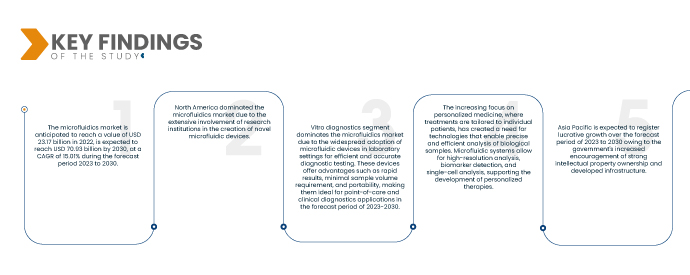
Data Bridge Market Research analyses that the Global Microfluidics Market is expected to grow to USD 23.17 billion in 2022, and is expected to reach USD 70.93 billion by 2030, at a CAGR of 15.01% during the forecast period 2023 to 2030. Lab-on-a-chip devices, which integrate multiple laboratory functions onto a single chip, are gaining popularity in various industries. The ability to perform multiple analyses simultaneously, reduce sample and reagent consumption, and increase automation has fueled the demand for microfluidic-based lab-on-a-chip devices.
Key Findings of the Study
Microfluidic chip commercialization is expected to drive the market's growth rate
The commercialization of microfluidic chips and platforms by key market players has significantly impacted the growth of the microfluidics market. These companies are actively investing in research and development efforts to enhance the functionality and performance of microfluidic devices. They are expanding their product portfolios to cater to diverse application areas and are forming strategic partnerships with academic institutions and research organizations to promote collaboration and accelerate the adoption of microfluidics in areas such as diagnostics, life sciences, and personalized medicine.
Report Scope and Market Segmentation
Report Metric
|
Details
|
Forecast Period
|
2023 to 2030
|
Base Year
|
2022
|
Historic Years
|
2021 (Customizable to 2015-2020)
|
Quantitative Units
|
Revenue in USD Billion, Volumes in Units, Pricing in USD
|
Segments Covered
|
Product Type (Microfluidic-based devices and Microfluidic Components), Material (Polymer, Glass, Silicon, Metal, Ceramics, PDMS, Other), Technology (Medical/Healthcare, Non-medical), Application (In Vitro diagnostics, Point-of-Care Testing, Clinical Diagnostics, Pharmaceutical Research, Lab Analytics, Microdispensing, Microreaction, Drug Delivery, Laboratory Testing, Analytical Testing, High Throughput Screening), Sector (Industrial, Healthcare, In-vitro Diagnostics, Environmental Research, Clinical Diagnostics), End User (Hospitals and Diagnostic Centers, Academic and Research Institutes, Pharmaceutical and Biotechnology Companies)
|
Countries Covered
|
U.S., Canada and Mexico in North America, Germany, France, U.K., Netherlands, Switzerland, Belgium, Russia, Italy, Spain, Turkey, Rest of Europe in Europe, China, Japan, India, South Korea, Singapore, Malaysia, Australia, Thailand, Indonesia, Philippines, Rest of Asia-Pacific (APAC) in the Asia-Pacific (APAC), Saudi Arabia, U.A.E, South Africa, Egypt, Israel, Rest of Middle East and Africa (MEA) as a part of Middle East and Africa (MEA), Brazil, Argentina and Rest of South America as part of South America.
|
Market Players Covered
|
Danaher (U.S.), Thermo Fisher Scientific Inc. (U.S.), PerkinElmer Inc. (U.S.), Agilent Technologies Inc. (U.S.), Bio-Rad Laboratories Inc. (U.S.), BD (U.S.), Illumina, Inc. (U.S.), F. Hoffmann-La Roche (Switzerland), Fluidigm Corporation (U.S.), Dolomite Microfluidics (U.K.), QIAGEN (Germany) Abbott (U.S.), BIOMÉRIEUX (France), microfluidic ChipShop GmbH (Germany), Elveflow (France), Cellix Bio. (India), Micronit B.V. (Netherlands), PARKER HANNIFIN CORP (U.S.) and Fortive (U.S.)
|
Data Points Covered in the Report
|
In addition to the insights on market scenarios such as market value, growth rate, segmentation, geographical coverage, and major players, the market reports curated by the Data Bridge Market Research also include depth expert analysis, patient epidemiology, pipeline analysis, pricing analysis, and regulatory framework.
|
Segment Analysis:
The microfluidics market is segmented on the basis of product type, material, technology, application, sector, and end user.
- On the basis of product type, the microfluidics market is segmented into microfluidic-based devices and microfluidic components. Microfluidic-based devices dominate the market due to their wide range of applications, including medical diagnostics, drug discovery, genomics, and proteomics. These devices integrate multiple functionalities, enabling precise manipulation and analysis of small volumes of fluids in various research and clinical settings in the forecast period of 2023-2030.
In 2023, Microfluidic-based devices dominate the product type segment of the market
In 2023, Microfluidic-based devices dominate the product type segment of the market in the forecast period of 2023-2030 owing to their broad range of uses, such as genomics, proteomics, drug discovery, and medical diagnostics. In a variety of research and clinical settings, these devices' integrated multiple functionalities allow for the precise manipulation and analysis of small volumes of fluids
- On the basis of material, the microfluidics market is segmented into polymer, glass, silicon, metal, ceramics, PDMS, others. The polymer material segment dominates with a CAGR of 18.9% in the microfluidics market due to its advantageous properties such as cost-effectiveness, ease of fabrication, biocompatibility, and compatibility with various microfluidic manufacturing techniques. In terms of technology, the medical/healthcare segment dominates due to the increasing demand for microfluidic devices in diagnostics, drug delivery, and personalized medicine in the forecast period of 2023-2030.
- On the basis of technology, the microfluidics market is segmented into medical/healthcare, and non-medical. The medical/healthcare segment dominates the microfluidics market due to its essential industry focused on promoting and maintaining health, providing diagnosis, treatment, and prevention of diseases. It encompasses various sectors, including hospitals, clinics, pharmaceuticals, medical devices, telemedicine, and research, crucial for human well-being and advancement in healthcare in the forecast period of 2023-2030.
- On the basis of application, the microfluidics market is segmented into in vitro diagnostics, point-of-care testing, clinical diagnostics, pharmaceutical research, lab analytics, micro dispensing, micro reaction, drug delivery, laboratory testing, analytical testing, high throughput screening. The Vitro diagnostics segment dominates the microfluidics market due to the widespread adoption of microfluidic devices in laboratory settings for efficient and accurate diagnostic testing in the forecast period of 2023-2030.
- On the basis of sector, the microfluidics market is segmented into industrial, healthcare, in-vitro diagnostics, environmental research, and clinical diagnostics. The healthcare sector dominates the sector segment of the microfluidics market with a CAGR of 19.0% due to its extensive use in in-vitro diagnostics and clinical diagnostics applications. Microfluidic devices enable rapid and accurate analysis of biological samples, leading to improved patient care and disease management in healthcare settings in the forecast period of 2023-2030.
In 2023, the healthcare sector dominates the sector segment of the microfluidics market
2023 年,醫療保健產業將在 2023-2030 年預測期內佔據微流體市場細分領域的主導地位,複合年增長率為 19.0%,這得益於其廣泛的應用範圍,涵蓋臨床診斷和體外診斷以及藥物發現、基因組學和 pr。微流體設備能夠在醫療保健環境中快速、精確地分析生物樣本,從而增強患者護理和疾病管理。
- 根據最終用戶,微流體市場細分為醫院和診斷中心、學術和研究機構、製藥和生物技術公司。由於微流體技術越來越多地應用於診斷目的,醫院和診斷中心的最終用戶部分佔據了微流體市場的主導地位。在 2023-2030 年的預測期內,醫院和診斷中心將依靠微流體設備進行高效、準確的檢測、診斷和病患照護。
主要參與者
Data Bridge Market Research 認為以下公司是微流體市場的主要微流體 市場參與者,它們是 Dolomite Microfluidics(英國)、QIAGEN(德國)、Abbott(美國)、BIOMÉRIEUX(法國)、microfluidic ChipShop GmbH(德國)、Elveflow(法國)、Cellix Bio。 (印度)、Micronit BV(荷蘭)、PARKER HANNIFIN CORP(美國)
市場開發
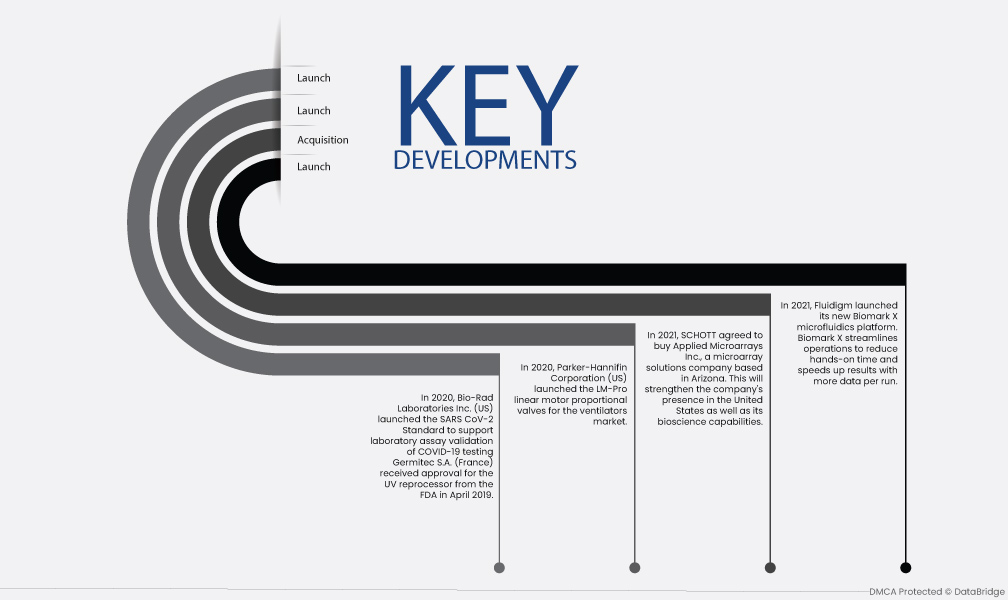
- 2021年,Fluidigm推出了全新的Biomark X微流體平台。 Biomark X 簡化了操作,減少了實際操作時間,並透過每次運行獲得更多數據來加快結果。
- 2021年,肖特同意收購位於亞利桑那州的微陣列解決方案公司Applied Microarrays Inc.。這將增強該公司在美國的影響力及其生物科學能力。
- 2020年,美國派克漢尼汾公司針對呼吸器市場推出了LM-Pro直線馬達比例閥。
- 2020 年,Bio-Rad Laboratories Inc.(美國)推出了 SARS CoV-2 標準,以支援 COVID-19 檢測的實驗室檢測驗證;Germitec SA(法國)於 2019 年 4 月獲得了 FDA 的紫外線再處理器批准。
區域分析
從地理上看,微流體市場報告涵蓋的國家有:北美洲的美國、加拿大和墨西哥,歐洲的德國、法國、英國、荷蘭、瑞士、比利時、俄羅斯、義大利、西班牙、土耳其,歐洲其他地區,中國、日本、印度、韓國、新加坡、馬來西亞、澳洲、泰國、印尼、菲律賓,亞太地區(APAC)的其他地區,沙烏地阿拉伯、阿聯酋、英國、埃及、以色列,其他
根據 Data Bridge 市場研究分析:
2023-2030 年預測期內,北美是微流體市場的主導地區
北美在微流體市場的主導地位可歸因於該地區研究機構的廣泛參與。知名大學和研究中心的存在促進了新型微流體設備和技術的發展。這些機構推動創新,進行前沿研究,並與產業參與者合作,推動微流體領域的發展。此外,北美擁有成熟的醫療保健和生物技術產業,這進一步推動了診斷、藥物發現和基因組學等應用對微流體技術的需求。
預計2023-2030 年預測期內亞太地區將成為微流體市場成長最快的地區
由於多種因素,預計亞太地區將經歷微流體市場的最高成長率。該地區各國政府正在加強對基礎設施、研究設施和科技園區發展的支持,為微流體創新創造有利的環境。此外,人們越來越重視智慧財產權所有權,鼓勵本地公司和新創公司投資研發,從而推動新的微流體技術和應用的出現。這些因素,加上該地區龐大的人口和不斷擴大的醫療保健產業,推動了亞太地區微流體市場的預期成長。
有關微流體市場 報告的更多詳細信息,請點擊此處 - https://www.databridgemarketresearch.com/reports/global-microfluidics-market