
Ultrasound imaging devices have diverse applications in healthcare. They are commonly used for obstetrics, cardiology, radiology, and musculoskeletal imaging. Features include real-time imaging, non-invasiveness, and portability. Ultrasound devices enable visualization of internal structures, monitoring of fetal development, assessment of cardiac function, detection of tumors, and guidance during minimally invasive procedures. They are crucial in diagnosing conditions such as gallbladder stones, liver diseases, and deep vein thrombosis. With their versatility and safety, ultrasound imaging devices have become indispensable tools for healthcare professionals in various medical specialties.
Access full Report @ https://www.databridgemarketresearch.com/reports/global-ultrasound-imaging-devices-market
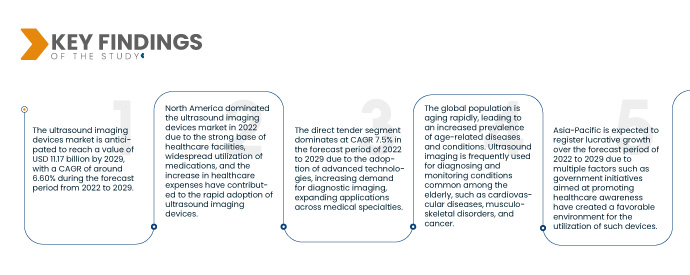
Data Bridge Market Research analyses that the Global Ultrasound Imaging Devices Market is valued at USD 6.70 billion in 2021 and is expected to reach USD 11.17 billion by 2029, registering a CAGR of 6.60% during the forecast period of 2022 to 2029. The continuous advancements in ultrasound technology have significantly enhanced the capabilities and image quality of ultrasound devices. Innovations such as 3D and 4D imaging, portable and handheld devices, and improved software algorithms have expanded the application of ultrasound imaging across various medical specialties which drives the market’s growth.
Key Findings of the Study
Growing volumes of healthcare data is expected to drive the market's growth rate
The rising prevalence of chronic diseases like cardiovascular diseases, cancer, and gastrointestinal disorders has led to an increased demand for diagnostic imaging methods. Ultrasound imaging devices offer non-invasive and real-time imaging capabilities, making them highly valuable for the diagnosis and monitoring of various conditions. The growing burden of chronic diseases, the demand for ultrasound imaging devices has surged as healthcare professionals seek effective tools for accurate and timely diagnosis, thus driving the growth of the market.
Report Scope and Market Segmentation
Report Metric
|
Details
|
Forecast Period
|
2022 to 2029
|
Base Year
|
2021
|
Historic Years
|
2020 (Customizable to 2014-2019)
|
Quantitative Units
|
Revenue in USD Billion, Volumes in Units, Pricing in USD
|
Segments Covered
|
Array Format (Phased Array, Linear Array, Curved Linear Array and Others), Device Display (Color Ultrasound Devices and Black and White (B/W) Ultrasound Devices), Device Portability (Trolley/Cart-Based Ultrasound Devices, Compact/Handheld Ultrasound Devices, Stationary Ultrasound Devices and Point-of-Care Ultrasound Devices), Technology (Diagnostic Ultrasound and Therapeutic Ultrasound), Application (Radiology/General Imaging, Obstetrics and Gynecology, Cardiovascular, Gastroenterology, Vascular, Urological, Orthopedic and Musculoskeletal, Pain Management, Emergency Department, Critical Care and Others), End User (Hospitals, Surgical Centers, Research and Academia, Maternity Centers, Ambulatory Care Centers, Diagnostic Centers and Others), Distribution Channel (Direct Tender, Third Party Distributors and Retail Sales)
|
Countries Covered
|
U.S., Canada and Mexico in North America, Germany, France, U.K., Netherlands, Switzerland, Belgium, Russia, Italy, Spain, Turkey, Rest of Europe in Europe, China, Japan, India, South Korea, Singapore, Malaysia, Australia, Thailand, Indonesia, Philippines, Rest of Asia-Pacific (APAC) in the Asia-Pacific (APAC), Saudi Arabia, U.A.E, South Africa, Egypt, Israel, Rest of Middle East and Africa (MEA) as a part of Middle East and Africa (MEA), Brazil, Argentina and Rest of South America as part of South America.
|
Market Players Covered
|
General Electric (U.S.), Koninklijke Philips N.V. (Netherlands), Canon Medical Systems Corporation (Japan), Hitachi, Ltd. (Japan), Siemens Healthineers AG (Germany), Hologic, Inc. (U.S.), FUJIFILM Holdings Corporation (Japan), Samsung Electronics Co., Ltd. (South Korea), Mindray Medical International Limited (China), Analogic Corporation (U.S.), Esaote S.p.A (Italy), Carestream Health (U.S.), CURA Healthcare (India), Chison Medical Technologies Co., Ltd. (China), Mobisante, Inc. (U.S.), Neusoft Corporation (China), Clarius Mobile Health (Canada), Medgyn Products, Inc. (U.S.), and United Imaging Healthcare Co., Ltd. (China)
|
Data Points Covered in the Report
|
In addition to the insights on market scenarios such as market value, growth rate, segmentation, geographical coverage, and major players, the market reports curated by the Data Bridge Market Research also include depth expert analysis, patient epidemiology, pipeline analysis, pricing analysis, and regulatory framework
|
Segment Analysis:
The ultrasound imaging devices market is segmented on the basis of array format, device display, device portability, technology, application, end user and distribution channel.
- On the basis of array format, the market is segmented into phased array, linear array, curved linear array and others. In 2022, curved linear array segment is expected to dominate the global ultrasound imaging devices market with a CAGR of 6.4% in the forecast period of 2022 to 2029 as curved linear array transducers are versatile and can be used across various medical specialties.
In 2022, the curved linear array segment is dominating the array format segment of the global ultrasound imaging devices market
In 2022, the curved linear array segment is dominating the market with a CAGR of 6.4% in the forecast period of 2022 to 2029 as curved linear array transducers are designed to provide high-quality images with a wide field of view, making them suitable for a variety of applications. These transducers offer versatility and flexibility, allowing healthcare professionals to perform imaging procedures in different areas of the body.
- On the basis of device display, the market is segmented into color ultrasound devices and black and white (B/W) ultrasound devices. In 2022, the color ultrasound devices segment is expected to dominate the global ultrasound imaging devices market with the CAGR of 6.4% in the forecast period of 2022 to 2029 as color doppler imaging provides valuable information about blood flow patterns, direction, and velocity.
In 2022, the color ultrasound devices segment is dominating the device display of the global ultrasound imaging devices market
In 2022, the color ultrasound segment is dominating the component segment with a CAGR of 6.4% in the forecast period of 2022 to 2029 of the global ultrasound imaging devices market as color ultrasound technology enables the visualization of blood flow within the body, providing valuable information about vascular structures and perfusion patterns. This feature is particularly useful in various medical specialties, including cardiology, obstetrics and gynecology, and vascular medicine.
- On the basis of device portability, the market is segmented into trolley/cart-based ultrasound devices, compact/handheld ultrasound devices, stationary ultrasound devices and point-of-care ultrasound devices. In 2022, trolley/cart-based ultrasound devices dominate the market at CAGR 6.5% in the forecast period of 2022 to 2029 as trolley/cart-based ultrasound devices offer a wide range of advanced features and functionalities.
- On the basis of technology, the market is segmented into diagnostic ultrasound and therapeutic ultrasound. The therapeutic ultrasound segment dominates at CAGR 7.5% in the forecast period of 2022 to 2029 as these devices utilize ultrasound waves for therapeutic purposes, such as promoting tissue healing, reducing pain, and aiding in rehabilitation.
- On the basis of application, the market is segmented into radiology/general imaging, obstetrics and gynecology, cardiovascular, gastroenterology, vascular, urological, orthopedic and musculoskeletal, pain management, emergency department, critical care and others. The critical care segment dominates at CAGR 6.6% in the forecast period of 2022 to 2029 due to its wide range of applications and the need for real-time imaging in critical care settings.
- 根據最終用戶,市場細分為醫院、外科中心、研究和學術中心、婦產中心、門診護理中心、診斷中心和其他。在 2022 年至 2029 年的預測期內,醫院部門的複合年增長率將達到 7.1%,因為這些設施配備了各種超音波成像設備,可滿足各種診斷需求。
- 根據分銷管道,市場分為直接招標、第三方分銷商和零售。由於先進技術的採用、診斷影像需求的增加以及醫學專業應用的擴大,直接招標領域在 2022 年至 2029 年的預測期內將佔據主導地位,複合年增長率為 7.5%。
主要參與者
Data Bridge Market Research 認為以下公司是超音波影像設備市場的主要參與者,它們是通用電氣(美國)、荷蘭皇家飛利浦公司(荷蘭)、佳能醫療系統公司(日本)、日立有限公司(日本)、西門子醫療股份公司(德國)、Hologic 公司(美國)、富士膠片控股公司(日本)
市場發展
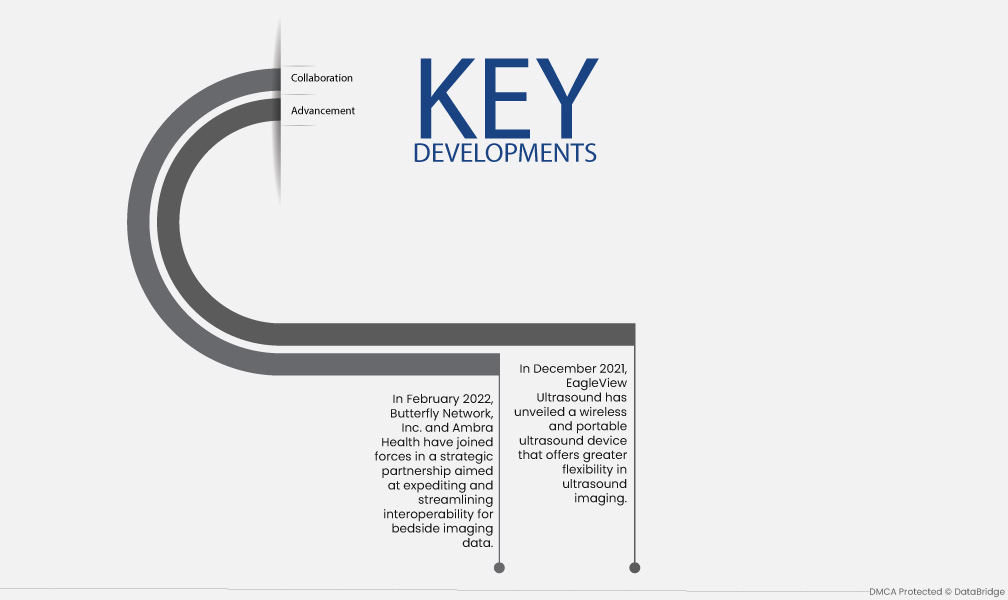
- 2022 年 2 月,Butterfly Network, Inc. 與 Ambra Health 建立策略合作夥伴關係,旨在加快和簡化床邊成像資料的互通性。此次合作增強了 Butterfly Network 企業平台(即 Butterfly Blueprint)的可擴展性,旨在提高醫院和衛生系統之間重要超音波資訊的可近性和共享性。
- 2021 年 12 月,EagleView Ultrasound 推出了一款無線便攜式超音波設備,為超音波成像提供更大的靈活性。這項創新使醫療保健提供者能夠更自由、更靈活地進行超音波檢查,特別是在護理點環境中。
區域分析
從地理上看,超音波成像設備市場報告涵蓋的國家有:北美洲的美國、加拿大和墨西哥,歐洲的德國、法國、英國、荷蘭、瑞士、比利時、俄羅斯、義大利、西班牙、土耳其,歐洲其他地區,中國、日本、印度、韓國、新加坡、馬來西亞、澳洲、泰國、印尼、菲律賓,亞太地區(APAC)的其他地區,沙烏地阿拉伯、阿聯酋、南非、埃及、印尼、菲律賓,亞太地區(APAC)的其他地區,沙烏地阿拉伯、阿聯酋、南非、埃及、以色列和其他地區的其他地區(APAC)
根據 Data Bridge 市場研究分析:
2022 年至 2029 年預測期內,北美是超音波影像設備市場的主導地區
2022 年,北美佔據了超音波成像設備市場的主導地位,因為這些設備因其非侵入性、即時成像能力和成本效益而被廣泛應用於醫療機構。此外,腎結石的盛行率不斷上升,進一步推動了對超音波成像設備的需求,因為它們是診斷和監測這種疾病的寶貴工具。這些因素的結合,加上該領域研究活動的不斷增加,推動了超音波成像設備在醫療保健領域的應用和進步。
預計亞太地區將成為2022 年至 2029 年預測期內超音波成像設備市場成長最快的地區
由於醫療旅遊業的興起吸引了尋求高品質醫療服務的患者,導致對超音波成像等先進診斷技術的需求增加,預計亞太地區在預測期內將實現增長。此外,該地區日益增長的研究活動促進了該領域的不斷進步和創新。大量未開發的市場、龐大的人口和日益增長的優質醫療需求,進一步推動了該地區超音波成像設備的採用和成長。
有關超音波成像設備市場 報告的更多詳細信息,請點擊此處 - https://www.databridgemarketresearch.com/reports/global-ultrasound-imaging-devices-market










