Global Gene Therapy Products Market
市场规模(十亿美元)
CAGR :
%
USD
6.75 Billion
USD
33.47 Billion
2024
2032
| 2025 –2032 | |
| USD 6.75 Billion | |
| USD 33.47 Billion | |
|
|
|
|
Global Gene Therapy Products Market Segmentation, By Product (Yescarta, Kymriah, Luxturna, Strimvelis and Gendicine), Application (Oncological Disorders, Rare Diseases, Cardiovascular Diseases, Neurological Disorders, Infectious Diseases and Other Diseases), Distribution Channel (Hospital Pharmacy, Online Pharmacy, Retail Pharmacy and Others) - Industry Trends and Forecast to 2032
Gene Therapy Products Market Size
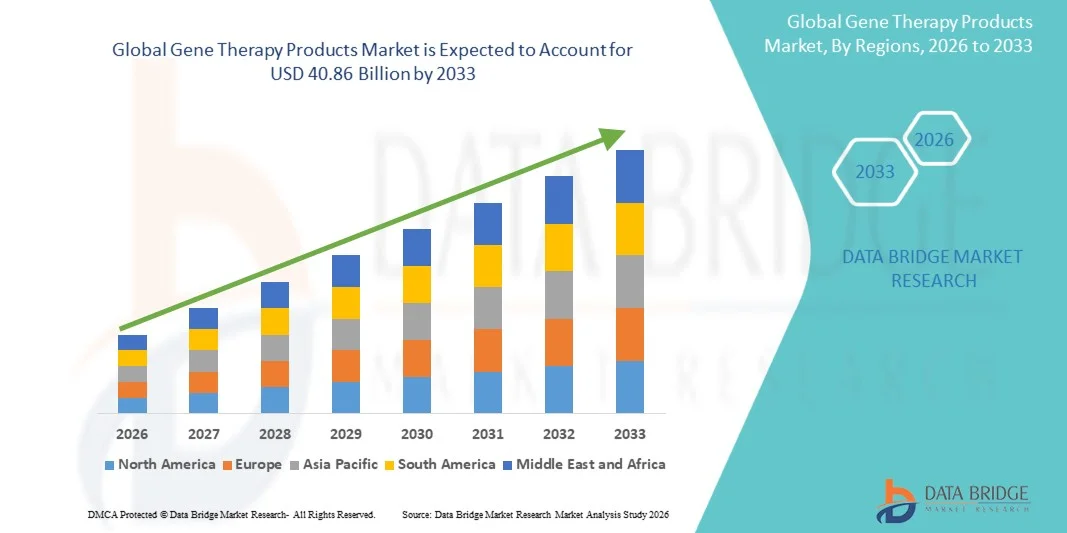
- The globalgene therapyproducts market size was valued atUSD 6.75 billion in 2024and is expected to reachUSD 33.47 billion by 2032, at aCAGR of 22.15%during the forecast period
- This growth is driven by factors such as the advancements in gene editing technologies, increased investment in R&D and rising prevalence of genetic disorders
Gene Therapy Products Market Analysis
- Gene therapy products are revolutionary treatments that involve altering the genes inside a patient's cells to treat or prevent disease. These products offer a promising solution for genetic disorders, cancers, and some viral infections, using techniques such as CRISPR-Cas9 and viral vector delivery systems
- The demand for gene therapy products is significantly driven by advancements in gene editing technologies, increasing investments in research and development, and the rising prevalence of genetic disorders such as sickle cell anaemia, Duchenne muscular dystrophy, and haemophilia
- North America is expected to dominate the global gene therapy products market due to its strong healthcare infrastructure, robust regulatory environment, and significant investments from both public and private sectors. The region also benefits from high adoption rates of cutting-edge technologies in medical treatments
- Asia-Pacific is expected to witness the fastest growth in the gene therapy products market during the forecast period. The increasing prevalence of genetic disorders, advancements in healthcare infrastructure, rising awareness about gene-based treatments, and improving regulatory frameworks in countries such as China and India are contributing to this rapid growth
- Oncological disorder segment is expected to dominate the market with a market share of 57.4% due to the increasing prevalence of various types of cancers worldwide and the growing adoption of gene therapy as a targeted treatment approach. Gene therapy's ability to specifically target cancer cells while minimizing damage to healthy cells has made it an increasingly attractive treatment option
Report Scope and Gene Therapy Products Market Segmentation
|
Attributes |
Gene Therapy Products Key Market Insights |
|
Segments Covered |
|
|
Countries Covered |
North America
Europe
Asia-Pacific
Middle East and Africa
South America
|
|
Key Market Players |
|
|
Market Opportunities |
|
|
Value Added Data Infosets |
In addition to the insights on market scenarios such as market value, growth rate, segmentation, geographical coverage, and major players, the market reports curated by the Data Bridge Market Research also include import export analysis, production capacity overview, production consumption analysis, price trend analysis, climate change scenario, supply chain analysis, value chain analysis, raw material/consumables overview, vendor selection criteria, PESTLE Analysis, Porter Analysis, and regulatory framework. |
Gene Therapy Products Market Trends
“Advancements in Gene Therapy Products &Precision Medicine”
- One prominent trend in the evolution of gene therapy products is the increasing integration of CRISPR technology and viral vector delivery systems, which enable precise editing of genetic material at the molecular level. This has led to more targeted and effective therapies for a range of genetic disorders
- These innovations improve the precision and efficiency of gene therapies, allowing for personalized treatments that can address the root causes of genetic diseases. By targeting specific genes or cells, gene therapy is transforming the treatment landscape for conditions such as sickle cell anemia, Duchenne muscular dystrophy, and hemophilia
- For instance, CRISPR-Cas9 technology has been used to correct genetic mutations responsible for inherited diseases, while gene-modified immune cells are offering new hope for patients with cancer through CAR-T cell therapies
- These advancements are not only improving patient outcomes by offering long-term solutions for genetic diseases but also driving the demand for next-generation gene therapies that leverage cutting-edge genetic engineering and precision medicine techniques, creating a new era of healthcare
Gene Therapy Products Market Dynamics
Driver
“Increasing Prevalence of Genetic Disorders”
- The rising prevalence of genetic disorders such as hemophilia, sickle cell anemia, muscular dystrophy, and cystic fibrosis is significantly contributing to the growing demand for gene therapy products
- As the global population continues to age, the incidence of genetic diseases, both congenital and acquired, continues to rise, particularly in hereditary conditions that have a significant genetic basis
- The demand for gene therapies is rising as these products offer potential long-term solutions to conditions that were previously considered incurable or difficult to treat
For instance,
- Sickle cell anemia affects approximately 100,000 Americans, with new gene therapies showing promising results in correcting the underlying genetic mutation, thus addressing a major unmet medical need
- As more individuals seek treatments for these genetic conditions, the demand for gene therapy products is expected to grow, ensuring improved patient outcomes and reducing the long-term healthcare burden
Opportunity
“Advancements in CRISPR and Genetic Editing Technology”
- The integration of CRISPR-Cas9 technology into gene therapy products is revolutionizing the treatment landscape. This innovation allows for precise gene editing, making it possible to correct genetic mutations at the molecular level, offering hope for treating a range of previously untreatable diseases
- CRISPR-based therapies enable personalized medicine, which is tailored to the specific genetic makeup of individual patients, improving the effectiveness of treatments
For instance,
- CRISPR-Cas9 is being used to treat conditions such as Duchenne muscular dystrophy and beta-thalassemia, where the genetic defect can be corrected at the DNA level, potentially curing the disease
- The commercialization of CRISPR technology and advancements in genetic editing are such asly to accelerate the development and adoption of gene therapy products, opening new avenues for treating genetic diseases and expanding the market
Restraint/Challenge
“High Development Costs and Regulatory Hurdles”
- One of the major challenges in the gene therapy products market is the high development costs, which can range from millions to billions of dollars to bring a single gene therapy product to market
- The complexity of developing safe and effective gene therapies requires extensive research and clinical trials, leading to long approval timelines and significant financial investments
For instance,
- Luxturna, a gene therapy treatment for inherited retinal disease, cost nearly USD 850,000 per patient, highlighting the cost challenges in gene therapy products
- In addition, regulatory hurdles remain a significant challenge, as gene therapy products are subject to stringent approvals by regulatory bodies such as the FDA and EMA, leading to delays in reaching patients
- These financial and regulatory barriers may limit the ability of healthcare providers, especially in developing countries, to access these life-changing therapies, potentially slowing market penetration and limiting growth
Gene Therapy Products Market Scope
The market is segmented on the basis of product, application and distribution channel.
|
Segmentation |
Sub-Segmentation |
|
By Product |
|
|
By Application |
|
|
By Distribution Channel |
|
In 2025, the oncological disorder is projected to dominate the market with a largest share in application segment
The oncology disorder segment is expected to dominate the gene therapy products market with the largest share of 57.4% in 2025 due to the increasing prevalence of various types of cancers worldwide and the growing adoption of gene therapy as a targeted treatment approach. Gene therapy's ability to specifically target cancer cells while minimizing damage to healthy cells has made it an increasingly attractive treatment option.
The Kymriah is expected to account for the largest share during the forecast period in product market
In 2025, Kymriah is expected to dominate the CAR-T cell therapy market with the largest market share of 42.3% due to its early entry into the market and FDA approval in 2017, along with a robust clinical efficacy profile. Kymriah is primarily used in North America and Europe but is expanding in Asia-Pacific and other regions. It is approved for treating B-cell acute lymphoblastic leukemia (ALL) and large B-cell lymphoma, addressing a significant patient population and leading the CAR-T market.
Gene Therapy Products Market Regional Analysis
“North America Holds the Largest Share in the Gene Therapy Products Market”
- North America dominates with share of 47.8% as in the global market, driven by advanced healthcare infrastructure, high adoption of cutting-edge medical technologies, and the presence of leading market players
- U.S. holds a significant share of 42.2%, largely due to increased demand for innovative gene therapies, growing investments in research & development, and a high prevalence of genetic disorders that require targeted therapies
- In addition, the well-established healthcare reimbursement systems and continuous advancements in gene therapies, including CAR-T and gene editing technologies, contribute significantly to the market’s growth in North America
- The market in North America is further strengthened by the presence of prominent biopharmaceutical companies and the availability of specialized treatment centers, resulting in an expanded reach of gene therapy products
“Asia-Pacific is Projected to Register the Highest CAGR in the Gene Therapy Products Market”
- Asia-Pacific is expected to experience the highest growth rate in the gene therapy products market, driven by rapid expansion in healthcare infrastructure, increasing awareness about genetic disorders, and rising surgical volumes
- Countries such as China, India, and Japan are emerging as key markets due to the growing aging population and rising prevalence of conditions such as inherited genetic diseases, cancer, and rare disorders
- Japan, with its advanced medical technology and strong healthcare system, continues to lead in adopting innovative gene therapy solutions. Meanwhile, China and India are witnessing growing investments in gene therapy research, development, and infrastructure, which are further boosting market growth
- The region’s market growth is also supported by increasing governmental and private sector initiatives focused on genetic research and expanding access to gene therapies, further fuelling the demand for these products
Gene Therapy Products Market Share
The market competitive landscape provides details by competitor. Details included are company overview, company financials, revenue generated, market potential, investment in research and development, new market initiatives, global presence, production sites and facilities, production capacities, company strengths and weaknesses, product launch, product width and breadth, application dominance. The above data points provided are only related to the companies' focus related to market.
The Major Market Leaders Operating in the Market Are:
- Bristol-Myers Squibb Company(US)
- GSK plc(UK)
- Merck KGaA(Germany)
- Novartis AG(Switzerland)
- Danaher Cooperation(US)
- Illumina, Inc. (US)
- Thermo Fisher Scientific Inc. (US)
- QIAGEN (Germany)
- F. Hoffmann-La Roche Ltd (Switzerland)
- Adaptimmune (UK)
- bluebird bio, Inc. (US)
- Achieve Life Sciences, Inc. (US)
- AbbVie Inc. (US)
- Spark Therapeutics, Inc. (US)
- Abeona Therapeutics Inc. (US)
- Adverum Biotechnologies, Inc. (US)
- Arbutus Biopharma (Canada)
- Amgen Inc. (US)
- Audentes Therapeutics (US)
- Gilead Sciences, Inc. (US)
Latest Developments in Global Gene Therapy Products Market
- In January 2025, bluebird bio, Inc., a leading player in gene therapy, received FDA approval for its LentiGlobin gene therapy for sickle cell disease, expanding its gene therapy portfolio. This approval marks a significant milestone for the treatment of hematologic diseases and offers patients a potential one-time treatment solution. The therapy is designed to increase healthy hemoglobin production in patients with sickle cell disease, improving their quality of life and potentially reducing the need for lifelong transfusions
- In December 2024, Gilead Sciences, Inc. launched a new clinical trial for its Yescarta gene therapy to treat relapsed or refractory B-cell lymphoma. The trial will evaluate the long-term efficacy and safety of Yescarta when combined with new immune-modifying therapies. This expansion in its oncology portfolio signals the continued progress in the gene therapy landscape, aimed at improving the survival rates of cancer patients
- In October 2024, Novartis AG expanded its Kymriah gene therapy offering to treat adult patients with large B-cell lymphoma. The expanded indication is expected to help further drive growth in the gene therapy market by offering a more comprehensive solution for lymphomas and other blood cancers. Novartis continues to focus on strengthening its oncology pipeline, positioning gene therapy as a key therapeutic modality
SKU-
Get online access to the report on the World's First Market Intelligence Cloud
- Interactive Data Analysis Dashboard
- Company Analysis Dashboard for high growth potential opportunities
- Research Analyst Access for customization & queries
- Competitor Analysis with Interactive dashboard
- Latest News, Updates & Trend analysis
- Harness the Power of Benchmark Analysis for Comprehensive Competitor Tracking
研究方法
数据收集和基准年分析是使用具有大样本量的数据收集模块完成的。该阶段包括通过各种来源和策略获取市场信息或相关数据。它包括提前检查和规划从过去获得的所有数据。它同样包括检查不同信息源中出现的信息不一致。使用市场统计和连贯模型分析和估计市场数据。此外,市场份额分析和关键趋势分析是市场报告中的主要成功因素。要了解更多信息,请请求分析师致电或下拉您的询问。
DBMR 研究团队使用的关键研究方法是数据三角测量,其中包括数据挖掘、数据变量对市场影响的分析和主要(行业专家)验证。数据模型包括供应商定位网格、市场时间线分析、市场概览和指南、公司定位网格、专利分析、定价分析、公司市场份额分析、测量标准、全球与区域和供应商份额分析。要了解有关研究方法的更多信息,请向我们的行业专家咨询。
可定制
Data Bridge Market Research 是高级形成性研究领域的领导者。我们为向现有和新客户提供符合其目标的数据和分析而感到自豪。报告可定制,包括目标品牌的价格趋势分析、了解其他国家的市场(索取国家列表)、临床试验结果数据、文献综述、翻新市场和产品基础分析。目标竞争对手的市场分析可以从基于技术的分析到市场组合策略进行分析。我们可以按照您所需的格式和数据样式添加您需要的任意数量的竞争对手数据。我们的分析师团队还可以为您提供原始 Excel 文件数据透视表(事实手册)中的数据,或者可以帮助您根据报告中的数据集创建演示文稿。