Rapid expansion of Bangladesh’s e-commerce ecosystem together with sustained growth of the ready-made garments (RMG) manufacturing sector has been driving accelerated demand for modern warehousing capacity across key industrial and urban corridors. Rising online order volumes have resulted in higher requirements for fulfilment centres, last-mile sorting hubs and temperature-controlled storage to support fast-cycle delivery. Simultaneously, expanding RMG production and export activity has increased the need for bonded storage, staging areas and pre-shipment consolidation facilities near ports and production clusters. These combined structural shifts have positioned warehousing as a critical backbone for Bangladesh’s evolving industrial, export and consumer-driven logistics landscape..
Access Full Report @ https://www.databridgemarketresearch.com/reports/bangladesh-warehousing-market
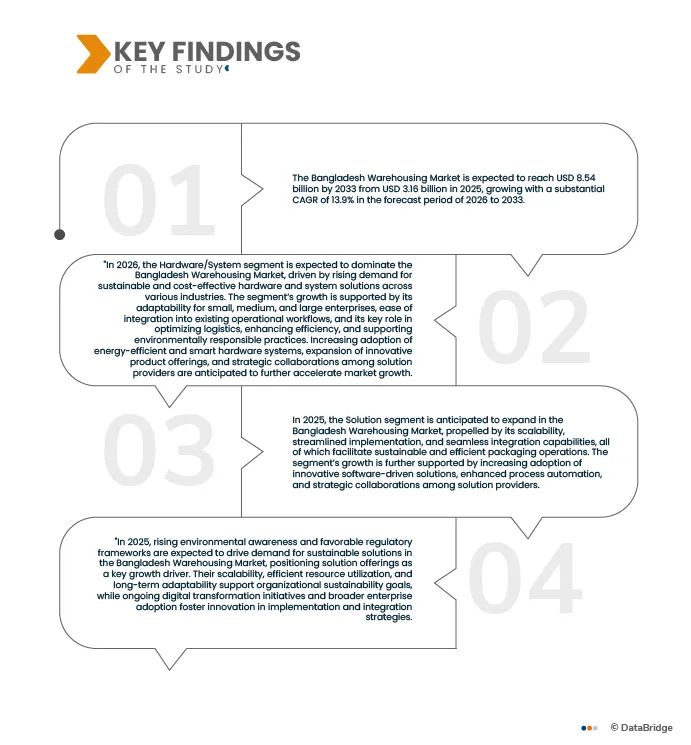
Data Bridge market research analyzes that The Bangladesh Warehousing Market size was valued at USD 3.16 billion in 2025 and is expected to reach USD 8.54 billion by 2033, at a CAGR of 13.9% during the forecast period
Key Findings of the Study
Modernization of the logistics ecosystem
Modernization of Bangladesh’s logistics ecosystem presents a significant opportunity for the warehousing market, as ongoing reforms aim to improve freight efficiency, expand multimodal connectivity and enhance storage infrastructure across industrial and consumption zones. National logistics strategies, digital trade-facilitation systems and port-capacity enhancements are contributing to the gradual shift from fragmented operations to integrated, technology-enabled logistics solutions. Development of specialized logistics parks, improvement of container-handling systems and expansion of cold-chain networks provide scope for large-scale, compliant warehouses capable of supporting export manufacturing, e-commerce and domestic distribution. These modernization efforts position warehousing as a critical enabler of a more efficient and competitive logistics landscape.
Report Scope and Market Segmentation
|
Report Metric
|
Details
|
|
Forecast Period
|
2026 to 2033
|
|
Base Year
|
2025
|
|
Historic Years
|
2024 (Customizable to 2018-2023)
|
|
Quantitative Units
|
Revenue in USD Billions
|
|
Segments Covered
|
By Components (Hardware/System, Software, Services); Type (Insource Warehousing, Outsource Warehousing); Function (Inventory Control and Management , Order Fulfilment ,Asset Tracking, Shipping , Workforce and Task( Process) Management , Yard and Dock Management , Predictive Maintenance , Other); Size (Small, Medium, Large); Ownership (Public Warehouses, Private Warehouses, Bonded Warehouses, Consolidated Warehouse); Tenure (Long Term (1–10 Years), Medium Term (3–12 Months),Short Term (Up to 3 Months), Pay Per Use); Scale (Up to 5,000 m², 5,000–25,000 m², Above 25,000 m²); Warehousing Storage Nature (Ambient Warehousing (Around 80°F), Air Conditioned (56°F And 75°F), Refrigerated (33°F And 55°F), Cold/Frozen (of or Below 32°F), Others); WMS Tier Type (Advanced WMS, Basic WMS, Intermediate WMS); Application (Food and Beverages, Transportation and Logistics, Retail and E-Commerce, Energy and Utilities, Chemical, Ready Made Garments (RMG), Automotive, Electrical and Electronics, Healthcare, Agriculture, Others)
|
|
Countries Covered
|
Bangladesh
|
|
Market Players Covered
|
|
|
Data Points Covered in the Report
|
In addition to the insights on market scenarios such as market value, growth rate, segmentation, geographical coverage, and major players, the market reports curated by the Data Bridge Market Research also include in-depth expert analysis, pricing analysis, brand share analysis, consumer survey, demography analysis, supply chain analysis, value chain analysis, raw material/consumables overview, vendor selection criteria, PESTLE Analysis, Porter Analysis, and regulatory framework.
|
Segment Analysis
The Bangladesh Warehousing market is segmented into ten notable segments based on the Components, Type, Function, Size, Ownership, Tenure, Scale, Warehousing Storage Nature, WMS Tier Type, Application.
- On the basis of Components, the Bangladesh Warehousing market is segmented into Hardware/System, Software, Services
- On the basis of Type, the Bangladesh Warehousing market is segmented into Insource Warehousing, Outsource Warehousing
- On the basis of Function, the Bangladesh Warehousing market is segmented into Inventory Control and Management, Order Fulfilment, Asset Tracking, Shipping, Workforce and Task (Process) Management, Yard and Dock Management, Predictive Maintenance, Other
- On the basis of Size, the Bangladesh Warehousing market is segmented into Small, Medium, Large
- On the basis of Ownership, the Bangladesh Warehousing market is segmented into Public Warehouses, Private Warehouses, Bonded Warehouses, Consolidated Warehouse
- On the basis of Tenure, the Bangladesh Warehousing market is segmented into Long Term (1–10 Years), Medium Term (3–12 Months), Short Term (Up to 3 Months), Pay Per Use
- On the basis of Scale, the Bangladesh Warehousing market is segmented into Up to 5,000 m², 5,000–25,000 m², Above 25,000 m².
- On the basis of Warehousing Storage Nature, the Bangladesh Warehousing market is segmented into Ambient Warehousing (Around 80°F), Air Conditioned (56°F And 75°F), Refrigerated (33°F And 55°F), Cold/Frozen (of or Below 32°F), Others
- On the basis of WMS Tier Type, the Bangladesh Warehousing market is segmented into Advanced WMS, Basic WMS, Intermediate WMS
- On the basis of Application, the Bangladesh Warehousing market is segmented into Food and Beverages, Transportation and Logistics, Retail and E-Commerce, Energy and Utilities, Chemical, Ready-Made Garments (RMG), Automotive, Electrical and Electronics, Healthcare, Agriculture, Others
In 2026, the Hardware/System segment is expected to dominate the market
In 2026, the hardware segment is expected to dominate the market due to the increasing demand for advanced monitoring and control systems that ensure precise temperature and environmental management across the Warehousing market. The growing focus on food safety, pharmaceutical integrity, and efficient supply chain operations is driving investments in sophisticated hardware solutions such as refrigerated vehicles, IoT-enabled sensors, and data loggers.
Major Players
DHL (Germany), Kuehne+Nagel (Switzerland), DSV (Denmark), CEVA Logistics (France), Yusen Logistics Global Management Co., Ltd. (Japan), Nippon Express Holdings (Japan), Expeditors International of Washington, Inc. (U.S.), GEODIS (France), Summit Alliance Port Limited (SAPL) (Bangladesh), A H Khan & Company Limited (Bangladesh)
Market Developments
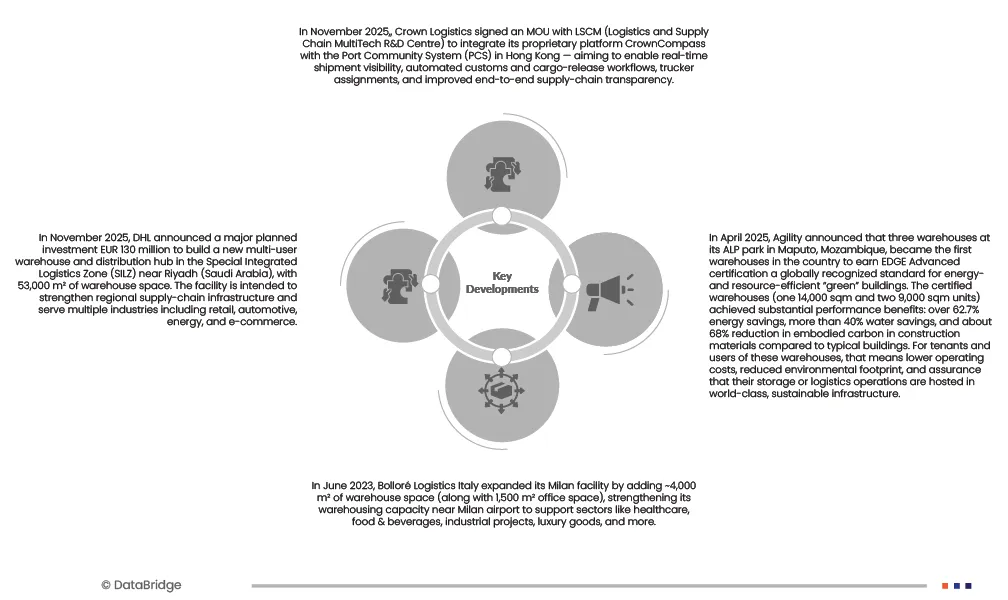
- In April 2025, Agility announced that three warehouses at its ALP park in Maputo, Mozambique, became the first warehouses in the country to earn EDGE Advanced certification a globally recognized standard for energy‑ and resource‑efficient “green” buildings. The certified warehouses (one 14,000 sqm and two 9,000 sqm units) achieved substantial performance benefits: over 62.7% energy savings, more than 40% water savings, and about 68% reduction in embodied carbon in construction materials compared to typical buildings. For tenants and users of these warehouses, that means lower operating costs, reduced environmental footprint, and assurance that their storage or logistics operations are hosted in world‑class, sustainable infrastructure.
- In October 2024, Agility disclosed a major expansion plan at its Riyadh warehousing complex: ALP will invest SAR 250 million to add 100,000 sqm of Class‑A warehouse capacity, raising the total warehousing space at the complex to 551,368 sqm. This expansion supports growing demand for modern logistics infrastructure in Saudi Arabia, and will enable ALP to serve more customers across sectors such as e‑commerce, retail, manufacturing, and distribution with world‑class warehousing and supply‑chain services.
As per Data Bridge Market Research analysis:
For more detailed information about the Bangladesh Warehousing Market report, click here – https://www.databridgemarketresearch.com/reports/bangladesh-warehousing-market