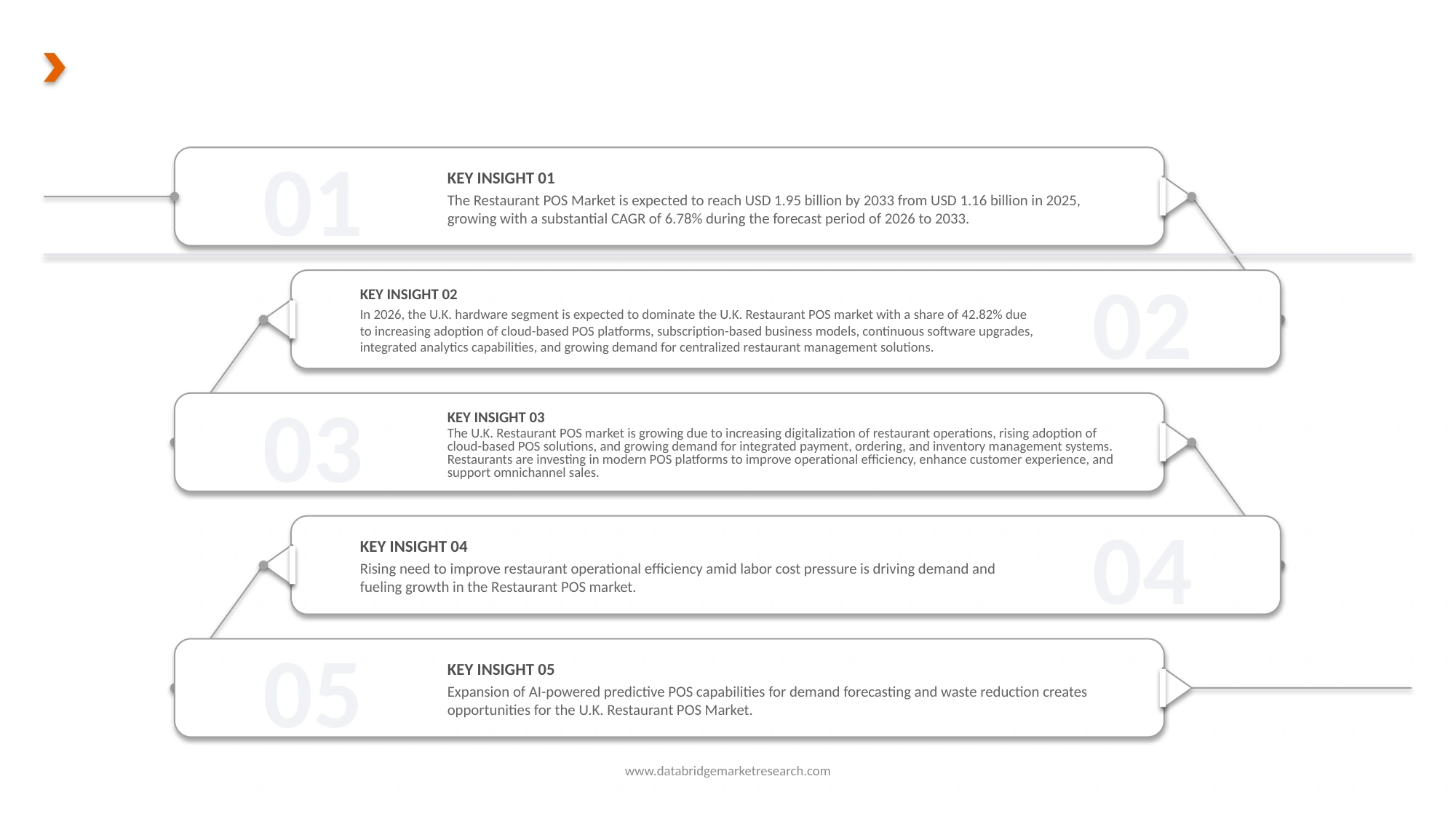
The increasing need to improve restaurant operational efficiency amid rising labor costs is a key factor driving the growth of the U.K. restaurant POS market. Restaurants across the country are facing persistent workforce shortages, increasing minimum wage requirements, and rising operating expenses, compelling operators to invest in technologies that automate routine tasks and enhance staff productivity. Modern POS systems streamline order processing, billing, payment acceptance, inventory management, kitchen communication, and employee scheduling through a centralized platform, enabling restaurants to reduce manual intervention, minimize order errors, and improve service speed. Additionally, cloud-based and AI-enabled POS solutions provide real-time operational insights, automated reporting, and demand forecasting, helping restaurant owners optimize staffing levels, control food costs, and maximize profitability while maintaining consistent customer service.
The growing adoption of digital ordering channels, self-service kiosks, contactless payments, and online food delivery platforms has further strengthened the importance of advanced POS systems in managing increasingly complex restaurant operations. Integrated POS platforms synchronize orders across dine-in, takeaway, delivery, and mobile applications, ensuring seamless communication between front-of-house and kitchen operations while reducing operational bottlenecks. As restaurants continue to focus on cost optimization, workforce efficiency, and enhanced customer experiences, investment in intelligent, cloud-connected POS solutions is expected to accelerate, making operational efficiency one of the primary growth drivers for the U.K. restaurant POS market.
Access Full Report @ https://www.databridgemarketresearch.com/reports/uk-restaurant-pos-market
Data Bridge market research analyzes that the Restaurant POS Market is expected to reach USD 1.95 billion by 2033 from USD 1.16 billion in 2025, growing at a substantial CAGR of 6.78% in the forecast period of 2026 to 2033.
Key Findings of the Study
Growing Adoption of Digital Payment Acceptance and in-Restaurant Order Automation
The growing adoption of digital payment acceptance and in-restaurant order automation is significantly driving the growth of the U.K. restaurant POS market. Consumers increasingly expect fast, secure, and convenient payment options, prompting restaurants to deploy modern POS systems that support contactless cards, digital wallets, QR code payments, and integrated online transactions. At the same time, restaurants are investing in self-service kiosks, tableside ordering, mobile POS devices, and QR code-based menu ordering to reduce wait times, improve order accuracy, and enhance customer convenience. These technologies enable restaurants to streamline front-of-house operations while minimizing manual intervention and improving service efficiency during peak hours.
Report Scope and Market Segmentation
|
Report Metric
|
Details
|
|
Forecast Period
|
2026 to 2033
|
|
Base Year
|
2025
|
|
Historic Years
|
2018-2024 (Customizable to 2013-2017)
|
|
Quantitative Units
|
Revenue in USD Billion
|
|
Segments Covered
|
By Offering (Hardware, Software, and Services), By POS System Type (Fixed Terminal POS, Mobile POS (MPOS) System, Tablet POS System, Web-Based POS, Self-Service Kiosk POS System, Terminal POS System, and Others), By Deployment Mode (Cloud, On Premises, and Hybrid), By Enterprise Size (Large Chain Restaurants, Medium Chain Restaurants, and Small Restaurants), By Operating System (Android, Windows, Mac, Linux, and Others), By Revenue Model (Subscription, One Time License, Freemium, and Others), By Intelligence Level (Traditional POS, Cloud-Enabled POS, Real-Time Analytics POS, AI-Enabled POS, Smart Inventory POS, Customer Behavior Analytics POS, Predictive Analytics POS, Generative AI POS, and Others), By Outlet Type (Single-Outlet POS and Multi-Outlet POS), By Functional Module (Order & Billing Management, Inventory & Procurement Management, Customer Engagement, Business Intelligence & Analytics, Kitchen Operations, and Workforce Management), By Payment Capability (Contactless Payments, Card Payments, Digital Wallet Payments, Cash Payments, QR Code Payments, and Buy Now Pay Later (BNPL)), By Integration Ecosystem (Food Delivery Platforms, Online Ordering Platforms, Accounting Software, CRM Platforms, Mobile Applications, Reservation Management Platforms, ERP Systems, and Others), By Restaurant Type (QSR (Quick Service Restaurants), FSR (Full Service Restaurants), Cafés & Bakeries, Bars, Cloud Kitchens, Catering, Stadium Restaurants, Airline Restaurants, and Others), and By End User (Independent Restaurants, Restaurant Chains & Franchises, Hotels & Hospitality Groups, Cloud Kitchens, Catering & Event Service Providers, and Institutional Foodservice Operators).
|
|
Countries Covered
|
U.K.
|
|
Market Players Covered
|
• TISSL Ltd. (U.K.)
• NFS Hospitality (U.K.)
• The Access Group (U.K.)
• Kobas Ltd. (U.K.)
• Syrve (Cyprus)
• Zonal Retail Data Systems Ltd. (U.K.)
• Epos Now Ltd. (U.K.)
• ICRTouch Ltd. (U.K.)
• Tevalis Ltd. (U.K.)
• POSApt Ltd. (U.K.)
• Toast Inc. (U.S.)
• TouchBistro Inc. (Canada)
• Lightspeed Commerce Inc. (Canada)
• Block, Inc. (U.S.)
• PAR Technology Corporation (U.S.)
• NCR Voyix Corporation (U.S.)
• Oracle Corporation (U.S.)
• Clover Network, LLC (U.S.)
• SumUp Payments Limited (U.K.)
• Revel Systems, Inc. (U.S.)
|
|
Data Points Covered in the Report
|
In addition to the market insights such as market value, growth rate, market segments, geographical coverage, market players, and market scenario, the market report curated by the Data Bridge Market Research team includes in-depth expert analysis, import/export analysis, pricing analysis, production consumption analysis, and pestle analysis.
|
Segment Analysis
The U.K. restaurant POS market is segmented into thirteen notable segments based on offering, POS system type, deployment mode, enterprise size, operating system, revenue model, intelligence level, outlet type, functional module, payment capability, integration ecosystem, restaurant type, and end user.
- On the basis of offering, the U.K. restaurant POS market is segmented into hardware, software, and services.
In 2026, the Hardware segment is expected to dominate the market.
In 2026, the Hardware segment is expected to dominate the U.K. restaurant POS market with share of 42.82% due to increasing adoption of cloud-based POS platforms, subscription-based business models, continuous software upgrades, integrated analytics capabilities, and growing demand for centralized restaurant management solutions.
- On the basis of POS system type, the U.K. restaurant POS market is segmented into fixed terminal POS, mobile POS (mPOS) system, tablet POS system, web-based POS, self-service kiosk POS system, terminal POS system, and others.
In 2026, the fixed terminal POS segment is expected to dominate the market.
In 2026, the fixed terminal POS segment is expected to dominate the U.K. restaurant POS market with share of 30.46% owing to its widespread deployment in full-service restaurants and restaurant chains, high reliability, robust transaction processing capabilities, and seamless integration with kitchen and back-office operations.
- On the basis of deployment mode, the U.K. restaurant POS market is segmented into cloud, on-premises, and hybrid. In 2026, the cloud segment is expected to dominate the U.K. restaurant POS market with share of 52.67% due to its lower upfront investment, remote accessibility, automatic software updates, scalability, and increasing preference among restaurants for subscription-based POS solutions.
- On the basis of enterprise size, the U.K. restaurant POS market is segmented into large chain restaurants, medium chain restaurants, and small restaurants. In 2026, the large chain restaurants segment is expected to dominate the U.K. restaurant POS market with share of 45.48% owing to the large number of independent foodservice establishments across the country, increasing digital transformation initiatives, and growing adoption of affordable cloud-based POS solutions.
- On the basis of operating system, the U.K. restaurant POS market is segmented into Android, Windows, Mac, Linux, and others. In 2026, the Android segment is expected to dominate the U.K. restaurant POS market with share of 40.04% due to the availability of cost-effective hardware, extensive application ecosystem, ease of deployment, and increasing preference for Android-based tablets and mobile POS devices.
- On the basis of revenue model, the U.K. restaurant POS market is segmented into subscription, one-time license, freemium, and others. In 2026, the subscription segment is expected to dominate the U.K. restaurant POS market with share of 54.52% owing to recurring revenue models, lower initial investment requirements, continuous feature enhancements, cloud deployment, and growing demand for Software-as-a-Service (SaaS) POS platforms.
- On the basis of intelligence level, the U.K. restaurant POS market is segmented into traditional POS, cloud-enabled POS, real-time analytics POS, AI-enabled POS, smart inventory POS, customer behavior analytics POS, predictive analytics POS, generative AI POS, and others. In 2026, the Traditional POS segment is expected to dominate the U.K. restaurant POS market with share of 28.98% due to increasing adoption of cloud infrastructure, centralized data management, remote monitoring capabilities, seamless software updates, and integration with third-party restaurant applications.
- On the basis of outlet type, the U.K. restaurant POS market is segmented into single-outlet POS and multi-outlet POS. In 2026, the single-outlet POS segment is expected to dominate the U.K. restaurant POS market with share of 63.27% owing to the significant presence of independent restaurants and small foodservice businesses requiring cost-effective and easy-to-manage POS systems.
- On the basis of functional module, the U.K. restaurant POS market is segmented into order & billing management, inventory & procurement management, customer engagement, business intelligence & analytics, kitchen operations, and workforce management. In 2026, the order & billing management segment is expected to dominate the U.K. restaurant POS market with share of 28.78% due to its essential role in daily restaurant operations, transaction processing, order accuracy, billing efficiency, and customer service optimization.
- On the basis of payment capability, the U.K. restaurant POS market is segmented into contactless payments, card payments, digital wallet payments, cash payments, QR code payments, and buy now pay later (BNPL). In 2026, the contactless payments segment is expected to dominate the U.K. restaurant POS market with share of 31.89% owing to widespread consumer adoption of tap-to-pay transactions, increasing use of NFC-enabled cards and smartphones, faster checkout experiences, and strong support from financial institutions.
- On the basis of integration ecosystem, the U.K. restaurant POS market is segmented into food delivery platforms, online ordering platforms, accounting software, CRM platforms, mobile applications, reservation management platforms, ERP systems, and others. In 2026, the food delivery platforms segment is expected to dominate the U.K. restaurant POS market with share of 24.70% due to the rapid growth of online food delivery, increasing integration with third-party delivery services, automated order synchronization, and enhanced operational efficiency.
- On the basis of restaurant type, the U.K. restaurant POS market is segmented into QSR (Quick Service Restaurants), FSR (Full Service Restaurants), cafés & bakeries, bars, cloud kitchens, catering, stadium restaurants, airline restaurants, and others. In 2026, the QSR (Quick Service Restaurants) segment is expected to dominate the U.K. restaurant POS market with share of 23.22% owing to high transaction volumes, increasing demand for fast service, widespread adoption of self-ordering technologies, and continuous expansion of leading quick-service restaurant brands.
On the basis of end user, the U.K. restaurant POS market is segmented into independent restaurants, restaurant chains & franchises, hotels & hospitality groups, cloud kitchens, catering & event service providers, and institutional foodservice operators. In 2026, the independent restaurants segment is expected to dominate the U.K. restaurant POS market with share of 41.74% due to the large installed base of independent foodservice establishments, increasing digitalization, growing adoption of affordable cloud-based POS systems, and rising demand for efficient restaurant management solutions.
Major Players
The Access Group (U.K.), Zonal Retail Data Systems Ltd. (U.K.), Epos Now Ltd. (U.K.), Lightspeed Commerce Inc. (Canada), Oracle Corporation (U.S.)
Market Developments
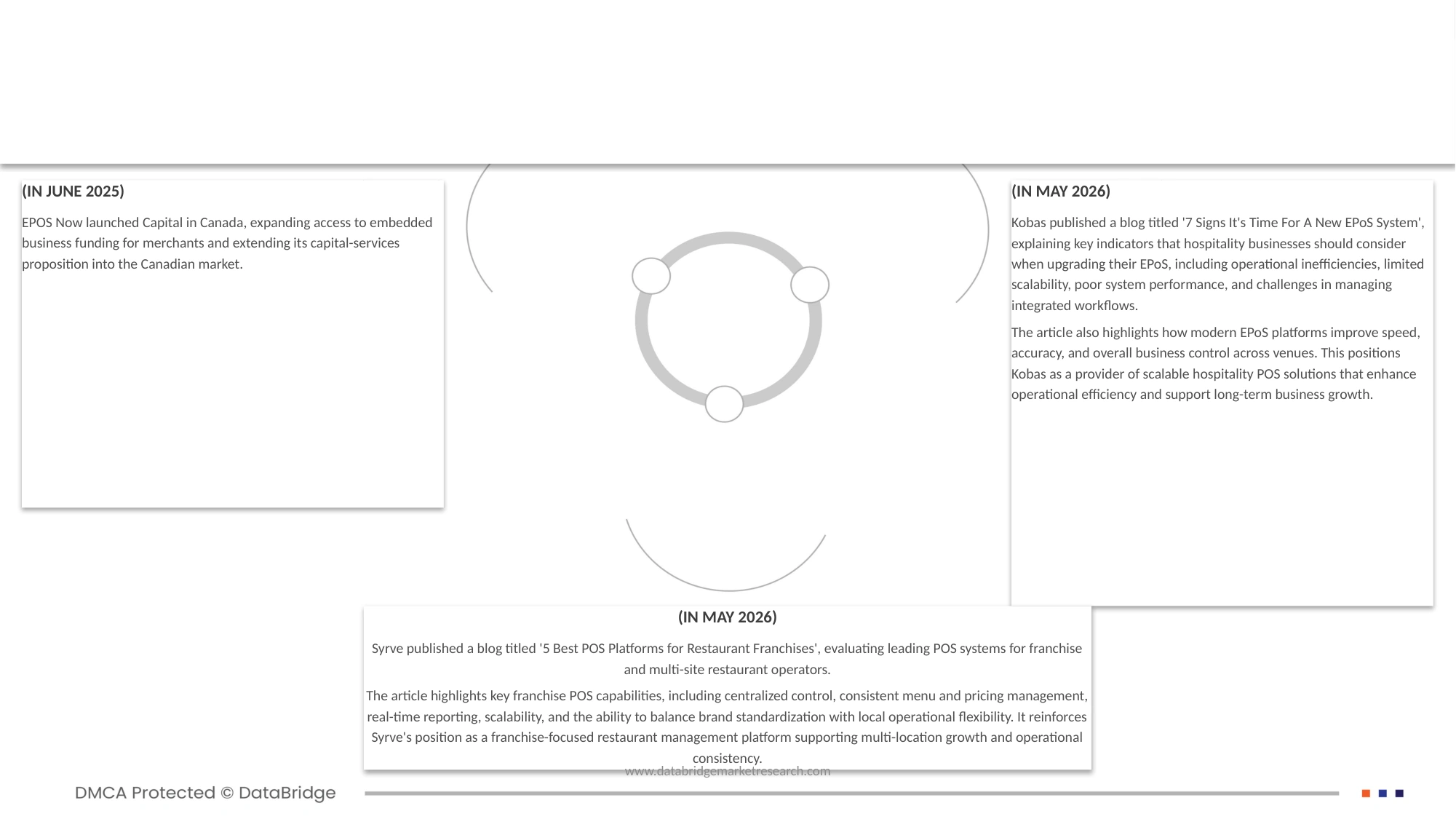
- In June 2025, EPOS Now launched Capital in Canada, expanding access to embedded business funding for merchants and extending its capital-services proposition into the Canadian market.
- In May 2026, Kobas published a blog titled “7 Signs It’s Time For A New EPoS System”, explaining key indicators that hospitality businesses should consider when upgrading their EPoS, such as inefficiencies in operations, lack of scalability, poor system performance, and difficulty managing integrated workflows. The article also highlights how modern EPoS platforms can improve speed, accuracy, and overall business control across venues. This helps Kobas position its EPoS solution as a modern, scalable system that reduces operational friction, improves efficiency, and supports long-term growth for hospitality businesses.
- In May 2026, Syrve published a blog titled “5 Best POS Platforms for Restaurant Franchises”, where it evaluates leading POS systems for franchise and multi-site restaurant operators. The article explains the key requirements for franchise POS solutions, including centralized control, consistent menu and pricing management, real-time reporting, scalability, and the ability to balance brand standardization with local operational flexibility. This positions Syrve as a strong franchise-focused restaurant management platform, reinforcing its capability to support multi-location growth, operational consistency, and improved performance visibility across restaurant networks.
- In June 2026, The Access Group was recognized in the UK Learning Power 100 for its excellence in learning and development, highlighting the company's commitment to employee growth, skills development, and fostering a strong learning culture across the organization. The recognition reflects Access Group’s investment in professional development initiatives that support both employee success and business performance. This achievement strengthens the company's employer brand, helps attract and retain top talent, and reinforces its ability to drive innovation and deliver high-quality solutions to customers.
- In April 2026, Sealed Air Corporation announced the completion of its previously announced acquisition by funds affiliated with CD&R. Sealed Air is now a privately held company, and its shares have ceased trading on the New York Stock Exchange.
As per Data Bridge Market Research analysis:
For more detailed information about theU.K. restaurant market report, click here – https://www.databridgemarketresearch.com/reports/uk-restaurant-pos-market