


Global Autoimmune Biosimilar Drug Market Segmentation, Par classe de médicaments (anticorps monocloniens, protéines recombinantes, peptides et autres molécules biosimilaires), Maladie (arthrite rhumatoïde, psoriasis, maladie inflammatoire du Bowel, spondylarthrite ankylosante et autres affections auto-immunes), Canal de distribution ( Pharmacies hospitalières, Pharmacies de détail et Pharmacies en ligne), Utilisateur final (Hôpitaux et cliniques, Pharmacies spécialisées, Soins à domicile et autres Utilisateurs finaux)- Tendances et prévisions de l'industrie jusqu'en 2033
Quelle est la taille et le taux de croissance du marché des médicaments biosimilaires auto-immuns
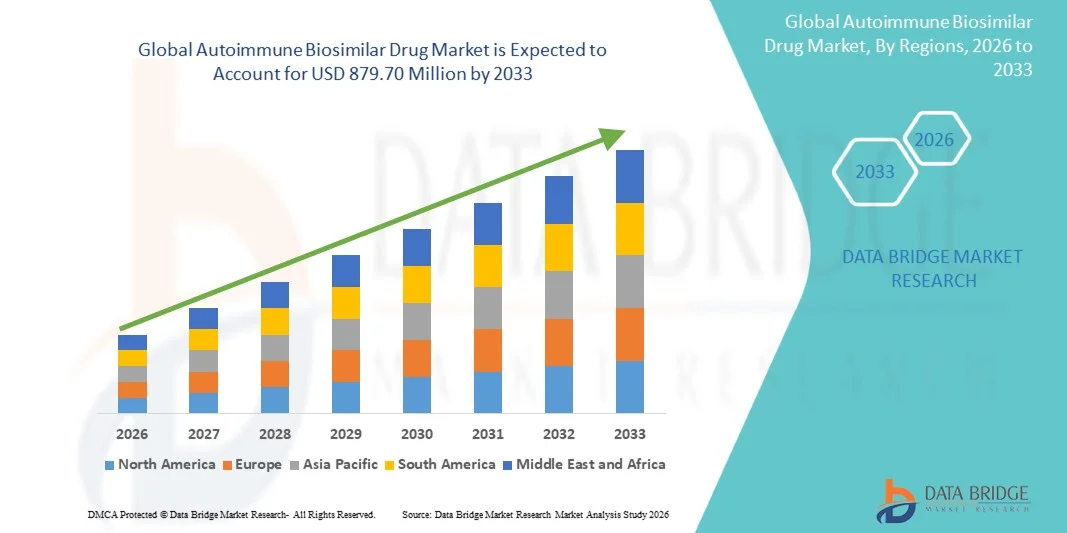
- Selon l'analyse de marché de Data Bridge, la taille du marché mondial des médicaments biosimilaires auto-immuns a été évaluée à415,80 millions de dollars en 2025et devrait atteindre879,70 millions de dollars en 2033, à unTCAC de 9,80%pendant la période de prévision
- La croissance du marché est largement alimentée par la demande croissante de solutions de rechange rentables aux thérapies biologiques d'origine utilisées dans le traitement des maladies auto-immunes, ainsi que par l'élargissement des approbations réglementaires et l'acceptation clinique des biosimilaires dans les principaux systèmes de soins de santé.
- En outre, l'augmentation de la prévalence des troubles auto-immuns dans le monde, associée à la confiance croissante des médecins, à l'amélioration de l'accès des patients et à l'adoption de politiques gouvernementales favorables à l'adoption de produits biosimilaires, accélère l'adoption de médicaments biosimilaires auto-immuns et stimule considérablement la croissance globale du marché.
Taille du marché et prévisions
Valeur marchande mondiale (2025):415,80 millions de dollars
Valeur marchande prévue (2033) :879,70 millions de dollars
Prévisions CAGR (2026-2033):9.80%
Quels sont les principaux débouchés du marché des médicaments biosimilaires auto-immuns
- Les médicaments biosimilaires auto-immuns, mis au point comme solutions de rechange rentables aux produits biologiques de référence pour le traitement des troubles auto-immuns chroniques, sont des composantes de plus en plus vitales des protocoles modernes de traitement immunologique dans les hôpitaux et les cliniques spécialisées en raison de leur efficacité, de leur sécurité et de leur accessibilité accrue.
- La demande croissante de biosimilaires auto-immuns est principalement alimentée par l'augmentation de la prévalence mondiale des maladies auto-immunes, le coût élevé des produits biologiques d'origine et les politiques réglementaires d'appui visant à élargir l'accès aux thérapies biologiques abordables.
- L'Amérique du Nord a dominé le marché des médicaments biosimilaires auto-immuns avec la plus grande part des revenus de 43,7 % en 2025, sous l'effet d'une forte utilisation des produits biologiques, de l'augmentation des approbations de la FDA pour les biosimilaires, de l'acceptation favorable des payeurs et de l'adoption généralisée aux États-Unis, en particulier pour les traitements contre la polyarthrite rhumatoïde, le psoriasis et les maladies inflammatoires de l'intestin.
- On s'attend à ce que l'Asie-Pacifique soit la région qui connaît la croissance la plus rapide au cours de la période de prévision, avec l'appui de vastes bassins de patients, l'amélioration de l'infrastructure des soins de santé, l'accroissement de la confiance des médecins dans les biosimilaires et l'expansion de la fabrication nationale de biosimilaires dans des pays comme la Chine, l'Inde et la Corée du Sud.
- Le segment des anticorps monoclonaux a dominé le marché des médicaments biosimilaires auto-immuns avec une part de 49,2 % en 2025, en raison de leur utilisation clinique étendue dans les principales indications auto-immunes et de l'expiration du brevet de plusieurs thérapies biologiques à revenu élevé.
Portée du rapport et segmentation du marché biosimilaire auto-immun
|
Attributs |
Médicaments biosimilaires auto-immuns Principales perspectives du marché |
|
Segments couverts |
|
|
Pays couverts |
Amérique du Nord
Europe
Asie-Pacifique
Moyen-Orient et Afrique
Amérique du Sud
|
|
Principaux acteurs du marché |
|
|
Possibilités de marché |
|
|
Infos sur la valeur ajoutée |
En plus des renseignements sur les scénarios du marché comme la valeur du marché, le taux de croissance, la segmentation, la couverture géographique et les principaux intervenants, les rapports de marché établis par Data Bridge Market Research comprennent également une analyse approfondie des experts, l'épidémiologie des patients, l'analyse des pipelines, l'analyse des prix et le cadre réglementaire. |
Quelle est la tendance clé du marché des médicaments biosimilaires auto-immuns
L'adoption accélérée par le soutien réglementaire et l'optimisation des coûts
- Une tendance significative et accélérée sur le marché mondial des médicaments biosimilaires auto-immuns est l'acceptation croissante de la réglementation et le soutien des politiques pour les biosimilaires, en particulier dans les systèmes de soins de santé sensibles aux coûts visant à réduire les dépenses à long terme pour les thérapies biologiques.
- Par exemple, les organismes de réglementation des États-Unis et de l'Europe ont simplifié les voies d'approbation et élargi les directives sur l'interchangeabilité biosimilaire, ce qui permet d'accélérer l'entrée sur le marché et d'élargir la confiance des médecins dans la prescription de biosimilaires auto-immunes.
- L'adhésion croissante des payeurs et des assureurs aux biosimilaires renforce encore cette tendance, car les cadres de remboursement privilégient de plus en plus les solutions de rechange biosimilaires à moindre coût plutôt que les produits biologiques d'origine pour la gestion des maladies auto-immunes chroniques
- L'expansion de la base de données cliniques démontrant l'efficacité, l'innocuité et l'immunogénicité comparables aux produits de référence encourage l'adoption d'une plus large gamme d'hôpitaux et de cliniques spécialisées traitant de la polyarthrite rhumatoïde, du psoriasis et des maladies inflammatoires de l'intestin
- Cette tendance à la normalisation des biosimilaires dans les soins auto-immuns de routine consiste à remodeler les paradigmes de traitement, ce qui incite les entreprises pharmaceutiques à investir fortement dans la gestion du cycle de vie, l'élargissement des indications et les programmes de surveillance post-commercialisation
- En conséquence, la demande de biosimilaires auto-immuns augmente régulièrement sur les marchés développés et émergents, les plaçant comme une pierre angulaire des stratégies de traitement immunologique durable.
- Le rôle croissant des données factuelles et des études de résultats à long terme renforce la confiance des médecins et favorise une substitution thérapeutique plus large par des biosimilaires auto-immuns
Dynamique du marché des médicaments biosimilaire auto-immune
Chauffeur
L'augmentation du coût des thérapies biologiques et l'expansion du bassin de patients auto-immuns
- La charge économique croissante associée à la thérapie biologique à long terme pour les maladies auto-immunes, associée à la prévalence mondiale croissante de maladies telles que la polyarthrite rhumatoïde et les maladies inflammatoires de l'intestin, est l'un des principaux moteurs de la croissance du marché biosimilaire auto-immune.
- Par exemple, les systèmes de santé en Amérique du Nord et en Europe encouragent de plus en plus les prescriptions biosimilaires à contrôler l'augmentation des dépenses en produits biologiques tout en maintenant la continuité du traitement pour les patients chroniques.
- Comme la connaissance de l'équivalence clinique biosimilaire augmente chez les médecins et les patients, la confiance dans le passage des produits biologiques d'origine aux biosimilaires s'améliore, ce qui favorise des taux d'adoption plus élevés.
- De plus, des politiques favorables de remboursement et des inclusions de formules accélèrent l'adoption de biosimilaires dans les réseaux hospitaliers et les pharmacies spécialisées.
- La nécessité d'élargir l'accès des patients à des traitements auto-immuns avancés dans des milieux où les ressources sont limitées renforce encore la demande d'options biosimilaires rentables
- Ensemble, ces facteurs stimulent la croissance soutenue du marché des médicaments biosimilaires auto-immuns dans les secteurs public et privé
- L'élargissement de l'expiration des brevets biologiques dans les indications auto-immunes crée des possibilités continues de lancement de nouveaux biosimilaires et d'entrée sur le marché
- La pression croissante exercée sur les budgets des soins de santé par les populations vieillissantes renforce encore le passage aux biosimilaires en tant que stratégie de réduction des coûts à long terme
Restriction/Défi
Obstacles de perception de l'hésitation et de l'interchangeabilité
- Les préoccupations persistantes concernant l'interchangeabilité, l'immunogénicité et les résultats à long terme dans le monde réel demeurent un défi clé limitant l'adoption plus rapide de biosimilaires auto-immuns sur certains marchés
- Par exemple, certains cliniciens continuent de faire preuve de prudence lorsqu'ils passent des produits biologiques d'origine à des produits biosimilaires, en particulier dans les cas complexes ou graves d'auto-immunisation.
- La variabilité des réglementations en matière d'interchangeabilité entre les régions complique encore les décisions de prescription et limite la substitution automatique dans plusieurs pays
- En outre, les exigences étendues en matière de formation des patients et de pharmacovigilance augmentent la complexité de la commercialisation et les coûts de post-lancement pour les fabricants de produits biosimilaires
- La pénétration du marché peut également être limitée par des stratégies de tarification agressives et des pratiques contractuelles utilisées par les fabricants biologiques d'origine pour conserver des parts de marché.
- Surmonter ces défis grâce à l'élargissement de la production de données cliniques, à des initiatives de formation des médecins et à des cadres réglementaires harmonisés sera essentiel pour une croissance durable du marché des médicaments biosimilaires auto-immuns
- Une connaissance biosimilaire limitée des patients dans certaines régions continue de ralentir l'acceptation et retarde les décisions de changement de traitement
- Les exigences de fabrication complexes et les coûts de développement initiaux élevés constituent des obstacles à l'entrée pour les petits joueurs qui cherchent à être compétitifs dans le paysage biosimilaire auto-immun
Comment le marché des médicaments biosimilaires auto-immuns est-il segmenté
Le marché est segmenté en fonction de la classe de médicaments, de la maladie, du canal de distribution et de l'utilisateur final.
- Par catégorie de drogues
Sur la base de la classe de médicaments, le marché mondial des médicaments biosimilaires auto-immuns est segmenté en anticorps monoclonaux, protéines recombinantes, peptides et autres molécules biosimilaires. Le segment des anticorps monoclonaux a dominé le marché avec la plus grande part des revenus de 49,2% en 2025, en raison de leur utilisation intensive dans le traitement des principales maladies auto-immunes telles que la polyarthrite rhumatoïde, le psoriasis et les maladies inflammatoires de l'intestin. Ces biosimilaires reproduisent étroitement les produits biologiques à revenu élevé dont les brevets ont expiré, ce qui permet une absorption rapide du marché. Des preuves cliniques solides appuyant une efficacité et une sécurité comparables ont encore accru la confiance du médecin dans les biosimilaires d'anticorps monoclonaux. De plus, des politiques de remboursement favorables et des volumes de prescription plus élevés dans les hôpitaux ont renforcé leur position dominante. Le potentiel d'économie élevé par rapport aux produits biologiques d'origine continue d'accélérer l'adoption dans les systèmes de santé développés.
On s'attend à ce que le segment des protéines recombinantes enregistre la croissance la plus rapide au cours de la période de prévision, appuyée par l'expansion des pipelines de recherche et l'augmentation des approbations pour les indications auto-immunes. Les progrès de l'ingénierie des protéines et des technologies de fabrication améliorent l'efficacité des rendements et réduisent les coûts de production. La demande croissante de thérapies auto-immunes à long terme abordables encourage l'utilisation clinique plus large de biosimilaires aux protéines recombinantes. Les marchés émergents contribuent également à la croissance grâce à l'amélioration de l'accès et des capacités de fabrication locales. L'augmentation de la familiarité avec les médecins et l'augmentation des indications appuient davantage l'expansion rapide du segment.
- Par maladie
Sur la base de la maladie, le marché est segmenté en polyarthrite rhumatoïde, psoriasis, maladie inflammatoire de l'intestin, spondylarthrite ankylosante, et d'autres conditions auto-immunes. Le segment de la polyarthrite rhumatoïde a dominé le marché en 2025, en raison de la forte prévalence mondiale de la maladie et de la dépendance à long terme aux thérapies biologiques. Les patients atteints de polyarthrite rhumatoïde nécessitent souvent un traitement continu, ce qui rend les biosimilaires rentables une option attrayante pour les systèmes de santé. La disponibilité de plusieurs biosimilaires approuvés ciblant les inhibiteurs du TNF a considérablement augmenté la concurrence et l'adoption. Des lignes directrices cliniques solides soutenant l'utilisation biosimilaire de la polyarthrite rhumatoïde renforcent encore la domination du marché. De plus, les volumes élevés de traitements dans les hôpitaux et les cliniques spécialisées contribuent à la production soutenue de revenus.
Le segment des maladies inflammatoires de l'intestin devrait croître au rythme le plus rapide au cours de la période de prévision, en raison de la hausse des taux d'incidence de la maladie de Crohn et de la colite ulcéreuse dans le monde. L'augmentation des taux de diagnostic et l'amélioration de l'accès aux thérapies biologiques élargissent le bassin de patients. Les biosimilaires offrent une solution viable pour réduire le coût élevé associé à la gestion à long terme des DCI. La confiance croissante des médecins dans le passage de patients stables à des biosimilaires favorise également l'adoption rapide. On s'attend à ce que l'élargissement de la couverture des remboursements et des données factuelles accélère encore la croissance.
- Par canal de distribution
Sur la base du canal de distribution, le marché est segmenté en pharmacies hospitalières, pharmacies de détail et pharmacies en ligne. Le segment des pharmacies hospitalières a dominé le marché en 2025, en raison du fait que la plupart des biosimilaires auto-immuns sont administrés sous surveillance clinique. Les hôpitaux jouent un rôle central dans l'instauration de thérapies biologiques et biosimilaires, en particulier pour les affections auto-immunes modérées à sévères. Un contrôle rigoureux des formules et des accords d'achat en vrac favorisent l'adoption biosimilaire dans les systèmes hospitaliers. De plus, les décisions de traitement et l'administration par perfusion prises par le médecin favorisent une augmentation des ventes dans les pharmacies hospitalières. La concentration des services de soins spécialisés renforce encore la domination de ce segment.
Le segment des pharmacies en ligne devrait enregistrer la croissance la plus rapide au cours de la période de prévision, grâce à la numérisation croissante des services de santé. L'acceptation croissante des médicaments électroniques, en particulier pour les biosimilaires sous-cutanés et auto-administrés, améliore l'accès des patients. La commodité, la livraison à domicile et les prix concurrentiels sont des facteurs clés de l'adoption. L'expansion des services de télémédecine et des ordonnances électroniques favorise encore la croissance. Les améliorations réglementaires à l'appui de la distribution pharmaceutique en ligne contribuent également à l'expansion du segment.
- Par Utilisateur final
Sur la base de l'utilisateur final, le marché est segmenté en hôpitaux et cliniques, pharmacies spécialisées, soins à domicile et autres utilisateurs finaux. Le segment des hôpitaux et des cliniques a dominé le marché en 2025 en raison de la forte dépendance des établissements pour le diagnostic auto-immun des maladies et l'initiation du traitement. La plupart des biosimilaires sont prescrits et administrés sous surveillance spécialisée, en particulier au début du traitement. Les hôpitaux bénéficient de protocoles de traitement structurés et de systèmes de remboursement qui encouragent l'utilisation biosimilaire. La disponibilité d'installations de perfusion et d'équipes de soins multidisciplinaires soutient davantage la domination. Les traitements à long terme et le pas élevé des patients contribuent à une demande soutenue.
Le secteur des soins à domicile devrait croître au rythme le plus rapide au cours de la période de prévision, en raison de la préférence croissante pour l'auto-administration et les soins à domicile. Les progrès réalisés dans les systèmes d'administration de médicaments ont facilité l'administration de biosimilaires en dehors des milieux cliniques. Les patients ayant des conditions auto-immunes stables préfèrent de plus en plus le traitement à domicile pour leur commodité et la réduction des visites à l'hôpital. Les économies réalisées tant pour les patients que pour les systèmes de santé accélèrent encore l'adoption. La croissance des services de soutien et la surveillance à distance des patients devraient renforcer cette trajectoire de croissance
Quelle région détient la plus grande part du marché des médicaments biosimilaires auto-immuns
- L'Amérique du Nord a dominé le marché des médicaments biosimilaires auto-immuns avec la plus grande part des revenus de 43,7 % en 2025, sous l'effet d'une forte utilisation des produits biologiques, de l'augmentation des approbations de la FDA pour les biosimilaires, de l'acceptation favorable des payeurs et de l'adoption généralisée aux États-Unis, en particulier pour les traitements contre la polyarthrite rhumatoïde, le psoriasis et les maladies inflammatoires de l'intestin.
- Les fournisseurs de soins de santé et les payeurs de la région mettent fortement l'accent sur des solutions de traitement rentables, avec des biosimilaires auto-immuns offrant une efficacité et une sécurité comparables, tout en réduisant considérablement les dépenses de thérapie à long terme
- Cette adoption généralisée est appuyée par une infrastructure de soins de santé bien établie, une confiance croissante des médecins dans l'interchangeabilité biosimilaire, des cadres de remboursement favorables et la prévalence croissante des maladies auto-immunes chroniques aux États-Unis et au Canada.
Aperçu du marché des médicaments biosimilaires auto-immuns aux États-Unis
Le marché américain des médicaments biosimilaires auto-immuns a enregistré la plus grande part de revenus en Amérique du Nord en 2025, en raison de l'utilisation élevée de thérapies biologiques et de l'augmentation des approbations de la FDA pour les biosimilaires auto-immuns. Les payeurs et les fournisseurs de soins de santé privilégient de plus en plus le confinement des coûts, encourageant l'adoption de biosimilaires comme solutions de rechange aux produits biologiques d'origine à coût élevé. La confiance croissante des médecins dans l'efficacité et l'innocuité des produits biosimilaires, appuyée par de solides données cliniques, accélère encore la pénétration du marché. De plus, l'augmentation des désignations d'interchangeabilité et des politiques de remboursement favorables contribuent de façon significative à la croissance du marché dans les milieux hospitaliers et spécialisés.
Europe Autoimmune Biosimilar Drug Market Insight
Le marché européen des médicaments biosimilaires auto-immuns devrait s'étendre à un TCAC solide au cours de la période de prévision, principalement en raison de cadres réglementaires bien établis et de politiques gouvernementales proactives favorisant l'utilisation des biosimilaires. Les mesures de réduction des coûts dans l'ensemble des systèmes de santé publics favorisent l'adoption généralisée de biosimilaires dans le traitement des maladies auto-immunes. Les pays européens acceptent fortement la substitution biosimilaire, en particulier dans les établissements hospitaliers. La région continue d'être fortement absorbée par la polyarthrite rhumatoïde, les maladies inflammatoires de l'intestin et les thérapies psoriasis, appuyées par des structures de remboursement matures.
Aperçu du marché des médicaments biosimilaires auto-immuns au Royaume-Uni
On s'attend à ce que le marché des médicaments biosimilaires auto-immuns du Royaume-Uni augmente au cours de la période de prévision, avec l'appui du Service national de la santé, en mettant fortement l'accent sur l'adoption de produits biosimilaires pour réduire les dépenses en produits biologiques. Les programmes de commutation structurés et les initiatives dirigées par un médecin accélèrent l'adoption de la biosimilaire dans les indications auto-immunes. L'augmentation de la prévalence des maladies auto-immunes chroniques et l'adoption de lignes directrices cliniques solides favorisent la demande. Le système centralisé d'approvisionnement en soins de santé du Royaume-Uni permet également une pénétration biosimilaire rapide et à grande échelle.
Allemagne Autoimmune Biosimilar Drug Insight
Le marché allemand des médicaments biosimilaires auto-immuns devrait s'étendre à un TCAC considérable, alimenté par une acceptation réglementaire précoce et une forte confiance des médecins dans les biosimilaires. L'Allemagne a été un pionnier dans l'adoption biosimilaire, soutenue par des politiques tarifaires favorables et des systèmes de tarification de référence. Une forte sensibilisation des professionnels de la santé et des patients encourage le changement des produits biologiques d'origine. L'infrastructure de soins de santé avancée du pays et de fortes habitudes de prescription en milieu hospitalier continuent de soutenir une croissance soutenue du marché.
Aperçu du marché des médicaments biosimilaires en Asie-Pacifique
On s'attend à ce que le marché des médicaments biosimilaires auto-immuns d'Asie-Pacifique augmente au rythme le plus rapide au cours de la période de prévision, sous l'impulsion d'une population de patients en croissance rapide et d'un accès accru aux thérapies biologiques. L'amélioration des infrastructures de soins de santé et la sensibilisation accrue aux biosimilaires favorisent l'adoption dans les économies émergentes. Les gouvernements de la région font la promotion d'une utilisation biosimilaire pour résoudre les problèmes d'accessibilité liés au traitement des maladies auto-immunes. En outre, la présence de fabricants de biosimilaires nationaux puissants améliore la disponibilité de l'offre et la compétitivité des coûts.
Aperçu du marché des médicaments biosimilaires auto-immuns au Japon
Le marché japonais des médicaments biosimilaires auto-immuns prend de l'ampleur en raison de l'augmentation des dépenses de santé et du soutien réglementaire accru aux biosimilaires. La population vieillissante du pays contribue à une prévalence plus élevée des troubles auto-immuns, ce qui stimule la demande d'options de traitement à long terme et rentables. Le fait que les médecins connaissent mieux la prescription biosimilaire améliore l'acceptation dans tous les milieux hospitaliers. L'accent mis par le Japon sur la qualité, la sécurité et la surveillance post-commercialisation favorise une expansion régulière du marché.
Inde Autoimmune Biosimilar Drug Market Insight
Le marché indien des médicaments biosimilaires auto-immuns a représenté la plus grande part des revenus en Asie-Pacifique en 2025, appuyé par une solide base de fabrication biosimilaire nationale et une forte demande de thérapies abordables. L'augmentation de la prévalence des maladies auto-immunes et l'amélioration des capacités diagnostiques augmentent le bassin de patients. Les initiatives gouvernementales visant à améliorer l'accès aux produits biologiques et aux biosimilaires accélèrent la croissance du marché. Les prix compétitifs, la sensibilisation accrue aux soins de santé et l'adoption croissante dans les hôpitaux publics et privés continuent de faire de l'Inde un marché clé de la croissance.
Quelles sont les principales entreprises du marché des médicaments biosimilaires auto-immuns
L'industrie des médicaments biosimilaires auto-immuns est principalement dirigée par des entreprises bien établies, notamment :
- La société Merck & Co., Inc.(États-Unis)
- Pfizer Inc. (États-Unis)
- La société Amgen Inc. (États-Unis)
- Groupe Sandoz AG(Suisse)
- Novartis AG (Suisse)
- Samsung Bioepis(Corée du Sud)
- Celltrion, Inc. (Corée du Sud)
- Biocon Biologics Limited (Inde)
- Alvotech (Islande)
- Fresenius Kabi AG (Allemagne)
- Boehringer Ingelheim International GmbH (Allemagne)
- Zydus Lifesciences Limited (Inde)
- Sun Pharmaceutical Industries Ltd. (Inde)
- Cipla Limited (Inde)
- Torrent Pharmaceuticals Ltd. (Inde)
- Reliance Life Sciences Pvt. Ltd. (Inde)
- Innovent Biologics, Inc. (Chine)
- Bio-Thera Solutions, Ltd. (Chine)
- Zhejiang Hisun Pharmaceutical Co., Ltd. (Chine)
- LG Chem, Ltd. (Corée du Sud)
Quelles sont les évolutions récentes du marché mondial des médicaments biosimilaires auto-immuns
- En novembre 2025, la Commission européenne a approuvé la formulation liquide RemsimaTM IV, la première version liquide prête à l'emploi d'un biosimilaire infliximab, conçue pour simplifier la préparation et réduire la charge de travail hospitalière dans le traitement des affections auto-immunes telles que la polyarthrite rhumatoïde et la maladie de Crohn
- En septembre 2025, la FDA américaine a approuvé l'adalimumab-atto (Amjevita), un biosimilaire à Humira, pour de multiples indications auto-immunes, y compris la polyarthrite rhumatoïde, la maladie de Crohn, et le psoriasis, élargissant les options de traitement abordables sur le marché américain.
- En janvier 2025, SteQeyma, un biosimilaire de l'ustekinumab, a été lancé dans cinq grands pays européens (France, Italie, Espagne, Royaume-Uni, Allemagne) pour le traitement des maladies inflammatoires chroniques auto-immunes, marquant un déploiement régional important
- En octobre 2024, la FDA des États-Unis a approuvé Imuldosa (ustekinumab-srlf), la cinquième référence biosimilaire Stelara, pour le traitement des maladies auto-immunes telles que le psoriasis en plaques, le rhumatisme psoriasique et la maladie inflammatoire de l'intestin, signalant une expansion biosimilaire continue sur le marché américain.
- En mars 2024, la FDA américaine a approuvé tocilizumab-aazg (Tyenne), un biosimilaire d'Actemra, pour diverses affections auto-immunes et inflammatoires avec des formulations intraveineuses et sous-cutanées la première avec des options d'administration double améliorant la flexibilité du traitement
SKU-
Accédez en ligne au rapport sur le premier cloud mondial de veille économique
- Tableau de bord d'analyse de données interactif
- Tableau de bord d'analyse d'entreprise pour les opportunités à fort potentiel de croissance
- Accès d'analyste de recherche pour la personnalisation et les requêtes
- Analyse de la concurrence avec tableau de bord interactif
- Dernières actualités, mises à jour et analyse des tendances
- Exploitez la puissance de l'analyse comparative pour un suivi complet de la concurrence
Méthodologie de recherche
La collecte de données et l'analyse de l'année de base sont effectuées à l'aide de modules de collecte de données avec des échantillons de grande taille. L'étape consiste à obtenir des informations sur le marché ou des données connexes via diverses sources et stratégies. Elle comprend l'examen et la planification à l'avance de toutes les données acquises dans le passé. Elle englobe également l'examen des incohérences d'informations observées dans différentes sources d'informations. Les données de marché sont analysées et estimées à l'aide de modèles statistiques et cohérents de marché. De plus, l'analyse des parts de marché et l'analyse des tendances clés sont les principaux facteurs de succès du rapport de marché. Pour en savoir plus, veuillez demander un appel d'analyste ou déposer votre demande.
La méthodologie de recherche clé utilisée par l'équipe de recherche DBMR est la triangulation des données qui implique l'exploration de données, l'analyse de l'impact des variables de données sur le marché et la validation primaire (expert du secteur). Les modèles de données incluent la grille de positionnement des fournisseurs, l'analyse de la chronologie du marché, l'aperçu et le guide du marché, la grille de positionnement des entreprises, l'analyse des brevets, l'analyse des prix, l'analyse des parts de marché des entreprises, les normes de mesure, l'analyse globale par rapport à l'analyse régionale et des parts des fournisseurs. Pour en savoir plus sur la méthodologie de recherche, envoyez une demande pour parler à nos experts du secteur.
Personnalisation disponible
Data Bridge Market Research est un leader de la recherche formative avancée. Nous sommes fiers de fournir à nos clients existants et nouveaux des données et des analyses qui correspondent à leurs objectifs. Le rapport peut être personnalisé pour inclure une analyse des tendances des prix des marques cibles, une compréhension du marché pour d'autres pays (demandez la liste des pays), des données sur les résultats des essais cliniques, une revue de la littérature, une analyse du marché des produits remis à neuf et de la base de produits. L'analyse du marché des concurrents cibles peut être analysée à partir d'une analyse basée sur la technologie jusqu'à des stratégies de portefeuille de marché. Nous pouvons ajouter autant de concurrents que vous le souhaitez, dans le format et le style de données que vous recherchez. Notre équipe d'analystes peut également vous fournir des données sous forme de fichiers Excel bruts, de tableaux croisés dynamiques (Fact book) ou peut vous aider à créer des présentations à partir des ensembles de données disponibles dans le rapport.











