The global artificial intelligence (AI) in drug discovery market represents a paradigm shift in pharmaceutical research and development. In recent years, the pharmaceutical industry has witnessed significant growth in data digitalization. The escalating prevalence of chronic diseases, particularly cardiovascular disorders and diabetes, has heightened the demand for artificial intelligence (AI) in drug discovery. This trend is anticipated to swiftly propel the global AI drug discovery market, addressing the pressing need for innovative solutions in pharmaceutical research and development.
Access Full Report @ https://www.databridgemarketresearch.com/reports/global-artificial-intelligence-ai-in-drug-discovery-market
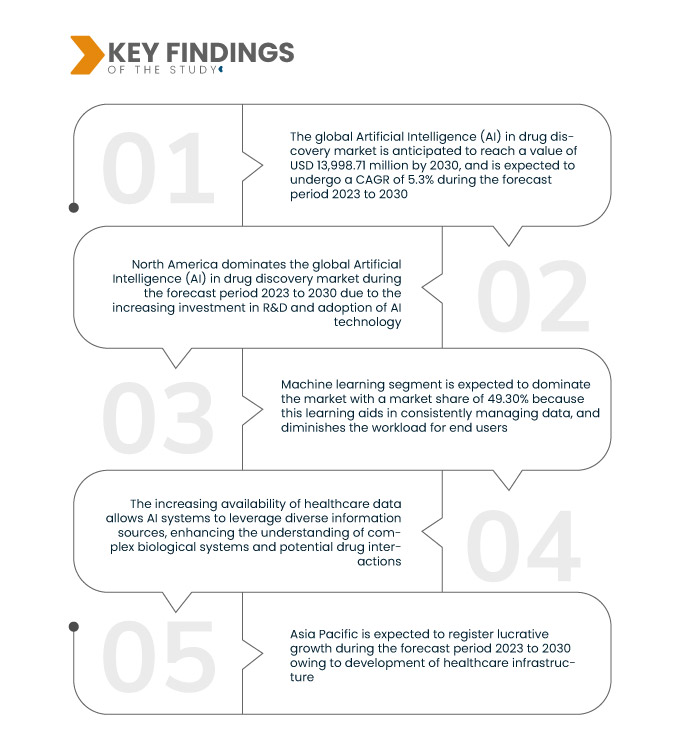
Data Bridge Market Research analyses that the Global Artificial Intelligence (AI) in Drug Discovery Market which was USD 885.32 million in 2022, is expected to reach USD 13,998.71 million by 2030, and is expected to undergo a CAGR of 5.3% during the forecast period 2023 to 2030. The use of artificial intelligence increases due to diverse sectors of the pharmaceutical industry, such as drug discovery and development, improving pharmaceutical productivity, drug repurposing, and clinical trials among others.
Key Findings of the Study
An increase in the incidence of chronic diseases is expected to drive the market's growth rate
The escalating incidence of chronic diseases globally, as evidenced by CDC reports stating that six in ten U.S. adults suffer from chronic conditions, drives the demand for innovative solutions. Chronic diseases such as diabetes and heart disease are leading causes of mortality. Artificial intelligence in drug discovery presents a promising avenue to address these challenges. By leveraging AI platforms, valuable insights can be derived to mitigate the severity and develop treatments for chronic diseases. This growing need for effective solutions positions the AI in drug discovery market for substantial growth in the forecast period.
Report Scope and Market Segmentation
Report Metric
|
Details
|
Forecast Period
|
2023 to 2030
|
Base Year
|
2022
|
Historic Years
|
2021 (Customizable to 2015-2020)
|
Quantitative Units
|
Revenue in USD Million, Volumes in Units, Pricing in USD
|
Segments Covered
|
Application (Novel Drug Candidates, Drug Optimization and Repurposing Preclinical Testing and Approval, Drug Monitoring, Finding New Diseases Associated Targets and Pathways, Understanding Disease Mechanisms, Aggregating and Synthesizing Information, Formation and Qualification of Hypotheses, De Novo Drug Design, Finding Drug Targets of an Old Drug, and Others), Technology (Machine Learning, Deep Learning, Natural Language Processing, and Others), Drug Type (Small Molecule and Large Molecule), Offering (Software and Services), Indication (Immuno-Oncology, Neurodegenerative Diseases, Cardiovascular Diseases, Metabolic Diseases, and Others), End Use (Contract Research Organizations (CROs), Pharmaceutical and Biotechnology Companies, Research Centers and Academic Institutes, and Others)
|
Countries Covered
|
U.S., Canada, Mexico, Germany, France, U.K., Italy, Spain, Russia, Turkey, Belgium, Netherlands, Switzerland, rest of Europe, China, Japan, India, South Korea, Singapore, Thailand, Malaysia, Australia and New Zealand, Philippines, Indonesia, rest of Asia-Pacific, U.A.E, Israel, South Africa, Saudi Arabia, Egypt, rest of Middle East and Africa, Brazil, Argentina and rest of South America
|
Market Players Covered
|
NVIDIA Corporation (U.S.), IBM Corp. (U.S.), Atomwise Inc. (U.S.), Microsoft (U.S.), Benevolent AI (U.K.), Aria Pharmaceuticals, Inc. (U.S.), DEEP GENOMICS (Canada), Exscientia (U.K.), Cloud (U.S.), Insilico Medicine (U.S.), Cyclica (Canada), NuMedii, Inc. (U.S.), Envisagenics (U.S.), Owkin Inc. (U.S.), BERG LLC (U.S.), Schrödinger, Inc. (U.S.), XtalPi Inc. (China) and BIOAGE Inc. (Canada)
|
Data Points Covered in the Report
|
In addition to the insights on market scenarios such as market value, growth rate, segmentation, geographical coverage, and major players, the market reports curated by the Data Bridge Market Research also include depth expert analysis, patient epidemiology, pipeline analysis, pricing analysis, and regulatory framework.
|
Segment Analysis:
The artificial intelligence (AI) in drug discovery market is segmented on the basis of application, technology, offering, indication and end user
- On the basis of application, the market is segmented into novel drug candidates, drug optimisation and repurposing preclinical testing and approval, drug monitoring, finding new diseases associated targets and pathways, understanding disease mechanisms, aggregating and synthesizing information, formation, and qualification of hypotheses, de novo drug design, finding drug targets of an old drug, and others. The novel drug candidates segment is expected to dominate the market with a market share of 26.25%
- on the basis of technology, the market is segmented into machine learning (ml), deep learning (DL), natural language processing (NLP), and others. Machine learning segment is expected to dominate the market with a market share of 49.30% because this learning aids in consistently managing data, decreases the chances of errors, saves time in the drug discovery process, and diminishes the workload for end users
The machine learning segment of the technology segment is anticipated to dominate the artificial intelligence (AI) in the drug discovery market
The machine learning segment is expected to dominate the market with a market share of 49.30% because this learning aids in consistently managing data, decreases the chances of errors, saves time in the drug discovery process, and diminishes the workload for end users. These are some of the major factors which increase the demand of machine learning technology and propel the market growth
- On the basis of drug type, the market is segmented into small molecule and large molecule. The small molecule segment is expected to dominate the market with a market share of 77.66% because it has some different advantages as therapeutics such as most have oral route of administration and can pass easily through cell membranes to reach intracellular targets
- On the basis of offering, the market is segmented into software and services. The software segment is expected to dominate the market with a market share of 65.73% because it provides several advantages such as improved or novel chemistry, better success rates, and quicker and cheaper and quicker discovery processes
The software segment is projected to hold the largest share of the offering segment in the artificial intelligence (AI) in drug discovery market
The software segment is expected to dominate the market with a market share of 65.73% because it provides several advantages such as improved or novel chemistry, better success rates, and quicker and cheaper and quicker discovery processes. This technology can address many constraints and challenges in traditional R&D.
- On the basis of indication, the market is segmented into immuno-oncology, neurodegenerative diseases, cardiovascular diseases, metabolic diseases, and others. Immuno-oncology segment is further segmented into prostate cancer, breast cancer, brain cancer, lung cancer, pancreatic cancer, colorectal cancer, leukemia, and others. The immuno-oncology segment is expected to dominate the market with a market share of 39.10% because artificial intelligence can discover drugs for complex diseases and the prominence of market players in providing artificial intelligence-based platforms for immuno-oncology
- 최종 용도를 기준으로 시장은 제약 및 생명공학 기업, CRO, 연구 센터 및 학술 기관 등으로 세분화됩니다. CRO 부문은 전문성, 효율성, 그리고 인공지능을 활용하여 약물 개발 프로세스를 개선함으로써 43.90%의 시장 점유율을 기록하며 시장을 주도할 것으로 예상됩니다.
주요 플레이어
Data Bridge Market Research는 다음 회사를 약물 발견 분야의 글로벌 인공지능(AI) 시장 주요 기업으로 인식합니다. 약물 발견 분야의 글로벌 인공지능(AI) 기업 Benevolent AI(영국), Aria Pharmaceuticals, Inc.(미국), Microsoft(미국), IBM(미국), NVIDIA Corporation(미국), Schrödinger(미국), Deep Genomics(캐나다), Envisagenics(미국), Cloud Pharmaceuticals(미국)
시장 개발
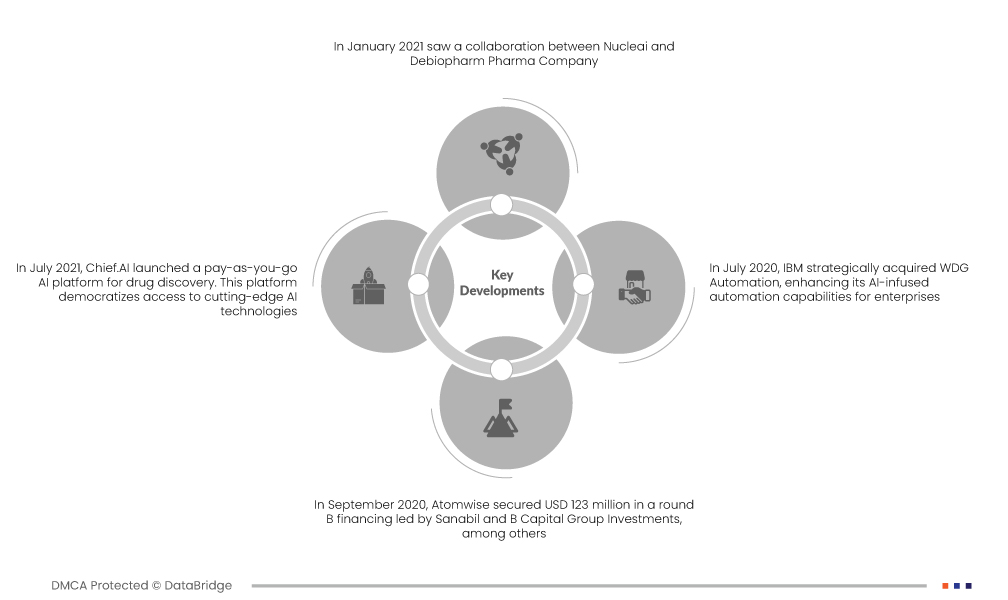
- 2021년 1월, 뉴클레이(Nucleai)와 데바이오팜 파마(Debiopharm Pharma Company)는 협력을 체결했습니다. 이 계약을 통해 데바이오팜 파마는 자사의 항암 신약 후보 물질 개발에 뉴클레이의 AI 플랫폼을 활용할 수 있게 되었으며, 특히 바이오마커 기반 치료 분야에서 신약 개발 프로세스 최적화에 있어 AI의 역할이 점차 커지고 있음을 강조합니다.
- 2021년 7월, Chief.AI는 신약 개발을 위한 종량제(Pay-as-you-go) AI 플랫폼을 출시했습니다. 이 플랫폼은 최첨단 AI 기술에 대한 접근성을 높여 중소기업이 정확하고 빠르게 획기적인 치료법을 발굴할 수 있도록 지원하며, 기존 신약 개발의 성공과 실패라는 난제를 해결합니다.
- 2020년 9월, 아톰와이즈는 사나빌(Sanabil)과 B 캐피털 그룹 인베스트먼트(B Capital Group Investments) 등이 주도한 B 라운드 투자 유치를 통해 1억 2,300만 달러(USD)를 확보했습니다. 이 대규모 투자는 아톰와이즈의 시장 입지를 확대하고, 신약 개발 파이프라인을 구축하며, 제약 회사와의 새로운 파트너십을 구축하는 것을 목표로 하며, 신약 개발 및 개발 과정에서 AI의 중요성을 강조합니다.
- 2020년 7월, IBM은 WDG Automation을 전략적으로 인수하여 기업을 위한 AI 기반 자동화 역량을 강화했습니다. 이를 통해 IBM은 비즈니스 프로세스부터 IT 운영에 이르기까지 포괄적인 AI 솔루션을 제공하는 입지를 더욱 공고히 하고, 이를 통해 전체 포트폴리오를 강화할 수 있게 되었습니다.
지역 분석
지리적으로, 약물 발견 시장 보고서에서 다루는 글로벌 인공지능(AI) 국가는 북미의 미국, 캐나다 및 멕시코, 독일, 프랑스, 영국, 네덜란드, 스위스, 벨기에, 러시아, 이탈리아, 스페인, 터키, 유럽의 기타 유럽, 중국, 일본, 인도, 한국, 싱가포르, 말레이시아, 호주, 태국, 인도네시아, 필리핀, 아시아 태평양(APAC)의 기타 아시아 태평양(APAC), 사우디아라비아, UAE, 남아프리카 공화국, 이집트, 이스라엘, 중동 및 아프리카(MEA)의 일부인 기타 중동 및 아프리카(MEA), 브라질, 아르헨티나, 남미의 일부인 기타 남미입니다.
Data Bridge Market Research 분석에 따르면:
북미는 2023-2030년 예측 기간 동안 약물 발견 시장에서 글로벌 인공지능(AI)을 주도하는 지역입니다.
북미는 의학 연구 개발 분야에서 AI가 널리 도입됨에 따라 신약 개발 분야에서 인공지능(AI) 시장을 주도하고 있습니다. R&D 활동에 대한 막대한 투자는 시장 성장을 더욱 가속화했습니다. 북미 시장을 선도하는 미국은 마이크로소프트, IBM, 구글과 같은 AI 기술 대기업들의 강력한 입지를 바탕으로 중추적인 역할을 수행하고 있습니다. 이러한 주요 기업들의 집중은 미국을 신약 개발 분야의 AI 시장 선도 국가로 자리매김하게 했으며, 지역 AI 시장 확대에 크게 기여하고 있습니다.
아시아 태평양 지역은 2023~2030년 예측 기간 동안 약물 발견 시장에서 글로벌 인공지능(AI)이 가장 빠르게 성장하는 지역으로 추산됩니다.
아시아 태평양 지역은 질병 이해 및 신약 개발을 위한 AI 도입 증가에 힘입어 2023년부터 2030년까지 전 세계 신약 개발 인공지능(AI) 시장을 주도할 것으로 예상됩니다. 특히, Intuition Systems와 Lantern Pharma의 바이오마커 식별 협력 사례는 인도의 역할을 강조합니다. Sigtuple과 Niramai와 같은 기업들은 바이오마커와 단백질을 식별하여 신약 개발 속도를 높이고 의료 서비스 개선에 기여하고 있습니다. 이러한 요소들은 예측 기간 동안 아시아 태평양 지역이 상당한 시장 성장을 이룰 수 있는 토대를 마련해 줍니다.
약물 발견 시장 보고서 에 대한 글로벌 인공지능(AI) 에 대한 자세한 내용은 여기를 클릭하세요. - https://www.databridgemarketresearch.com/reports/global-artificial-intelligence-ai-in-drug-discovery-market