



Global Fermented Chymosin Market Segmentation, By Type (Microbial, Animal-Free, and Recombinant), Product (Liquid Chymosin, Powdered Chymosin, and Granulated Chymosin), Application (Cheese Production, Yogurt Manufacturing, and Milk Coagulation), Technology (Fermentation Technology, Biotechnology, and Genetic Engineering), Component (Enzyme Concentrates, Stabilizers, and Preservatives), End User (Dairy Industry, Food and Beverage Industry, and Biotechnology Firms), Process (Batch Fermentation, Continuous Fermentation, and Fed-Batch Fermentation), Functionality (Coagulation Efficiency, Purity Levels, and Stability), Material Type (Biological Material, Synthetic Material, and Hybrid Material) – Industry Trends and Forecast to 2032
Fermented Chymosin Market Analysis
The fermented chymosin market has been experiencing significant growth, driven by increasing demand for rennet in the food and beverage industry, particularly for cheese production. Traditionally, chymosin was extracted from the stomach lining of calves, but advancements in biotechnology have enabled the fermentation of chymosin using microorganisms such as Aspergillus niger and Kluyveromyces lactis, offering a more sustainable and cost-effective alternative. This process has also helped meet the growing consumer preference for vegetarian-friendly rennet in cheese-making. Recent advancements in fermentation technology have improved the yield, efficiency, and purity of fermented chymosin, making it more commercially viable. In addition, the use of recombinant DNA technology allows for the production of chymosin that is identical to the natural enzyme, enhancing consistency in production and quality of cheese. The market is further supported by the rise of dairy production in emerging economies, where the demand for cheese is expanding rapidly. However, challenges such as price volatility and regulatory hurdles remain. Overall, the fermented chymosin market is poised for continued growth, with biotechnology innovations driving both sustainability and efficiency in enzyme production for the dairy industry.
Fermented Chymosin Market Size
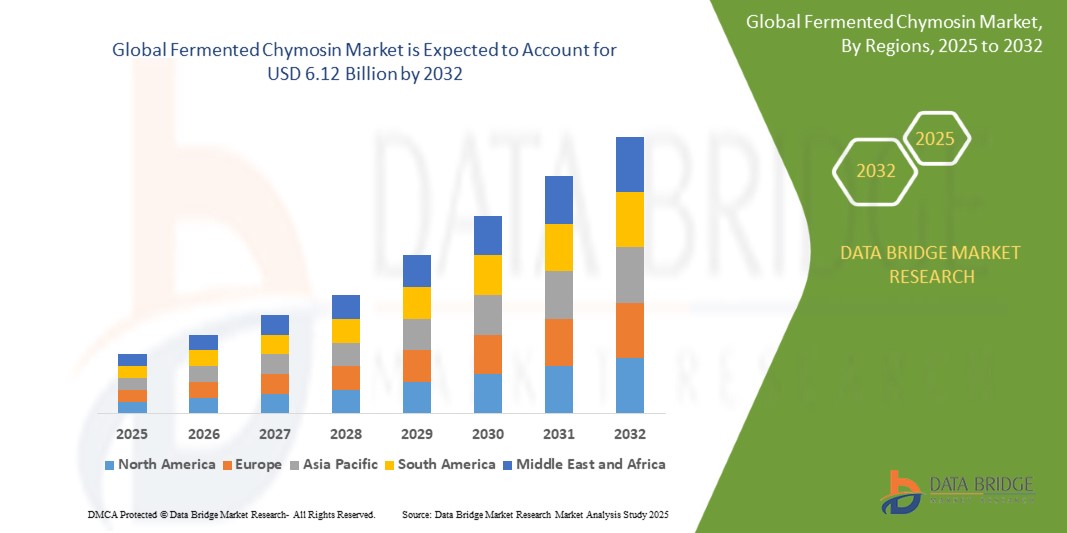
The global fermented chymosin market size was valued at USD 4.27 billion in 2024 and is projected to reach USD 6.12 billion by 2032, with a CAGR of 4.60 % during the forecast period of 2025 to 2032. In addition to the insights on market scenarios such as market value, growth rate, segmentation, geographical coverage, and major players, the market reports curated by the Data Bridge Market Research also include in-depth expert analysis, pricing analysis, brand share analysis, consumer survey, demography analysis, supply chain analysis, value chain analysis, raw material/consumables overview, vendor selection criteria, PESTLE Analysis, Porter Analysis, and regulatory framework.
Fermented Chymosin Market Trends
“Increasing Adoption of Biotechnology-Driven Production Methods”
The fermented chymosin market is witnessing a key trend toward the adoption of biotechnology-driven production methods, particularly the use of recombinant DNA technology to create more sustainable and cost-efficient enzyme solutions for the dairy industry. This method involves fermenting microorganisms such as Aspergillus niger or Kluyveromyces lactis to produce chymosin, a crucial enzyme in cheese-making. By using fermented chymosin instead of animal-derived rennet, producers can meet the growing demand for vegetarian and Halal-certified products. For instance, companies such as Chr. Hansen have led the way with their use of recombinant chymosin in the production of various cheeses, providing consistent quality and reducing environmental impact. The increasing preference for plant-based and sustainable products is driving this shift in the industry, as consumers seek cleaner alternatives. As global cheese consumption rises, particularly in emerging markets, the fermented chymosin market is expected to grow, supported by advancements in fermentation technology that enhance the scalability and efficiency of enzyme production.
Report Scope and Fermented Chymosin Market Segmentation
|
Attributes |
Fermented Chymosin Key Market Insights |
|
Segments Covered |
|
|
Countries Covered |
U.S., Canada and Mexico in North America, Germany, France, U.K., Netherlands, Switzerland, Belgium, Russia, Italy, Spain, Turkey, Rest of Europe in Europe, China, Japan, India, South Korea, Singapore, Malaysia, Australia, Thailand, Indonesia, Philippines, Rest of Asia-Pacific (APAC) in the Asia-Pacific (APAC), Saudi Arabia, U.A.E, South Africa, Egypt, Israel, Rest of Middle East and Africa (MEA) as a part of Middle East and Africa (MEA), Brazil, Argentina and Rest of South America as part of South America |
|
Key Market Players |
Chr. Hansen A/S (Denmark), Mayasan A.S. (Turkey), DSM (Netherlands), Maysa Food (Turkey), Nelson-Jameson, Inc. (U.S.), DuPont (U.S.), Codex-ing Biotech Ingredients (India), Kerry Group plc. (Ireland), Meiji Holdings CO., Ltd. (Japan), Novozymes A/S (Denmark), Biocatalysts (U.K.), Sacco System (Italy), Enzyme Development Corporation (U.S.), AFFCO (New Zealand), Fonterra Co-operative Group Limited (New Zealand), CAGLIFICIO CLERICI (Italy), ENZYBEL GROUP (Belgium), Amicogen, Inc. (South Korea), AB Enzymes (Germany), Advanced Enzyme Technologies (India), Royal Bio (U.S.), and Biocon (India) |
|
Market Opportunities |
|
|
Value Added Data Infosets |
In addition to the insights on market scenarios such as market value, growth rate, segmentation, geographical coverage, and major players, the market reports curated by the Data Bridge Market Research also include in-depth expert analysis, pricing analysis, brand share analysis, consumer survey, demography analysis, supply chain analysis, value chain analysis, raw material/consumables overview, vendor selection criteria, PESTLE Analysis, Porter Analysis, and regulatory framework |
Fermented Chymosin Market Definition
Fermented chymosin is an enzyme used in cheese-making, traditionally derived from the stomach lining of calves. However, through biotechnology advancements, it is now produced by fermenting microorganisms, such as Aspergillus niger or Kluyveromyces lactis, using recombinant DNA technology. This process involves inserting the gene responsible for producing chymosin into the microorganisms, which then ferment and produce the enzyme in large quantities.
Fermented Chymosin Market Dynamics
Drivers
- Rising Demand for Vegetarian and Halal Products
The rising demand for vegetarian and Halal products is a significant driver of growth in the fermented chymosin market. As consumers become more conscious of ethical, religious, and dietary preferences, there is an increasing shift towards plant-based and vegetarian-friendly alternatives. Fermented chymosin, which is produced through biotechnology using microorganisms such as Aspergillus niger or Kluyveromyces lactis, offers a Halal and Kosher-certified solution for cheese-making, addressing the needs of diverse consumer groups. For instance, companies such as Chr. Hansen have developed fermented chymosin that meets the growing demand for non-animal-derived rennet in cheese production, ensuring that cheeses remain accessible to vegetarian and Halal-conscious consumers. The ability to produce high-quality, consistent, and scalable chymosin from fermentation processes has made it an increasingly preferred choice in global markets, where dietary preferences are rapidly evolving. This growing trend for plant-based and ethically sourced products is a major driver of the demand for fermented chymosin, fueling market expansion.
- Rising Demand for Cheese Production
The rising demand for cheese production is a key driver for the growth of the fermented chymosin market. As global cheese consumption continues to increase, particularly in regions such as North America and Europe, the need for efficient and high-quality coagulation agents such as fermented chymosin becomes more crucial. Fermented chymosin is essential in the cheese-making process, enabling the curdling of milk and the formation of cheese. For instance, in countries such as the U.S., where cheese consumption is steadily growing, particularly in the production of popular varieties such as mozzarella and cheddar, the demand for high-purity, consistent chymosin has surged. This increasing demand for cheese, combined with the growing preference for microbial and animal-free chymosin alternatives, further drives the expansion of the fermented chymosin market. In addition, innovations in fermentation technology are improving the efficiency and cost-effectiveness of chymosin production, making it an attractive option for cheese manufacturers worldwide.
Opportunities
- Increasing Technological Advancements in Fermentation
Technological advancements in fermentation are significantly enhancing the efficiency, purity, and yield of fermented chymosin, creating a strong market opportunity. Innovations in biotechnology and genetic engineering have enabled the production of high-purity, cost-effective chymosin through microbial fermentation, improving its sustainability and scalability. For instance, companies such as DSM are utilizing advanced fermentation techniques to produce microbial chymosin with enhanced coagulation efficiency and lower production costs, making it an increasingly attractive option for the dairy industry. These advancements also ensure greater consistency and quality in the final product, which is crucial for large-scale cheese production. As consumer demand grows for more sustainable, animal-free alternatives to traditional rennet, the improved technology behind fermented chymosin positions it as a key player in meeting these needs, boosting its adoption across the global dairy industry. The continuous evolution of fermentation technology presents a significant opportunity for companies to capitalize on the growing demand for eco-friendly, high-performance chymosin products.
- Growth of Plant-Based and Alternative Dairy Products
The growth of plant-based and alternative dairy products is creating a promising market opportunity for fermented chymosin, particularly in the production of non-animal-based cheeses. As consumers increasingly turn to plant-based diets for health, environmental, and ethical reasons, the demand for vegan and dairy-free cheese alternatives has surged. Fermented chymosin, derived through microbial fermentation, offers a viable solution to coagulate plant-based milks, such as almond, soy, and oat, in a similar way to traditional dairy rennet. For instance, companies such as Nutrisure and Impossible Foods are using microbial fermentation to produce animal-free chymosin, enabling the production of high-quality plant-based cheeses. This allows manufacturers to create cheese alternatives that mimic the texture, taste, and functionality of conventional dairy products while maintaining ethical and sustainable production practices. As the plant-based food sector continues to expand, the use of fermented chymosin in non-dairy products is expected to grow, presenting significant opportunities for innovation and market expansion in the alternative dairy industry.
Restraints/Challenges
- Regulatory Hurdles
Regulatory hurdles pose a significant challenge in the fermented chymosin market, as the approval process for these enzymes can be slow and complex due to varying food safety regulations across different regions. For instance, in the U.S., the Food and Drug Administration (FDA) requires extensive testing and documentation to ensure that fermented chymosin meets safety and quality standards before it can be used in food products. Similarly, the European Food Safety Authority (EFSA) and Asian regulatory bodies may have their own distinct guidelines, leading to differences in approval timelines. These varying standards can delay market entry, increase production costs, and complicate global distribution for manufacturers. Companies such as Chr. Hansen have faced such challenges when trying to introduce their recombinant chymosin into new markets, as they must navigate each region's regulatory framework. Despite the widespread use of fermented chymosin in cheese-making, regulatory compliance remains a critical barrier, limiting the speed at which new innovations and products can reach global consumers.
- Consumer Awareness and Perception
Consumer awareness and perception present a significant challenge in the fermented chymosin market, as many consumers still prefer traditional animal-based rennet due to a lack of understanding or skepticism about genetically engineered products. Despite the fact that fermented chymosin, produced through biotechnology and recombinant DNA technology, is an ethical and sustainable alternative, some consumers worry about the safety and naturalness of such enzymes. For instance, in some regions, consumers may associate genetically modified organisms (GMOs) with health risks, even though fermented chymosin is identical to its animal-derived counterpart and undergoes rigorous safety testing. Companies such as Chr. Hansen and others in the market must continuously work to educate the public, highlighting the benefits of fermented chymosin, such as its consistency, sustainability, and suitability for vegetarian and Halal products. Overcoming these perceptions and building trust in biotech-based food ingredients is a key challenge, as consumer acceptance is essential for driving market adoption and ensuring long-term growth in the industry.
This market report provides details of new recent developments, trade regulations, import-export analysis, production analysis, value chain optimization, market share, impact of domestic and localized market players, analyses opportunities in terms of emerging revenue pockets, changes in market regulations, strategic market growth analysis, market size, category market growths, application niches and dominance, product approvals, product launches, geographic expansions, technological innovations in the market. To gain more info on the market contact Data Bridge Market Research for an Analyst Brief, our team will help you take an informed market decision to achieve market growth.
Impact and Current Market Scenario of Raw Material Shortage and Shipping Delays
Data Bridge Market Research offers a high-level analysis of the market and delivers information by keeping in account the impact and current market environment of raw material shortage and shipping delays. This translates into assessing strategic possibilities, creating effective action plans, and assisting businesses in making important decisions.
Apart from the standard report, we also offer in-depth analysis of the procurement level from forecasted shipping delays, distributor mapping by region, commodity analysis, production analysis, price mapping trends, sourcing, category performance analysis, supply chain risk management solutions, advanced benchmarking, and other services for procurement and strategic support.
Expected Impact of Economic Slowdown on the Pricing and Availability of Products
When economic activity slows, industries begin to suffer. The forecasted effects of the economic downturn on the pricing and accessibility of the products are taken into account in the market insight reports and intelligence services provided by DBMR. With this, our clients can typically keep one step ahead of their competitors, project their sales and revenue, and estimate their profit and loss expenditures.
Fermented Chymosin Market Scope
The market is segmented on the basis of type, product, application, technology, component, end user, process, functionality, and material type. The growth amongst these segments will help you analyze meagre growth segments in the industries and provide the users with a valuable market overview and market insights to help them make strategic decisions for identifying core market applications.
Type
- Microbial
- Animal-Free
- Recombinant
Product
- Liquid Chymosin
- Powdered Chymosin
- Granulated Chymosin
Application
- Cheese Production
- Yogurt Manufacturing
- Milk Coagulation
Technology
- Fermentation Technology
- Biotechnology
- Genetic Engineering
Component
- Enzyme Concentrates
- Stabilizers
- Preservatives
End User
- Dairy Industry
- Food and Beverage Industry
- Biotechnology Firms
Process
- Batch Fermentation
- Continuous Fermentation
- Fed-Batch Fermentation
Functionality
- Coagulation Efficiency
- Purity Levels
- Stability
Material Type
- Biological Material
- Synthetic Material
- Hybrid Material
Fermented Chymosin Market Regional Analysis
The market is analysed and market size insights and trends are provided by country, type, product, application, technology, component, end user, process, functionality, and material type as referenced above.
The countries covered in the market report are U.S., Canada, Mexico in North America, Germany, Sweden, Poland, Denmark, Italy, U.K., France, Spain, Netherland, Belgium, Switzerland, Turkey, Russia, Rest of Europe in Europe, Japan, China, India, South Korea, New Zealand, Vietnam, Australia, Singapore, Malaysia, Thailand, Indonesia, Philippines, Rest of Asia-Pacific (APAC) in Asia-Pacific (APAC), Brazil, Argentina, Rest of South America as a part of South America, U.A.E, Saudi Arabia, Oman, Qatar, Kuwait, South Africa, Rest of Middle East and Africa (MEA) as a part of Middle East and Africa (MEA)
North America is dominating the global fermented chymosin market due to the region's strong dairy industry, the increasing demand for high-quality cheese production, and advancements in fermentation technologies. The region benefits from well-established dairy processing infrastructure, high consumer demand for dairy products, and continuous innovations in biotechnology, making it a key player in the market. In addition, the rising preference for microbial and animal-free chymosin in cheese production is contributing to the region's market leadership. Key players in North America are investing in research and development, further boosting market growth.
The country section of the report also provides individual market impacting factors and changes in regulation in the market domestically that impacts the current and future trends of the market. Data points such as down-stream and upstream value chain analysis, technical trends and porter's five forces analysis, case studies are some of the pointers used to forecast the market scenario for individual countries. Also, the presence and availability of global brands and their challenges faced due to large or scarce competition from local and domestic brands, impact of domestic tariffs and trade routes are considered while providing forecast analysis of the country data.
Fermented Chymosin Market Share
The market competitive landscape provides details by competitor. Details included are company overview, company financials, revenue generated, market potential, investment in research and development, new market initiatives, global presence, production sites and facilities, production capacities, company strengths and weaknesses, product launch, product width and breadth, application dominance. The above data points provided are only related to the companies' focus related to market.
Fermented Chymosin Market Leaders Operating in the Market Are:
- Chr. Hansen A/S (Denmark)
- Mayasan A.S. (Turkey)
- DSM (Netherlands)
- Maysa Food (Turkey)
- Nelson-Jameson, Inc. (U.S.)
- DuPont (U.S.)
- Codex-ing Biotech Ingredients (India)
- Kerry Group plc. (Ireland)
- Meiji Holdings CO., Ltd. (Japan)
- Novozymes A/S (Denmark)
- Biocatalysts (U.K.)
- Sacco System (Italy)
- Enzyme Development Corporation (U.S.)
- AFFCO (New Zealand)
- Fonterra Co-operative Group Limited (New Zealand)
- CAGLIFICIO CLERICI (Italy)
- ENZYBEL GROUP (Belgium)
- Amicogen, Inc. (South Korea)
- AB Enzymes (Germany)
- Advanced Enzyme Technologies (India)
- Royal Bio (U.S.)
- Biocon (India)
Latest Developments in Fermented Chymosin Market
- In May 2023, a group of precision fermentation startups have united to address the EU's challenging novel foods approval process. In spite of advances in synthetic biology enabling startups to program microbes to sustainably produce a wide range of ingredients, In the complex regulatory procedures in the EU are hindering industry progress, according to the founders of a new trade association
- In February 2023, nine foodtech startups, ranging from animal-free dairy companies to firms creating meaty flavors for plant-based alternatives, have joined forces to form the Precision Fermentation Alliance. In this alliance advocates for the use of precision fermentation, where genetically engineered microbes such as yeast, fungi, bacteria, and algae produce ingredients more sustainably, efficiently, and ethically compared to traditional methods involving animals, petrochemicals, or conventional agriculture
- In May 2020, Royal DSM, a global science-based company, launched its Delvo Cheese CP-500 cultures to improve mozzarella cheese production. In these cultures boost yield and resource efficiency, achieving higher moisture content and increasing yield by up to 1.3% compared to the commonly used Direct Vat Set (DVS) culture in the U.S.
SKU-
세계 최초의 시장 정보 클라우드 보고서에 온라인으로 접속하세요

- 대화형 데이터 분석 대시보드
- 높은 성장 잠재력 기회를 위한 회사 분석 대시보드
- 사용자 정의 및 질의를 위한 리서치 분석가 액세스
- 대화형 대시보드를 통한 경쟁자 분석
- 최신 뉴스, 업데이트 및 추세 분석
- 포괄적인 경쟁자 추적을 위한 벤치마크 분석의 힘 활용
연구 방법론
데이터 수집 및 기준 연도 분석은 대규모 샘플 크기의 데이터 수집 모듈을 사용하여 수행됩니다. 이 단계에는 다양한 소스와 전략을 통해 시장 정보 또는 관련 데이터를 얻는 것이 포함됩니다. 여기에는 과거에 수집한 모든 데이터를 미리 검토하고 계획하는 것이 포함됩니다. 또한 다양한 정보 소스에서 발견되는 정보 불일치를 검토하는 것도 포함됩니다. 시장 데이터는 시장 통계 및 일관된 모델을 사용하여 분석하고 추정합니다. 또한 시장 점유율 분석 및 주요 추세 분석은 시장 보고서의 주요 성공 요인입니다. 자세한 내용은 분석가에게 전화를 요청하거나 문의 사항을 드롭하세요.
DBMR 연구팀에서 사용하는 주요 연구 방법론은 데이터 마이닝, 시장에 대한 데이터 변수의 영향 분석 및 주요(산업 전문가) 검증을 포함하는 데이터 삼각 측량입니다. 데이터 모델에는 공급업체 포지셔닝 그리드, 시장 타임라인 분석, 시장 개요 및 가이드, 회사 포지셔닝 그리드, 특허 분석, 가격 분석, 회사 시장 점유율 분석, 측정 기준, 글로벌 대 지역 및 공급업체 점유율 분석이 포함됩니다. 연구 방법론에 대해 자세히 알아보려면 문의를 통해 업계 전문가에게 문의하세요.
사용자 정의 가능
Data Bridge Market Research는 고급 형성 연구 분야의 선두 주자입니다. 저희는 기존 및 신규 고객에게 목표에 맞는 데이터와 분석을 제공하는 데 자부심을 느낍니다. 보고서는 추가 국가에 대한 시장 이해(국가 목록 요청), 임상 시험 결과 데이터, 문헌 검토, 재생 시장 및 제품 기반 분석을 포함하도록 사용자 정의할 수 있습니다. 기술 기반 분석에서 시장 포트폴리오 전략에 이르기까지 타겟 경쟁업체의 시장 분석을 분석할 수 있습니다. 귀하가 원하는 형식과 데이터 스타일로 필요한 만큼 많은 경쟁자를 추가할 수 있습니다. 저희 분석가 팀은 또한 원시 엑셀 파일 피벗 테이블(팩트북)로 데이터를 제공하거나 보고서에서 사용 가능한 데이터 세트에서 프레젠테이션을 만드는 데 도움을 줄 수 있습니다.











