The global plastic optical fiber (POF) market is increasingly driven by the rising demand for short‑range, high‑speed connectivity across several sectors. Plastic optical fiber stands out from traditional glass fiber and copper solutions due to attributes like flexibility, robust performance in confined spaces, immunity to electromagnetic interference, and easier, lower‑cost installation; making it attractive for localized, high‑bandwidth communication needs. Fundamentally designed for distances typically under nearly100 m, POF provides sufficient bandwidth for real‑time data exchange in automotive, residential, industrial, and enterprise networks, where short‑distance performance is critical.
POF’s short‑range capability helps enable a range of modern high‑speed systems, from in‑vehicle infotainment to localized area networks, by offering a balance of speed, cost, and installation simplicity compared with more complex glass fiber or copper alternatives.
Access Full Report @ https://www.databridgemarketresearch.com/reports/global-plastic-optical-fiber-market
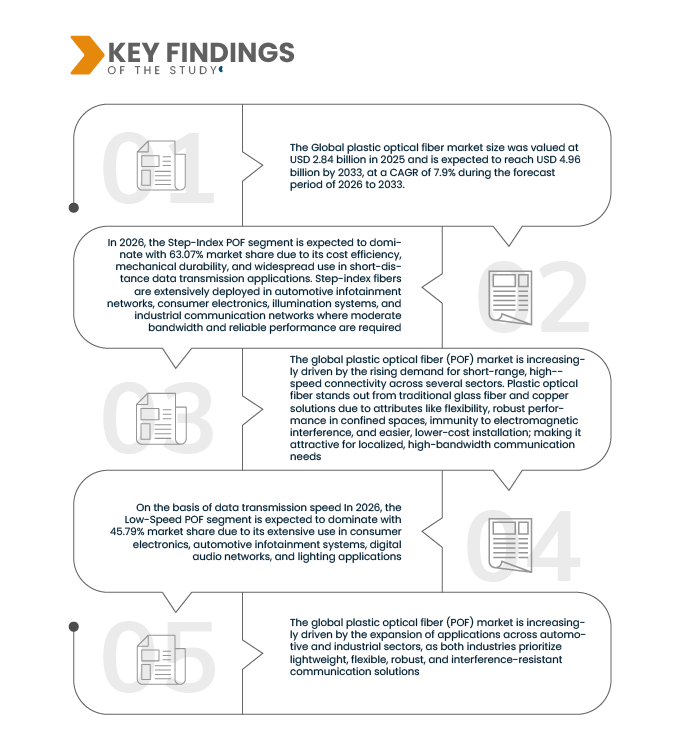
The Global Plastic Optical Fiber Market size was valued at USD 2.84 billion in 2025 and is expected to reach USD 4.96 billion by 2033, at a CAGR of 7.9% during the forecast period of 2026 to 2033.
Key Findings of the Study
Expansion of Automotive and Industrial Applications
The global plastic optical fiber (POF) market is increasingly driven by the expansion of applications across automotive and industrial sectors, as both industries prioritize lightweight, flexible, robust, and interference‑resistant communication solutions. In the automotive domain, the shift toward connected, electric, and autonomous vehicles has elevated the need for high‑speed in‑vehicle data networks capable of handling infotainment, sensor communications, and advanced driver‑assistance systems (ADAS). Meanwhile, industrial settings; particularly factory automation, robotics, and control systems; require cabling that can withstand harsh environments while ensuring reliable short‑distance data transmission. These evolving application landscapes are prompting manufacturers and OEMs to adopt POF technologies, expanding usage beyond traditional consumer and home networking scenarios and solidifying POF’s role in future digital infrastructure.
Report Scope and Market Segmentation
|
Report Metric
|
Details
|
|
Forecast Period
|
2026 to 2033
|
|
Base Year
|
2025
|
|
Historic Years
|
2024 (Customizable to 2018-2023)
|
|
Quantitative Units
|
Revenue in USD Billion
|
|
Segments Covered
|
By Type (Step-Index POF, Gradient-Index POF), By Class Type (Class 4, Class 3, Class 0, Class 2, Class 1, Others), By Offering (Components, Services), By Data Transmission Speed (Low-Speed POF (<100 Mbps) , Medium-Speed POF (100 Mbps–1 Gbps), High-Speed POF (>1 Gbps)), By Network Architecture (Star Network POF Systems, Point-To-Point POF Systems, Ring Network POF Systems), By Light Source (LED-Based POF Systems, Laser-Based POF Systems), By Communication Protocol (MOST (Media Oriented Systems Transport), Ethernet over POF, FlexRay, CAN over POF, Others), By Application (Automotive, Consumer Electronics, Industrial Automation & Control, Smart Infrastructure, Medical Applications, Data Centers & Server Rooms, Others), By End User (Automotive OEMs, Industrial, Consumer Electronics Companies, Telecommunication Providers, Healthcare Organizations, Defense, Energy & Aerospace, Others)
|
|
Countries Covered
|
North America
Europe
Asia-Pacific
Middle East and Africa
South America
|
|
Market Players Covered
|
|
|
Data Points Covered in the Report
|
In addition to the insights on market scenarios such as market value, growth rate, segmentation, geographical coverage, and major players, the market reports curated by the Data Bridge Market Research also include in-depth expert analysis, geographically represented company-wise production and capacity, network layouts of distributors and partners, detailed and updated price trend analysis and deficit analysis of supply chain and demand.
|
Segment Analysis
The plastic optical fiber market is segmented into eight notable segments based on the service type, class type, offering, data transmission speed, network architecture, light source, communication protocol, application, and end-use industry.
- On the basis of type, the global Plastic Optical Fiber market is segmented into Step-Index POF and Gradient-Index POF.
In 2026, the Step-Index POF segment is expected to dominate the market
In 2026, the Step-Index POF segment is expected to dominate with 63.07% market share due to its cost efficiency, mechanical durability, and widespread use in short-distance data transmission applications. Step-index fibers are extensively deployed in automotive infotainment networks, consumer electronics, illumination systems, and industrial communication networks where moderate bandwidth and reliable performance are required.
- On the basis of offering, the global Plastic Optical Fiber market is segmented into components and services.
In 2026, the components segment is expected to dominate the market
In 2026, the components segment is expected to dominate with 83.49% market share owing to strong demand for optical fibers, connectors, transmitters, receivers, and integrated optical modules used across automotive electronics, industrial automation systems, and smart infrastructure networks. Increasing deployment of optical communication hardware in vehicles, robotics systems, and home networking equipment is significantly driving demand for POF components.
- On the basis of data transmission speed, the global Plastic Optical Fiber market is segmented into Low-Speed POF (<100 Mbps), Medium-Speed POF (100 Mbps–1 Gbps), and High-Speed POF (>1 Gbps).
In 2026, the Low-Speed POF segment is expected to dominate the market
In 2026, the Low-Speed POF segment is expected to dominate with 45.79% market share due to its extensive use in consumer electronics, automotive infotainment systems, digital audio networks, and lighting applications. These applications typically require reliable short-range communication rather than extremely high bandwidth, making low-speed POF solutions more cost-effective and widely adopted.
- On the basis of network architecture, the global Plastic Optical Fiber market is segmented into Star Network POF Systems, Point-to-Point POF Systems, and Ring Network POF Systems.
In 2026, the Star Network POF Systems segment is expected to dominate the market
In 2026, the Star Network POF Systems segment is expected to dominate with 42.47% market share due to its scalability, simplified network management, and efficient fault isolation capabilities. Star architectures allow centralized communication management and are widely used in smart building infrastructure, automotive communication systems, and industrial networks. Their ability to support multiple devices while maintaining stable connectivity contributes significantly to their widespread adoption.
- On the basis of light source, the global Plastic Optical Fiber market is segmented into LED-Based POF Systems and Laser-Based POF Systems.
In 2026, the LED-Based POF Systems segment is expected to dominate the market
In 2026, the LED-Based POF Systems segment is expected to dominate with 64.63% market share due to their lower cost, longer operational life, and compatibility with short-distance communication systems. LED transmitters are widely used in automotive infotainment systems, home networking devices, and consumer electronics applications where moderate data rates are sufficient. Their energy efficiency and simplified system integration further support strong market demand.
- On the basis of communication protocol, the global Plastic Optical Fiber market is segmented into MOST (Media Oriented Systems Transport), Ethernet over POF, FlexRay, CAN over POF, and Others.
In 2026, the MOST protocol segment is expected to dominate the market
In 2026, the MOST protocol segment is expected to dominate with 36.61% market share due to its extensive adoption in automotive infotainment networks and multimedia communication systems. MOST technology enables high-speed, synchronized data transmission between entertainment systems, navigation units, and other in-vehicle electronic components, making it a preferred protocol for automotive optical networking.
- On the basis of application, the global Plastic Optical Fiber market is segmented into Automotive, Consumer Electronics, Industrial Automation & Control, Smart Infrastructure, Medical Applications, Data Centers & Server Rooms, and Others.
In 2026, the Automotive segment is expected to dominate the market
In 2026, the Automotive segment is expected to dominate with 28.02% market share due to the increasing integration of optical communication systems in modern vehicles. Plastic optical fibers are widely used in automotive infotainment systems, advanced driver assistance systems (ADAS), and vehicle communication networks. The growing adoption of electric vehicles, connected car technologies, and in-vehicle digital entertainment systems further drives demand for POF in the automotive sector.
- On the basis of end user, the global Plastic Optical Fiber market is segmented into Automotive OEMs, Industrial, Consumer Electronics Companies, Telecommunication Providers, Healthcare Organizations, Defense, Energy & Aerospace, and Others.
In 2026, the Automotive OEMs segment is expected to dominate the market
In 2026, the Automotive OEMs segment is expected to dominate with 27.47% market share due to increasing integration of optical communication networks in vehicles for infotainment, data transfer, and advanced electronics systems. Automotive manufacturers are increasingly adopting POF solutions due to their lightweight design, electromagnetic interference resistance, and ease of installation compared with conventional copper wiring systems. The ongoing transition toward connected vehicles and intelligent mobility solutions further strengthens the segment’s leading market position.
Major Players
Mitsubishi Chemical Group Corporation (Japan), Toray Industries, Inc. (Japan), Asahi Kasei Corporation (Japan), AGC Inc. (Japan), Firecomms Ltd. (Ireland).
Market Developments
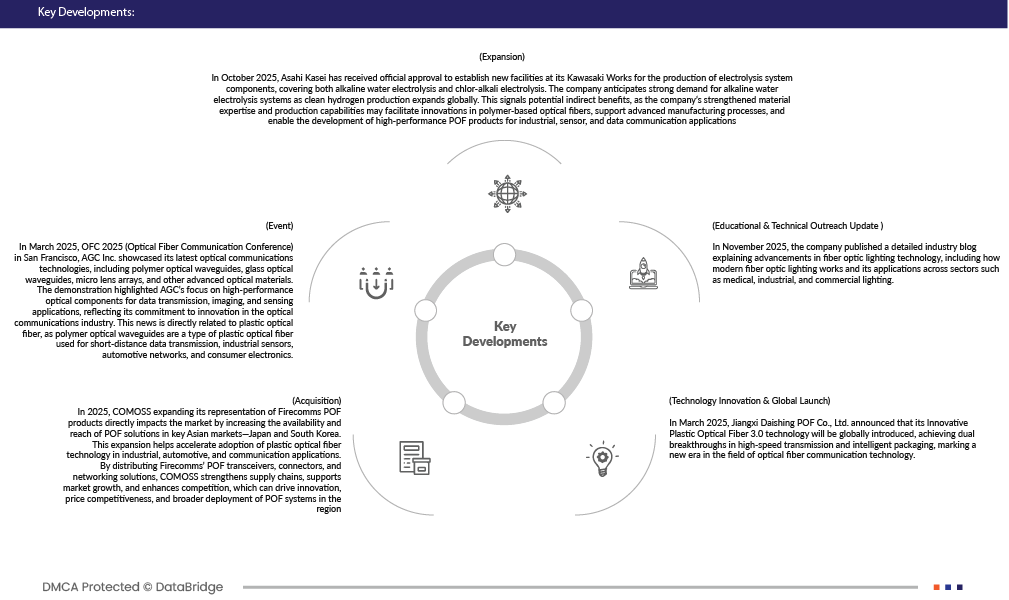
- In October 2025, Asahi Kasei has received official approval to establish new facilities at its Kawasaki Works for the production of electrolysis system components, covering both alkaline water electrolysis and chlor-alkali electrolysis. The company anticipates strong demand for alkaline water electrolysis systems as clean hydrogen production expands globally. This signals potential indirect benefits, as the company’s strengthened material expertise and production capabilities may facilitate innovations in polymer-based optical fibers, support advanced manufacturing processes, and enable the development of high-performance POF products for industrial, sensor, and data communication applications.
- In March 2025, OFC 2025 (Optical Fiber Communication Conference) in San Francisco, AGC Inc. showcased its latest optical communications technologies, including polymer optical waveguides, glass optical waveguides, micro lens arrays, and other advanced optical materials. The demonstration highlighted AGC’s focus on high-performance optical components for data transmission, imaging, and sensing applications, reflecting its commitment to innovation in the optical communications industry. This news is directly related to plastic optical fiber, as polymer optical waveguides are a type of plastic optical fiber used for short-distance data transmission, industrial sensors, automotive networks, and consumer electronics.
- In 2025, COMOSS expanding its representation of Firecomms POF products directly impacts the market by increasing the availability and reach of POF solutions in key Asian markets—Japan and South Korea. This expansion helps accelerate adoption of plastic optical fiber technology in industrial, automotive, and communication applications. By distributing Firecomms’ POF transceivers, connectors, and networking solutions, COMOSS strengthens supply chains, supports market growth, and enhances competition, which can drive innovation, price competitiveness, and broader deployment of POF systems in the region.
- In March 2025, Jiangxi Daishing POF Co., Ltd. announced that its Innovative Plastic Optical Fiber 3.0 technology will be globally introduced, achieving dual breakthroughs in high-speed transmission and intelligent packaging, marking a new era in the field of optical fiber communication technology.
- In November 2025, the company published a detailed industry blog explaining advancements in fiber optic lighting technology, including how modern fiber optic lighting works and its applications across sectors such as medical, industrial, and commercial lighting.
As per Data Bridge Market Research analysis:
For more detailed information about the global plastic optical fiber market report, click here – https://www.databridgemarketresearch.com/reports/global-plastic-optical-fiber-market