


What is the Asia-Pacific Cholesterol Testing Market Size and Growth Rate?
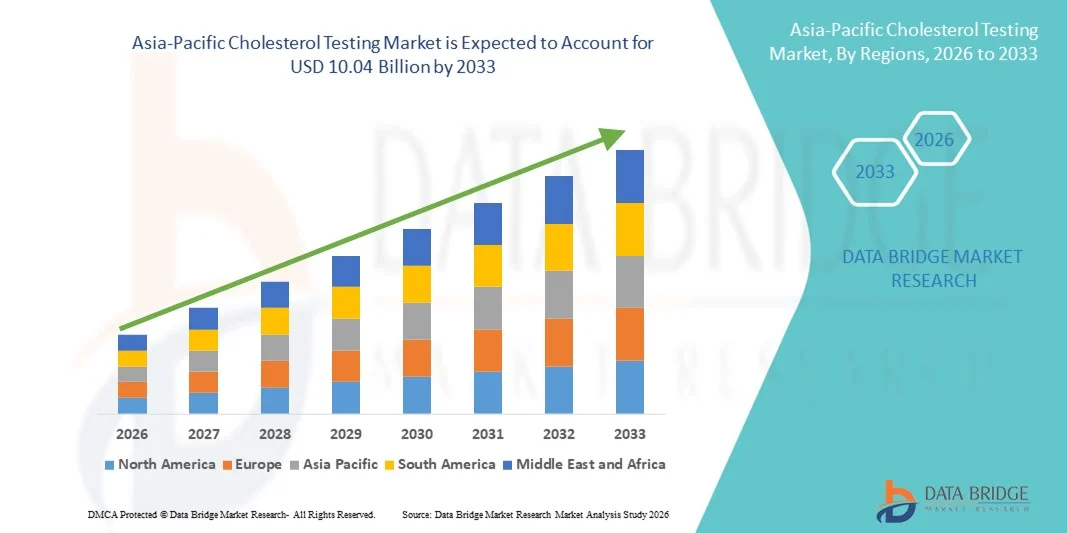
- As per Data Bridge Market Research Analysis the Asia-Pacific cholesterol testing market size was valued at USD 4.72 billion in 2025 and is expected to reach USD 10.04 billion by 2033, at a CAGR of 9.9% during the forecast period
- The market growth is largely driven by the increasing prevalence of cardiovascular diseases, growing awareness of cholesterol-related health risks, and the expansion of preventive healthcare programs across the region
- Furthermore, rising consumer demand for early detection, rapid testing solutions, and technologically advanced diagnostic devices is positioning cholesterol testing as a critical component of routine health monitoring. These factors are accelerating the adoption of cholesterol testing solutions, thereby significantly boosting the industry's growth
Market Size & Forecast
Global Market Value (2025): USD 4.72 billion
Expected Market Value (2033): USD 10.04 billion
Forecast CAGR (2026–2033): 9.9%
What are the Major Takeaways of Asia-Pacific Cholesterol Testing Market?
- Cholesterol testing, including laboratory diagnostics, point-of-care devices, and test kits, is increasingly vital for early detection and management of cardiovascular and metabolic disorders across both clinical and home settings due to its accuracy, speed, and ease of use
- The escalating demand for cholesterol testing is primarily fueled by growing awareness of cardiovascular health, the increasing prevalence of hypercholesterolemia and related lifestyle diseases, and a rising preference for preventive healthcare and regular monitoring
- China dominated the Asia-Pacific cholesterol testing market with the largest revenue share of 35.1% in 2025, characterized by expanding healthcare infrastructure, government-led screening programs, and increasing adoption of advanced diagnostic technologies
- India is expected to be the fastest-growing country in the Asia-Pacific cholesterol testing market during the forecast period due to rising healthcare awareness, expanding medical facilities, and growing adoption of point-of-care and at-home testing solutions
- The Test Kits segment dominated the cholesterol testing market with a market share of 44.8% in 2025, driven by their convenience, ease of use, and suitability for both clinical and home-based monitoring
Report Scope and Asia-Pacific Cholesterol Testing Market Segmentation
|
Attributes |
Asia-Pacific Cholesterol Testing Key Market Insights |
|
Segments Covered |
|
|
Countries Covered |
Asia-Pacific
|
|
Key Market Players |
|
|
Market Opportunities |
|
|
Value Added Data Infosets |
In addition to the insights on market scenarios such as market value, growth rate, segmentation, geographical coverage, and major players, the market reports curated by the Data Bridge Market Research also include in-depth expert analysis, patient epidemiology, pipeline analysis, pricing analysis, and regulatory framework |
What is the Key Trend in the Asia-Pacific Cholesterol Testing Market?
Rise of Home and Point-of-Care Testing Solutions
- A significant and accelerating trend in the Asia-Pacific cholesterol testing market is the growing adoption of home-based and point-of-care testing devices, enabling rapid, convenient, and reliable cholesterol monitoring outside traditional clinical settings
- For instance, the CardioCheck Plus system allows patients to measure cholesterol levels at home with professional-level accuracy and sync results to healthcare providers via mobile apps, facilitating timely interventions
- Advanced devices integrate AI-driven analysis to track cholesterol patterns over time, offering intelligent health alerts and suggestions for lifestyle modifications based on patient data. Furthermore, some Roche Accu-Chek models provide predictive insights to guide users on potential cardiovascular risks
- The seamless integration of cholesterol testing devices with digital health platforms and telemedicine services allows centralized tracking of patient data, enabling healthcare providers to remotely monitor cholesterol levels and recommend treatment adjustments
- This trend toward more convenient, intelligent, and connected cholesterol testing solutions is fundamentally reshaping consumer expectations for preventive healthcare. Consequently, companies such as Abbott are developing portable, AI-enabled test kits that offer real-time results and remote data sharing
- The demand for cholesterol testing solutions that provide quick, accurate, and connected monitoring is growing rapidly across both clinical and home settings, as consumers increasingly prioritize preventive health and early disease detection
- Increasing government initiatives in countries such as China, India, and Japan to promote preventive health screenings are further driving the adoption of cholesterol testing devices
Asia-Pacific Cholesterol Testing Market Dynamics
Driver
Growing Need Due to Rising Cardiovascular Diseases and Health Awareness
- The increasing prevalence of cardiovascular diseases, coupled with growing health awareness, is a significant driver for the heightened demand for cholesterol testing in Asia-Pacific
- For instance, in March 2025, Abbott introduced a new point-of-care cholesterol testing kit in India, designed to deliver lab-quality results within minutes, supporting preventive health check-ups
- As patients and healthcare providers seek early detection of cholesterol-related risks, testing solutions offer rapid results, tracking of trends, and actionable guidance for lifestyle or treatment modifications
- Furthermore, the rising adoption of preventive healthcare programs and corporate health screenings is making cholesterol testing a routine component of health management strategies in countries such as China and Japan
- The convenience of portable test kits, ease of home testing, and the ability to integrate results with digital health platforms are key factors propelling the adoption of cholesterol testing across both clinical and home settings
- Increasing awareness campaigns by healthcare authorities highlighting the dangers of hypercholesterolemia are driving proactive testing behavior among consumers in urban and semi-urban areas
- Expansion of healthcare infrastructure in developing Asia-Pacific countries, including mobile clinics and rural health centers, is improving access to cholesterol testing, further boosting market growth
Restraint/Challenge
Accuracy Concerns and Regulatory Hurdles
- Concerns surrounding the accuracy and reliability of some point-of-care and home-based cholesterol testing solutions pose a significant challenge to broader market penetration
- For instance, reports of inconsistent readings in certain low-cost test kits have made some consumers and healthcare providers hesitant to fully rely on home testing solutions
- Addressing these accuracy concerns through stringent calibration, quality assurance, and compliance with regional regulatory standards is crucial for building consumer trust. Companies such as Roche emphasize ISO-certified devices and validated test strips to reassure users
- In addition, the relatively high cost of advanced AI-enabled or connected test kits compared to conventional lab tests can be a barrier for price-sensitive consumers in developing countries. While standard test kits are affordable, premium devices with advanced analytics often carry a higher price tag
- Overcoming these challenges through rigorous quality control, regulatory compliance, consumer education, and the development of cost-effective testing options will be vital for sustained growth in the Asia-Pacific cholesterol testing market
- Limited awareness and training among healthcare workers in rural areas on proper usage and interpretation of cholesterol test kits can reduce adoption rates in underdeveloped regions
- Potential delays in regulatory approvals for new test kits in certain Asia-Pacific countries may slow down market entry for innovative diagnostic solutions
How is the Asia-Pacific Cholesterol Testing Market Segmented?
The market is segmented on the basis of product type, test, test type, prescription mode, and end-user.
- By Product Type
On the basis of product type, the market is segmented into test kits and testing strips. The Test Kits segment dominated the market with the largest market revenue share of 44.8% in 2025, driven by their convenience, ease of use, and ability to deliver quick results for both clinical and home monitoring. Test kits allow patients and healthcare providers to perform cholesterol tests without the need for specialized laboratory infrastructure, increasing accessibility in remote or underserved regions. The growing adoption of preventive healthcare practices and home-based monitoring has further reinforced the dominance of this segment. Companies such as Abbott and Roche are developing AI-enabled test kits that integrate with digital platforms, offering real-time data tracking and alerts. Test kits also see strong demand due to their compatibility with telemedicine services and mobile health apps, enabling better patient engagement and timely interventions.
The Testing Strips segment is anticipated to witness the fastest growth rate during 2026–2033, fueled by increasing point-of-care testing adoption and demand for cost-effective, portable cholesterol monitoring solutions. Testing strips are widely used in clinics and homecare settings due to their simplicity, low cost, and ease of disposal. The flexibility of using strips with multiple devices and the ability to provide rapid results make them highly attractive for routine monitoring. Growing awareness of early cholesterol management and preventive health programs in countries such as India, China, and Japan is further accelerating the uptake of testing strips in the region.
- By Test
On the basis of test, the market is segmented into Total Cholesterol Test, High-Density Lipoprotein (HDL) Cholesterol, and Low-Density Lipoprotein (LDL) Cholesterol. The Total Cholesterol Test segment dominated the market in 2025 due to its comprehensive evaluation of lipid levels, which is critical for assessing cardiovascular risk. Total cholesterol tests are often recommended in routine health check-ups and preventive screenings, making them a standard choice in hospitals, diagnostic centers, and homecare testing. The segment benefits from high adoption in government-led health initiatives and corporate wellness programs, especially in China and Japan. Advanced test kits allow for simultaneous measurement of total cholesterol along with other lipid parameters, offering accurate and actionable insights. Total cholesterol testing is also preferred by healthcare providers for its ability to quickly identify at-risk patients and guide dietary or therapeutic interventions.
The LDL Cholesterol segment is expected to witness the fastest CAGR from 2026 to 2033, driven by increased awareness of “bad cholesterol” as a key contributor to cardiovascular diseases. LDL tests are essential for patients with pre-existing heart conditions and those on cholesterol-lowering therapies, supporting continuous monitoring. Rising adoption of personalized healthcare and preventive interventions is propelling demand for LDL testing kits in both clinics and home settings. The segment is also growing due to the integration of LDL testing into mobile health platforms, allowing users to track trends and receive automated lifestyle recommendations.
- By Test Type
On the basis of test type, the market is segmented into non-invasive and invasive tests. The Non-Invasive segment dominated the market in 2025 due to patient preference for painless, easy-to-use testing solutions that do not require blood draws. Non-invasive devices offer quick screening capabilities, making them ideal for homecare, clinics, and wellness programs. These tests also reduce infection risk and increase testing compliance, particularly among elderly and pediatric populations. Companies are increasingly focusing on non-invasive innovations that combine AI analysis and mobile connectivity to deliver real-time feedback. The growing emphasis on preventive healthcare and wellness checks in urban Asia-Pacific countries has significantly boosted non-invasive test adoption.
The Invasive segment is expected to witness the fastest growth during 2026–2033, primarily in hospital and clinical settings where laboratory accuracy is critical. Invasive tests, typically using venous blood samples, provide detailed and highly accurate lipid profiles. The segment benefits from increasing hospital-based screenings, integration into routine medical check-ups, and rising chronic disease management programs. Invasive tests are also gaining traction due to improved automation in laboratories, reducing turnaround time and enhancing reliability for physicians and patients.
- By Prescription Mode
On the basis of prescription mode, the market is segmented into Over-the-Counter (OTC) and Prescription-Based tests. The Over-the-Counter segment dominated the market in 2025 due to growing consumer preference for self-monitoring and easy access to cholesterol testing without medical consultation. OTC products empower individuals to manage their cholesterol proactively and integrate results with digital health platforms for remote monitoring. The convenience and accessibility of OTC kits drive high adoption in urban and semi-urban regions, particularly in China and India. Telemedicine integration further enhances the appeal of OTC tests by allowing healthcare providers to remotely monitor patient results. Companies are focusing on user-friendly designs and clear instructions to enhance consumer confidence and repeat usage
The Prescription-Based segment is expected to witness the fastest growth from 2026 to 2033, driven by rising regulatory approvals and adoption in hospital and diagnostic settings. Prescription-based tests are preferred by clinicians for patients with known cardiovascular conditions and require laboratory-level accuracy. This segment also benefits from insurance coverage in developed Asia-Pacific countries, making them more accessible for chronic disease management programs. Integration with electronic health records enables better patient tracking and personalized interventions.
- By End-Users
On the basis of end-users, the market is segmented into clinics, hospitals, ambulatory centers, homecare, and diagnostic centers. The Hospitals segment dominated the market in 2025 due to high patient volumes, availability of advanced diagnostic infrastructure, and routine cholesterol screening programs. Hospitals prefer both point-of-care test kits and invasive laboratory tests to ensure accurate diagnosis and treatment planning. Government and private hospital initiatives for preventive health screening further support this dominance. Hospitals also leverage digital platforms to track patient lipid profiles over time, enabling better long-term health outcomes.
The Homecare segment is expected to witness the fastest growth from 2026 to 2033, fueled by increasing consumer awareness of preventive healthcare, rising disposable incomes, and adoption of home-based monitoring solutions. Homecare testing provides convenience, reduces hospital visits, and empowers patients to track their cholesterol levels regularly. The segment benefits from mobile app integrations and AI-enabled devices that guide lifestyle or dietary interventions based on real-time data. Growing partnerships between test kit manufacturers and telemedicine providers also contribute to accelerating homecare adoption across the Asia-Pacific region.
Which Region Holds the Largest Share of the Asia-Pacific Cholesterol Testing Market?
- China dominated the Asia-Pacific cholesterol testing market with the largest revenue share of 35.1% in 2025, characterized by expanding healthcare infrastructure, government-led screening programs, and increasing adoption of advanced diagnostic technologies
- Consumers and healthcare providers in the region highly value the convenience, rapid results, and accuracy offered by advanced cholesterol testing solutions, including point-of-care devices and home-based test kits
- This widespread adoption is further supported by government-led preventive health programs, growing disposable incomes, and the increasing preference for routine health monitoring, establishing cholesterol testing as a critical solution for both clinical and home settings across Asia-Pacific
The China Cholesterol Testing Market Insight
The China cholesterol testing market dominated Asia-Pacific in 2025 with the largest revenue share of 35.1%, driven by extensive healthcare infrastructure, government-led preventive health campaigns, and increasing consumer awareness. Rapid urbanization and rising disposable incomes are promoting the adoption of point-of-care and home-based cholesterol testing solutions. Chinese consumers and healthcare providers increasingly value convenient, accurate, and connected testing options that integrate with digital health platforms. The presence of major diagnostic manufacturers and ongoing innovations in test kits and strips further strengthen market growth.
Japan Cholesterol Testing Market Insight
The Japan cholesterol testing market is gaining momentum due to the country’s technologically advanced healthcare system, aging population, and focus on preventive health. Rising demand for home and point-of-care testing is fueled by convenience, accuracy, and integration with telemedicine services. Japanese consumers increasingly rely on digital health solutions to monitor cholesterol trends and manage cardiovascular risk. Hospitals and clinics are adopting advanced testing devices that offer rapid results, enabling timely interventions. Japan’s emphasis on lifestyle management and routine screenings continues to support the growth of cholesterol testing solutions.
India Cholesterol Testing Market Insight
The India cholesterol testing market accounted for one of the largest revenue shares in Asia-Pacific in 2025, driven by rapid urbanization, a growing middle class, and increasing awareness of cardiovascular health. India’s expanding healthcare infrastructure and government preventive health programs are accelerating the adoption of both point-of-care and home-based cholesterol testing solutions. Affordable test kits and strips, combined with mobile health and telemedicine integration, are encouraging wider adoption among urban and semi-urban populations. The rising prevalence of lifestyle-related disorders, coupled with the push for smart health initiatives, is further boosting market growth in India.
Australia Cholesterol Testing Market Insight
The Australia cholesterol testing market is witnessing steady growth due to high healthcare awareness, well-established diagnostic infrastructure, and widespread preventive health programs. Consumers and healthcare providers prefer accurate, easy-to-use test kits and point-of-care devices for routine monitoring. Government-led health campaigns and corporate wellness programs further support adoption. Integration with digital health platforms and telemedicine services enhances accessibility, enabling remote patient monitoring. The market also benefits from a technologically receptive population that values convenience and preventive care solutions.
Which are the Top Companies in Asia-Pacific Cholesterol Testing Market?
The Asia-Pacific Cholesterol Testing industry is primarily led by well-established companies, including:
- Thermo Fisher Scientific Inc. (U.S.)
- Abbott (U.S.)
- Eurofins Scientific SE (Luxembourg)
- Randox Laboratories Ltd. (U.K.)
- Labcorp (U.S.)
- SYNLAB AG (Germany)
- Quest Diagnostics Incorporated (U.S.)
- Fresenius SE & Co. KGaA (Germany)
- Novartis AG (Switzerland)
- Bio Rad Laboratories, Inc. (U.S.)
- Beckman Coulter, Inc. (U.S.)
- DiaSorin S.p.A. (Italy)
- PerkinElmer, Inc. (U.S.)
- Ortho Clinical Diagnostics (U.S.)
- BioReference Health, LLC (U.S.)
- Cell Biolabs, Inc. (U.S.)
- ACON Laboratories, Inc. (U.S.)
- Diazyme Laboratories, Inc. (U.S.)
- EKF Diagnostics Holdings plc (U.K.)
What are Latest Developments in Asia-Pacific Cholesterol Testing Market?
- In September 2025, early interest in reverse screening programmes for familial hypercholesterolaemia (FH) was reported in parts of China, where children were screened to identify inherited high cholesterol risk and prompt early intervention. This reflects growing preventive health efforts at the population level in Asia‑Pacific
- In September 2025, cardiologists in Bengaluru, India publicly advocated for early testing of lipoprotein(a) (Lp(a)) and comprehensive lipid profiling, noting its significant role in cardiovascular risk beyond traditional cholesterol measures. This increased clinical emphasis influences broader cholesterol screening practices
- In June 2025, the China Health Promotion Foundation launched a cholesterol health management communication plan aimed at increasing public awareness of cholesterol control and healthy lifestyles. The campaign involved multiple health institutions and private partners, highlighting preventive screening and risk management strategies to curb rising cardiovascular disease
- In September 2024, the Family Heart Foundation launched Cholesterol Connect, a public program offering free at‑home blood lipid panel testing (including LDL‑C and lipoprotein(a) screening) along with personalized guidance to help individuals better monitor and manage cardiovascular health risks. This initiative targets increased awareness and early detection of high cholesterol levels across communities
- In September 2023, Novartis associates across the Asia‑Pacific, Middle East & Africa (APMA) region participated in cholesterol testing and awareness activities as part of Cholesterol Education Month, getting their cholesterol levels checked and engaging stakeholders to promote heart health as part of the September Unblocked APMA Challenge. This initiative aimed to raise awareness of the importance of getting cholesterol checked, mobilizing healthcare professionals and patients to better understand and manage cardiovascular risk factors

- Interactive Data Analysis Dashboard
- Company Analysis Dashboard for high growth potential opportunities
- Research Analyst Access for customization & queries
- Competitor Analysis with Interactive dashboard
- Latest News, Updates & Trend analysis
- Harness the Power of Benchmark Analysis for Comprehensive Competitor Tracking
Data collection and base year analysis are done using data collection modules with large sample sizes. The stage includes obtaining market information or related data through various sources and strategies. It includes examining and planning all the data acquired from the past in advance. It likewise envelops the examination of information inconsistencies seen across different information sources. The market data is analysed and estimated using market statistical and coherent models. Also, market share analysis and key trend analysis are the major success factors in the market report. To know more, please request an analyst call or drop down your inquiry.
The key research methodology used by DBMR research team is data triangulation which involves data mining, analysis of the impact of data variables on the market and primary (industry expert) validation. Data models include Vendor Positioning Grid, Market Time Line Analysis, Market Overview and Guide, Company Positioning Grid, Patent Analysis, Pricing Analysis, Company Market Share Analysis, Standards of Measurement, Global versus Regional and Vendor Share Analysis. To know more about the research methodology, drop in an inquiry to speak to our industry experts.
Data Bridge Market Research is a leader in advanced formative research. We take pride in servicing our existing and new customers with data and analysis that match and suits their goal. The report can be customized to include price trend analysis of target brands understanding the market for additional countries (ask for the list of countries), clinical trial results data, literature review, refurbished market and product base analysis. Market analysis of target competitors can be analyzed from technology-based analysis to market portfolio strategies. We can add as many competitors that you require data about in the format and data style you are looking for. Our team of analysts can also provide you data in crude raw excel files pivot tables (Fact book) or can assist you in creating presentations from the data sets available in the report.













