


Asia-Pacific Ear and Nasal Packing Market Size
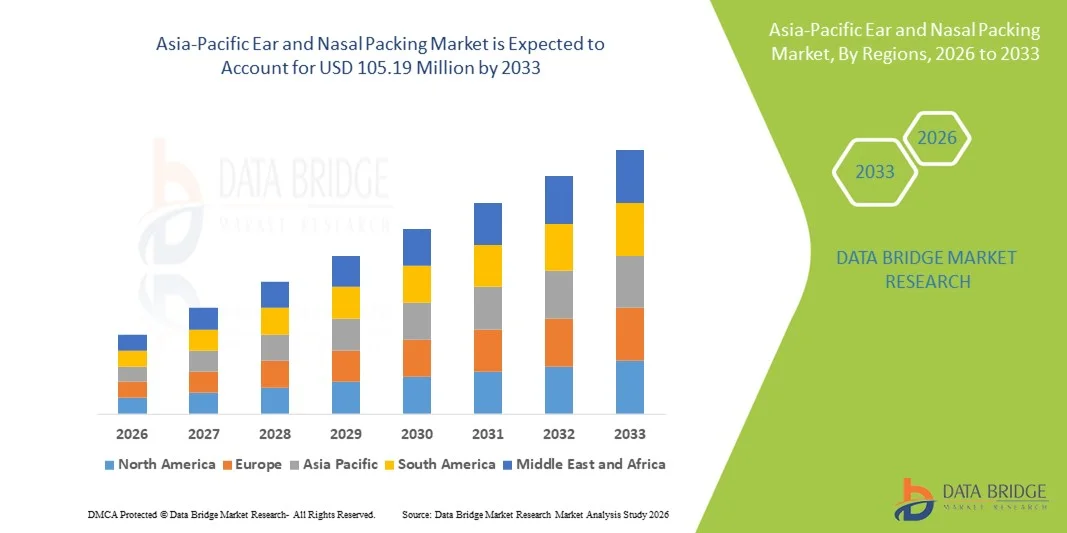
- The Asia-Pacific ear and nasal packing market size was valued at USD 65.90 million in 2025 and is expected to reach USD 105.19 million by 2033, at a CAGR of 6.02% during the forecast period
- The market growth is largely fueled by increasing prevalence of ENT disorders rising adoption of minimally invasive ear and nasal surgeries, and growing awareness of advanced wound care solutions across both developed and emerging APAC healthcare systems
- Furthermore, rapid development of healthcare infrastructure, expanding patient access to specialized ENT treatments, and technological advances in bio‑resorbable and patient‑friendly packing materials are driving demand for ear and nasal packing products as essential components of modern clinical care in the region, significantly boosting industry growth
Asia-Pacific Ear and Nasal Packing Market Analysis
- Ear and nasal packing products, used to control bleeding and support tissue healing after ENT procedures, are increasingly vital components of modern clinical care in hospitals, clinics, and surgical centers due to their effectiveness, patient comfort, and compatibility with advanced surgical techniques
- The escalating demand for ear and nasal packing is primarily fueled by the rising prevalence of ENT disorders (such as epistaxis and sinusitis), growing adoption of minimally invasive ENT surgeries, and an increasing emphasis on post-operative patient care and safety
- China is dominated the Asia-Pacific ear and nasal packing market with the largest revenue share of 35.2% in 2025, characterized by well-established healthcare infrastructure, high ENT procedure volumes, and a strong presence of key medical device manufacturers
- India is expected to be the fastest-growing country in the Asia-Pacific ear and nasal packing market during the forecast period due to rapid urbanization, improving healthcare access, rising disposable incomes, and increasing awareness of ENT care solutions
- The nasal segment dominated the Asia-Pacific ear and nasal packing market with a market share of 65.9% in 2025, driven by its widespread clinical use in controlling post-surgical bleeding
Report Scope and Asia-Pacific Ear and Nasal Packing Market Segmentation
|
Attributes |
Asia-Pacific Ear and Nasal Packing Key Market Insights |
|
Segments Covered |
|
|
Countries Covered |
Asia-Pacific
|
|
Key Market Players |
|
|
Market Opportunities |
|
|
Value Added Data Infosets |
In addition to the insights on market scenarios such as market value, growth rate, segmentation, geographical coverage, and major players, the market reports curated by the Data Bridge Market Research also include in-depth expert analysis, patient epidemiology, pipeline analysis, pricing analysis, and regulatory framework |
Asia-Pacific Ear and Nasal Packing Market Trends
Advancements in Bio-Absorbable and Patient-Friendly Materials
- A key and accelerating trend in the Asia-Pacific ear and nasal packing market is the development of bio-absorbable and patient-friendly materials that enhance comfort and reduce post-operative complications in ENT procedures
- For instance, Surgicel Fibrillar and Nasopore products allow surgeons to manage bleeding effectively while minimizing discomfort for patients, improving overall post-surgical outcomes
- These advanced materials are increasingly designed to dissolve naturally after surgery, eliminating the need for manual removal and reducing patient follow-up visits
- Integration of innovative materials with minimally invasive ENT procedures enables better healing, lower infection risk, and higher patient satisfaction rates, driving adoption in hospitals and specialty ENT centers
- This trend towards safer, more patient-centric ear and nasal packing solutions is prompting companies such as Medtronic and Entellus Medical to invest in bio-absorbable and customizable packing products
- The demand for innovative, patient-friendly packing materials is growing rapidly across both public and private healthcare institutions, as hospitals increasingly prioritize effective post-operative care and procedural efficiency
- Rising adoption of ENT outpatient procedures is accelerating the need for quick, convenient packing solutions that reduce hospital stay durations and improve workflow efficiency
- Increasing collaborations between manufacturers and research institutes are leading to the development of customized packing solutions for specific ENT surgeries
- The integration of eco-friendly and sustainable materials in packing products is becoming a growing trend, catering to hospitals seeking greener healthcare solutions
Asia-Pacific Ear and Nasal Packing Market Dynamics
Driver
Rising Prevalence of ENT Disorders and Surgical Procedures
- The increasing prevalence of ENT disorders such as sinusitis, epistaxis, and otitis media, along with the growing number of minimally invasive ENT surgeries, is a major driver for market growth
- For instance, in 2025, ENT specialists in India and Thailand reported rising surgical volumes requiring advanced ear and nasal packing solutions, prompting hospitals to adopt newer, safer products
- As patients seek effective post-operative care and faster recovery, ear and nasal packing products provide critical support in managing bleeding, tissue healing, and patient comfort
- Furthermore, growing healthcare awareness and expanding access to specialized ENT treatments are encouraging hospitals and clinics to adopt advanced packing solutions
- The demand for efficient, safe, and patient-friendly packing materials is further fueled by healthcare institutions aiming to improve clinical outcomes and reduce post-surgical complications
- Increasing investments in hospital infrastructure and ENT specialty centers across Asia-Pacific are creating new growth avenues for ear and nasal packing products
- Partnerships between local distributors and global manufacturers are expanding product availability, driving adoption in both urban and semi-urban healthcare facilities
- Rising government initiatives supporting ENT healthcare programs are further encouraging adoption of advanced packing solutions in public hospitals
- The growing preference for minimally invasive surgical procedures is stimulating demand for specialized and easy-to-use ear and nasal packing products
- Increased training and awareness programs for ENT surgeons in emerging countries are boosting adoption of advanced packing solutions across hospitals and clinics
Restraint/Challenge
Regulatory Compliance and High Cost of Advanced Materials
- Stringent regulatory requirements for medical devices and the need for clinical validation pose challenges for manufacturers looking to launch new ear and nasal packing products in Asia-Pacific markets
- For instance, delays in approvals from agencies such as Japan’s PMDA or India’s CDSCO can slow the introduction of innovative bio-absorbable materials, limiting market expansion
- While advanced materials offer improved patient comfort, they often come at a higher price compared to traditional non-absorbable packing, which can hinder adoption in cost-sensitive hospitals or smaller clinics
- Overcoming regulatory hurdles and cost constraints requires companies to conduct robust clinical trials, provide clear efficacy data, and develop cost-effective manufacturing processes
- Addressing these challenges through streamlined approvals, competitive pricing, and clinician education will be vital for sustained growth in the Asia-Pacific ear and nasal packing market
- Variability in healthcare reimbursement policies across APAC countries can also limit hospital adoption of premium packing products
- Limited awareness among smaller clinics and ENT practitioners about the clinical advantages of bio-absorbable materials may slow market penetration in emerging countries
- Inconsistent quality standards across local manufacturers can create trust issues and affect adoption of new packing products
- Logistical challenges in distributing specialized packing materials to remote hospitals and clinics can hinder market growth in less urbanized countries
- High dependence on imported bio-absorbable products may expose the market to currency fluctuations and import tariffs, affecting affordability and adoption
Asia-Pacific Ear and Nasal Packing Market Scope
The market is segmented on the basis of type, material, distribution channel, and end user.
- By Type
On the basis of type, the Asia-Pacific ear and nasal packing market is segmented into nasal and ear. The nasal segment dominated the market with the largest revenue share of 65.9% in 2025, driven by its critical role in controlling post-operative bleeding in nasal surgeries and sinus procedures. Hospitals and ENT specialists often prioritize nasal packing for its effectiveness in reducing complications such as epistaxis and tissue trauma. The segment also sees strong demand due to the availability of both bio-absorbable and non-absorbable options, providing flexibility based on surgical requirements and patient comfort. Nasal packing products are frequently used in both routine and complex ENT procedures, further contributing to their dominant market position. Surgeons value these products for ease of use, reliable hemostasis, and compatibility with minimally invasive techniques. The segment’s dominance is reinforced by high adoption in key markets such as China, Japan, and South Korea, where advanced ENT procedures are common.
The ear segment is anticipated to witness the fastest growth rate of 8.2% CAGR from 2026 to 2033, fueled by increasing adoption in otologic surgeries and rising prevalence of ear disorders such as chronic otitis media. Ear packing provides critical support in post-surgical healing, helps prevent infection, and reduces discomfort associated with ear procedures. Its growth is further supported by innovations in bio-absorbable materials, which eliminate the need for manual removal and improve patient compliance. Increasing awareness among ENT surgeons and expanding hospital infrastructure in countries such as India and Thailand are also driving the segment’s growth. In addition, growing outpatient ENT procedures and rising healthcare spending in emerging APAC nations are boosting demand for ear-specific packing products.
- By Material
On the basis of material, the market is segmented into bio-absorbable and non-absorbable. The bio-absorbable segment dominated the market with the largest revenue share of 60% in 2025, driven by its patient-friendly properties, reduced need for removal, and ability to support minimally invasive ENT procedures. Hospitals prefer bio-absorbable packing for its efficiency in post-operative care, lower infection risk, and enhanced patient comfort. The segment benefits from technological innovations such as impregnated packing with antibiotics or hemostatic agents, which improve clinical outcomes. Surgeons value bio-absorbable materials for easy handling, predictable absorption rates, and compatibility with delicate tissues. Their dominance is particularly visible in advanced healthcare markets such as Japan, South Korea, and China. Increasing patient preference for comfortable, non-invasive post-surgical care is further strengthening this segment.
The non-absorbable segment is expected to witness the fastest growth rate of 7.5% CAGR from 2026 to 2033, fueled by rising demand in cost-sensitive hospitals and clinics that continue to rely on traditional durable packing materials. Non-absorbable products offer high reliability, structural integrity, and long-term use for complex procedures. Growing awareness of non-absorbable solutions for specific surgical indications is expanding their adoption. Distribution through direct tender channels and OTC availability is helping reach smaller clinics and secondary care hospitals. In addition, manufacturers are innovating with safer, more comfortable non-absorbable designs to attract new users while maintaining clinical effectiveness.
- By Distribution Channel
On the basis of distribution channel, the market is segmented into direct tender and OTC. The direct tender segment dominated the market in 2025 with the largest revenue share of 70%, driven by the centralized procurement practices of hospitals and large healthcare institutions. Hospitals prefer bulk purchasing of ear and nasal packing products via direct tender to ensure consistent supply, competitive pricing, and regulatory compliance. The segment benefits from strong relationships between distributors and hospital procurement teams, particularly in Japan, China, and South Korea. Bulk tenders also allow institutions to secure bio-absorbable and non-absorbable products in one contract, reducing administrative effort. Direct tender distribution ensures timely delivery to high-volume ENT centers and specialty hospitals, further reinforcing its dominance. High adoption in government-funded hospitals and specialty ENT centers adds to the segment’s market share.
The OTC segment is expected to witness the fastest growth rate of 9% CAGR from 2026 to 2033, driven by increasing demand from smaller clinics, ambulatory centers, and outpatient ENT procedures. OTC availability allows quick access to packing materials for urgent cases or minor procedures without requiring tender agreements. Growing awareness among ENT practitioners and improved distribution networks are supporting the adoption of OTC channels in emerging APAC countries such as India and Thailand. The convenience, flexibility, and reduced lead times associated with OTC products are encouraging their growing use in private healthcare facilities.
- By End User
On the basis of end user, the market is segmented into hospitals, clinics, ambulatory centers, and others. The hospitals segment dominated the market with the largest revenue share of 75% in 2025, driven by the high volume of ENT surgeries, availability of advanced surgical facilities, and strong purchasing power. Hospitals often prioritize bio-absorbable and high-quality non-absorbable packing products to ensure optimal patient care and procedural efficiency. Key markets such as China, Japan, and South Korea have large hospital networks performing complex ENT procedures, supporting the dominance of this segment. Hospitals also benefit from centralized procurement and training programs for staff, which further strengthens adoption of advanced packing solutions. Institutional preferences for trusted brands and products with proven clinical efficacy are central to market leadership.
The clinics and ambulatory centers segment is expected to witness the fastest growth rate of 8.5% CAGR from 2026 to 2033, fueled by the expansion of outpatient ENT procedures, growing private healthcare infrastructure, and increasing patient preference for day-care ENT treatments. Smaller ENT practices are adopting bio-absorbable and easy-to-use packing products to enhance patient comfort and reduce follow-up visits. Rising disposable incomes and awareness of advanced ENT care in countries such as India, Thailand, and Indonesia are boosting demand. Improved distribution through OTC channels further facilitates adoption in non-hospital settings, supporting segment growth.
Asia-Pacific Ear and Nasal Packing Market Regional Analysis
- China is dominated the Asia-Pacific ear and nasal packing market with the largest revenue share of 35.2% in 2025, characterized by well-established healthcare infrastructure, high ENT procedure volumes, and a strong presence of key medical device manufacturers
- Healthcare providers in these countries highly value the efficacy, patient-friendly design, and clinical reliability offered by advanced ear and nasal packing products, including bio-absorbable and non-absorbable options
- This widespread adoption is further supported by increasing hospital infrastructure, growing awareness of post-operative care, and the rising number of minimally invasive ENT surgeries, establishing advanced ear and nasal packing solutions as essential components of modern clinical care across hospitals and specialty ENT centers
The China Ear and Nasal Packing Market Insight
The China ear and nasal packing market captured the largest revenue share of 35.2% in 2025 within Asia-Pacific, fueled by the country’s advanced healthcare infrastructure and high volume of ENT procedures. Hospitals and specialty ENT centers are increasingly prioritizing bio-absorbable and non-absorbable packing materials to manage post-operative bleeding and improve patient recovery. The growing prevalence of sinus and nasal disorders, combined with rising adoption of minimally invasive ENT surgeries, further propels the market. Moreover, government initiatives supporting hospital upgrades and medical device procurement are significantly contributing to market expansion. China’s large patient base and increasing awareness of ENT care are driving the adoption of advanced packing products across urban and semi-urban healthcare facilities.
Japan Ear and Nasal Packing Market Insight
The Japan ear and nasal packing market is gaining momentum due to the country’s focus on advanced healthcare and high patient safety standards. Japanese hospitals and ENT clinics emphasize the use of bio-absorbable packing materials that enhance post-surgical outcomes and minimize patient discomfort. The market growth is driven by increasing ENT procedure volumes, rising awareness of post-operative care, and technological innovations in packing products. Moreover, the aging population in Japan is boosting demand for easier-to-use and patient-friendly packing solutions in both hospitals and ambulatory centers. The integration of advanced materials in routine ENT care is also encouraging adoption in specialty clinics. In addition, Japan’s regulatory framework ensures high product quality, reinforcing confidence among healthcare providers.
India Ear and Nasal Packing Market Insight
The India ear and nasal packing market accounted for the largest market revenue share in South Asia in 2025, attributed to rapid urbanization, rising healthcare spending, and expansion of hospital infrastructure. India has witnessed increasing ENT surgical volumes in both public and private hospitals, driving demand for bio-absorbable and non-absorbable packing products. Growing awareness of post-operative care, along with initiatives promoting ENT healthcare programs, is further propelling the market. Affordable and easy-to-use packing solutions are increasing adoption in smaller clinics and ambulatory centers. The availability of domestic and imported products, combined with expanding outpatient ENT procedures, supports market growth. Rising patient preference for comfort and reduced follow-up visits is also contributing to the adoption of advanced packing materials.
South Korea Ear and Nasal Packing Market Insight
The South Korea ear and nasal packing market is poised to grow steadily, fueled by the country’s technologically advanced healthcare system and high adoption of modern ENT procedures. Hospitals and clinics prioritize bio-absorbable materials for improved patient comfort and reduced need for follow-up interventions. Rising prevalence of sinus, nasal, and ear disorders is driving demand for both routine and complex ENT surgeries. Increasing awareness among healthcare professionals regarding innovative packing solutions is supporting adoption. Integration of advanced packing products in hospital protocols enhances procedural efficiency and patient satisfaction. South Korea’s emphasis on medical quality and patient-centric care is further strengthening market growth.
Asia-Pacific Ear and Nasal Packing Market Share
The Asia-Pacific Ear and Nasal Packing industry is primarily led by well-established companies, including:
- Medtronic (Ireland)
- Stryker (U.S.)
- Smith+Nephew (U.K.)
- Olympus Corporation (Japan)
- Network Medical Products Ltd. (U.S.)
- Lohmann & Rauscher GmbH & Co. KG (Germany)
- Meril Life Sciences Pvt. Ltd. (India)
- Boston Medical Products Inc. (U.S.)
- Fannin Ltd. (Ireland)
- Datt Mediproducts Pvt. Ltd. (India)
- SPIGGLE & THEIS Medizintechnik GmbH (Germany)
- Medasil Surgical Ltd. (U.K.)
- EON Meditech Pvt. Ltd. (India)
- Anand Meditech (India)
- KOKEN CO., LTD. (Japan)
- Boston Scientific Corporation (U.S.)
- B. Braun SE (Germany)
- AptarGroup, Inc. (U.S.)
- NeilMed Pharmaceuticals Inc. (U.S.)
- Summit Medical Group (U.S.)
What are the Recent Developments in Asia-Pacific Ear and Nasal Packing Market?
- In February 2025, Olympus Corporation introduced a dissolvable nasal packing material designed to minimize patient discomfort and eliminate follow‑up removal appointments, a key innovation that supports the shift toward more patient‑friendly ENT postoperative care with implications for adoption in Asia‑Pacific hospitals and clinics
- In January 2025, researchers published in Gels reported on the development of injectable chitosan hydrogel particles used as nasal packing material after endoscopic sinus surgery in a pilot clinical application, demonstrating potential improved wound healing properties representing material innovation that could influence clinical adoption patterns in the Asia‑Pacific region
- In August 2024, a clinical study published in B‑ENT Head and Neck Surgery and Oncology found that a tualang honey‑impregnated nasal packing used in endoscopic sinus surgery significantly reduced post‑operative inflammation and bacterial growth, suggesting potential improvements in patient outcomes and postoperative care in ENT surgeries in Malaysia
- In June 2024, Stryker showcased an innovative range of ear packing solutions focused on enhanced malleability and reduced trauma during insertion and removal developments that influence clinical practice and product expectations globally, including in APAC healthcare systems where ENT surgical volume is rising
- In September 2023, a clinical study published in the Pakistan Journal of Medical Sciences compared nasal packing with integrated airway vs without airway after septoplasty, showing that nasal packing with an integrated airway reduced postoperative pain and improved oxygen saturation indicating evolving clinical practice in nasal packing techniques post‑ENT surgery

- Interactive Data Analysis Dashboard
- Company Analysis Dashboard for high growth potential opportunities
- Research Analyst Access for customization & queries
- Competitor Analysis with Interactive dashboard
- Latest News, Updates & Trend analysis
- Harness the Power of Benchmark Analysis for Comprehensive Competitor Tracking
Data collection and base year analysis are done using data collection modules with large sample sizes. The stage includes obtaining market information or related data through various sources and strategies. It includes examining and planning all the data acquired from the past in advance. It likewise envelops the examination of information inconsistencies seen across different information sources. The market data is analysed and estimated using market statistical and coherent models. Also, market share analysis and key trend analysis are the major success factors in the market report. To know more, please request an analyst call or drop down your inquiry.
The key research methodology used by DBMR research team is data triangulation which involves data mining, analysis of the impact of data variables on the market and primary (industry expert) validation. Data models include Vendor Positioning Grid, Market Time Line Analysis, Market Overview and Guide, Company Positioning Grid, Patent Analysis, Pricing Analysis, Company Market Share Analysis, Standards of Measurement, Global versus Regional and Vendor Share Analysis. To know more about the research methodology, drop in an inquiry to speak to our industry experts.
Data Bridge Market Research is a leader in advanced formative research. We take pride in servicing our existing and new customers with data and analysis that match and suits their goal. The report can be customized to include price trend analysis of target brands understanding the market for additional countries (ask for the list of countries), clinical trial results data, literature review, refurbished market and product base analysis. Market analysis of target competitors can be analyzed from technology-based analysis to market portfolio strategies. We can add as many competitors that you require data about in the format and data style you are looking for. Our team of analysts can also provide you data in crude raw excel files pivot tables (Fact book) or can assist you in creating presentations from the data sets available in the report.













