


Asia-Pacific Knee Cartilage Repair Market Size
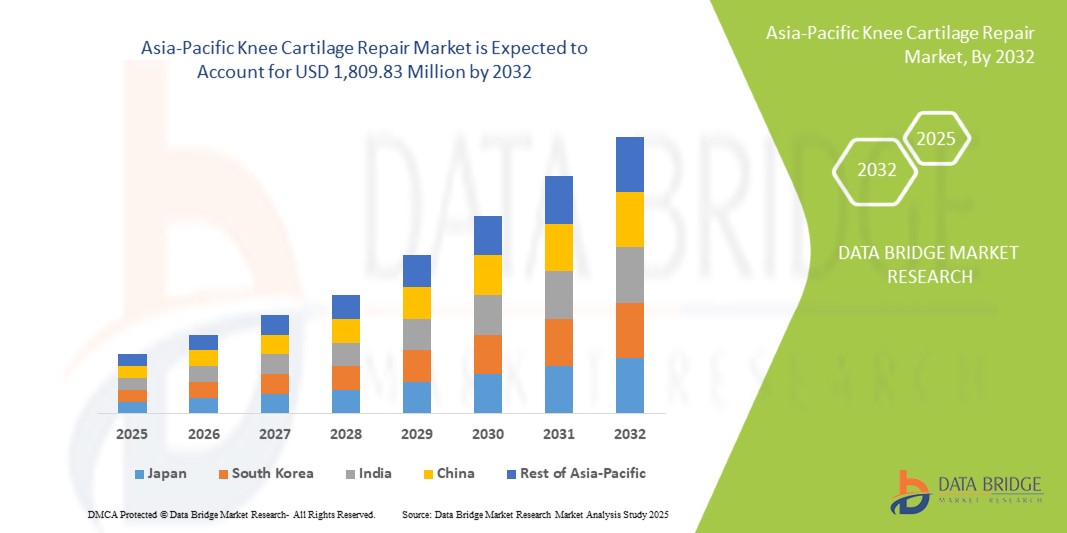
- The Asia-Pacific knee cartilage repair market size was valued at USD 779.69 million in 2024 and is expected to reach USD 1,809.83 million by 2032, at a CAGR of 11.1% during the forecast period
- The market growth is primarily driven by increasing prevalence of knee injuries and osteoarthritis, along with rising awareness about advanced cartilage repair techniques in the region
- In addition, expanding healthcare infrastructure, growing geriatric population, and increasing adoption of minimally invasive surgical procedures are fueling demand for effective knee cartilage repair solutions across Asia-Pacific. These factors are collectively accelerating market growth and adoption of innovative treatments in this segment
Asia-Pacific Knee Cartilage Repair Market Analysis
- Knee cartilage repair, involving advanced surgical and regenerative treatments to restore damaged knee cartilage, is becoming increasingly vital for managing osteoarthritis and sports-related injuries across the Asia-Pacific region. This growth is supported by technological progress in minimally invasive procedures and rising healthcare investments aimed at improving patient outcomes
- The market is driven by a rising prevalence of knee disorders due to aging populations and active lifestyles, growing awareness among patients and healthcare providers about the benefits of cartilage repair, expanding healthcare infrastructure, and increasing demand for effective, long-term treatment options
- China dominated the Asia-Pacific knee cartilage repair market in 2024 with the largest revenue share of 39%, benefiting from a large patient base, rapid urbanization, and strong adoption of innovative cartilage repair techniques in leading medical centers
- India is projected to be the fastest growing country in the Asia-Pacific knee cartilage repair market, propelled by a surge in sports injuries, increasing healthcare awareness, government initiatives to improve medical infrastructure, and growing accessibility to advanced orthopedic treatments in both urban and semi-urban areas
- The microfracture dominated the Asia-Pacific knee cartilage repair market with a share of 37.2% in 2024, favored by orthopedic surgeons for its minimally invasive nature, cost-effectiveness, and proven ability to stimulate cartilage regeneration, making it a widely accepted treatment option across hospitals and specialty clinics
Report Scope and Asia-Pacific Knee Cartilage Repair Market Segmentation
|
Attributes |
Asia-Pacific Knee Cartilage Repair Key Market Insights |
|
Segments Covered |
|
|
Countries Covered |
Asia-Pacific
|
|
Key Market Players |
|
|
Market Opportunities |
|
|
Value Added Data Infosets |
In addition to the insights on market scenarios such as market value, growth rate, segmentation, geographical coverage, and major players, the market reports curated by the Data Bridge Market Research also include in-depth expert analysis, pricing analysis, brand share analysis, consumer survey, demography analysis, supply chain analysis, value chain analysis, raw material/consumables overview, vendor selection criteria, PESTLE Analysis, Porter Analysis, and regulatory framework. |
Asia-Pacific Knee Cartilage Repair Market Trends
Advancements in Regenerative and Minimally Invasive Techniques
- A major trend shaping the Asia-Pacific knee cartilage repair market is the increasing adoption of regenerative therapies such as autologous chondrocyte implantation (ACI), stem cell treatments, and platelet-rich plasma (PRP) injections, which offer improved cartilage healing and reduced recovery times compared to traditional surgical options
- For instance, leading orthopedic centers in China and Japan are incorporating ACI and PRP protocols alongside microfracture surgeries to enhance patient outcomes and promote cartilage regeneration. Similarly, emerging biotechnologies focused on tissue engineering are gaining traction in research institutes across the region
- Minimally invasive procedures such as microfracture and drilling continue to dominate treatment preferences due to their cost-effectiveness, quicker rehabilitation, and fewer complications, making them accessible to a wider patient base in both urban and semi-urban settings
- Increasing collaborations between hospitals, research institutes, and biotech firms in Asia-Pacific are driving innovation and clinical adoption of advanced cartilage repair modalities. These partnerships facilitate clinical trials and accelerate regulatory approvals for novel therapies
- This trend towards combining traditional surgical methods with cutting-edge regenerative approaches is significantly improving treatment success rates and patient quality of life, reshaping clinical practice standards
- The rising focus on patient-centric care and customized treatment plans is further propelling demand for integrated knee cartilage repair solutions tailored to individual injury profiles and lifestyle needs
Asia-Pacific Knee Cartilage Repair Market Dynamics
Driver
Increasing Incidence of Osteoarthritis and Sports Injuries
- The growing prevalence of osteoarthritis, driven by aging populations and lifestyle changes, alongside rising sports-related knee injuries, is a key factor fueling demand for effective cartilage repair solutions across Asia-Pacific
- For instance, urbanization and increased participation in competitive sports in countries such as India and Australia have contributed to a surge in knee cartilage damage cases, prompting higher adoption of surgical and regenerative treatments
- Rising healthcare expenditure and expanding access to advanced orthopedic care in emerging markets further support market growth, as patients seek long-term solutions to maintain mobility and reduce pain
- Enhanced awareness through education and outreach programs is increasing early diagnosis and intervention rates, improving market penetration in rural and semi-urban regions
- The integration of knee cartilage repair procedures within multidisciplinary orthopedic and sports medicine centers is facilitating comprehensive care and driving higher procedure volumes
Restraint/Challenge
High Treatment Costs and Limited Reimbursement
- The relatively high cost of advanced cartilage repair procedures, such as autologous chondrocyte implantation and stem cell therapies, poses a significant barrier to widespread adoption, especially in lower-income segments and developing countries within Asia-Pacific
- For instance, in India and Southeast Asia, many patients delay or avoid such treatments due to out-of-pocket expenses and lack of insurance coverage, limiting market growth in these regions
- Limited insurance coverage and reimbursement policies for these innovative treatments further restrict patient access and affordability, slowing market expansion
- Infrastructure limitations in rural areas, including lack of specialized orthopedic centers and trained surgeons, challenge equitable delivery of advanced cartilage repair solutions
- Variability in regulatory frameworks across Asia-Pacific countries can delay approval and commercialization of new therapies, impacting market entry timelines for manufacturers
- Addressing these challenges through cost reduction strategies, government initiatives for improved healthcare funding, and expanded training programs for healthcare professionals will be essential to unlock the region’s full market potential
Asia-Pacific Knee Cartilage Repair Market Scope
The market is segmented on the basis of product, modality, cartilage type, application, end user, and distribution channel.
- By Product
On the basis of product, the Asia-Pacific knee cartilage repair market is segmented into cell-based and non-cell based products. The cell-based segment dominated the market with the largest revenue share of around 62% in 2024, driven by rising adoption of regenerative therapies such as autologous chondrocyte implantation (ACI) and stem cell treatments. These therapies offer enhanced cartilage regeneration and long-term clinical benefits, making them highly preferred by orthopedic specialists. The segment’s growth is further supported by increased investments in biotechnology research and supportive regulatory approvals.
Meanwhile, the non-cell based segment is expected to witness the fastest growth during the forecast period, driven by the expanding use of scaffolds, growth factors, and synthetic implants. These products are gaining traction as cost-effective alternatives, especially in emerging markets where affordability is a key consideration.
- By Modality
On the basis of modality, the Asia-Pacific knee cartilage repair market is segmented into osteochondral transplantation, microfracture, abrasion arthroplasty, drilling, chondrocyte implantation, and others. The microfracture segment dominated with a market share of 37.2% in 2024, favored due to its minimally invasive approach, relatively low cost, and effectiveness in stimulating the body’s natural cartilage repair mechanisms. This modality is widely used across various healthcare settings, from large hospitals to specialty clinics
Conversely, the osteochondral transplantation segment is anticipated to be the fastest growing during forecast period, propelled by technological advancements improving graft integration and long-term outcomes. Its use is expanding particularly in complex cartilage injuries and cases unsuitable for microfracture.
- By Cartilage Type
On the basis of cartilage type, the Asia-Pacific knee cartilage repair market is segmented into hyaline cartilage and fibrocartilage. The hyaline cartilage segment dominated with approximately 58% share in 2024, as it corresponds to the native cartilage targeted in most repair procedures aiming for durable joint function restoration. Treatments focusing on hyaline cartilage regeneration generally provide superior biomechanical properties and patient satisfaction.
The fibrocartilage segment is expected to grow fastest during forecast period, driven by emerging therapies aimed at improving the quality and durability of fibrocartilage repair, expanding the treatment options available for a wider patient group.
- By Application
On the basis of application, the Asia-Pacific knee cartilage repair market is segmented into osteoarthritis, rheumatoid arthritis, osteonecrosis, fractures, bone tumors, and others. The osteoarthritis segment dominated with about 54% market share in 2024, reflecting the high and increasing prevalence of degenerative joint diseases in Asia-Pacific’s aging population. This segment’s growth is fueled by increasing demand for effective treatments to reduce pain and improve mobility.
Meanwhile, the osteonecrosis segment is forecasted to be the fastest growing during forecast period, attributed to rising diagnosis rates supported by better imaging techniques and growing demand for joint preservation interventions to delay or avoid joint replacement surgeries.
- By End User
On the basis of end user, the Asia-Pacific knee cartilage repair market is segmented into hospitals, ambulatory surgical centers, specialty clinics, research and academic institutes, and others. The hospitals segment dominated the market with 70% revenue share in 2024, largely due to their availability of comprehensive orthopedic services, advanced surgical infrastructure, and skilled surgeons capable of performing complex cartilage repair procedures.
The ambulatory surgical centers segment is expected to witness the fastest growth during forecast period, supported by the increasing preference for outpatient procedures that offer cost efficiencies, shorter recovery times, and convenience for patients.
- By Distribution Channel
On the basis of distribution channel, the Asia-Pacific knee cartilage repair market is segmented into direct sales, third-party distributors, online sales, and others. The direct sales segment dominated with around 65% share in 2024, driven by strong relationships between manufacturers and healthcare providers, which facilitate customized product support and training essential for complex procedures.
The online sales segment is projected to grow fastest during forecast period, buoyed by the increasing digitalization of healthcare procurement, greater acceptance of e-commerce platforms for medical products, and easier access to non-surgical consumables and related supplies, especially in remote and semi-urban areas.
Asia-Pacific Knee Cartilage Repair Market Regional Analysis
- China dominated the Asia-Pacific knee cartilage repair market in 2024 with the largest revenue share of 39%, benefiting from a large patient base, rapid urbanization, and strong adoption of innovative cartilage repair techniques in leading medical centers
- Patients and healthcare providers in the region are increasingly adopting innovative cartilage repair procedures due to growing awareness of their benefits in improving joint function and reducing recovery times, supported by government initiatives to enhance healthcare access
- This strong market presence is further bolstered by rapidly growing economies, urbanization, and improving medical facilities, particularly in countries such as China, Japan, South Korea, and Australia, making Asia-Pacific a key hub for both demand and innovation in knee cartilage repair solutions
The China Knee Cartilage Repair Market Insight
The China knee cartilage repair market dominates the Asia-Pacific region with the largest market revenue share, largely due to its vast population and accelerated urbanization, which contribute to increasing cases of lifestyle-related joint disorders. Ongoing healthcare reforms aimed at expanding access to quality orthopedic care, coupled with substantial investments in hospital infrastructure, are facilitating wider adoption of advanced cartilage repair procedures. Moreover, the rise in sports participation leading to more knee injuries, alongside the growing demand for joint preservation therapies among the aging population, bolsters China’s market leadership. The strong presence of domestic and international medical device manufacturers also enhances product availability and cost-effectiveness.
India Knee Cartilage Repair Market Insight
The India knee cartilage repair market is the fastest-growing market in the region, experiencing rapid expansion fueled by an expanding middle class and increasing health consciousness. Lifestyle changes and urbanization have led to a surge in osteoarthritis and sports-related injuries, escalating demand for cartilage repair treatments. Government programs aimed at improving healthcare accessibility and private sector investments have increased the reach of advanced therapies. Furthermore, India’s large pool of skilled orthopedic surgeons and availability of cost-effective treatment options attract patients and manufacturers asuch as. The ongoing push towards smart cities and the growing emphasis on digital healthcare solutions are accelerating the adoption of minimally invasive and regenerative cartilage repair techniques.
The Japan Knee Cartilage Repair Market Insight
The Japan knee cartilage repair market is experiencing steady growth, largely driven by the country’s highly advanced healthcare infrastructure and one of the world’s fastest aging populations. The increasing prevalence of degenerative joint diseases such as osteoarthritis among the elderly is creating a substantial demand for effective joint preservation and cartilage repair solutions. Japanese healthcare providers and patients show a strong preference for cutting-edge medical technologies, including autologous chondrocyte implantation and other regenerative therapies that offer minimally invasive treatment options with improved recovery times.
South Korea Knee Cartilage Repair Market Insight
The South Korea knee cartilage repair market is witnessing robust growth, fueled by rapid advancements in medical technology and strong governmental support for healthcare innovation. The country’s well-established healthcare system benefits from significant investment in cutting-edge orthopedic treatments, including stem cell therapies and tissue engineering approaches that promote cartilage regeneration. Collaborative partnerships between leading hospitals, research institutions, and medical device manufacturers are accelerating the adoption of sophisticated cartilage repair procedures, facilitating faster clinical translation of new technologies.
Asia-Pacific Knee Cartilage Repair Market Share
The Asia-Pacific knee cartilage repair industry is primarily led by well-established companies, including:
- Smith + Nephew (U.K.)
- Stryker (U.S.)
- Zimmer Biomet (U.S.)
- Johnson & Johnson and its affiliates (U.S.)
- Arthrex, Inc. (U.S.)
- B. Braun SE (Germany)
- Vericel Corporation (U.S.)
- Anika Therapeutics, Inc. (U.S.)
- Collagen Solutions (US) LLC (U.S.)
- BD (U.S.)
- Medacta International (Switzerland)
- GEISTLICH Pharma AG (Switzerland)
- Orthocell Limited (Australia)
- BioTissue AG (Switzerland)
- CollPlant Biotechnologies (Israel)
- Tissue Regenix Group (U.K.)
- Hyalex Orthopaedics (U.S.)
- CytexOrtho (U.S.)
- MEDIPOST (South Korea)
- Isto Biologics (U.S.)
What are the Recent Developments in Asia-Pacific Knee Cartilage Repair Market?
- In August 2025, Northwestern University scientists have developed a new bioactive material that successfully regenerated high-quality cartilage in the knee joints of a large-animal model. Although it looks such as a rubbery goo, the material is actually a complex network of molecular components, which work together to mimic cartilage’s natural environment in the body
- In March 2025, Researchers at the University of Basel developed a novel cartilage repair technique using nasal-septum cells grown on a scaffold and matured for two weeks before implantation. In a 98-patient clinical trial, the longer maturation period led to better knee function and tissue quality compared to shorter maturation. This approach shows promise for treating complex knee injuries and is advancing towards larger clinical studies
- In October 2024, The U.S. Food and Drug Administration (FDA) has approved a request for a supplemental Biologics License Application for the repair of knee cartilage defects using arthroscopic delivery of the autologous cultured chondrocytes on a porcine collagen membrane
- In April 2024, Hyalex Orthopaedics, a privately held medical device company developed cartilage repair products based on the transformative HYALEX materials platform, announced that patients have successfully received HYALEX Knee Implants as part of the company's first-in-human clinical trials of its novel HYALEX Knee Cartilage System. The company is currently running the two prospective, multi-center, single-arm studies in the U.S. and Europe, with sites for both studies having already enrolled and treated patients
- In August 2024, Researchers at Northwestern University have developed a novel bioactive material that regenerated high-quality cartilage in the knee joints of a sheep model. They observed evidence of improved repair, including the growth of new cartilage containing collagen II and proteoglycans, within six months. In the future, this material could be used to avoid full knee replacement surgeries, treat degenerative diseases and repair sports-related injuries

- Interactive Data Analysis Dashboard
- Company Analysis Dashboard for high growth potential opportunities
- Research Analyst Access for customization & queries
- Competitor Analysis with Interactive dashboard
- Latest News, Updates & Trend analysis
- Harness the Power of Benchmark Analysis for Comprehensive Competitor Tracking
Data collection and base year analysis are done using data collection modules with large sample sizes. The stage includes obtaining market information or related data through various sources and strategies. It includes examining and planning all the data acquired from the past in advance. It likewise envelops the examination of information inconsistencies seen across different information sources. The market data is analysed and estimated using market statistical and coherent models. Also, market share analysis and key trend analysis are the major success factors in the market report. To know more, please request an analyst call or drop down your inquiry.
The key research methodology used by DBMR research team is data triangulation which involves data mining, analysis of the impact of data variables on the market and primary (industry expert) validation. Data models include Vendor Positioning Grid, Market Time Line Analysis, Market Overview and Guide, Company Positioning Grid, Patent Analysis, Pricing Analysis, Company Market Share Analysis, Standards of Measurement, Global versus Regional and Vendor Share Analysis. To know more about the research methodology, drop in an inquiry to speak to our industry experts.
Data Bridge Market Research is a leader in advanced formative research. We take pride in servicing our existing and new customers with data and analysis that match and suits their goal. The report can be customized to include price trend analysis of target brands understanding the market for additional countries (ask for the list of countries), clinical trial results data, literature review, refurbished market and product base analysis. Market analysis of target competitors can be analyzed from technology-based analysis to market portfolio strategies. We can add as many competitors that you require data about in the format and data style you are looking for. Our team of analysts can also provide you data in crude raw excel files pivot tables (Fact book) or can assist you in creating presentations from the data sets available in the report.













