


What is the Asia-Pacific Spirometer Market Size and Growth Rate?
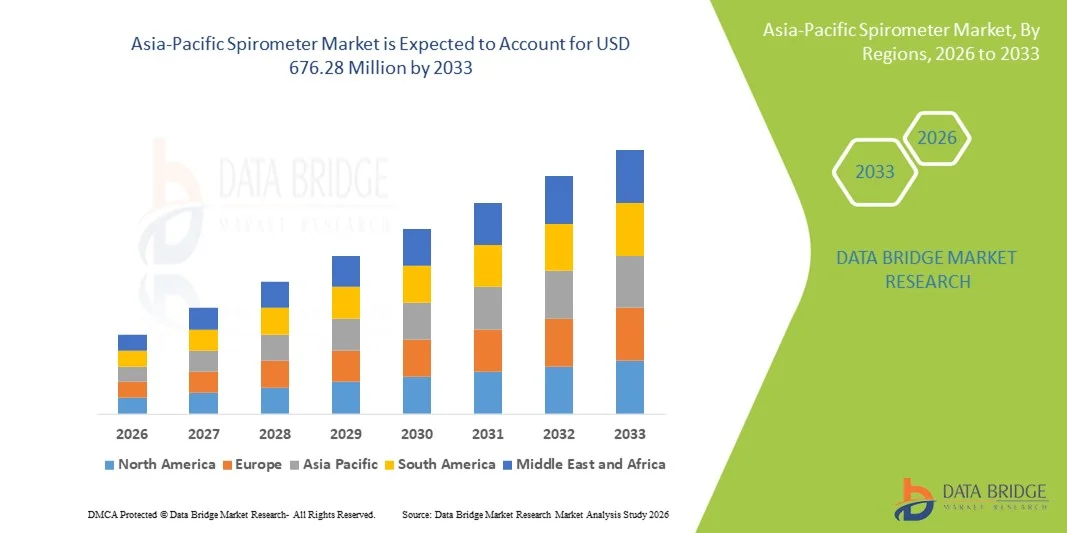
- As per Data Bridge Market Research Analysis the Asia-Pacific spirometer market size was valued at USD 304.25 million in 2025 and is expected to reach USD 676.28 million by 2033, at a CAGR of 10.5% during the forecast period
- The market growth is largely fueled by increasing healthcare investments, rapid urbanization, and an expanding patient pool suffering from conditions such as COPD and asthma, which are elevating demand for spirometry diagnostics in both hospital and homecare settings
- Furthermore, rising adoption of technologically advanced and cost‑effective spirometry solutions, improvements in telemedicine and remote monitoring, and growing awareness of early lung function assessment are positioning spirometers as essential tools in respiratory care across China, India, Japan, South Korea and other Asia‑Pacific countries. These converging factors are accelerating adoption of spirometer technologies, thereby significantly boosting the industry’s growth
Market Size & Forecast
- Global Market Value (2025): USD 304.25 million
- Expected Market Value (2033): USD 676.28 million
- Forecast CAGR (2026–2033):10.5%
Asia-Pacific Spirometer Market Analysis
- Spirometers, providing accurate measurement of lung function and respiratory capacity, are increasingly essential tools in modern respiratory care across hospitals, clinics, and homecare settings due to their role in early diagnosis, disease management, and integration with digital health platforms
- The escalating demand for spirometers is primarily fueled by the rising prevalence of chronic respiratory diseases such as COPD and asthma, increasing healthcare awareness, and growing adoption of remote patient monitoring and telemedicine solutions
- China dominated the Asia-Pacific spirometer market with the largest revenue share of 38.1% in 2025, supported by advanced healthcare infrastructure, high patient awareness, and strong adoption of technologically advanced diagnostic devices across hospitals and clinics
- India is expected to be the fastest-growing country in the Asia-Pacific spirometer market during the forecast period due to increasing healthcare expenditure, rising prevalence of respiratory disorders, rapid urbanization, and expanding access to diagnostic facilities in hospitals, clinics, and homecare settings
- Devices segment dominated the Asia-Pacific spirometer market with a market share of 52.9% in 2025, driven by their essential role in clinical diagnostics, integration with software platforms for data management, and increasing adoption across hospitals, clinics, and homecare settings
Report Scope and Asia-Pacific Spirometer Market Segmentation
|
Attributes |
Asia-Pacific Spirometer Key Market Insights |
|
Segments Covered |
|
|
Countries Covered |
Asia-Pacific
|
|
Key Market Players |
|
|
Market Opportunities |
|
|
Value Added Data Infosets |
In addition to the insights on market scenarios such as market value, growth rate, segmentation, geographical coverage, and major players, the market reports curated by the Data Bridge Market Research also include in-depth expert analysis, patient epidemiology, pipeline analysis, pricing analysis, and regulatory framework |
What is the Key Trend in the Asia-Pacific Spirometer Market?
Integration with Portable and Connected Devices
- A significant and accelerating trend in the Asia-Pacific spirometer market is the growing adoption of portable and connected devices that integrate with digital health platforms, enabling remote monitoring and data sharing
- For instance, the MIR Spirobank Smart allows patients to conduct lung function tests at home and automatically sync results with mobile apps for physician review, enhancing convenience and monitoring accuracy
- Connected spirometers enable real-time tracking of respiratory health, automated reminders for regular testing, and cloud-based storage of historical data for better disease management. For instance, CareFusion’s portable devices support remote monitoring and analytics to detect early signs of deterioration in chronic respiratory patients
- The seamless integration of spirometers with telemedicine platforms allows healthcare providers to monitor multiple patients simultaneously, reduce hospital visits, and provide timely interventions based on continuous data streams
- This trend towards more connected, patient-centric, and digitally integrated spirometer solutions is reshaping expectations in respiratory care. Consequently, companies such as Philips Respironics are developing smart spirometers with Bluetooth connectivity and app-based monitoring for improved patient engagement
- The demand for portable and connected spirometer devices is growing rapidly across both hospitals and homecare sectors, as healthcare providers and patients increasingly prioritize convenience, continuous monitoring, and early intervention
- Integration with wearable devices and health trackers is enabling holistic monitoring of patients’ respiratory and overall health, creating opportunities for comprehensive digital health ecosystems
Asia-Pacific Spirometer Market Dynamics
Driver
Rising Prevalence of Chronic Respiratory Diseases and Telemedicine Adoption
- The increasing incidence of chronic respiratory diseases such as asthma, COPD, and bronchitis, coupled with the accelerating adoption of telemedicine and homecare solutions, is a significant driver for the heightened demand for spirometers
- For instance, in 2024, CareFusion launched a telemonitoring program in India that enabled patients with COPD to perform home-based spirometry tests while sending results directly to healthcare providers for analysis
- As awareness of early diagnosis and regular lung function monitoring grows, spirometers offer advanced features such as connected reporting, automated alerts, and longitudinal tracking, providing a compelling upgrade over manual peak flow meters
- Furthermore, the growing focus on remote healthcare delivery and patient-centric care models is making spirometers an essential diagnostic and monitoring tool in both hospital and homecare settings
- The convenience of portable devices, data sharing through mobile apps, and real-time physician oversight are key factors propelling the adoption of spirometers. The trend towards DIY home testing and the increasing availability of affordable, user-friendly devices further contribute to market growth
- Government initiatives and reimbursement programs promoting early detection of respiratory diseases are incentivizing healthcare providers to adopt spirometry solutions in clinics and hospitals
- Increasing partnerships between spirometer manufacturers and digital health platform providers are driving adoption by enabling seamless integration with patient management systems
Restraint/Challenge
Limited Awareness and High Initial Costs in Emerging Countries
- Low awareness about the importance of regular lung function testing, especially in rural and semi-urban regions, poses a significant challenge to broader market penetration. As spirometry requires training and proper usage, some healthcare providers and patients hesitate to adopt the devices
- For instance, surveys in India and Southeast Asia indicate that a substantial portion of patients with respiratory disorders rely on symptomatic treatment without undergoing lung function tests
- Addressing these awareness gaps through patient education, training programs, and demonstration of the clinical benefits of spirometry is crucial for improving adoption rates. In addition, the relatively high cost of advanced spirometers compared to traditional peak flow meters can limit purchase by smaller clinics or budget-conscious patients
- While portable devices are becoming more affordable, premium models with advanced connectivity or integrated software features often carry higher prices, which may hinder adoption in price-sensitive markets
- Overcoming these challenges through awareness campaigns, cost-effective device offerings, and integration with telehealth initiatives will be vital for sustained market growth
- Limited availability of skilled personnel to operate spirometry equipment in remote or underdeveloped regions may slow adoption despite increasing demand
- Regulatory variations across Asia-Pacific countries regarding medical device approvals and data privacy compliance can create market entry barriers for new manufacturers
Asia-Pacific Spirometer Market Scope
The market is segmented on the basis of product, mechanism, disease, disposable components, end-user, and distribution channel.
- By Product
On the basis of product, the Asia-Pacific spirometer market is segmented into consumables and accessories, devices, and software. The Devices segment dominated the market with the largest market revenue share of 52.9% in 2025, driven by the essential role of spirometers in clinical diagnostics, patient monitoring, and respiratory disease management. Hospitals and clinics prefer devices due to their reliability, accuracy, and ability to provide real-time lung function measurements. Devices also support integration with digital platforms and mobile apps, which enhances patient engagement and remote monitoring capabilities. Established players such as Philips Respironics and CareFusion have strengthened their device portfolios to cater to hospital and homecare settings. Increasing prevalence of chronic respiratory diseases, such as asthma and COPD, further supports the high adoption of devices.
The Software segment is expected to witness the fastest CAGR from 2026 to 2033, driven by the rising adoption of AI-enabled spirometry platforms and telemedicine integration. Software solutions allow physicians to analyze longitudinal patient data, detect early deterioration, and provide personalized treatment recommendations. Cloud-based software also enables remote patient management, reducing hospital visits and improving workflow efficiency. Integration with wearable devices and mobile applications is further boosting software adoption in homecare and outpatient monitoring.
- By Mechanism
On the basis of mechanism, the market is segmented into flow-sensing spirometer and peak flow meters. The Flow-Sensing Spirometer segment dominated the market with a share of 58% in 2025, due to its high accuracy, reproducibility, and suitability for a wide range of patients, including those with chronic respiratory diseases. Flow-sensing devices are preferred in hospitals and clinics for comprehensive lung function analysis. They also support advanced features such as digital data storage, connectivity to EMR systems, and integration with telehealth platforms. Leading manufacturers are focusing on innovations in flow-sensing technology to enhance measurement precision and patient compliance.
The Peak Flow Meters segment is expected to witness the fastest growth, with a projected CAGR of 13% from 2026 to 2033, driven by their simplicity, portability, and affordability. Peak flow meters are widely used in homecare and primary care settings for asthma monitoring. Increasing awareness about self-monitoring among patients and rising demand for easy-to-use respiratory devices in emerging Asia-Pacific countries are fueling growth. Manufacturers are also launching digital peak flow meters that sync with mobile apps to track patient performance over time.
- By Disease
On the basis of disease, the market is segmented into asthma, bronchitis, emphysema, chronic obstructive lung disease (COPD), lung cancer, and others. The Asthma segment dominated the market with the largest revenue share of 34% in 2025, driven by the high prevalence of asthma in countries such as China and India. Spirometers are critical for monitoring airway obstruction, assessing treatment effectiveness, and enabling early intervention. Increasing awareness programs and school-based screening initiatives further support market demand. Asthma patients benefit from portable spirometry and digital tracking systems for continuous monitoring. Hospitals and clinics prioritize spirometry for asthma diagnosis and management due to its non-invasive nature and clinical accuracy.
The Chronic Obstructive Lung Disease (COPD) segment is expected to witness the fastest growth, with a CAGR of 12.5% from 2026 to 2033, owing to the rising incidence of COPD in aging populations and industrialized urban areas. Early detection through spirometry improves disease management and reduces hospitalizations. Government initiatives and health awareness campaigns in countries such as India and Southeast Asia are promoting routine lung function testing for at-risk populations. Manufacturers are offering specialized spirometry solutions designed for COPD diagnosis and long-term monitoring.
- By Disposable Components
On the basis of disposable components, the market is segmented into filters, sensors, and tubes. The Filters segment dominated the market with a share of 45% in 2025, due to their critical role in maintaining hygiene, preventing cross-contamination, and ensuring accurate measurements in hospital and clinic settings. Filters are widely used in high-volume facilities where multiple patients use a single device. Compliance with medical safety standards and infection control protocols further drives demand. Leading spirometer companies supply high-quality, single-use filters compatible with their device portfolios.
The Sensors segment is expected to witness the fastest growth, with a CAGR of 14% from 2026 to 2033, driven by technological advancements in digital and AI-enabled spirometry. Sensors enhance device accuracy, provide real-time readings, and enable integration with software for telemedicine and remote monitoring. Rising demand for portable and connected devices is pushing the adoption of advanced sensors in homecare and clinical settings. Manufacturers are also developing reusable, durable sensor systems to reduce operating costs for healthcare facilities.
- By End-User
On the basis of end-user, the market is segmented into hospitals, clinics, and homecare. The Hospitals segment dominated the market with the largest share of 55% in 2025, due to high patient footfall, advanced diagnostic requirements, and preference for hospital-grade spirometry equipment. Hospitals require comprehensive spirometry solutions for monitoring chronic respiratory diseases and supporting inpatient care. Integration with hospital information systems and EMRs further enhances device utility. Key manufacturers focus on providing hospital-specific devices with enhanced accuracy, connectivity, and compliance with international medical standards.
The Homecare segment is expected to witness the fastest growth, with a CAGR of 15% from 2026 to 2033, driven by the rising trend of home-based monitoring and telemedicine adoption. Increasing awareness about respiratory health, convenience of self-monitoring, and portable spirometry solutions are key factors. Manufacturers are launching user-friendly, compact devices that sync with smartphones and cloud platforms to allow real-time physician monitoring. Growth is particularly strong in India and Southeast Asia, where homecare adoption is rapidly increasing.
- By Distribution Channel
On the basis of distribution channel, the market is segmented into over the counter (otc) and direct tender. The Direct Tender segment dominated the market with a share of 60% in 2025, driven by bulk procurement by hospitals and government healthcare programs. Direct tender agreements ensure consistent supply of devices, consumables, and software to large institutions at negotiated prices. Key manufacturers often partner with government health authorities and large hospital networks to secure tenders, ensuring long-term contracts. The approach also supports integration of training and maintenance services for hospital staff.
The Over the Counter (OTC) segment is expected to witness the fastest growth, with a CAGR of 13% from 2026 to 2033, fueled by rising adoption of spirometers for homecare and outpatient monitoring. OTC availability allows patients to directly purchase devices for self-monitoring without prescriptions. Increasing awareness of respiratory health, coupled with the convenience of portable and easy-to-use devices, is boosting OTC sales. Manufacturers are introducing affordable and user-friendly OTC devices tailored for home use.
Asia-Pacific Spirometer Market Regional Analysis
- China dominated the Asia-Pacific spirometer market with the largest revenue share of 38.1% in 2025, supported by advanced healthcare infrastructure, high patient awareness, and strong adoption of technologically advanced diagnostic devices across hospitals and clinics
- Healthcare providers and patients in the region increasingly prioritize accurate, reliable, and connected spirometry devices, enabling better diagnosis, monitoring, and management of conditions such as asthma, COPD, and bronchitis
- This widespread adoption is further supported by government initiatives promoting respiratory health, growing hospital and clinic networks, and rising investments in telemedicine and homecare solutions, establishing spirometers as an essential diagnostic and monitoring tool across both clinical and home settings
The China Asia-Pacific Spirometer Market Insight
The China spirometer market captured the largest revenue share of 38.1% in 2025, fueled by rising prevalence of chronic respiratory diseases, expanding hospital networks, and increasing awareness of early lung function testing. Patients and healthcare providers prioritize accurate, reliable, and connected spirometry devices for diagnosis and monitoring of asthma, COPD, and bronchitis. The growing integration of telemedicine and digital health platforms is further propelling market growth. In addition, government initiatives promoting respiratory health and investments in modern diagnostic equipment are significantly contributing to the market’s expansion.
Japan Asia-Pacific Spirometer Market Insight
The Japan spirometer market is gaining momentum due to high healthcare standards, rapid urbanization, and a growing elderly population with respiratory health needs. Adoption is driven by the demand for precise and user-friendly spirometry devices in hospitals, clinics, and homecare. Integration of spirometers with digital health platforms and telemonitoring systems enhances disease management. Japan’s focus on preventive healthcare and chronic disease monitoring further supports market growth. Manufacturers are introducing portable and connected spirometers to cater to both clinical and home-based applications.
India Asia-Pacific Spirometer Market Insight
The India spirometer market is expected to grow at the fastest CAGR of 12% from 2026 to 2033, driven by rapid urbanization, rising disposable incomes, and increasing prevalence of respiratory disorders such as asthma and COPD. Homecare adoption and telemedicine integration are boosting demand for portable and connected spirometry devices. Awareness campaigns and government initiatives promoting early diagnosis of respiratory diseases are accelerating adoption across hospitals, clinics, and homecare settings. The availability of cost-effective devices and the emergence of domestic manufacturers further support market expansion.
Australia Asia-Pacific Spirometer Market Insight
The Australia spirometer market is expanding steadily due to high healthcare expenditure, advanced hospital infrastructure, and increasing focus on respiratory wellness. Adoption is driven by the need for accurate diagnosis, monitoring of chronic respiratory diseases, and integration with digital health platforms. Telemonitoring solutions and portable spirometers are gaining traction in homecare settings. Government initiatives and insurance reimbursement programs for chronic disease management further support market growth. Increasing awareness among patients regarding preventive respiratory care is encouraging the adoption of spirometry solutions
Asia-Pacific Spirometer Market Share
The Asia-Pacific Spirometer industry is primarily led by well-established companies, including:
- COSMED Srl (Italy)
- SDI Diagnostics, Inc. (U.S.)
- Shenzhen Mindray Bio Medical Electronics Co., Ltd. (China)
- Contec Medical Systems Co., Ltd. (China)
- FUKUDA DENSHI CO., LTD. (Japan)
- Beijing Aeonmed Co., Ltd. (China)
- Nanjing Chenwei Medical Equipment Co., Ltd. (China)
- Jiangsu Yuyue Medical Instruments Co., Ltd. (China)
- ndd Medical Technologies, Inc. (Switzerland)
- Schiller AG (Switzerland)
- MGC Diagnostics Corporation (U.S.)
- Vyaire Medical, Inc. (U.S.)
- CHEST M.I., Inc. (Japan)
- Konica Minolta, Inc. (Japan)
- Teleflex Incorporated (U.S.)
- Baxter (U.S.)
- Henry Schein, Inc. (U.S.)
- ICU Medical, Inc. (U.S.)
- PulmOne Advanced Medical Devices Ltd (Israel)
- Midmark Corporation (U.S.)
What are the Recent Developments in Asia-Pacific Spirometer Market?
- In August 2024, Monitored Therapeutics released its complete GoClinic® Respiratory Evaluation solution aimed at primary care physicians, combining spirometry with automated interpretation and coaching technology to support wider outpatient respiratory screening and management
- In February 2024, Monitored Therapeutics, Inc. announced that its GoSpiro spirometer received approval from China’s National Medical Products Administration (NMPA), opening local manufacturing and distribution in partnership with Shenzhen‑based Spiritumtec to expand availability of advanced respiratory monitoring devices in China
- In April 2023, NDD Medical Technologies expanded in the Asia‑Pacific region by launching a next‑generation portable spirometry system in India and Southeast Asia, featuring Bluetooth connectivity and cloud integration to enhance early respiratory disease detection and monitoring
- In December 2021, BioSpectrum Asia reported the launch of Cipla’s Spirofy spirometer in India, highlighting its portability, wireless design, and real‑time reporting features to support wider COPD and asthma diagnosis in community settings
- In November 2021, Cipla launched Spirofy, India’s first pneumotach‑based portable, wireless spirometer designed to improve diagnosis of chronic obstructive pulmonary disease (COPD) and asthma as part of its initiative to strengthen respiratory healthcare in India

- Interactive Data Analysis Dashboard
- Company Analysis Dashboard for high growth potential opportunities
- Research Analyst Access for customization & queries
- Competitor Analysis with Interactive dashboard
- Latest News, Updates & Trend analysis
- Harness the Power of Benchmark Analysis for Comprehensive Competitor Tracking
Data collection and base year analysis are done using data collection modules with large sample sizes. The stage includes obtaining market information or related data through various sources and strategies. It includes examining and planning all the data acquired from the past in advance. It likewise envelops the examination of information inconsistencies seen across different information sources. The market data is analysed and estimated using market statistical and coherent models. Also, market share analysis and key trend analysis are the major success factors in the market report. To know more, please request an analyst call or drop down your inquiry.
The key research methodology used by DBMR research team is data triangulation which involves data mining, analysis of the impact of data variables on the market and primary (industry expert) validation. Data models include Vendor Positioning Grid, Market Time Line Analysis, Market Overview and Guide, Company Positioning Grid, Patent Analysis, Pricing Analysis, Company Market Share Analysis, Standards of Measurement, Global versus Regional and Vendor Share Analysis. To know more about the research methodology, drop in an inquiry to speak to our industry experts.
Data Bridge Market Research is a leader in advanced formative research. We take pride in servicing our existing and new customers with data and analysis that match and suits their goal. The report can be customized to include price trend analysis of target brands understanding the market for additional countries (ask for the list of countries), clinical trial results data, literature review, refurbished market and product base analysis. Market analysis of target competitors can be analyzed from technology-based analysis to market portfolio strategies. We can add as many competitors that you require data about in the format and data style you are looking for. Our team of analysts can also provide you data in crude raw excel files pivot tables (Fact book) or can assist you in creating presentations from the data sets available in the report.













