


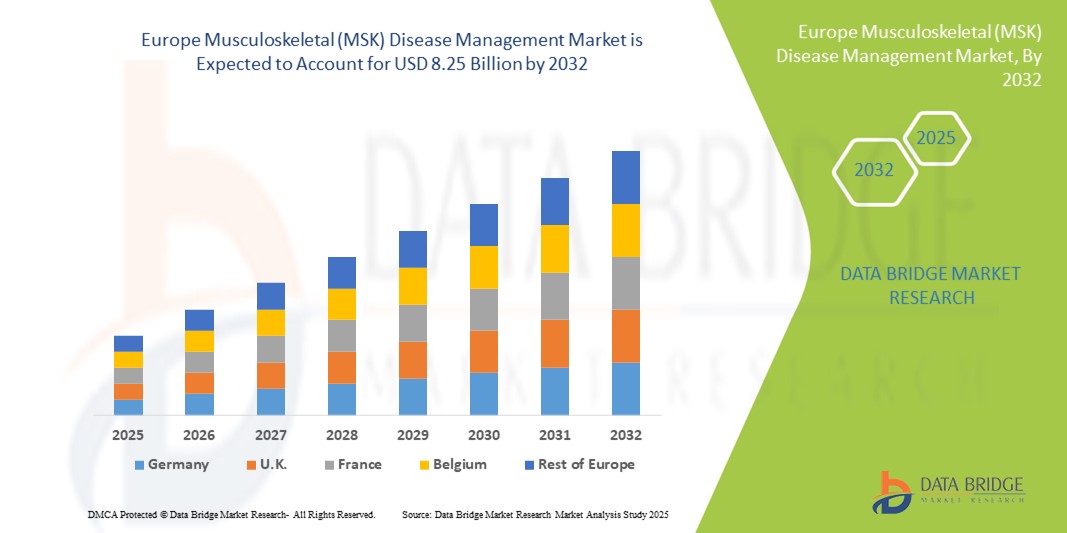
Europe Musculoskeletal (MSK) Disease Management Market Size
- The Europe musculoskeletal (MSK) disease management market size was valued at USD 1.66 billion in 2024 and is expected to reach USD 8.25 billion by 2032, at a CAGR of 22.2% during the forecast period
- The market growth is largely fueled by the rising prevalence of musculoskeletal disorders, advancements in digital health technologies, and increasing demand for personalized care solutions, driving the adoption of comprehensive MSK disease management strategies
- Furthermore, an aging population and growing awareness of preventive and post-operative care are establishing MSK disease management solutions as a critical component of healthcare delivery in Europe. These converging factors are accelerating the uptake of digital and integrated treatment approaches, thereby significantly boosting the industry's growth
Europe Musculoskeletal (MSK) Disease Management Market Analysis
- Musculoskeletal (MSK) disease management solutions, including digital biofeedback systems, musculoskeletal-focused digital apps, and integrated rehabilitation solutions, are increasingly vital components of modern healthcare systems in Europe due to their ability to enhance patient outcomes, support remote monitoring, and integrate with telehealth platforms
- The escalating demand for MSK disease management is primarily fueled by the rising prevalence of musculoskeletal disorders, growing awareness of preventive and post-operative care, and a preference for personalized, patient-centric therapy approaches
- Germany dominated the Europe musculoskeletal (MSK) disease management market with the largest revenue share of 28.9% in 2024, characterized by advanced healthcare infrastructure, high healthcare expenditure, and a strong presence of key market players, with substantial adoption of digital therapeutics and rehabilitation programs driven by innovations from both established healthcare companies and specialized startups
- France is expected to be the fastest-growing country in the Europe musculoskeletal (MSK) disease management market during the forecast period due to increasing healthcare investment, growing geriatric populations, and rising accessibility to integrated digital health solutions
- Musculoskeletal-focused digital apps segment dominated the Europe musculoskeletal (MSK) disease management market with a market share of 36.1% in 2024, driven by their effectiveness in improving mobility, supporting virtual therapy, and integrating with devices such as smartphones and tablets for continuous patient engagement
Report Scope and Europe Musculoskeletal (MSK) Disease Management Market Segmentation
|
Attributes |
Europe Musculoskeletal (MSK) Disease Management Key Market Insights |
|
Segments Covered |
|
|
Countries Covered |
Europe
|
|
Key Market Players |
|
|
Market Opportunities |
|
|
Value Added Data Infosets |
In addition to the insights on market scenarios such as market value, growth rate, segmentation, geographical coverage, and major players, the market reports curated by the Data Bridge Market Research also include in-depth expert analysis, pricing analysis, brand share analysis, consumer survey, demography analysis, supply chain analysis, value chain analysis, raw material/consumables overview, vendor selection criteria, PESTLE Analysis, Porter Analysis, and regulatory framework. |
Europe Musculoskeletal (MSK) Disease Management Market Trends
Integration of Digital and Remote Therapy Solutions
- A significant and accelerating trend in the Europe MSK disease management market is the increasing adoption of digital therapy platforms, including musculoskeletal-focused apps and digital biofeedback systems, enhancing patient engagement, treatment adherence, and real-time monitoring
- For instance, Hinge Health’s digital MSK program integrates remote exercise tracking and personalized therapy plans, allowing patients to follow prescribed routines from home while clinicians monitor progress virtually
- The integration of computer vision and precision motion technologies enables accurate assessment of patient movement, providing automated feedback, progress tracking, and personalized exercise adjustments, improving therapy outcomes and patient satisfaction
- Integration with mobile and tablet platforms facilitates seamless connectivity between patients and healthcare providers, enabling centralized management of therapy sessions, progress tracking, and virtual consultations
- This trend towards intelligent, connected, and patient-centric MSK management is reshaping expectations for rehabilitation, prompting companies such as Sword Health to develop integrated solutions combining digital apps, wearable sensors, and virtual coaching
- The demand for MSK disease management solutions that leverage remote monitoring, digital guidance, and personalized feedback is growing rapidly across Europe, particularly in countries with advanced healthcare infrastructure and digital health initiatives
Europe Musculoskeletal (MSK) Disease Management Market Dynamics
Driver
Rising Prevalence of Musculoskeletal Disorders and Digital Adoption
- The increasing incidence of musculoskeletal disorders across adults and geriatrics, combined with accelerated adoption of digital health platforms, is a key driver for the Europe MSK disease management market
- For instance, Kaia Health launched virtual therapy programs in Germany and the UK, enabling patients to access guided rehabilitation exercises and real-time progress tracking from home, improving adherence and outcomes
- As awareness of preventive care, post-operative rehabilitation, and chronic pain management grows, demand for solutions offering remote monitoring, customized therapy plans, and patient engagement increases significantly
- Furthermore, healthcare systems’ push toward telehealth adoption and integration of digital therapeutics is making MSK disease management an essential part of both hospital and home-based care
- Personalized care solutions, such as customized therapy plans for geriatrics and adults, alongside integration with smartphones and tablets, are propelling adoption in clinical and home health settings
Restraint/Challenge
High Cost of Advanced Digital Solutions and Regulatory Hurdles
- The relatively high initial investment required for advanced digital MSK management systems and adherence platforms poses a challenge to widespread adoption across all European markets
- For instance, small clinics or rehabilitation centers in France and Italy may hesitate to adopt comprehensive digital biofeedback systems due to cost concerns and budget constraints
- Compliance with healthcare regulations and data privacy laws, including GDPR, adds complexity to implementation and integration of patient data across devices and platforms
- While digital MSK solutions provide superior monitoring and outcomes, limited awareness and lack of trained personnel to operate such systems can hinder uptake, particularly in smaller healthcare facilities
- Some orthopedic conditions are treatable and some cannot be cured at this time but can be treated to reduce pain and improve quality of life. Accurate diagnosis and targeted treatment can help reduce problems even in progressive conditions without treatment. Treatment recommendations depend on the type and severity of your condition. Treatments range from RICE (Rest, Ice, Compression and Elevation) to major surgery
- Addressing these challenges through cost-effective solutions, regulatory guidance, and training programs for healthcare providers will be critical to sustaining long-term growth and adoption across Europe
Europe Musculoskeletal (MSK) Disease Management Market Scope
The market is segmented on the basis of type, technology, integration type, modality, application, patient population, and end user.
- By Type
On the basis of type, the Europe musculoskeletal (MSK) disease management market is segmented into digital biofeedback system, musculoskeletal-focused digital apps, solutions, and others. The Musculoskeletal-focused Digital Apps segment dominated the market with the largest revenue share of 36.1% in 2024. This dominance is driven by the apps’ ease of access, convenience, and ability to provide personalized exercise programs and remote monitoring. Patients and clinicians prefer these apps for continuous tracking of mobility and adherence to therapy. Integration with wearable devices allows real-time feedback and virtual consultations, improving engagement. Digital apps are also widely used in both pre- and post-surgery applications. The rising adoption of telehealth services across Europe further reinforces this segment’s market leadership.
The Digital Biofeedback System segment is expected to witness the fastest growth with a CAGR of 18.7% from 2025 to 2033, fueled by advancements in precision motion and computer vision technologies. Biofeedback systems provide real-time correction of patient movements, reducing recovery time and enhancing therapy outcomes. Hospitals, clinics, and home care settings are increasingly deploying these systems. The systems are particularly effective for post-surgery rehabilitation and chronic musculoskeletal conditions. Their integration with digital apps ensures seamless monitoring and adaptive therapy plans. Patients also benefit from interactive guidance, gamification features, and remote clinician oversight.
- By Technology
On the basis of technology, the Europe musculoskeletal (MSK) disease management market is segmented into precision motion technology, computer vision technology, and other technologies. The Precision Motion Technology segment dominated the market in 2024 due to its ability to provide accurate tracking of joint angles, detect deviations, and monitor patient movements. This precision enhances the effectiveness of rehabilitation programs while minimizing the risk of injury. Hospitals and rehabilitation centers in Germany and the UK are increasingly deploying these technologies. Integration with digital apps allows clinicians to remotely monitor adherence and progress. Precision motion technology is widely applied in both virtual and in-person therapy sessions. Its adoption in pre- and post-surgery care strengthens patient recovery outcomes.
The Computer Vision Technology segment is anticipated to witness the fastest growth during the forecast period. Driven by AI-enabled video analysis, computer vision allows automated assessment of patient exercises without additional sensors. Patients receive real-time guidance and corrective feedback during therapy sessions, enhancing engagement and accuracy. This technology is particularly useful in home-based and virtual therapy programs. Countries such as France, Italy, and Spain are rapidly adopting computer vision due to digital health initiatives and tele-rehabilitation support. Integration with tablets and smartphones ensures convenience and usability. Computer vision also enables adaptive and personalized therapy plans tailored to patient performance.
- By Integration Type
On the basis of integration type, the Europe musculoskeletal (MSK) disease management market is segmented into phone, tablet, computer, and others. The Phone segment dominated in 2024 due to the widespread use of smartphones, allowing patients to access therapy programs, monitor progress, and communicate with clinicians conveniently. Mobile integration improves adherence to treatment plans and ensures real-time feedback. Most digital apps and biofeedback systems are optimized for smartphone use. Patients benefit from portability and ease of use in both home and clinical settings. Phones also allow integration with wearable sensors for continuous monitoring. The segment remains dominant due to its accessibility across different patient populations.
The Tablet segment is expected to witness the fastest growth during the forecast period. Tablets provide a larger display, interactive interface, and better visualization of exercises, which is particularly beneficial for elderly patients. Clinics and rehabilitation centers use tablets to deliver structured therapy sessions and virtual guidance. Integration with digital apps enables detailed progress tracking and gamification features. Tablets enhance engagement in pre- and post-surgery applications. Countries such as Germany, France, and the UK are investing in tablet-based MSK therapy solutions. Tablets also support remote supervision by clinicians, improving outcomes.
- By Modality
On the basis of modality, the Europe musculoskeletal (MSK) disease management market is segmented into virtual therapy, in-person therapy, customized/personalized therapy, and others. The Virtual Therapy segment dominated in 2024 due to its flexibility, ability to deliver remote care, and growing acceptance of tele-rehabilitation services. Virtual therapy allows structured exercise programs under remote clinician supervision. Clinicians monitor compliance, track progress, and adjust therapy in real-time. The COVID-19 pandemic accelerated adoption in Germany, France, and the UK. Virtual sessions reduce travel time, costs, and improve patient adherence. Integration with digital apps enhances engagement and long-term outcomes.
The Customized/Personalized Therapy segment is expected to witness the fastest growth from 2025 to 2033. Personalized therapy leverages data from apps and biofeedback systems to tailor exercises to individual patient needs. It is highly effective for post-surgery recovery and chronic musculoskeletal conditions. Integration with precision motion and computer vision technologies allows adaptive therapy adjustments. Countries such as Italy and Spain are increasingly adopting personalized solutions. Clinicians can remotely monitor progress and modify therapy plans. Personalized therapy improves outcomes, satisfaction, and adherence across patient populations.
- By Application
On the basis of application, the Europe musculoskeletal (MSK) disease management market is segmented into pre-surgery applications and post-surgery applications. The Post-Surgery Applications segment dominated in 2024 due to high demand for rehabilitation following orthopedic surgeries, joint replacements, and musculoskeletal injuries. Post-surgery therapy restores mobility, reduces pain, and prevents complications. Digital solutions enable remote monitoring, guidance, and virtual consultations. Hospitals and rehabilitation centers use these applications to optimize resources and outcomes. Integration with wearable devices and apps ensures continuous monitoring. Countries such as Germany, France, and the UK have high adoption rates.
The Pre-Surgery Applications segment is expected to witness the fastest growth during forecast period. Pre-surgery rehabilitation strengthens muscles and improves mobility before surgery, reducing post-operative recovery time. Digital biofeedback systems and apps provide structured exercise programs. Countries such as Germany, France, and Italy are implementing prehabilitation programs supported by technology. Integration with tablets and phones enhances accessibility. Clinicians can track patient readiness and optimize surgical outcomes. Pre-surgery applications are increasingly being recognized as critical components of comprehensive MSK care.
- By Patient Population
On the basis of patient population, the Europe musculoskeletal (MSK) disease management market is segmented into pediatrics, adults, and geriatrics. The Adults segment dominated in 2024 due to the high prevalence of musculoskeletal disorders, workplace injuries, and chronic conditions in this group. Adults actively use digital apps and rehabilitation solutions. Remote monitoring and virtual therapy improve adherence and outcomes. Integration with phones and tablets facilitates continuous engagement. Clinics and hospitals leverage adult-focused programs for pre- and post-surgery care. The segment accounts for the largest revenue share due to broad applicability.
The Geriatrics segment is expected to witness the fastest growth from 2025 to 2033, driven by Europe’s aging population and increasing incidence of age-related musculoskeletal disorders. Geriatric patients benefit from easy-to-use digital biofeedback systems and virtual therapy programs. Integration with tablets and phones ensures usability. Remote monitoring allows clinicians to track progress and prevent complications. Countries such as Italy, Spain, and the UK are leading adoption. The demand for home-based therapy solutions is rapidly increasing.
- By End User
On the basis of end user, the Europe musculoskeletal (MSK) disease management market is segmented into hospitals & clinics, nursing homes, health centers, rehabilitation centers, virtual/home health care settings, and others. The Hospitals & Clinics segment dominated in 2024 due to established infrastructure, specialized teams, and high adoption of digital MSK solutions. Hospitals use apps and biofeedback systems for inpatient and outpatient care. Clinicians monitor adherence, progress, and outcomes remotely. Integration with wearable devices and tablets enhances therapy efficiency. Countries such as Germany, France, and the UK are leading adoption. The segment remains dominant due to high infrastructure and expertise.
The Virtual/Home Health Care Settings segment is expected to witness the fastest growth from 2025 to 2033. Home-based rehabilitation allows patients to access therapy remotely, improving convenience and adherence. Integration with phones, tablets, and apps facilitates monitoring and guidance. Tele-rehabilitation adoption is rising across Europe, particularly in Germany, France, and the UK. Home care settings reduce hospital visits while maintaining high-quality therapy. Stakeholders are investing in virtual care platforms to meet growing demand.
Europe Musculoskeletal (MSK) Disease Management Market Regional Analysis
- Germany dominated the Europe musculoskeletal (MSK) disease management market with the largest revenue share of 28.9% in 2024, characterized by advanced healthcare infrastructure, high healthcare expenditure, and a strong presence of key market players, with substantial adoption of digital therapeutics and rehabilitation programs driven by innovations from both established healthcare companies and specialized startups
- Patients and clinicians in the region highly value solutions that provide remote monitoring, personalized therapy programs, and integration with digital apps and wearable devices, enhancing adherence and treatment outcomes
- The widespread adoption of MSK management solutions in Germany is further supported by a technologically inclined population, government initiatives promoting telehealth, and high healthcare expenditure. These factors establish MSK disease management solutions as a preferred choice across hospitals, clinics, and home care settings
The Germany Musculoskeletal (MSK) Disease Management Market Insight
The Germany musculoskeletal (MSK) disease management market is expected to expand at a considerable CAGR during the forecast period, driven by well-developed healthcare infrastructure, high healthcare spending, and growing awareness of digital therapeutics. Hospitals, rehabilitation centers, and virtual care providers are increasingly adopting musculoskeletal-focused apps and digital biofeedback systems to monitor patient recovery and improve outcomes. Germany’s focus on innovation, integration of precision motion technologies, and widespread tele-rehabilitation adoption are fueling growth. The demand for home-based care and personalized therapy programs is rising, particularly for post-surgery rehabilitation and chronic conditions. Digital solutions that allow remote monitoring and patient engagement are becoming mainstream in German healthcare. The emphasis on sustainability, efficiency, and high-quality patient care further strengthens market adoption.
France Musculoskeletal (MSK) Disease Management Market Insight
The France musculoskeletal (MSK) disease management market is anticipated to grow at a noteworthy CAGR during the forecast period, driven by government initiatives promoting digital health adoption and rising awareness of preventive care. French healthcare providers are increasingly integrating virtual therapy and digital apps for both pre-surgery and post-surgery rehabilitation. Patients are benefiting from remote monitoring, interactive guidance, and personalized exercise programs delivered through phones, tablets, and computers. The increasing prevalence of musculoskeletal disorders among adults and geriatrics is boosting the demand for comprehensive management solutions. Tele-rehabilitation and digital therapeutics adoption is supported by strong healthcare infrastructure and policy frameworks.
U.K. Musculoskeletal (MSK) Disease Management Market Insight
The U.K. musculoskeletal (MSK) disease management market is poised to expand at a considerable CAGR during the forecast period, fueled by growing awareness of chronic musculoskeletal conditions, rising geriatric population, and increasing adoption of connected digital health solutions. Hospitals, clinics, and home care providers are adopting musculoskeletal-focused apps, biofeedback systems, and virtual therapy platforms. The integration of precision motion and computer vision technologies supports accurate monitoring and adaptive therapy plans. Patient engagement through mobile and tablet applications is increasing adherence to rehabilitation programs. Government initiatives promoting telehealth and digital therapeutics further stimulate market growth. The focus on personalized, patient-centric care drives adoption across residential and clinical settings.
Italy Musculoskeletal (MSK) Disease Management Market Insight
The Italy musculoskeletal (MSK) disease management market is expected to grow at a strong CAGR during the forecast period, supported by rising musculoskeletal disorder prevalence, increasing geriatric population, and growing investment in digital health technologies. Italian hospitals and rehabilitation centers are leveraging digital biofeedback systems and musculoskeletal-focused apps to provide remote monitoring and interactive therapy. Pre-surgery and post-surgery applications are witnessing strong adoption, particularly for joint replacement and orthopedic procedures. Virtual therapy platforms enable patient engagement and reduce hospital visits. Government-backed digital health initiatives and tele-rehabilitation programs further support market expansion. Patients benefit from personalized exercise plans, progress tracking, and integration with mobile and tablet devices.
Europe Musculoskeletal (MSK) Disease Management Market Share
The Europe Musculoskeletal (MSK) Disease Management industry is primarily led by well-established companies, including:
- Össur (Iceland)
- Chiesi Farmaceutici S.p.A. (Italy)
- Wörwag Pharma (Germany)
- Zimmer Biomet (U.S.)
- Bauerfeind (Germany)
- CSL (Switzerland)
- Medtronic (Ireland)
- Stryker (U.S.)
- Smith + Nephew (U.K.)
- DePuy Synthes (U.S.)
- Johnson & Johnson and its affiliates (U.S.)
- Globus Medical (U.S.)
- Kaia Health Software GmbH (Germany)
- Sword Health (Portugal)
- BMC Musculoskeletal Disorders (U.K.)
- TRAK (Finland)
- SmILE Project (Spain)
- EUROCAM (Belgium)
- HOSPEEM (Belgium)
- EIT Health (Belgium)
What are the Recent Developments in Europe Musculoskeletal (MSK) Disease Management Market?
- In April 2025, the SmILE project was initiated to develop smart implants and digital health solutions aimed at preventing and managing musculoskeletal diseases. This European initiative seeks to enhance patient care and independence through innovative technologies
- In March 2025, Johnson & Johnson MedTech showcased its innovations in digital orthopaedics at the American Academy of Orthopaedic Surgeons (AAOS) 2025 conference. These advancements aim to transform the full ecosystem of orthopaedic procedures to meet the growing demand for effective, scalable solutions in musculoskeletal care
- In February 2025, the SmILE project was initiated to develop smart implants and digital health solutions aimed at preventing and managing musculoskeletal diseases. This European initiative seeks to enhance patient care and independence through innovative technologies, focusing on reducing the burden of musculoskeletal non-communicable diseases among the elderly
- In November 2024, research explored the potential of artificial intelligence (AI) in musculoskeletal imaging, focusing on its clinical adoption, ethical considerations, and technical challenges. The study aimed to provide a balanced perspective on the future of AI in musculoskeletal radiology, including the types of AI models utilized and current solutions
- In February 2023, the World Health Organization (WHO) and the European Society for Clinical and Economic Aspects of Osteoporosis and Musculoskeletal Diseases (ESCEO) announced a collaboration aimed at improving bone health and addressing ageing populations. The partnership focuses on developing public health strategies and action plans to prevent fractures among older individuals, aligning with WHO's Thirteenth General Programme of Work

- Interactive Data Analysis Dashboard
- Company Analysis Dashboard for high growth potential opportunities
- Research Analyst Access for customization & queries
- Competitor Analysis with Interactive dashboard
- Latest News, Updates & Trend analysis
- Harness the Power of Benchmark Analysis for Comprehensive Competitor Tracking
Data collection and base year analysis are done using data collection modules with large sample sizes. The stage includes obtaining market information or related data through various sources and strategies. It includes examining and planning all the data acquired from the past in advance. It likewise envelops the examination of information inconsistencies seen across different information sources. The market data is analysed and estimated using market statistical and coherent models. Also, market share analysis and key trend analysis are the major success factors in the market report. To know more, please request an analyst call or drop down your inquiry.
The key research methodology used by DBMR research team is data triangulation which involves data mining, analysis of the impact of data variables on the market and primary (industry expert) validation. Data models include Vendor Positioning Grid, Market Time Line Analysis, Market Overview and Guide, Company Positioning Grid, Patent Analysis, Pricing Analysis, Company Market Share Analysis, Standards of Measurement, Global versus Regional and Vendor Share Analysis. To know more about the research methodology, drop in an inquiry to speak to our industry experts.
Data Bridge Market Research is a leader in advanced formative research. We take pride in servicing our existing and new customers with data and analysis that match and suits their goal. The report can be customized to include price trend analysis of target brands understanding the market for additional countries (ask for the list of countries), clinical trial results data, literature review, refurbished market and product base analysis. Market analysis of target competitors can be analyzed from technology-based analysis to market portfolio strategies. We can add as many competitors that you require data about in the format and data style you are looking for. Our team of analysts can also provide you data in crude raw excel files pivot tables (Fact book) or can assist you in creating presentations from the data sets available in the report.













