


Europe Neonatal Jaundice Management Market Size
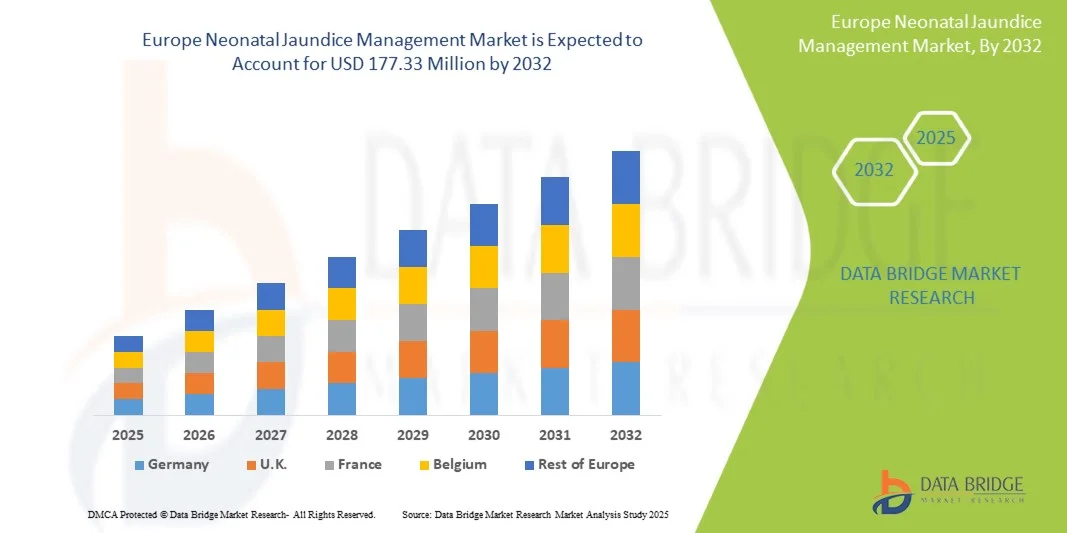
- The Europe neonatal jaundice management market size was valued at USD 109.59 million in 2024 and is expected to reach USD 177.33 million by 2032, at a CAGR of 6.2% during the forecast period
- The market growth is largely fueled by the high prevalence of neonatal jaundice in Europe and technological advancements in phototherapy devices, including AI-enabled bilirubin monitoring, which are improving diagnosis and treatment outcomes
- Furthermore, increasing investments in neonatal healthcare infrastructure and government initiatives promoting maternal and child health are driving the adoption of advanced jaundice management solutions, positioning them as the preferred approach for effective neonatal care. These converging factors are accelerating the uptake of neonatal jaundice management technologies, thereby significantly boosting the industry's growth
Europe Neonatal Jaundice Management Market Analysis
- Neonatal jaundice management solutions, including diagnosis and treatment devices, are increasingly vital components of neonatal healthcare in both hospitals and clinics across Europe due to their effectiveness in preventing severe hyperbilirubinemia, improved patient outcomes, and integration with advanced neonatal care protocols
- The escalating demand for neonatal jaundice management solutions is primarily fueled by the high prevalence of neonatal jaundice, growing awareness among healthcare providers and parents, and rising adoption of technologically advanced phototherapy and diagnostic devices
- Germany dominated the European neonatal jaundice management market with the largest revenue share of 28.3% in 2024, characterized by well-established healthcare infrastructure, high-quality neonatal intensive care units (NICUs), and strong government support, with substantial growth in device adoption driven by innovations in light-emitting diode (LED) light sources and fiberoptic technologies
- France is expected to be the fastest growing country in the European neonatal jaundice management market during the forecast period, with a market share of 14.6% in 2024, due to increasing healthcare investments, expanding hospital networks, and rising awareness of neonatal care protocols
- Light-emitting diode (LED) technology dominated the Europe neonatal jaundice management market with a market share of 48.7% in 2024, driven by its high treatment efficacy, energy efficiency, and continuous innovations improving neonatal care outcomes
Report Scope and Europe Neonatal Jaundice Management Market Segmentation
|
Attributes |
Europe Neonatal Jaundice Management Key Market Insights |
|
Segments Covered |
|
|
Countries Covered |
Europe
|
|
Key Market Players |
|
|
Market Opportunities |
|
|
Value Added Data Infosets |
In addition to the insights on market scenarios such as market value, growth rate, segmentation, geographical coverage, and major players, the market reports curated by the Data Bridge Market Research also include in-depth expert analysis, pricing analysis, brand share analysis, consumer survey, demography analysis, supply chain analysis, value chain analysis, raw material/consumables overview, vendor selection criteria, PESTLE Analysis, Porter Analysis, and regulatory framework. |
Europe Neonatal Jaundice Management Market Trends
“Integration of Advanced Phototherapy and AI Monitoring”
- A significant and accelerating trend in the European neonatal jaundice management market is the integration of advanced phototherapy devices with AI-enabled bilirubin monitoring systems, improving treatment precision and reducing hospital stays
- For instance, the BiliSoft LED Phototherapy System integrates real-time bilirubin tracking, allowing clinicians to adjust treatment intensity automatically based on the infant’s condition
- AI-enabled devices in jaundice management allow predictive analysis of bilirubin trends, enabling healthcare providers to intervene earlier and personalize therapy. For instance, Dräger’s Bilirubin Meter utilizes AI to predict risk levels and optimize phototherapy duration
- The seamless integration of these devices with hospital electronic health records (EHR) allows centralized monitoring of neonatal patients, facilitating better care coordination and reducing errors
- This trend towards smarter, more precise, and interconnected jaundice management systems is reshaping clinical protocols. Consequently, companies such as Natus are developing LED phototherapy solutions with AI monitoring to optimize treatment duration and intensity
- The demand for neonatal jaundice management devices with AI-driven monitoring and improved phototherapy efficiency is growing rapidly across hospitals and clinics, as healthcare providers prioritize patient safety and clinical outcomes
Europe Neonatal Jaundice Management Market Dynamics
Driver
“Rising Incidence of Neonatal Jaundice and Advanced Technology Adoption”
- The increasing prevalence of neonatal jaundice across Europe, coupled with the growing adoption of advanced phototherapy and monitoring systems, is a significant driver for market growth
- For instance, in March 2024, Natus Medical announced the launch of its LED phototherapy system with integrated bilirubin monitoring, aimed at enhancing treatment outcomes in European NICUs
- As clinicians seek more effective and personalized treatment methods, neonatal jaundice management devices offer features such as continuous bilirubin tracking, adjustable light intensity, and predictive alerts for treatment optimization
- Furthermore, increasing awareness among parents and healthcare professionals regarding early diagnosis and intervention is driving the adoption of sophisticated jaundice management solutions
- The convenience of integrated monitoring systems, combined with rapid treatment response and reduced hospital stays, is propelling the use of these devices in both hospitals and specialized neonatal care centers. The trend towards AI-enabled monitoring and improved phototherapy efficacy further contributes to market growth
Restraint/Challenge
“High Device Cost and Regulatory Compliance Hurdles”
- Concerns surrounding the high cost of advanced phototherapy and AI-enabled bilirubin monitoring devices pose a significant challenge to broader market adoption, particularly in smaller clinics and budget-constrained hospitals
- For instance, hospitals may delay procurement due to premium pricing of LED phototherapy systems with integrated AI monitoring despite long-term clinical benefits
- Addressing regulatory compliance and clinical validation requirements across European countries is crucial, as variations in approval protocols can slow market entry and adoption. For instance, devices must meet CE marking and national health authority guidelines before deployment
- In addition, limited training among healthcare staff for operating sophisticated AI-enabled devices can reduce utilization efficiency, making onboarding and education critical
- While costs are gradually decreasing and devices are becoming more user-friendly, the perceived premium for advanced technology can still hinder adoption
- Overcoming these challenges through cost reduction, regulatory alignment, and training will be vital for sustained market growth
Europe Neonatal Jaundice Management Market Scope
The market is segmented on the basis of management, type, technology, end user, and distribution channel.
- By Management
On the basis of management, the market is segmented into diagnosis and treatment. The treatment segment dominated the market with the largest revenue share in 2024, driven by the high adoption of phototherapy devices in hospitals and specialized neonatal care centers. Hospitals and clinics prioritize treatment solutions as they directly reduce bilirubin levels and prevent severe complications in newborns. Treatment devices also include LED phototherapy, fiberoptic blankets, and conventional phototherapy lamps, which offer varying efficacy and suitability for different care settings. The integration of advanced phototherapy with AI-enabled monitoring is increasing demand further. Ongoing technological innovations and clinical effectiveness contribute to the segment’s dominance. Continuous research and hospital investments reinforce the preference for treatment over standalone diagnostic devices.
The diagnosis segment is expected to witness the fastest growth from 2025 to 2032, fueled by increasing awareness of early detection and monitoring of neonatal jaundice. Non-invasive bilirubin meters and AI-enabled screening systems are gaining adoption across both primary and secondary care facilities. Early diagnosis reduces the need for prolonged hospital stays and ensures timely phototherapy initiation. Healthcare professionals are increasingly incorporating routine bilirubin checks into neonatal protocols. Portable diagnostic devices are also creating opportunities for home monitoring and outpatient care. The growing focus on preventive neonatal healthcare and regulatory encouragement for standardized screening is boosting this segment’s growth.
- By Type
On the basis of type, the market is segmented into primary care and secondary care. The secondary care segment dominated the market with the largest revenue share in 2024, owing to the concentration of advanced NICUs and specialized phototherapy equipment in hospitals. Secondary care facilities provide comprehensive monitoring, intensive treatment, and emergency management for severe cases of neonatal jaundice. The availability of trained neonatal specialists and continuous patient monitoring enhances treatment outcomes. Hospitals are increasingly investing in AI-enabled phototherapy systems for secondary care. The presence of integrated EHR and monitoring systems makes secondary care the preferred setting for complex cases. Consequently, secondary care continues to account for the majority of market revenue.
The primary care segment is expected to witness the fastest growth during 2025–2032 due to rising awareness among parents and increased adoption of portable diagnostic and phototherapy devices in outpatient clinics and local healthcare centers. Home-based and community-level neonatal jaundice monitoring is gaining traction, allowing early detection and intervention. Primary care facilities are expanding their services to include neonatal screening and follow-up treatment. Affordability and accessibility of portable devices further drive adoption. Government initiatives promoting early neonatal screening programs contribute to rapid growth. The convenience of primary care for parents also accelerates market penetration.
- By Technology
On the basis of technology, the market is segmented into light-emitting diode (LED) light sources, fluorescent, halogen, fiberoptic, and others. The LED segment dominated the market with a revenue share of 48.7% in 2024, driven by high treatment efficacy, energy efficiency, and reduced heat exposure to neonates. Hospitals and neonatal care centers prefer LED phototherapy due to its consistent wavelength output and longer operational life. The low heat generation minimizes dehydration risk and improves infant comfort. Continuous technological innovations, such as AI integration for adaptive light intensity, further enhance adoption. LED devices are also compatible with fiberoptic blankets for portable treatment, increasing flexibility in care. The combination of clinical effectiveness, safety, and energy savings supports its dominance.
The fiberoptic segment is expected to witness the fastest growth from 2025 to 2032, fueled by the rising demand for portable phototherapy solutions and home-based treatment options. Fiberoptic blankets and pads allow neonates to receive therapy without restricting movement. This technology is particularly beneficial for outpatient care and at-home monitoring, enabling early intervention. Parents are increasingly adopting fiberoptic devices for convenience and safety. Integration with LED light sources improves efficacy while maintaining portability. Regulatory approvals and growing awareness of neonatal home care contribute to rapid adoption.
- By End User
On the basis of end user, the market is segmented into hospitals, clinics, ambulatory surgical centers, home users, and others. The hospital segment dominated the market with the largest revenue share in 2024, due to the presence of NICUs and specialized phototherapy facilities. Hospitals offer advanced treatment options, continuous bilirubin monitoring, and professional neonatal care. High adoption of AI-enabled phototherapy devices further strengthens hospital dominance. Hospitals also benefit from government initiatives promoting neonatal care and early jaundice treatment. Continuous patient monitoring ensures better treatment outcomes, reinforcing the preference for hospital-based care. The segment also captures revenue from equipment maintenance and long-term service contracts.
The home users segment is expected to witness the fastest growth during 2025–2032, driven by increasing availability of portable phototherapy and non-invasive bilirubin monitoring devices. Parents are adopting home-based care to avoid prolonged hospital stays and facilitate early intervention. Portable devices allow convenient treatment while maintaining neonatal comfort. Integration with telemedicine platforms enables remote guidance from clinicians. Government programs encouraging outpatient neonatal care further boost adoption. Growing awareness among parents of the importance of early jaundice management accelerates market expansion.
- By Distribution Channel
On the basis of distribution channel, the market is segmented into direct tender, retail sales, and third-party distribution. The direct tender segment dominated the market with the largest revenue share in 2024, primarily driven by hospital procurement contracts and bulk purchases of phototherapy and diagnostic equipment. Hospitals prefer direct procurement to ensure quality, timely delivery, and after-sales support. Large-scale tenders also reduce overall equipment costs and simplify warranty management. Manufacturers often provide training and installation support as part of direct sales agreements. Government healthcare programs promoting neonatal care further strengthen this channel. The segment captures long-term relationships with hospitals and specialized neonatal centers.
The retail sales segment is expected to witness the fastest growth from 2025 to 2032, fueled by increasing sales of portable phototherapy devices and bilirubin meters to clinics and home users. Online platforms and specialized medical device retailers are expanding access to neonatal care solutions. Retail channels also cater to parents seeking convenient home monitoring and treatment options. Affordable device options and bundled packages increase market penetration. Marketing efforts and parent awareness campaigns drive consumer adoption through retail. The segment benefits from flexible payment options and quick product delivery, accelerating growth.
Europe Neonatal Jaundice Management Market Regional Analysis
- Germany dominated the European neonatal jaundice management market with the largest revenue share of 28.3% in 2024, characterized by well-established healthcare infrastructure, high-quality neonatal intensive care units (NICUs), and strong government support, with substantial growth in device adoption driven by innovations in light-emitting diode (LED) light sources and fiberoptic technologies
- Healthcare providers in the country prioritize timely diagnosis and effective treatment of neonatal jaundice, leveraging technologically advanced phototherapy devices and non-invasive bilirubin meters to ensure improved patient outcomes
- This widespread adoption is further supported by government initiatives promoting neonatal care, high-quality hospital networks, and a skilled workforce of neonatal specialists, establishing Germany as a key market for both diagnostic and treatment solutions
France Neonatal Jaundice Management Market Insight
The France neonatal jaundice management market is anticipated to grow at a noteworthy CAGR during the forecast period, driven by rising awareness of early neonatal screening and growing investments in neonatal healthcare infrastructure. Hospitals and primary care centers are increasingly adopting portable phototherapy and AI-enabled bilirubin monitoring devices to reduce hospital stays and improve patient outcomes. Supportive healthcare policies, preventive care initiatives, and enhanced training of neonatal staff accelerate market penetration. Integration of advanced devices into clinical workflows enhances efficiency. Rising parental awareness further fuels adoption. France is emerging as a key growth market in Western Europe.
U.K. Neonatal Jaundice Management Market Insight
The U.K. neonatal jaundice management market is expected to expand at a considerable CAGR during the forecast period, fueled by increasing adoption of advanced phototherapy solutions and diagnostic devices in hospitals and clinics. Growing concerns regarding neonatal health complications are driving investments in timely treatment and monitoring. Government-supported neonatal screening programs, combined with strong hospital infrastructure, support widespread adoption. The rise of portable and home-based phototherapy systems is also contributing to market growth. Skilled neonatal care professionals and advanced NICUs ensure high-quality outcomes. Integration with AI monitoring systems further enhances the market’s appeal.
Italy Neonatal Jaundice Management Market Insight
The Italy neonatal jaundice management market is poised to grow steadily during the forecast period, driven by increasing awareness among healthcare providers and parents regarding early detection and treatment of neonatal jaundice. Adoption of modern phototherapy devices, including LED and fiberoptic technologies, improves treatment efficacy and safety. Expanding neonatal care facilities and hospital infrastructure investments support market expansion. Government initiatives promoting maternal and child health contribute to growth. Hospitals are integrating advanced diagnostic and treatment systems to optimize care. Focus on outpatient and community-level neonatal services further accelerates adoption.
Europe Neonatal Jaundice Management Market Share
The Europe Neonatal Jaundice Management industry is primarily led by well-established companies, including:
- Drägerwerk AG & Co. KGaA (Germany)
- F. Hoffmann-La Roche Ltd (Switzerland)
- Koninklijke Philips N.V. (Netherlands)
- Siemens Healthineers AG (Germany)
- GE HealthCare (U.S.)
- Natus Medical Incorporated (U.S.)
- Atom Medical Corp (Japan)
- BD (U.S.)
- Medtronic (Ireland)
- Fisher & Paykel Healthcare Limited. (New Zealand)
- Getinge AB (Sweden)
- Wieland Vertriebs GmbH (Germany)
- Phoenix Medical Systems. (India)
- Nice Neotech Medical Systems Pvt. Ltd. (India)
- Fanem. (Brazil)
- MTTS (Vietnam)
- Zhengzhou Dison Instrument and Meter Co., Ltd. (China)
- David Medical Device Co., Ltd. (China)
What are the Recent Developments in Europe Neonatal Jaundice Management Market?
- In August 2025, a pilot study in Rotterdam, Netherlands, assessed the effectiveness of a wearable phototherapy device for neonatal jaundice. The study found that the device was safe and effective in reducing bilirubin levels in term neonates, offering a potential alternative to traditional phototherapy
- In June 2025, Drägerwerk AG launched a next-generation phototherapy device utilizing LED technology. This device is designed to improve treatment outcomes for neonatal jaundice by delivering effective therapy while minimizing thermal stress and energy consumption.
- In January 2025, a study in the UK implemented the American Academy of Pediatrics' 2022 guidelines for neonatal hyperbilirubinemia. The implementation resulted in a 42–68% reduction in hospitalizations for hyperbilirubinemia requiring phototherapy, highlighting the guidelines' effectiveness
- In July 2024, the NeoSCB app was introduced to enable midwives to screen for significant jaundice during home visits. The app uses a smartphone camera to capture photos of the baby's eye, allowing for accessible and efficient diagnostic processes in neonatal care
- In April 2024, the European Union-funded project "Picterus" introduced a smartphone-based solution for neonatal jaundice screening. This tool enables midwives and nurses to assess jaundice levels during early home visits, reducing hospital visits and stress for parents

- Interactive Data Analysis Dashboard
- Company Analysis Dashboard for high growth potential opportunities
- Research Analyst Access for customization & queries
- Competitor Analysis with Interactive dashboard
- Latest News, Updates & Trend analysis
- Harness the Power of Benchmark Analysis for Comprehensive Competitor Tracking
Data collection and base year analysis are done using data collection modules with large sample sizes. The stage includes obtaining market information or related data through various sources and strategies. It includes examining and planning all the data acquired from the past in advance. It likewise envelops the examination of information inconsistencies seen across different information sources. The market data is analysed and estimated using market statistical and coherent models. Also, market share analysis and key trend analysis are the major success factors in the market report. To know more, please request an analyst call or drop down your inquiry.
The key research methodology used by DBMR research team is data triangulation which involves data mining, analysis of the impact of data variables on the market and primary (industry expert) validation. Data models include Vendor Positioning Grid, Market Time Line Analysis, Market Overview and Guide, Company Positioning Grid, Patent Analysis, Pricing Analysis, Company Market Share Analysis, Standards of Measurement, Global versus Regional and Vendor Share Analysis. To know more about the research methodology, drop in an inquiry to speak to our industry experts.
Data Bridge Market Research is a leader in advanced formative research. We take pride in servicing our existing and new customers with data and analysis that match and suits their goal. The report can be customized to include price trend analysis of target brands understanding the market for additional countries (ask for the list of countries), clinical trial results data, literature review, refurbished market and product base analysis. Market analysis of target competitors can be analyzed from technology-based analysis to market portfolio strategies. We can add as many competitors that you require data about in the format and data style you are looking for. Our team of analysts can also provide you data in crude raw excel files pivot tables (Fact book) or can assist you in creating presentations from the data sets available in the report.












