


Europe Radio Immunoassay (RIA) Reagents and Devices Market Size
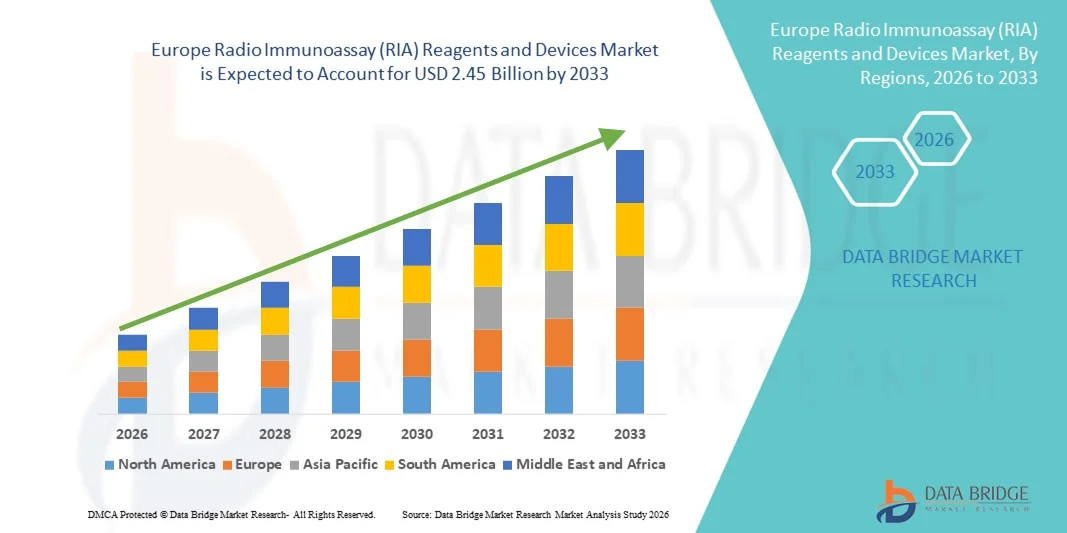
- The Europe Radio Immunoassay (RIA) reagents and devices market size was valued at USD 2.00 billion in 2025 and is expected to reach USD 2.45 billion by 2033, at a CAGR of 2.6% during the forecast period
- The market growth is largely fueled by the increasing prevalence of chronic and endocrine disorders, rising demand for highly sensitive diagnostic techniques, and expanding clinical and research applications across hospitals, diagnostic laboratories, and academic institutions throughout Europe
- Furthermore, continuous technological advancements in assay sensitivity, automation of laboratory workflows, and growing investments in nuclear medicine and immunodiagnostics are positioning RIA reagents and devices as reliable tools for precise hormone, infectious disease, and therapeutic drug monitoring. These converging factors are accelerating market adoption, thereby significantly boosting the industry's growth
Europe Radio Immunoassay (RIA) Reagents and Devices Market Analysis
- Radio Immunoassay (RIA) reagents and devices, designed for the highly sensitive quantification of hormones, peptides, drugs, and other biological markers using radiolabeled antigens or antibodies, remain essential components of clinical diagnostics and biomedical research laboratories across Europe due to their precision, reliability, and established clinical validation
- The escalating demand for RIA reagents and devices is primarily fueled by the rising prevalence of endocrine disorders, increasing need for accurate therapeutic drug monitoring, expanding applications in oncology and infectious disease testing, and sustained utilization of RIA in specialized diagnostic laboratories despite the emergence of alternative immunoassay technologies
- Germany dominated the Europe RIA reagents and devices market with the largest revenue share of 28.4% in 2025, characterized by advanced healthcare infrastructure, strong regulatory standards, and substantial investments in clinical research and nuclear medicine, with widespread adoption across university hospitals and accredited diagnostic laboratories
- Poland is expected to be the fastest growing country in the market during the forecast period, due to ongoing healthcare infrastructure modernization, increasing diagnostic awareness, and rising investments in laboratory equipment and immunodiagnostic technologies
- The Reagents and Kits segment dominated the Europe RIA reagents and devices market with a market share of 61.7% in 2025, driven by recurring demand for assay kits, radiolabeled tracers, and antibodies used in routine hormone testing, oncology diagnostics, and therapeutic drug monitoring across hospitals and reference laboratories
Report Scope and Europe Radio Immunoassay (RIA) Reagents and Devices Market Segmentation
|
Attributes |
Europe Radio Immunoassay (RIA) Reagents and Devices Key Market Insights |
|
Segments Covered |
|
|
Countries Covered |
Europe
|
|
Key Market Players |
|
|
Market Opportunities |
|
|
Value Added Data Infosets |
In addition to the insights on market scenarios such as market value, growth rate, segmentation, geographical coverage, and major players, the market reports curated by the Data Bridge Market Research also include in-depth expert analysis, patient epidemiology, pipeline analysis, pricing analysis, and regulatory framework |
Europe Radio Immunoassay (RIA) Reagents and Devices Market Trends
Automation and High-Sensitivity Assay Integration in Clinical Diagnostics
- A significant and accelerating trend in the Europe Radio Immunoassay (RIA) reagents and devices market is the increasing integration of automated assay platforms and high-sensitivity detection systems within hospital and reference laboratories. This technological advancement is significantly enhancing diagnostic precision, workflow efficiency, and reproducibility of test results
- For instance, several European diagnostic laboratories are adopting automated gamma counters and integrated RIA analyzers that streamline sample processing and reduce manual handling errors. Similarly, manufacturers are introducing ready-to-use RIA kits with improved stability and standardized protocols to support consistent clinical outcomes
- Automation integration in RIA systems enables features such as higher throughput testing, improved radiation safety monitoring, and enhanced data management capabilities for laboratory information systems. For instance, modern RIA platforms incorporate automated calibration and quality control functions to ensure assay reliability while minimizing operator intervention. Furthermore, improved reagent formulations provide greater assay sensitivity for detecting low-concentration biomarkers in endocrinology and oncology testing
- The seamless integration of RIA devices with digital laboratory infrastructure facilitates centralized data management and regulatory documentation. Through unified laboratory software systems, healthcare providers can manage immunoassay data alongside other diagnostic modalities, creating a more connected and compliant diagnostic environment
- This trend toward more automated, standardized, and high-precision RIA solutions is fundamentally reshaping laboratory expectations for immunodiagnostic testing. Consequently, companies operating in Europe are developing advanced RIA reagent kits and compact detection systems with enhanced analytical sensitivity and improved radiation safety features
- The demand for automated and high-sensitivity RIA solutions is growing steadily across both clinical and research settings, as healthcare institutions increasingly prioritize diagnostic accuracy, workflow optimization, and regulatory compliance
- Increasing emphasis on laboratory accreditation and quality assurance standards across Europe is encouraging healthcare providers to adopt standardized, validated RIA systems that ensure traceability, consistency, and compliance with international diagnostic guidelines
Europe Radio Immunoassay (RIA) Reagents and Devices Market Dynamics
Driver
Increasing Prevalence of Endocrine Disorders and Demand for Accurate Hormone Testing
- The rising incidence of endocrine and metabolic disorders across Europe, coupled with the growing need for precise hormone quantification, is a significant driver for the heightened demand for RIA reagents and devices
- For instance, healthcare institutions are expanding diagnostic capabilities for thyroid disorders, fertility assessment, and adrenal function testing through the adoption of highly sensitive immunoassay platforms. Such strategic investments in specialized diagnostic infrastructure are expected to drive the RIA market growth during the forecast period
- As clinicians seek highly accurate and reproducible results for hormone and therapeutic drug monitoring, RIA offers established clinical validation and superior sensitivity for detecting low-level analytes compared to certain alternative methods
- Furthermore, the increasing focus on early disease detection and personalized treatment strategies is making RIA an essential component of specialized diagnostic panels, particularly in oncology and reproductive health management
- The consistent demand for validated, cost-effective hormone testing solutions and the presence of well-established laboratory networks across European countries are key factors propelling the sustained adoption of RIA reagents and devices in both public and private healthcare sectors. The expansion of academic research initiatives and clinical trials further contributes to market growth
- The rising geriatric population across Europe, which is more susceptible to hormonal imbalances and chronic conditions, is further accelerating the need for reliable and sensitive immunoassay-based diagnostic solutions
- Increased government healthcare spending and reimbursement support for specialized diagnostic testing in several European countries are strengthening the financial feasibility of adopting advanced RIA technologies
Restraint/Challenge
Regulatory Compliance Complexity and Radiation Safety Concerns
- Stringent regulatory requirements related to the handling, storage, and disposal of radioactive materials used in RIA pose a significant challenge to broader market expansion across Europe. As RIA relies on radiolabeled substances, laboratories must comply with strict radiation protection and licensing regulations, increasing operational complexity
- For instance, variations in national regulatory frameworks and radiation safety guidelines across European countries can delay product approvals and laboratory implementation timelines
- Addressing these compliance challenges through enhanced radiation shielding technologies, standardized documentation practices, and rigorous staff training programs is essential for maintaining operational continuity. Companies supplying RIA reagents and devices must ensure adherence to European safety directives and provide clear usage protocols to laboratory personnel. In addition, the gradual shift toward non-radioactive immunoassay alternatives such as chemiluminescence-based assays presents competitive pressure for traditional RIA solutions
- While RIA remains highly sensitive and clinically validated, the perception of regulatory burden and radiation risk can limit new laboratory adoption, particularly in smaller diagnostic centers with limited infrastructure
- Overcoming these challenges through continuous innovation in low-radiation assay design, streamlined regulatory strategies, and enhanced safety education initiatives will be vital for sustaining long-term market growth
- The high costs associated with radioactive waste disposal, specialized storage facilities, and compliance audits can increase operational expenditures for laboratories, thereby restricting market expansion in cost-sensitive settings
- Limited availability of trained personnel qualified to handle radioactive materials and perform RIA procedures safely may further constrain adoption, particularly in emerging European healthcare markets
Europe Radio Immunoassay (RIA) Reagents and Devices Market Scope
The market is segmented on the basis of type, application, and end user.
- By Type
On the basis of type, the Europe Radio Immunoassay (RIA) reagents and devices market is segmented into reagents and kits, and analyzers. The reagents and kits segment dominated the market with the largest revenue share of 61.7% in 2025, driven by the recurring demand for radiolabeled antibodies, antigens, and assay kits used in hormone testing, oncology diagnostics, and therapeutic drug monitoring. Laboratories across Europe require continuous procurement of validated and standardized kits to ensure accuracy and regulatory compliance. The high testing volume for endocrine and metabolic disorders further strengthens demand for RIA reagents. In addition, established clinical protocols and long-standing reliance on RIA methodologies in specialized laboratories support the dominance of this segment. The cost-effectiveness and wide availability of commercially approved RIA kits also contribute significantly to sustained market leadership.
The analyzers segment is anticipated to witness the fastest growth rate from 2026 to 2033, fueled by increasing automation in diagnostic laboratories and the need for higher throughput systems. Modern RIA analyzers equipped with automated calibration, radiation safety monitoring, and digital data integration features are gaining traction across advanced healthcare facilities. The push toward laboratory modernization and accreditation compliance is encouraging investments in compact and integrated analyzer systems. Furthermore, technological advancements that reduce manual intervention and enhance reproducibility are strengthening adoption. Growing research activities and expansion of nuclear medicine facilities across European countries are also supporting segment growth.
- By Application
On the basis of application, the market is segmented into hospital, pharmaceutical industry, academics, research and clinical diagnostics. The clinical diagnostics segment dominated the market in 2025 due to the extensive use of RIA for hormone assays, fertility testing, thyroid function evaluation, and therapeutic drug monitoring. Clinical laboratories depend on RIA for its high sensitivity and specificity in detecting low-concentration biomarkers. The increasing prevalence of endocrine disorders and chronic diseases across Europe continues to drive routine diagnostic testing volumes. Established reimbursement structures and standardized testing protocols further support the segment’s leadership. In addition, the strong presence of accredited diagnostic laboratories across Western Europe enhances overall demand.
The pharmaceutical industry segment is expected to register the fastest growth during the forecast period, driven by expanding drug development activities and the need for precise bioanalytical testing. RIA plays a crucial role in pharmacokinetic and pharmacodynamic studies, particularly for hormone-based and oncology therapies. Pharmaceutical companies rely on highly sensitive immunoassays during preclinical and clinical research phases. Increasing investment in biologics and personalized medicine is accelerating assay demand. Moreover, collaborative research initiatives between pharmaceutical firms and academic institutions across Europe are further stimulating segment expansion.
- By End User
On the basis of end user, the market is segmented into hospital, pharmaceutical industry, academics, and clinical diagnostic labs. The clinical diagnostic labs segment dominated the market in 2025, attributed to the high volume of routine and specialized testing conducted in independent and reference laboratories. These laboratories possess the required infrastructure, regulatory certifications, and trained personnel to handle radioactive materials safely. The consistent inflow of patient samples for endocrine and oncology diagnostics sustains reagent consumption. Furthermore, centralized laboratory networks across Europe improve operational efficiency and testing capacity. The focus on quality assurance and standardized diagnostic practices further reinforces segment dominance.
The academics segment is projected to witness the fastest growth rate from 2026 to 2033, supported by increasing biomedical research funding and expansion of university-based research programs. Academic institutions utilize RIA in endocrinology, immunology, and translational medicine research projects. The growing emphasis on innovation in diagnostic biomarkers and hormone-related studies is boosting assay utilization. Government grants and European Union research initiatives are further strengthening laboratory capabilities. In addition, the collaboration between academic research centers and healthcare institutions is accelerating the adoption of advanced RIA technologies.
Europe Radio Immunoassay (RIA) Reagents and Devices Market Regional Analysis
- Germany dominated the Europe RIA reagents and devices market with the largest revenue share of 28.4% in 2025, characterized by advanced healthcare infrastructure, strong regulatory standards, and substantial investments in clinical research and nuclear medicine, with widespread adoption across university hospitals and accredited diagnostic laboratories
- Healthcare providers and diagnostic laboratories in the country highly value the analytical sensitivity, established clinical validation, and reliability offered by RIA technologies for hormone testing, oncology diagnostics, and therapeutic drug monitoring
- This widespread adoption is further supported by well-established hospital networks, stringent regulatory standards, robust reimbursement frameworks, and a strong presence of research institutions, positioning RIA reagents and devices as essential tools across both clinical and research settings
U.S. Europe Radio Immunoassay (RIA) Reagents and Devices Market Insight
The U.S. Radio Immunoassay (RIA) reagents and devices market captured the largest revenue share within North America in 2025, fueled by the strong presence of advanced diagnostic laboratories and extensive clinical research activities. Healthcare providers are increasingly prioritizing highly sensitive immunoassay techniques for accurate hormone quantification and therapeutic drug monitoring. The growing prevalence of endocrine disorders and cancer further propels demand for validated diagnostic solutions. Moreover, continuous investments in nuclear medicine infrastructure and laboratory automation technologies are significantly contributing to the market's expansion.
Europe Radio Immunoassay (RIA) Reagents and Devices Market Insight
The Europe Radio Immunoassay (RIA) reagents and devices market is projected to expand at a substantial CAGR throughout the forecast period, primarily driven by rising demand for precise hormone testing and strong regulatory emphasis on diagnostic accuracy. The increasing burden of chronic and metabolic diseases, coupled with expanding clinical research initiatives, is fostering the adoption of RIA technologies. European healthcare systems are also focused on maintaining high laboratory quality standards and accreditation compliance. The region is experiencing consistent demand across hospitals, clinical diagnostic laboratories, and research institutions, with RIA solutions being utilized in both routine diagnostics and specialized research applications.
U.K. Radio Immunoassay (RIA) Reagents and Devices Market Insight
The U.K. Radio Immunoassay (RIA) reagents and devices market is anticipated to grow at a noteworthy CAGR during the forecast period, driven by strong public healthcare infrastructure and increasing focus on early disease detection. In addition, the growing incidence of thyroid disorders, fertility-related conditions, and hormone imbalances is encouraging the adoption of sensitive immunoassay techniques. The country’s well-established academic and biomedical research ecosystem is expected to continue stimulating market growth. Expanding collaborations between research institutions and healthcare providers further support RIA utilization in clinical and translational research settings.
Germany Radio Immunoassay (RIA) Reagents and Devices Market Insight
The Germany Radio Immunoassay (RIA) reagents and devices market is expected to expand at a considerable CAGR during the forecast period, fueled by advanced laboratory infrastructure and high healthcare expenditure. Germany’s strong emphasis on diagnostic precision and regulatory compliance promotes the adoption of validated RIA systems, particularly in university hospitals and reference laboratories. The integration of automated RIA analyzers with digital laboratory information systems is becoming increasingly prevalent. Furthermore, sustained investments in biomedical research and nuclear medicine are reinforcing the country’s leadership position within Europe.
Asia-Pacific Radio Immunoassay (RIA) Reagents and Devices Market Insight
The Asia-Pacific Radio Immunoassay (RIA) reagents and devices market is poised to grow at the fastest CAGR during the forecast period of 2026 to 2033, driven by improving healthcare infrastructure, rising diagnostic awareness, and expanding pharmaceutical research activities in countries such as China, Japan, and India. The region's growing focus on early disease diagnosis and laboratory modernization is accelerating RIA adoption. Furthermore, increasing government initiatives supporting healthcare access and research development are enhancing market penetration. As regional manufacturing capabilities expand, the affordability and availability of RIA reagents and devices are reaching a broader healthcare base.
Japan Radio Immunoassay (RIA) Reagents and Devices Market Insight
The Japan Radio Immunoassay (RIA) reagents and devices market is gaining momentum due to the country’s advanced healthcare system, strong research culture, and aging population. The Japanese market places significant emphasis on accurate and early diagnosis, driving adoption of highly sensitive immunoassay technologies. The integration of automated diagnostic platforms within hospitals and research institutions is fueling growth. Moreover, increasing demand for reliable hormone and oncology-related testing is expected to spur further utilization in both clinical and academic sectors.
India Radio Immunoassay (RIA) Reagents and Devices Market Insight
The India Radio Immunoassay (RIA) reagents and devices market accounted for a significant revenue share in Asia Pacific in 2025, attributed to expanding healthcare infrastructure, rising prevalence of chronic diseases, and growing diagnostic awareness. India is emerging as a key market for specialized laboratory testing, with RIA increasingly utilized in tertiary care hospitals and research centers. The push toward improving diagnostic accessibility, alongside increasing investments in medical education and research, is supporting market expansion. In addition, the availability of cost-effective assay kits and the growth of private diagnostic laboratory chains are key factors propelling the market in India.
Europe Radio Immunoassay (RIA) Reagents and Devices Market Share
The Europe Radio Immunoassay (RIA) Reagents and Devices industry is primarily led by well-established companies, including:
- DIAsource ImmunoAssays SA (Belgium)
- Eurogentec S.A. (Belgium)
- Radiometer Medical ApS (Denmark)
- EUROLyser Diagnostica GmbH (Austria)
- DiaSorin S.p.A. (Italy)
- STRATEC SE (Germany)
- Berthold Technologies GmbH & Co. KG (Germany)
- Tecan Trading AG (Switzerland)
- Euro Diagnostica AB (Sweden)
- Institute of Isotopes Co., Ltd. (Hungary)
- Cisbio Bioassays (France)
- Beckman Coulter, Inc. (U.S.)
- PerkinElmer, Inc. (U.S.)
- MP Biomedicals, LLC (U.S.)
- DRG International, Inc. (U.S.)
- Abcam plc (U.K.)
- Merck KGaA (Germany)
- Siemens Healthineers AG (Germany)
- EUROIMMUN Medizinische Labordiagnostika AG (Germany)
- IBL International GmbH (Germany)
What are the Recent Developments in Europe Radio Immunoassay (RIA) Reagents and Devices Market?
- In January 2025, Medipan GmbH announced it extended the shelf life of its RIA kits for TSH, Tg, and Calcitonin by two weeks, enhancing flexibility and planning for clinical labs using these thyroid and cancer marker assays
- In November 2024, the European Observatory on the Supply of Medical Radioisotopes reported progress on the European Radioisotope Valley Initiative (ERVI) under the EU’s SAMIRA action plan, aiming to expand regional radioisotope production capacity (including isotopes used in RIA diagnostics) through partnerships among CERN, research reactors, and radiochemical facilities
- In November 2024, BBC reported a critical shortage of medical radioactive isotopes in the UK due to a reactor shutdown in the Netherlands—impacting diagnostic sectors that rely on radiolabeled tests such as RIA and spurring calls for domestic isotope production facilities
- In June 2023, EUROIMMUN received its IVDR certificate of compliance under the new EU In Vitro Diagnostic Regulation (IVDR), enabling the company to market upgraded RIA and immunodiagnostic products as IVDR-compliant across the European Union
- In May 2023, Freenome (a U.S./UK-linked biotech) acquired UK-based immunodiagnostics firm Oncimmune Ltd., strengthening early-cancer detection technology and expanding its clinical assay and biomarker platforms across Europe a move influencing the immunodiagnostic ecosystem that includes RIA workflow

- Interactive Data Analysis Dashboard
- Company Analysis Dashboard for high growth potential opportunities
- Research Analyst Access for customization & queries
- Competitor Analysis with Interactive dashboard
- Latest News, Updates & Trend analysis
- Harness the Power of Benchmark Analysis for Comprehensive Competitor Tracking
Data collection and base year analysis are done using data collection modules with large sample sizes. The stage includes obtaining market information or related data through various sources and strategies. It includes examining and planning all the data acquired from the past in advance. It likewise envelops the examination of information inconsistencies seen across different information sources. The market data is analysed and estimated using market statistical and coherent models. Also, market share analysis and key trend analysis are the major success factors in the market report. To know more, please request an analyst call or drop down your inquiry.
The key research methodology used by DBMR research team is data triangulation which involves data mining, analysis of the impact of data variables on the market and primary (industry expert) validation. Data models include Vendor Positioning Grid, Market Time Line Analysis, Market Overview and Guide, Company Positioning Grid, Patent Analysis, Pricing Analysis, Company Market Share Analysis, Standards of Measurement, Global versus Regional and Vendor Share Analysis. To know more about the research methodology, drop in an inquiry to speak to our industry experts.
Data Bridge Market Research is a leader in advanced formative research. We take pride in servicing our existing and new customers with data and analysis that match and suits their goal. The report can be customized to include price trend analysis of target brands understanding the market for additional countries (ask for the list of countries), clinical trial results data, literature review, refurbished market and product base analysis. Market analysis of target competitors can be analyzed from technology-based analysis to market portfolio strategies. We can add as many competitors that you require data about in the format and data style you are looking for. Our team of analysts can also provide you data in crude raw excel files pivot tables (Fact book) or can assist you in creating presentations from the data sets available in the report.













