


Europe Wound Care Monitoring Market Size
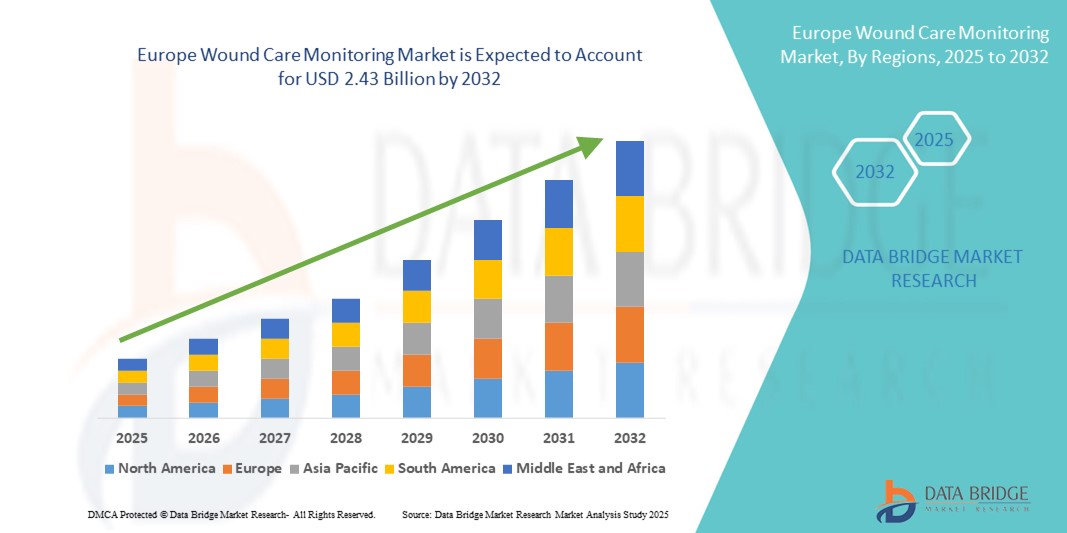
- The Europe wound care monitoring market size was valued at USD 1.68 billion in 2024 and is expected to reach USD 2.43 billion by 2032, at a CAGR of 4.70% during the forecast period
- The market growth is largely driven by increasing incidence of chronic wounds, diabetic ulcers, and pressure sores, which has intensified the demand for advanced wound monitoring solutions across healthcare settings
- Furthermore, rising investments in healthcare infrastructure, growing adoption of remote monitoring technologies, and a shift toward patient-centric and outcome-based care models are establishing wound monitoring devices as essential tools in modern clinical practice. These converging factors are accelerating the deployment of smart wound care systems, thereby significantly boosting the region's market expansion
Europe Wound Care Monitoring Market Analysis
- Wound care monitoring systems, enabling real-time assessment of wound healing and infection risks, are becoming increasingly essential across clinical and homecare settings due to their role in improving treatment outcomes, reducing hospital readmissions, and supporting remote patient management
- The escalating demand for wound care monitoring devices is primarily fueled by the rising prevalence of chronic wounds, aging populations, and the growing burden of diabetes and vascular diseases across European countries
- Germany dominated the Europe wound care monitoring market with the largest revenue share of 29.9% in 2024, supported by advanced healthcare infrastructure, favorable reimbursement frameworks, and high adoption rates of digital health technologies
- Poland is expected to be the fastest growing country in the wound care monitoring market during the forecast period due to expanding healthcare access, increasing government investments, and growing awareness about chronic wound management
- Chronic wound segment dominated the Europe wound care monitoring market with a market share of 46.8% in 2024, driven by the high incidence of pressure ulcers, diabetic foot ulcers, and venous leg ulcers requiring continuous monitoring for optimal healing
Report Scope and Europe Wound Care Monitoring Market Segmentation
|
Attributes |
Europe Wound Care Monitoring Key Market Insights |
|
Segments Covered |
|
|
Countries Covered |
Europe
|
|
Key Market Players |
|
|
Market Opportunities |
|
|
Value Added Data Infosets |
In addition to the insights on market scenarios such as market value, growth rate, segmentation, geographical coverage, and major players, the market reports curated by the Data Bridge Market Research also include in-depth expert analysis, pricing analysis, brand share analysis, consumer survey, demography analysis, supply chain analysis, value chain analysis, raw material/consumables overview, vendor selection criteria, PESTLE Analysis, Porter Analysis, and regulatory framework. |
Europe Wound Care Monitoring Market Trends
Advancement in Digital Wound Imaging and Telehealth Integration
- A significant and accelerating trend in the Europe wound care monitoring market is the adoption of advanced digital wound imaging systems combined with telehealth platforms. This integration allows clinicians to remotely assess wound progression, share data in real-time, and make faster treatment decisions, especially for chronic wound patients requiring long-term care
- For instance, companies such as MolecuLight are gaining prominence in European markets with their handheld fluorescence imaging devices, enabling real-time visualization of bacteria in wounds. Such innovations are transforming traditional wound management by offering objective and consistent wound documentation
- The integration of wound imaging with telehealth platforms supports remote monitoring, especially in countries such as the U.K. and Germany, where aging populations and stretched healthcare systems increase the need for home-based wound care solutions. Patients can securely transmit wound images and updates to clinicians without frequent in-person visits
- Furthermore, AI-powered wound analysis tools are emerging, offering automated wound measurement and healing predictions. These smart tools improve care planning, reduce human error, and enable early detection of complications, enhancing overall clinical efficiency
- The trend of digitization and connected care aligns with the broader European movement toward value-based healthcare, wherein monitoring outcomes and preventing complications are prioritized. As a result, companies such as Swift Medical and Tissue Analytics are entering European markets with scalable, cloud-connected wound care platforms
- This growing emphasis on smart, digital wound care monitoring solutions is reshaping clinical workflows across hospitals, nursing homes, and homecare settings in Europe. The increasing demand for efficient, patient-centered wound care supported by real-time data is driving both innovation and adoption
Europe Wound Care Monitoring Market Dynamics
Driver
Rising Chronic Wound Burden and Geriatric Population
- The increasing prevalence of chronic wounds such as diabetic foot ulcers, venous leg ulcers, and pressure ulcers across Europe, largely driven by aging populations and the rising incidence of diabetes, is a major driver of the wound care monitoring market
- For instance, countries such as Germany and Italy are witnessing a growing need for advanced monitoring tools to manage wound care in both clinical and homecare settings, given their large elderly populations and high chronic disease burden
- These wounds require continuous observation and precision care, prompting the adoption of smart monitoring systems that assist healthcare providers in tracking wound healing, identifying infections early, and adjusting treatment plans accordingly
- Furthermore, government initiatives across Europe promoting digital health transformation and remote patient monitoring are supporting the integration of advanced wound care technologies into routine practice, especially within public healthcare systems
- The emphasis on reducing hospitalization rates and improving patient outcomes through early intervention is further encouraging the use of wound care monitoring tools that support real-time decision-making and documentation
Restraint/Challenge
High Device Costs and Reimbursement Limitations
- One of the primary challenges in the Europe wound care monitoring market is the high upfront cost of advanced monitoring devices and limited reimbursement coverage for these technologies in several countries
- While Western European nations such as France and Germany have progressive reimbursement systems, other regions still face hurdles in integrating expensive wound imaging tools into publicly funded healthcare settings
- The initial cost of acquiring and implementing digital wound monitoring systems can be a barrier for smaller clinics, nursing homes, and homecare providers, especially in price-sensitive markets such as Eastern Europe
- In addition, the lack of uniform regulatory standards across the European Union for digital wound care tools can delay product approvals and hinder cross-border adoption
- Addressing these barriers through cost-effective device innovations, expanding reimbursement coverage, and harmonizing digital health regulations will be essential to unlocking the full potential of wound monitoring technologies in Europe
Europe Wound Care Monitoring Market Scope
The market is segmented on the basis of product, modality, product type, wound type, application, end user, and distribution channel.
- By Product
On the basis of product, the Europe wound care monitoring market is segmented into devices and wound assessment apps. The devices segment dominated the market with the largest market revenue share in 2024, driven by rising adoption of advanced wound imaging technologies, biosensors, and digital scanners in hospitals and specialized wound care centers. Devices enable real-time visualization, precise wound measurement, and faster clinical decision-making, which are critical for managing chronic wounds in countries such as Germany and France.
The wound assessment apps segment is anticipated to witness the fastest growth rate from 2025 to 2032, fueled by the growing demand for mobile health solutions and remote monitoring capabilities. These apps allow secure image sharing, healing progression tracking, and remote consultations, and are increasingly used in homecare and telehealth services across the U.K., Netherlands, and Scandinavia.
- By Modality
On the basis of modality, the Europe wound care monitoring market is segmented into wearable and non-wearable. The non-wearable segment held the largest market revenue share in 2024, driven by the widespread use of stationary imaging devices and handheld scanners in clinical settings. These tools offer high-resolution wound assessment and are widely adopted across hospital-based wound clinics in Western Europe.
The wearable segment is expected to witness the fastest CAGR from 2025 to 2032, fueled by growing demand for continuous, real-time monitoring in home-based care settings. Wearable wound sensors and smart dressings are increasingly adopted in Italy and Spain for chronic wound patients, enabling early detection of complications and reducing hospital visits.
- By Product Type
On the basis of product type, the Europe wound care monitoring market is segmented into contact wound measuring devices and non-contact wound measuring devices. The non-contact wound measuring devices segment dominated the market with the largest market revenue share in 2024, driven by increasing preference for non-invasive, infection-minimizing wound imaging. These devices are particularly valuable in pressure ulcer and diabetic wound care, especially in Germany and the U.K.
The contact wound measuring devices segment is expected to grow steadily during forecast period, particularly in settings where close-up assessment and tactile interaction are preferred, such as trauma centers and surgical wound management units.
- By Wound Type
On the basis of wound type, the Europe wound care monitoring market is segmented into chronic wounds and acute wounds. The chronic wounds segment dominated the market with the largest market revenue share of 46.8% in 2024, driven by the high prevalence of diabetes, vascular conditions, and pressure ulcers among aging populations across Europe. Countries such as France and Germany have a significant patient base requiring long-term wound monitoring solutions.
The acute wounds segment is anticipated to witness moderate growth during forecast period, supported by the rising number of surgeries and trauma cases that require short-term but intensive wound healing surveillance, especially in high-volume hospital systems in Eastern Europe.
- By Application
On the basis of application, the Europe wound care monitoring market is segmented into wound healing monitoring, wound assessment, infection detection, and treatment monitoring. The wound healing monitoring segment dominated the market with the largest market revenue share in 2024, as continuous monitoring of healing progress is crucial for early intervention and improving outcomes, especially in diabetic and pressure ulcer cases.
The infection detection segment is expected to witness the fastest growth rate from 2025 to 2032, driven by increased clinical focus on early infection identification to prevent complications, and rising adoption of imaging tools capable of detecting bacterial presence in real time.
- By End User
On the basis of end user, the Europe wound care monitoring market is segmented into hospitals, clinics, home healthcare, long-term care facilities, trauma centers, and others. The hospitals segment dominated the market with the largest market revenue share in 2024, driven by access to advanced imaging tools, higher patient volumes, and integration of wound care into broader chronic disease management programs.
The home healthcare segment is anticipated to witness the fastest CAGR from 2025 to 2032, fueled by increasing preference for decentralized care, particularly among elderly populations in the U.K. and Italy, and supported by innovations in remote monitoring technologies.
- By Distribution Channel
On the basis of distribution channel, the Europe wound care monitoring market is segmented into direct tenders and retail sales. The direct tenders segment held the largest market revenue share in 2024, due to procurement processes led by government healthcare systems and large hospital networks across Western Europe, particularly in Germany and France.
The retail sales segment is expected to witness the fastest growth rate from 2025 to 2032, driven by growing consumer adoption of mobile wound assessment apps and the availability of connected wound monitoring devices through pharmacies and e-commerce platforms.
Europe Wound Care Monitoring Market Regional Analysis
- Germany dominated the Europe wound care monitoring market with the largest revenue share of 29.9% in 2024, supported by advanced healthcare infrastructure, favorable reimbursement frameworks, and high adoption rates of digital health technologies
- Patients and healthcare providers in Germany value precision in wound assessment, real-time monitoring, and integration with electronic health records, all of which are increasingly enabled through smart wound monitoring systems
- This robust market adoption is further supported by government initiatives promoting digital healthcare, favorable reimbursement policies, and a growing elderly population requiring continuous wound care, positioning Germany as a leading hub for innovation and implementation in wound care monitoring solutions
The Germany Wound Care Monitoring Market Insight
The Germany wound care monitoring market captured the largest revenue share in Europe in 2024, supported by its advanced healthcare infrastructure, aging population, and high prevalence of chronic wounds. Germany’s strong emphasis on digital health innovation and regulatory support for telemedicine are promoting the use of smart wound care technologies. Hospitals and specialized wound centers across the country are increasingly adopting AI-powered and imaging-based monitoring tools to enhance care quality and reduce treatment costs. In addition, collaborations between healthcare providers and med-tech companies are further stimulating market growth.
U.K. Wound Care Monitoring Market Insight
The U.K. wound care monitoring market is expected to grow at a robust CAGR during the forecast period, fueled by the National Health Service's (NHS) push toward digital transformation and remote patient monitoring. The high burden of chronic wounds and strong adoption of mobile health solutions are driving the use of digital wound assessment tools in both clinical and homecare settings. Moreover, the U.K.’s expanding telehealth infrastructure, combined with the growing need for cost-effective chronic wound management, is encouraging healthcare providers to implement connected wound monitoring devices.
France Wound Care Monitoring Market Insight
The France wound care monitoring market is projected to grow steadily, driven by increasing cases of pressure ulcers, diabetic foot ulcers, and surgical wounds. France’s public healthcare system is investing in digital innovations to support outpatient and long-term wound care. Hospitals and home healthcare services are progressively utilizing digital imaging systems and mobile apps for consistent wound tracking. In addition, policy incentives supporting the deployment of telehealth tools and smart monitoring platforms are contributing to the wider adoption of these technologies.
Poland Wound Care Monitoring Market Insight
The Poland wound care monitoring market is expected to grow at the fastest CAGR during the forecast period, driven by improving healthcare infrastructure, rising awareness of chronic wound complications, and increasing government investments in healthcare modernization. Poland is witnessing a growing demand for affordable and accessible wound monitoring solutions in both public and private healthcare sectors. The country’s expanding telemedicine services, combined with a focus on enhancing rural healthcare delivery, are accelerating the adoption of mobile apps and portable imaging technologies for wound care.
Europe Wound Care Monitoring Market Share
The Europe wound care monitoring industry is primarily led by well-established companies, including:
- Smith+Nephew (U.K.)
- Mölnlycke Health Care AB (Sweden)
- B. Braun SE (Germany)
- Coloplast A/S (Denmark)
- ConvaTec Group PLC (U.K.)
- Paul Hartmann AG (Germany)
- Urgo Medical (France)
- 3M (U.S.)
- Johnson & Johnson and its affiliates (U.S.)
- Medtronic (Ireland)
- Essity AB (Sweden)
- Smiths Group plc (U.S.)
- BSN medical GmbH (Germany)
- Woundworks B.V. (Netherlands)
- Systagenix Wound Management Ltd. (U.K.)
- Tissue Regenix Group plc (U.K.)
- SIGVARIS Group (Switzerland)
- Advancis Medical (U.K.)
- Derma Sciences Inc. (U.S.)
- Mediq Group (Netherlands)
What are the Recent Developments in Europe Wound Care Monitoring Market?
- In April 2023, Smith+Nephew, a global medical technology company headquartered in the U.K., launched an AI-powered wound imaging system in Germany aimed at improving wound assessment accuracy and accelerating healing outcomes. The solution integrates with digital health records and enables remote consultation, enhancing patient care efficiency. This development reflects the company’s focus on digital transformation and advanced wound management technologies across European healthcare systems
- In March 2023, Mölnlycke Health Care, based in Sweden, introduced a connected wound care solution featuring real-time monitoring sensors in collaboration with European hospitals. Designed to continuously measure wound parameters such as moisture and temperature, the technology aims to reduce infection rates and support personalized treatment. This innovation underscores Mölnlycke’s commitment to combining smart technology with clinical excellence to address the growing burden of chronic wounds
- In February 2023, the French company TISSIUM, known for developing biomorphic wound healing platforms, secured funding under the EU Horizon program to develop a digital wound monitoring interface for use in post-operative care. This interface leverages machine learning for predictive wound healing insights and aligns with Europe’s broader initiative to digitize patient care. The project demonstrates the rising interest in integrating AI and monitoring tools into mainstream wound care practices
- In February 2023, Mediq, a leading Dutch healthcare solutions provider, expanded its smart wound care portfolio in partnership with regional telemedicine providers across Belgium and the Netherlands. The collaboration offers remote wound diagnostics supported by mobile imaging and cloud-based data sharing, improving access to expert care, particularly in elderly and homecare settings. This move supports Mediq’s strategy to bridge gaps in wound care access through scalable digital platforms
- In January 2023, B. Braun Melsungen AG, headquartered in Germany, launched its WoundView+ system a smart wound documentation tool across select hospitals in the U.K. and Spain. The platform enables clinicians to track wound healing through time-stamped visual records and AI-generated analytics. By enhancing diagnostic precision and patient engagement, this innovation highlights B. Braun’s focus on advancing digital capabilities in wound management within the European healthcare landscape

- Interactive Data Analysis Dashboard
- Company Analysis Dashboard for high growth potential opportunities
- Research Analyst Access for customization & queries
- Competitor Analysis with Interactive dashboard
- Latest News, Updates & Trend analysis
- Harness the Power of Benchmark Analysis for Comprehensive Competitor Tracking
Data collection and base year analysis are done using data collection modules with large sample sizes. The stage includes obtaining market information or related data through various sources and strategies. It includes examining and planning all the data acquired from the past in advance. It likewise envelops the examination of information inconsistencies seen across different information sources. The market data is analysed and estimated using market statistical and coherent models. Also, market share analysis and key trend analysis are the major success factors in the market report. To know more, please request an analyst call or drop down your inquiry.
The key research methodology used by DBMR research team is data triangulation which involves data mining, analysis of the impact of data variables on the market and primary (industry expert) validation. Data models include Vendor Positioning Grid, Market Time Line Analysis, Market Overview and Guide, Company Positioning Grid, Patent Analysis, Pricing Analysis, Company Market Share Analysis, Standards of Measurement, Global versus Regional and Vendor Share Analysis. To know more about the research methodology, drop in an inquiry to speak to our industry experts.
Data Bridge Market Research is a leader in advanced formative research. We take pride in servicing our existing and new customers with data and analysis that match and suits their goal. The report can be customized to include price trend analysis of target brands understanding the market for additional countries (ask for the list of countries), clinical trial results data, literature review, refurbished market and product base analysis. Market analysis of target competitors can be analyzed from technology-based analysis to market portfolio strategies. We can add as many competitors that you require data about in the format and data style you are looking for. Our team of analysts can also provide you data in crude raw excel files pivot tables (Fact book) or can assist you in creating presentations from the data sets available in the report.













