


What is the Acrylic Teeth Market Size and Growth Rate?
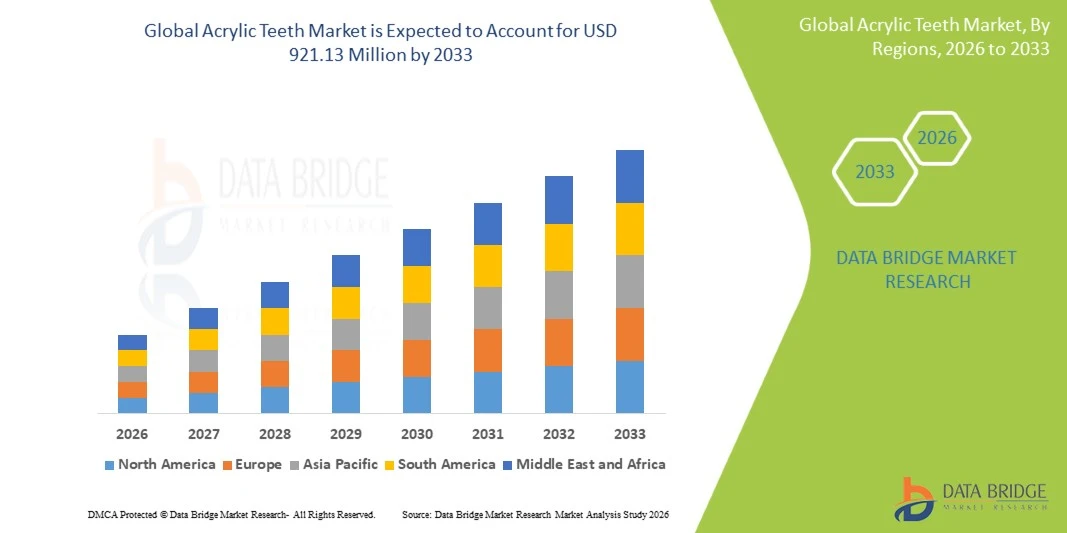
- As per Data Bridge Market Research analysis, the Acrylic Teeth market was valued at USD 493.99 million in 2025 and is projected to reach USD 921.13 million by 2033, growing at a CAGR of 8.10% from 2026 to 2033.
- The market is expanding due to the rising prevalence of tooth loss and edentulism, increasing demand for cosmetic and restorative dentistry, growing geriatric population, rising awareness regarding dental aesthetics and oral health, and advancements in denture materials and fabrication technologies.
- Acrylic teeth are increasingly used in denture and dental prosthetic applications because of their affordability, lightweight characteristics, aesthetic appearance, and suitability for customized tooth replacement solutions.
Market Size & Forecast
- Global Market Value (2025): USD 493.99 million
- Expected Market Value (2033): USD 921.13 million
- Forecast CAGR (2026–2033): 8.10%
- Leading Region in 2025: North America
- Fastest Growing Region: Asia-Pacific
What are the Major Takeaways of the Acrylic Teeth Market?
- North America dominated the global Acrylic Teeth market with the largest revenue share of 34.8% in 2025, supported by advanced dental care infrastructure, increasing demand for dental prosthetics, rising adoption of cosmetic dentistry, growing geriatric population, and the presence of established dental clinics and laboratories.
- Asia-Pacific is expected to be the fastest-growing region, registering a CAGR of 10.2% from 2026 to 2033, driven by increasing dental care expenditure, expanding healthcare infrastructure, rising awareness of oral health and dental aesthetics, growing geriatric population, and increasing demand for affordable dental prosthetic solutions.
- The full denture segment dominated the type category with a market share of 43.6% in 2025, supported by the increasing prevalence of complete tooth loss, growing geriatric population, demand for affordable tooth replacement solutions, and widespread use of acrylic teeth in complete denture applications.
- The partial denture segment is expected to be the fastest-growing type segment, registering a CAGR of 9.7% from 2026 to 2033, driven by increasing cases of partial tooth loss, rising demand for removable dental prosthetics, and growing adoption of customized denture solutions.
- The three-layer acrylic teeth segment dominated the layer category with a market share of 51.4% in 2025, supported by its improved aesthetic appearance, enhanced color gradation, natural tooth-like appearance, and increasing demand for aesthetically appealing dental prosthetics.
- The PMMA segment dominated the material category with a market share of 48.7% in 2025, supported by its favorable mechanical properties, durability, lightweight characteristics, ease of processing, cost effectiveness, and widespread use in dental prosthetic applications.
- The composite resin segment is expected to be the fastest-growing material segment, registering a CAGR of 10.1% from 2026 to 2033, driven by increasing demand for improved aesthetics, enhanced wear resistance, and advanced materials for customized dental restorations and prosthetics.
Report Scope and Acrylic Teeth Market Segmentation
|
Attributes |
Acrylic Teeth Key Market Insights |
|
Segments Covered |
|
|
Countries Covered |
North America
Europe
Asia-Pacific
Middle East and Africa
South America
|
|
Key Market Players |
|
|
Market Opportunities |
|
|
Value Added Data Infosets |
In addition to the insights on market scenarios such as market value, growth rate, segmentation, geographical coverage, and major players, the market reports curated by the Data Bridge Market Research also include in-depth expert analysis, patient epidemiology, pipeline analysis, pricing analysis, and regulatory framework. |
What is the Key Trend in the Acrylic Teeth Market?
- Increasing adoption of digital dentistry, CAD/CAM, and 3D printing technologies is becoming a major trend in the global Acrylic Teeth market, as dental laboratories and clinics increasingly shift from conventional manual denture fabrication toward digitally designed and manufactured dental prosthetics. Digital workflows enable improved precision, customization, reproducibility, production efficiency, and faster turnaround times, while supporting the development of patient-specific acrylic teeth and dentures.
- Integration of CAD/CAM and 3D printing with acrylic teeth manufacturing is gaining importance as dental professionals seek to improve the fit, appearance, consistency, and production speed of dental prosthetics. These technologies enable digital scanning, computer-aided design, automated manufacturing, and customized production of dentures, supporting the growing demand for personalized and natural-looking acrylic teeth.
- For instance, in February 2025, Formlabs announced a strategic collaboration with Henry Schein to accelerate the adoption of digital dentistry, expanding access to Form 4B and Form 4BL 3D printing solutions for dental laboratories. The collaboration reflects the increasing use of additive manufacturing to support faster and more digitally integrated dental workflows.
- Overall, the acrylic teeth market is increasingly shaped by digital dentistry, CAD/CAM workflows, 3D printing, multilayer acrylic teeth, advanced resin materials, customization, and demand for natural-looking dental prosthetics. Dental laboratories and clinics are therefore moving toward integrated digital workflows that combine scanning, computer-aided design, milling, and additive manufacturing to improve production efficiency, precision, consistency, and patient-specific customization.
What are the Key Drivers of the Acrylic Teeth Market?
- The rising prevalence of tooth loss, edentulism, and age-related dental disorders is a major growth driver in the Acrylic Teeth market, as the increasing number of patients requiring tooth replacement is creating sustained demand for complete and partial denture solutions. Aging populations, periodontal diseases, dental caries, and other oral health conditions are increasing the need for affordable and customizable prosthetic teeth. Acrylic teeth are widely used in dentures because of their lightweight characteristics, affordability, ease of customization, and ability to provide a natural appearance.
- Growing demand for cosmetic and restorative dentistry is further supporting market growth, as patients increasingly seek dental prosthetics that restore both oral functionality and aesthetic appearance. Improvements in multilayer acrylic teeth, shade matching, tooth morphology, and material properties are enabling manufacturers and dental laboratories to provide more natural-looking prosthetic solutions. Increasing awareness of oral health and dental aesthetics is therefore encouraging the adoption of acrylic teeth across dental clinics, hospitals, and prosthodontic laboratories.
- For instance, in March 2025, the World Health Organization reported that nearly 3.5 billion people globally are affected by oral diseases, highlighting the substantial global burden of oral health conditions and the continuing need for restorative and rehabilitative dental care. The increasing burden of oral diseases, combined with tooth loss associated with aging and periodontal conditions, supports demand for denture-based tooth replacement solutions.
- Overall, the acrylic teeth market is increasingly shaped by the rising prevalence of tooth loss and edentulism, population aging, demand for aesthetic dental restoration, increasing awareness of oral healthcare, and technological advancements in CAD/CAM and 3D printing. Dental providers and laboratories are increasingly adopting digitally enabled manufacturing and customized prosthetic solutions to improve production efficiency, aesthetic outcomes, fit, and patient-specific restoration, supporting continued expansion of the global Acrylic Teeth market.
What Factors are Challenging the Growth of the Acrylic Teeth Market?
- Increasing demand for natural-looking and durable acrylic teeth is creating challenges related to material performance, wear resistance, color stability, and long-term durability. Acrylic teeth are exposed to repeated chewing forces, cleaning procedures, moisture, and temperature variations, which can contribute to wear, surface deterioration, discoloration, and changes in aesthetics over time. Manufacturers are therefore required to develop advanced acrylic formulations with improved mechanical strength, stain resistance, and natural appearance while maintaining cost effectiveness.
- The increasing adoption of CAD/CAM and 3D printing technologies is creating challenges related to manufacturing costs, technical expertise, digital workflow integration, and standardization. Dental laboratories and clinics require specialized scanners, software, milling or printing equipment, materials, and trained personnel to implement digital workflows. Smaller dental laboratories and clinics may face difficulties in investing in these technologies, which can limit their adoption in price-sensitive markets.
- For instance, in 2024, Ivoclar introduced Ivotion Denture System developments and digital denture workflow solutions, highlighting the industry's shift toward digitally manufactured dentures and the increasing need for integrated materials and digital production processes. Such developments demonstrate that dental manufacturers are increasingly required to combine advanced denture materials with digital design and manufacturing technologies while maintaining consistent quality and customization.
- Overall, the acrylic teeth market is increasingly shaped by challenges related to material durability, color stability, manufacturing precision, digital technology investment, skilled workforce requirements, standardization, and cost pressures. Manufacturers and dental laboratories are therefore required to improve acrylic formulations, adopt advanced CAD/CAM and 3D-printing workflows, maintain consistent product quality, and provide customized solutions while keeping dental prosthetic products affordable and accessible.
How is the Acrylic Teeth Market Segmented?
The global acrylic teeth market is segmented on the basis of type, layer, material, technology, application, and end user.
- By Type
On the basis of type, the global acrylic teeth market is segmented into full denture, partial denture, immediate denture, and removable denture. The full denture segment dominated the market with a 43.6% share in 2025, driven by the increasing prevalence of complete tooth loss, growing geriatric population, rising demand for affordable tooth replacement solutions, and widespread use of acrylic teeth in complete denture applications.
The partial denture segment is projected to register the fastest growth at a CAGR of 9.7% from 2026 to 2033, supported by increasing cases of partial tooth loss, growing demand for removable dental prosthetics, rising awareness of dental aesthetics, and increasing adoption of customized denture solutions.
- By Layer
On the basis of layer, the global acrylic teeth market is segmented into two-layer acrylic teeth, three-layer acrylic teeth, and others. The three-layer acrylic teeth segment dominated the market with a 51.4% share in 2025, driven by its natural-looking appearance, improved shade gradation, enhanced aesthetics, and increasing demand for high-quality dental prosthetics.
The three-layer acrylic teeth segment is also projected to register the fastest growth at a CAGR of 9.4% from 2026 to 2033, supported by increasing demand for aesthetically appealing dentures, advancements in multilayer acrylic tooth manufacturing, and growing consumer preference for natural-looking dental restorations.
- By Material
On the basis of material, the global acrylic teeth market is segmented into composite resin, PMMA, and porcelain acrylic. The PMMA segment dominated the market with a 48.7% share in 2025, supported by its favorable mechanical properties, lightweight characteristics, ease of processing, cost effectiveness, and extensive use in dental prosthetic applications.
The composite resin segment is projected to register the fastest growth at a CAGR of 10.1% from 2026 to 2033, driven by increasing demand for improved aesthetics, enhanced wear resistance, improved color stability, and advanced materials for customized dental prosthetics.
- By Technology
On the basis of technology, the global acrylic teeth market is segmented into CAD/CAM and 3D printing. The CAD/CAM segment dominated the market with a 61.3% share in 2025, driven by increasing digitalization of dental laboratories, improved manufacturing precision, faster production, customization capabilities, and growing adoption of digitally designed dental prosthetics.
The 3D printing segment is projected to register the fastest growth at a CAGR of 13.2% from 2026 to 2033, supported by advancements in additive manufacturing, increasing demand for customized dental products, shorter production times, reduced material waste, and growing adoption of digital dentistry.
- By Application
On the basis of application, the global acrylic teeth market is segmented into orthodontics, cosmetic dentistry, and restorative dentistry. The restorative dentistry segment dominated the market with a 45.2% share in 2025, supported by the increasing prevalence of tooth loss and dental disorders, rising demand for tooth replacement solutions, and growing use of acrylic teeth in restorative dental procedures.
The cosmetic dentistry segment is projected to register the fastest growth at a CAGR of 10.8% from 2026 to 2033, driven by increasing awareness of dental aesthetics, rising demand for natural-looking teeth, growing disposable income, and increasing consumer interest in cosmetic dental procedures.
- By End User
On the basis of end user, the global acrylic teeth market is segmented into dental clinics, hospitals, and home care. The dental clinics segment dominated the market with a 58.6% share in 2025, supported by the large volume of dental procedures performed in clinics, increasing adoption of dental prosthetics, growing demand for customized dentures, and expansion of private dental care facilities.
The dental clinics segment is projected to register strong growth at a CAGR of 9.2% from 2026 to 2033, driven by increasing dental visits, expansion of dental practices, rising demand for prosthetic and cosmetic dentistry, and growing adoption of digitally manufactured dental products.
Which Region Holds the Largest Share of the Acrylic Teeth Market?
- North America accounted for the largest share of the global acrylic teeth market, with a hypothetical revenue share of 34.8% in 2025, supported by advanced dental care infrastructure, high adoption of dental prosthetic solutions, increasing demand for cosmetic and restorative dentistry, growing awareness of oral health, and the presence of established dental clinics, laboratories, and dental product manufacturers.
- The region benefits from increasing dental care expenditure, widespread adoption of advanced dental technologies such as CAD/CAM, growing use of digitally manufactured dental prosthetics, and increasing demand for customized and aesthetically appealing dentures. The U.S. represents the major contributor within North America, supported by established dental healthcare infrastructure, a large network of dental clinics and laboratories, increasing geriatric population, rising demand for tooth replacement solutions, and growing adoption of digital dentistry and advanced dental materials.
U.S. Acrylic Teeth Market Insight
The U.S. acrylic teeth market is expanding due to the increasing prevalence of tooth loss, growing geriatric population, rising demand for restorative and cosmetic dentistry, and increasing adoption of advanced dental prosthetic solutions. The market is supported by well-established dental care infrastructure, a large network of dental clinics and laboratories, and increasing utilization of CAD/CAM and digital dentistry technologies. Growing consumer awareness of dental aesthetics and oral health is further supporting demand for natural-looking and customized acrylic teeth. Increasing investments in advanced dental materials and digitally manufactured dentures are also expected to contribute to market growth in the U.S.
Canada Acrylic Teeth Market Insight
The Canada acrylic teeth market is expanding due to the increasing prevalence of tooth loss, growing geriatric population, rising awareness of oral health, and increasing demand for cosmetic and restorative dental procedures. The market is supported by Canada's established dental care infrastructure, growing adoption of advanced dental prosthetics, and increasing use of CAD/CAM technologies for customized dentures. Dental clinics and laboratories are increasingly adopting digitally designed and manufactured acrylic teeth to improve precision, aesthetics, and production efficiency. Rising demand for affordable and natural-looking tooth replacement solutions is expected to further support market growth across Canada.
Asia-Pacific Acrylic Teeth Market Insight
The Asia-Pacific acrylic teeth market is expected to witness significant growth during the forecast period, driven by the increasing geriatric population, rising prevalence of tooth loss, growing awareness of oral health, and expanding access to dental care. Increasing healthcare expenditure and the development of dental infrastructure across countries such as China, Japan, India, South Korea, and Australia are supporting market expansion. Growing demand for cosmetic and restorative dentistry, dental tourism, and affordable prosthetic solutions is further contributing to adoption. Increasing use of CAD/CAM and 3D printing technologies is also expected to support market growth across the region.
China Acrylic Teeth Market Insight
The China acrylic teeth market is expanding due to the growing prevalence of tooth loss, increasing geriatric population, rising awareness of oral health, and increasing demand for restorative and cosmetic dental procedures. Expansion of dental clinics and laboratories, improving access to dental care, and rising healthcare expenditure are supporting market growth. The increasing adoption of CAD/CAM technologies and 3D printing is also encouraging the production of customized and aesthetically appealing dental prosthetics. In addition, growing dental tourism and advancements in acrylic-based dental materials are expected to create further opportunities for manufacturers and dental service providers across China.
Japan Acrylic Teeth Market Insight
The Japan acrylic teeth market is expanding due to the country’s aging population, increasing prevalence of tooth loss, and growing demand for restorative and prosthetic dental solutions. Rising awareness of oral health and dental aesthetics is supporting the adoption of acrylic teeth in full and partial dentures. Japan’s advanced dental healthcare infrastructure and established network of dental clinics are also encouraging the use of modern dental materials and digital technologies such as CAD/CAM. In addition, increasing demand for customized, natural-looking, and durable dental prosthetics is expected to support market growth across Japan.
Germany Acrylic Teeth Market Insight
The Germany acrylic teeth market is expanding due to the increasing prevalence of tooth loss, growing geriatric population, rising demand for dental prosthetics, and increasing awareness of oral health and dental aesthetics. Germany’s well-established dental care infrastructure, large network of dental clinics and laboratories, and strong adoption of advanced dental technologies support market development. The growing use of CAD/CAM systems and digitally manufactured dental prosthetics is improving precision, customization, and production efficiency. Increasing demand for restorative and cosmetic dentistry, along with advancements in dental materials and prosthetic solutions, is expected to further support market growth in Germany.
U.K. Acrylic Teeth Market Insight
The U.K. acrylic teeth market is expanding due to increasing demand for dental prosthetics, growing awareness of oral health, and rising adoption of cosmetic and restorative dentistry. The market is supported by the country’s established dental care infrastructure, increasing geriatric population, and demand for affordable and aesthetically appealing tooth replacement solutions. Dental clinics and laboratories are increasingly adopting CAD/CAM and digital manufacturing technologies to improve the precision and customization of acrylic teeth. Growing dental expenditure, advancements in denture materials, and increasing preference for natural-looking dental restorations are expected to further support market growth in the U.K.
Which are the Top Companies in Acrylic Teeth Market?
The acrylic teeth industry is primarily led by well-established companies, including:
- Dentsply Sirona Inc. (U.S.)
- Ivoclar Vivadent (Liechtenstein)
- Kulzer GmbH (Germany)
- VITA Zahnfabrik (Germany)
- YAMAHACHI DENTAL MFG., CO. (Japan)
- SHOFU INC. (Japan)
- GC International AG (Japan)
- Heraeus Kulzer GmbH (Germany)
- Mitsui Chemicals, Inc. (Japan)
- Nissin Dental Products, Inc. (Japan)
- New Stetic S.A. (Colombia)
- CANDULOR AG (Switzerland)
- Ruthinium Group (Italy)
- Keystone Dental, Inc. (U.S.)
- Kettenbach GmbH & Co. KG (Germany)
- Huge Dental Material Co., Ltd. (China)
- Unidesa-Odi S.L. (Spain)
- Vertex Dental (Netherlands)
- bredent GmbH & Co. KG (Germany)
- Schütz Dental GmbH (Germany)
What are Latest Developments in Acrylic Teeth Market?
- In June 2026, Dentsply Sirona and HeyGears expanded their collaboration through validation of the One-Piece Lucitone Digital Print Denture workflow. The collaboration supports digitally manufactured dentures and combines Dentsply Sirona's denture materials with HeyGears' dual-material 3D-printing technology.
- In June 2026, Ivoclar introduced new gingiva and tooth shades across its denture portfolio, including Ivotion Dent Multi, to provide greater personalization and more natural-looking removable prosthetics. The development responds to increasing demand for individualized aesthetics in denture solutions.
- In February 2026, HeyGears launched its One-Piece Denture Solution at LMT LAB DAY Chicago. The solution uses dual-material DLP 3D printing to fuse denture-base and teeth materials in a single manufacturing process, targeting improved aesthetics, fit, structural reliability, and production efficiency.
- In January 2026, Dentsply Sirona expanded its partnership with Benco Dental to provide Dentsply Sirona's full dental technology portfolio to U.S. customers. The expanded relationship includes CEREC, scanning, designing, and manufacturing technologies, supporting broader adoption of connected digital dentistry workflows.
- In March 2025, Ivoclar and SprintRay strengthened their partnership by validating Ivotion Base Print denture-base material for the SprintRay Pro 2 3D printer. The collaboration integrates Ivoclar's PMMA-quality denture material with SprintRay's digital 3D-printing platform and supports more efficient digital denture fabrication.
- In January 2025, Argen acquired the lab and denture clinic business of Dental Axess Canada, strengthening its position in digital dentistry and expanding its customer base for digital dental manufacturing. The acquisition also supports Argen's strategy around digital workflows, dental materials, and emerging manufacturing technologies.

- Interactive Data Analysis Dashboard
- Company Analysis Dashboard for high growth potential opportunities
- Research Analyst Access for customization & queries
- Competitor Analysis with Interactive dashboard
- Latest News, Updates & Trend analysis
- Harness the Power of Benchmark Analysis for Comprehensive Competitor Tracking
Data collection and base year analysis are done using data collection modules with large sample sizes. The stage includes obtaining market information or related data through various sources and strategies. It includes examining and planning all the data acquired from the past in advance. It likewise envelops the examination of information inconsistencies seen across different information sources. The market data is analysed and estimated using market statistical and coherent models. Also, market share analysis and key trend analysis are the major success factors in the market report. To know more, please request an analyst call or drop down your inquiry.
The key research methodology used by DBMR research team is data triangulation which involves data mining, analysis of the impact of data variables on the market and primary (industry expert) validation. Data models include Vendor Positioning Grid, Market Time Line Analysis, Market Overview and Guide, Company Positioning Grid, Patent Analysis, Pricing Analysis, Company Market Share Analysis, Standards of Measurement, Global versus Regional and Vendor Share Analysis. To know more about the research methodology, drop in an inquiry to speak to our industry experts.
Data Bridge Market Research is a leader in advanced formative research. We take pride in servicing our existing and new customers with data and analysis that match and suits their goal. The report can be customized to include price trend analysis of target brands understanding the market for additional countries (ask for the list of countries), clinical trial results data, literature review, refurbished market and product base analysis. Market analysis of target competitors can be analyzed from technology-based analysis to market portfolio strategies. We can add as many competitors that you require data about in the format and data style you are looking for. Our team of analysts can also provide you data in crude raw excel files pivot tables (Fact book) or can assist you in creating presentations from the data sets available in the report.













