What is the Agricultural Testing Market Size and Growth Rate?
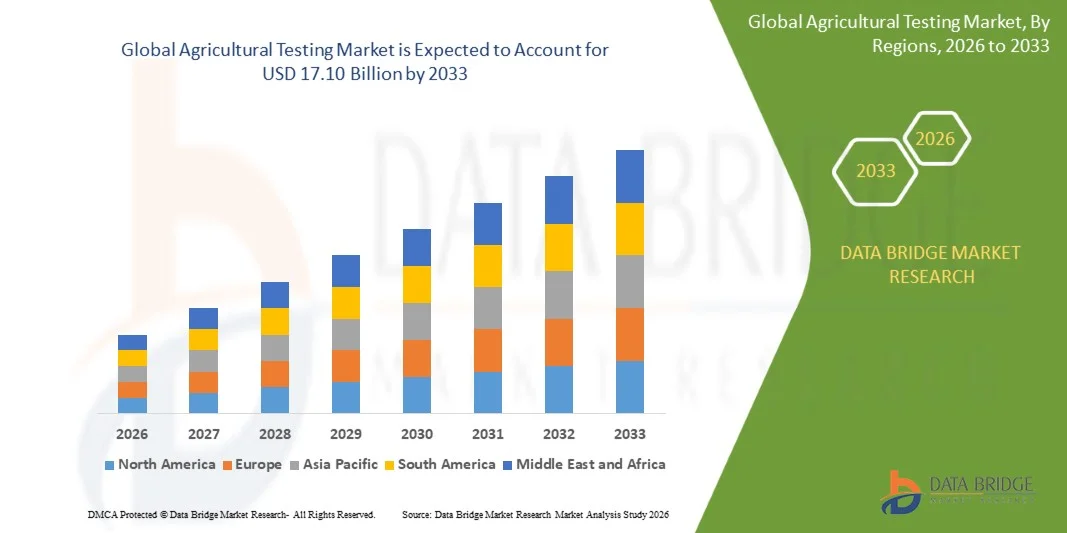
- As per Data Bridge Market Research analysis, the agricultural testing market was valued at USD 11.80 billion in 2025 and is projected to reach USD 17.10 billion by 2033, growing at a CAGR of 4.60% from 2026 to 2033.
- The market is experiencing consistent growth driven by rising demand for food safety and quality testing, increasing soil and water quality monitoring, advancements in agricultural testing technologies, and expanding applications across crop production, agricultural commodities, and environmental monitoring.
- The increasing focus on sustainable agriculture and soil health, combined with stricter food safety regulations and growing concerns regarding pesticide residues, heavy metals, pathogens, and other contaminants, is compelling farmers, agribusinesses, food processors, and regulatory agencies to adopt advanced agricultural testing solutions. Rapid and molecular testing technologies are gaining adoption by providing accurate, efficient, and reliable testing for improving crop productivity, ensuring agricultural product safety, and supporting regulatory compliance.
Market Size & Forecast
- Global Market Value (2025): USD 11.80 Billion
- Expected Market Value (2033): USD 17.10 Billion
- Forecast CAGR (2026–2033): 4.60%
- Leading Region in 2025: North America
- Fastest Growing Region: Asia Pacific
What are the Major Takeaways of the Agricultural Testing Market?
- North America dominated the agricultural testing market with the largest revenue share of 35.2% in 2025, supported by advanced agricultural infrastructure, stringent food safety regulations, and widespread adoption of soil, water, and crop testing.
- Asia-Pacific is expected to be the fastest-growing region at a CAGR of 5.8% from 2026 to 2033, fueled by increasing agricultural production, rising food safety requirements, growing soil health awareness, and expanding testing infrastructure across China, India, and Japan
- The soil segment led the market with a 45.6% share in 2025, driven by the increasing need for soil fertility assessment, nutrient management, and precision agriculture
- Seed are the fastest-growing sample type, projected to register a CAGR of 8.8%, reflecting the surge in requirements for seed quality, germination, purity, vigor, and pathogen detection.
- The nutrient analysis segment dominated the testing type category with a 36.4% revenue share in 2025, led by increasing demand for accurate assessment of macro- and micronutrient availability.
- Quality assurance accounted for 54.2% of the market share in 2025, preferred by increasing requirements for consistent agricultural product quality and regulatory compliance.
- The fruits & vegetables segment is the fastest-growing crop type category, with a CAGR of 8.0%, driven by increasing demand for pesticide-residue, microbiological, nutrient, and quality testing.
Report Scope and Agricultural Testing Market Segmentation
|
Attributes |
Agricultural Testing Key Market Insights |
|
Segments Covered |
|
|
Countries Covered |
North America
Europe
Asia-Pacific
Middle East and Africa
South America
|
|
Key Market Players |
|
|
Market Opportunities |
|
|
Value Added Data Infosets |
In addition to the insights on market scenarios such as market value, growth rate, segmentation, geographical coverage, and major players, the market reports curated by the Data Bridge Market Research also include import export analysis, production capacity overview, production consumption analysis, price trend analysis, climate change scenario, supply chain analysis, value chain analysis, raw material/consumables overview, vendor selection criteria, PESTLE Analysis, Porter Analysis, and regulatory framework. |
What is the Key Trend in the Agricultural Testing Market?
- Agricultural testing providers are increasingly adopting rapid, portable, and digital testing technologies to deliver faster soil, nutrient, crop, and contaminant analysis while reducing dependence on conventional laboratory testing.
- For instance, in June 2025, India’s NITI Aayog highlighted NutriSens, a portable soil-testing device developed by Proximal Soilsens Technologies that analyzes six soil parameters in less than five minutes using one gram of soil; the device was being used by 10,000–15,000 farmers across multiple Indian states.
- Digital integration enables farmers and agricultural laboratories to access testing results rapidly and use real-time data to improve fertilizer management, soil health assessment, and crop production decisions.
- Agricultural testing organizations are increasingly combining spectroscopy, sensor technologies, mobile applications, and digital platforms to improve testing speed, accessibility, and data-driven agricultural management.
- For instance, in September 2025, Eurofins Agro introduced a rapid standardized Soil Health Indicator assessment combining near-infrared spectroscopy, multi-nutrient extraction, and ICP-MS analysis to evaluate physical, chemical, and biological soil characteristics.
- As farmers and agricultural organizations continue to prioritize faster diagnostics, precision agriculture, and sustainable soil management, the adoption of rapid and digitally enabled agricultural testing solutions is expected to accelerate, reinforcing testing as a core component of modern agricultural decision-making.
What are the Key Drivers of the Agricultural Testing Market?
- The increasing emphasis on food safety, soil fertility, crop productivity, and sustainable agricultural practices has significantly increased demand for agricultural testing capable of detecting nutrients, pesticides, pathogens, heavy metals, and other contaminants.
- For instance, in February 2025, the U.S. Department of Agriculture’s Agricultural Marketing Service highlighted its National Science Laboratories, which provide chemical, microbiological, and biomolecular testing of food and agricultural commodities for government agencies and private-sector agricultural industries, demonstrating the growing role of testing in agricultural quality and safety
- Farmers, food processors, agribusinesses, and regulatory agencies are integrating testing into agricultural production and supply chains to improve product quality, optimize input utilization, meet regulatory requirements, and reduce contamination risks.
- For instance, in May 2025, the European Commission adopted Regulation (EU) 2025/854 establishing coordinated pesticide-residue control programs for 2026–2028, requiring Member States to collect and analyze samples to verify compliance with maximum residue levels, supporting continued demand for agricultural residue testing.
- With governments, farmers, and agricultural businesses increasingly relying on testing-based decisions to improve food safety, soil health, and resource efficiency, agricultural testing will remain indispensable for sustainable production and regulatory compliance.
What Factors are Challenging the Growth of the Agricultural Testing Market?
- Advanced agricultural testing laboratories require significant upfront investment due to the integration of mass spectrometers, chromatography systems, spectroscopy equipment, automated analyzers, and specialized laboratory infrastructure.
- For instance, in April 2023, the FAO reported that modern soil-testing laboratory equipment worth approximately USD 120,000 was donated to Uganda’s National Semi-Arid Resources Research Institute, including HPLC, an automatic Kjeldahl analyzer, digestion furnace, centrifuge, and other specialized equipment, illustrating the substantial investment required to establish advanced soil-testing capabilities.
- These high costs can limit adoption among smaller laboratories, agricultural organizations, and testing facilities in developing economies where access to sophisticated analytical infrastructure and skilled personnel remains constrained.
- For instance, in January 2026, India’s Ministry of Food Processing Industries published specific cost norms for food-testing laboratory equipment and accessories under its laboratory-upgradation scheme, while its broader program provides financial assistance for establishing and upgrading testing laboratories, demonstrating the significant equipment and infrastructure expenditure involved in expanding advanced testing capacity.
- The high capital investment and recurring operational costs associated with advanced agricultural testing continue to restrict adoption, particularly among small laboratories, agricultural enterprises, and testing facilities in price-sensitive and emerging regions, slowing the deployment of sophisticated testing technologies despite growing demand.
How is the Agricultural Testing Market Segmented?
The agricultural testing market is segmented on the basis of sample, testing type, application, and crop type.
- By Sample
On the basis of sample, the agricultural testing market is segmented into soil, water, seed, plant tissue, agricultural commodities, biosolids, manure & compost, and others. The soil segment dominated the market with a 45.6% share in 2025, owing to the increasing need for soil fertility assessment, nutrient management, and precision agriculture. Soil testing is widely used to determine nutrient availability, pH, organic matter, salinity, and contamination levels. Farmers increasingly rely on soil analysis to optimize fertilizer application and improve crop productivity. Growing adoption of regenerative and conservation agriculture is also increasing demand for regular soil monitoring. Soil testing supports efficient resource utilization by helping farmers avoid excessive fertilizer application.
The seed segment is projected to register the fastest growth at a CAGR of 8.8% from 2026 to 2033, driven by increasing requirements for seed quality, germination, purity, vigor, and pathogen detection. Seed testing is becoming increasingly important as international seed trade requires standardized quality and phytosanitary verification. Seed producers and distributors use testing to minimize crop establishment risks and ensure planting performance. Growing adoption of certified, hybrid, and high-value seeds is further increasing the need for specialized testing services. International movement of seeds is also strengthening demand for laboratory certification and disease screening. Increasing investment in seed breeding and commercial seed production is creating additional testing requirements.
- By Testing Type
On the basis of testing type, the agricultural testing market is segmented into nutrient analysis, contaminant testing, microbiological testing, genetic & molecular testing, residue testing, heavy metal testing, pH analysis, and others. The nutrient analysis segment dominated the market with a 36.4% share in 2025, supported by increasing demand for accurate assessment of macro- and micronutrient availability. Nutrient analysis helps farmers determine fertilizer requirements and improve crop nutrition management. Plant tissue analysis is also increasingly used to monitor nutrient uptake during crop development. Precision agriculture is strengthening the importance of detailed nutrient information for site-specific farm management. Farmers can use testing results to reduce unnecessary fertilizer application and improve input efficiency.
The residue testing segment is projected to register the fastest growth at CAGR of 8.0% from 2026 to 2033, driven by increasingly stringent food-safety requirements and pesticide-residue regulations. Residue testing is essential for detecting pesticides, herbicides, fungicides, and other chemical residues in agricultural products. Export-oriented producers increasingly require residue analysis to comply with international maximum-residue-level requirements. Food processors and retailers are also strengthening testing procedures to reduce contamination risks throughout agricultural supply chains. Growing consumer demand for safe and traceable food products is further supporting testing adoption. Increasing international trade of fruits, vegetables, grains, and other agricultural commodities is expected to create sustained demand for residue testing services.
- By Application
On the basis of application, the agricultural testing market is segmented into safety testing, quality assurance, soil fertility testing, crop health testing, water quality testing, seed quality testing, environmental monitoring, and others. The quality assurance segment dominated the market with a 54.2% share in 2025, driven by increasing requirements for consistent agricultural product quality and regulatory compliance. Quality assurance testing is used to evaluate agricultural products against specified quality, nutritional, and compositional requirements. Farmers, agribusinesses, food processors, and retailers increasingly rely on testing to maintain consistent product standards. Testing also supports certification, traceability, and acceptance of agricultural commodities in domestic and international markets. Growing international trade is increasing the need for standardized quality verification across agricultural supply chains.
The safety testing segment is projected to register the fastest growth at a CAGR of 7.6% from 2026 to 2033, driven by increasing concerns regarding pesticide residues, pathogens, heavy metals, toxins, and other contaminants. Safety testing helps verify that agricultural products meet food-safety and regulatory requirements before reaching consumers. Regulatory authorities are strengthening monitoring programs for chemical residues and microbiological contaminants across agricultural supply chains. Food processors and retailers are also increasing testing requirements to minimize contamination risks and protect consumer health. Growing consumer awareness regarding food safety is encouraging producers to implement more comprehensive testing procedures. Expanding international agricultural trade further requires commodities to comply with safety standards in destination markets.
- By Crop Type
On the basis of crop type, the agricultural testing market is segmented into cereals & grains, fruits & vegetables, oilseeds & pulses, commercial crops, plantation crops, turf & ornamental crops, and others. The cereals & grains segment dominated the market with 40% share in 2025, supported by the large-scale cultivation, processing, and international trade of wheat, rice, corn, and other major grains. These crops require extensive testing for nutrients, contaminants, pesticide residues, pathogens, and quality characteristics. Large commercial farming operations generate recurring requirements for soil, seed, plant tissue, and commodity testing. Grain exporters also require standardized testing to satisfy buyer specifications and regulatory requirements. Growing emphasis on food safety and quality assurance is increasing testing throughout cereal and grain supply chains.
The fruits & vegetables segment is projected to register the fastest growth at CAGR of 8.0% from 2026 to 2033, driven by increasing demand for pesticide-residue, microbiological, nutrient, and quality testing. Fresh produce is particularly sensitive to contamination and quality deterioration, creating a strong need for frequent testing throughout production and distribution. Export-oriented fruit and vegetable producers increasingly conduct laboratory analysis to comply with food-safety and residue requirements. Growing consumer preference for safe, fresh, and traceable produce is encouraging more comprehensive testing practices. Retailers and food processors are also strengthening supplier-testing requirements to minimize contamination risks. Expansion of organized agricultural supply chains and international fresh-produce trade is expected to further support testing demand within this segment.
Which Region Holds the Largest Share of the Agricultural Testing Market?
- North America dominated the agricultural testing market with the largest revenue share of 35.2% in 2025, supported by advanced agricultural infrastructure, stringent food safety regulations, and widespread adoption of soil, water, and crop testing.
- The region also benefits from sophisticated agricultural laboratories, increasing demand for soil and nutrient analysis, and strong adoption of contaminant and residue testing across agricultural supply chains. Growing focus on sustainable farming, food safety, and regulatory compliance, particularly across the U.S. and Canada, continues to strengthen North America's leadership position in the global market.
U.S. Agricultural Testing Market Insight
The U.S. agricultural testing market is witnessing strong growth due to rising demand for soil, water, seed, contaminant, and residue testing across modern agricultural operations. The country’s mature agricultural infrastructure, stringent food safety requirements, and established laboratory network are driving demand across farming, agribusiness, food processing, and research applications. In addition, increasing adoption of sustainable farming practices, precision agriculture, and advanced chemical, microbiological, and molecular testing technologies is accelerating market expansion.
Asia-Pacific Agricultural Testing Market Insight
The Asia-Pacific agricultural testing market is expected to witness rapid growth, driven by expanding agricultural production, rising focus on soil health, and increasing investments in agricultural research and testing infrastructure across countries such as China, India, and Japan. Growing awareness regarding nutrient management, food safety, contaminant detection, and sustainable farming practices is supporting regional market expansion. In addition, increasing adoption of precision agriculture and advanced agricultural testing technologies is strengthening demand across farmers, agribusinesses, and food supply chains.
Japan Agricultural Testing Market Insight
The Japan agricultural testing market is witnessing consistent growth due to rising investments in food safety, agricultural quality control, and advanced testing technologies. Agricultural laboratories, research institutes, and food-related organizations are increasingly utilizing testing solutions for pesticide residues, contaminants, soil quality, and agricultural commodities. Moreover, increasing emphasis on regulatory compliance, laboratory accreditation, and advanced analytical methods is further contributing to market growth in Japan.
China Agricultural Testing Market Insight
The China agricultural testing market is growing rapidly, driven by expanding agricultural production, increasing focus on food safety, and rising demand for soil and nutrient analysis. Growing adoption of advanced testing technologies for contaminants, pesticide residues, and agricultural commodities is significantly boosting market demand. In addition, rising investments in agricultural research, precision farming, and sustainable soil-management practices are positioning China as one of the important growth markets for agricultural testing in the Asia-Pacific region.
U.K. Agricultural Testing Market Insight
The U.K. agricultural testing market is experiencing steady growth, supported by increasing demand for food safety, agricultural quality assurance, and environmental monitoring. Growing adoption of laboratory-based testing for soil health, contaminants, residues, and agricultural commodities is contributing to market expansion. Furthermore, increasing emphasis on sustainable agriculture, regulatory compliance, and advanced analytical technologies is improving testing adoption across farms, agribusinesses, laboratories, and food supply chains.
Germany Agricultural Testing Market Insight
The Germany agricultural testing market is expanding steadily due to the country’s strong agricultural research capabilities, stringent food safety requirements, and increasing adoption of advanced testing technologies. Agricultural organizations, laboratories, and food producers are increasingly utilizing testing solutions for soil quality, nutrient analysis, pesticide residues, contaminants, and agricultural commodities. Continuous advancements in analytical testing, environmental monitoring, and sustainable farming practices, along with strong regulatory focus on agricultural and food quality, are further driving market growth in Germany.
Which are the Top Companies in Agricultural Testing Market?
The agricultural testing industry is primarily led by well-established companies, including:
- SGS (Switzerland)
- Intertek (U.K.)
- Eurofins (Luxembourg)
- Bureau Veritas (France)
- ALS (Australia)
- Tentamus Group (Germany)
- AsureQuality (New Zealand)
- AgSource (U.S.)
- Mérieux NutriSciences (France)
- TÜV SÜD (Germany)
- Element Materials Technology (U.K.)
- R.J. Hill Laboratories Limited (New Zealand)
- Brookside Laboratories, Inc. (U.S.)
- Midwest Laboratories, Inc. (U.S.)
- Waypoint Analytical, LLC (U.S.)
- A&L Analytical Laboratories, Inc. (U.S.)
- Servi-Tech, Inc. (U.S.)
- AgSource Laboratories (U.S.)
- Romer Labs (Austria)
What are Latest Developments in Agricultural Testing Market?
- In June 2025, NITI Aayog highlighted the development and adoption of NutriSens, a portable soil-testing device developed by Proximal Soilsens Technologies, which can analyze six key soil parameters in less than five minutes using a small soil sample. The technology provides real-time soil health information through a mobile application and is being used across multiple Indian states, supporting faster and more accessible soil diagnostics for farmers.
- In September 2024, the Indian Ministry of Agriculture and Farmers Welfare announced the development of a rapid soil-testing method based on Diffuse Reflectance Spectroscopy by IIT Kharagpur in collaboration with ICRISAT. The method was developed and validated for high-throughput soil analysis, enabling multiple soil parameters to be assessed rapidly without relying entirely on conventional wet-chemistry laboratory methods.
- In December 2023, ICRISAT launched its “Technology on Wheels” mobile soil and water testing laboratory to bring scientific testing services closer to farmers. The initiative was designed to support sustainable soil and water management by providing field-level testing and helping farmers access scientific information for improved agricultural decision-making.
- In May 2022, IIT Kanpur announced the market launch of its Bhu-Parikshak rapid soil-testing device through AgroNxt Services. The device, developed by IIT Kanpur researchers, can assess soil health in approximately 90 seconds through an embedded mobile application, providing farmers with a faster alternative for soil analysis and supporting wider adoption of technology-enabled agricultural testing.
- In August 2021, the Haryana government inaugurated 40 new soil-testing laboratories at the block level under the Har Khet Swasth Khet programme. The laboratories were established to expand access to soil testing and were planned to support soil analysis across approximately 25 lakh acres, strengthening localized soil-health assessment and fertilizer-management services for farmers.

- Interactive Data Analysis Dashboard
- Company Analysis Dashboard for high growth potential opportunities
- Research Analyst Access for customization & queries
- Competitor Analysis with Interactive dashboard
- Latest News, Updates & Trend analysis
- Harness the Power of Benchmark Analysis for Comprehensive Competitor Tracking
Data collection and base year analysis are done using data collection modules with large sample sizes. The stage includes obtaining market information or related data through various sources and strategies. It includes examining and planning all the data acquired from the past in advance. It likewise envelops the examination of information inconsistencies seen across different information sources. The market data is analysed and estimated using market statistical and coherent models. Also, market share analysis and key trend analysis are the major success factors in the market report. To know more, please request an analyst call or drop down your inquiry.
The key research methodology used by DBMR research team is data triangulation which involves data mining, analysis of the impact of data variables on the market and primary (industry expert) validation. Data models include Vendor Positioning Grid, Market Time Line Analysis, Market Overview and Guide, Company Positioning Grid, Patent Analysis, Pricing Analysis, Company Market Share Analysis, Standards of Measurement, Global versus Regional and Vendor Share Analysis. To know more about the research methodology, drop in an inquiry to speak to our industry experts.
Data Bridge Market Research is a leader in advanced formative research. We take pride in servicing our existing and new customers with data and analysis that match and suits their goal. The report can be customized to include price trend analysis of target brands understanding the market for additional countries (ask for the list of countries), clinical trial results data, literature review, refurbished market and product base analysis. Market analysis of target competitors can be analyzed from technology-based analysis to market portfolio strategies. We can add as many competitors that you require data about in the format and data style you are looking for. Our team of analysts can also provide you data in crude raw excel files pivot tables (Fact book) or can assist you in creating presentations from the data sets available in the report.