What is the Agriculture Chemical Packaging Market Size and Growth Rate?
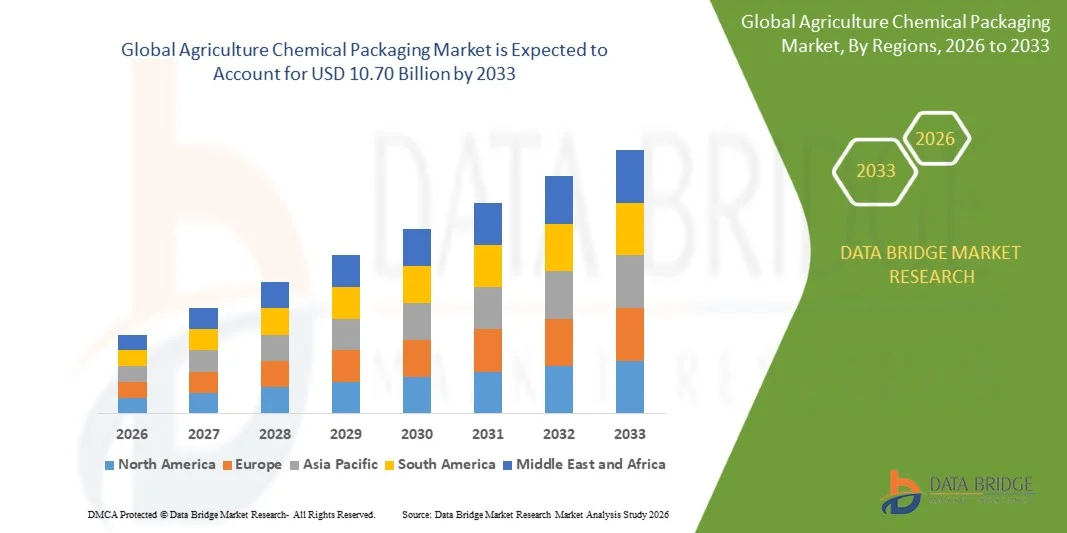
- As per Data Bridge Market Research analysis, the agriculture chemical packaging market was valued at USD 6.60 billion in 2025 and is projected to reach USD 10.70 billion by 2033, growing at a CAGR of 6.40% from 2026 to 2033.
- The market is experiencing consistent growth driven by rising consumption of crop protection products and fertilizers, tightening container safety and recyclability rules, and expanding agricultural output across Asia-Pacific, South America, and North America.
- The increasing shift toward recyclable, reusable, and tamper-evident containers, combined with growing investment in closed transfer systems and container-return programs, is supporting market adoption. Agriculture chemical packaging is being applied across agriculture packaging formats, fungicide packaging for crop disease control, and seed treatment products, offering growers safer handling, accurate dosing, and lower residue-related waste.
Market Size & Forecast
- Global Market Value (2025): USD 6.60 Billion
- Expected Market Value (2033): USD 10.70 Billion
- Forecast CAGR (2026–2033): 6.40%
- Leading Region in 2025: Asia-Pacific
- Fastest Growing Region: South America
What are the Major Takeaways of the Agriculture Chemical Packaging Market?
- Asia-Pacific dominated the agriculture chemical packaging market with the largest revenue share of 40.85% in 2025, supported by large cropland, high pesticide and fertilizer consumption, and a strong base of container manufacturers.
- South America is expected to be the fastest-growing region at a CAGR of 8.10% from 2026 to 2033, fueled by expanding soybean and corn acreage in Brazil, rising crop protection use, and growing adoption of returnable containers.
- The plastic segment led the market with a 62.35% share in 2025, driven by the lightweight, chemically resistant, and cost-efficient nature of HDPE bottles, jerrycans, and drums.
- Paper & paperboard is the fastest-growing material type, projected to register a CAGR of 7.90%, reflecting rising demand for recyclable bags and cartons for dry formulations and granular fertilizers.
- The bottles & jerrycans segment dominated the packaging type category with a 38.70% revenue share in 2025, led by wide use for liquid herbicides, insecticides, and fungicides.
- Pesticides accounted for 57.40% of the market share in 2025, supported by high consumption of herbicides, insecticides, and fungicides that require UN-certified, leak-proof containers.
- The fertilizers segment is the fastest-growing application category, with a CAGR of 8.20%, driven by growing demand for liquid and specialty nutrient formulations supplied in reusable containers.
Report Scope and Agriculture Chemical Packaging Market Segmentation
|
Attributes |
Agriculture Chemical Packaging Market Key Market Insights |
|
Segments Covered |
|
|
Countries Covered |
North America
Europe
Asia-Pacific
Middle East and Africa
South America
|
|
Key Market Players |
|
|
Market Opportunities |
|
|
Value Added Data Infosets |
In addition to the insights on market scenarios such as market value, growth rate, segmentation, geographical coverage, and major players, the market reports curated by the Data Bridge Market Research also include import export analysis, production capacity overview, production consumption analysis, price trend analysis, climate change scenario, supply chain analysis, value chain analysis, raw material/consumables overview, vendor selection criteria, PESTLE Analysis, Porter Analysis, and regulatory framework. |
What is the Key Trend in the Agriculture Chemical Packaging Market?
- Agrochemical packaging is shifting from single-use containers toward recyclable, rinseable, and reusable formats as manufacturers, distributors, and regulators place greater emphasis on container stewardship and waste reduction.
- For instance, in July 2023, according to Iowa State University Extension and Outreach, the Ag Container Recycling Council collected and recycled over 900,000 pounds of pesticide containers in Iowa during 2022, accepting triple-rinsed rigid HDPE containers of 55 gallons or smaller, highlighting growing adoption of stewardship-based packaging.
- Closed transfer systems, tamper-evident closures, and standardized bottle designs are being introduced to reduce operator exposure, spillage, and dosing errors during product handling.
- Bulk and returnable containers are gaining preference among large farms, distributors, and formulators because they reduce rinsing requirements, single-use plastic, and handling costs across the supply chain.
- For instance, in February 2025, according to the European Commission, the Packaging and Packaging Waste Regulation (EU) 2025/40 entered into force and generally applies from 12 August 2026, covering all packaging placed on the EU market and introducing recyclability performance grades from 2030.
- As regulations on recyclability, recycled content, and container disposal expand across regions, agriculture chemical packaging is expected to evolve toward lighter, mono-material, and circular designs that maintain chemical compatibility and safety.
What are the Key Drivers of the Agriculture Chemical Packaging Market?
- Rising use of crop protection products and fertilizers to protect yields and meet growing food demand is increasing the volume of agrochemicals that must be stored, transported, and applied in compliant containers.
- For instance, in July 2025, according to the Food and Agriculture Organization (FAO), total pesticide use in agriculture reached 3.73 million tonnes of active ingredients in 2023, a 14 percent increase over a decade and double the 1990 level, sustaining demand for UN-certified agrochemical containers.
- Stricter rules on hazardous goods transport, operator safety, and container disposal are encouraging manufacturers to adopt higher-specification and traceable packaging solutions.
- For instance, in May 2023, according to BASF Agricultural Solutions, the easyconnect closed transfer system, a pre-fitted recyclable cap and coupler for liquid crop protection products supported by 13 agrochemical companies including Bayer, Corteva, FMC, and Syngenta, won the Pack the Future Award for sustainable packaging innovation.
- Growth of large commercial farms and professional distributors is increasing the use of bulk, returnable, and digitally tracked containers across major agricultural regions.
What Factors Are Challenging the Growth of the Agriculture Chemical Packaging Market?
- Agrochemical containers must resist aggressive formulations, prevent permeation, and meet transport certification requirements, which increases material, testing, and manufacturing complexity.
- For instance, in November 2025, according to the Delaware Department of Agriculture, the state canceled its pesticide container recycling program because containers were repeatedly rejected for visible residue since 2021, shifting disposal cost and effort to the department and highlighting rinsing and contamination challenges.
- Residues left in containers limit recycling rates and make collection programs costly to operate, particularly where farmers lack training or access to rinsing equipment.
- Fluctuating resin prices and the need to adopt recyclable or reusable designs can raise packaging cost, especially for small manufacturers and cost-sensitive farming regions.
- For instance, in March 2024, according to the U.S. Court of Appeals for the Fifth Circuit, EPA orders that would have halted PFAS production in the fluorination of HDPE containers used for pesticides were vacated, after EPA linked PFAS found in a mosquito insecticide to its fluorinated container, underscoring regulatory uncertainty around barrier technologies.
- The combination of residue-related recycling barriers, regulatory uncertainty, and higher costs of reusable and recyclable designs can slow adoption among small producers and price-sensitive markets, where conventional single-use containers remain the default choice.
How is the Agriculture Chemical Packaging Market Segmented?
The agriculture chemical packaging market is segmented on the basis of material, packaging type, application, and crop type.
- By Material
On the basis of material, the agriculture chemical packaging market is segmented into plastic, metal, paper & paperboard, and others. The plastic segment dominated the market with 62.35% share in 2025, supported by its light weight, chemical resistance, and low cost. High-density polyethylene is widely used for bottles, jerrycans, and drums that must withstand aggressive formulations. Plastic containers can be molded in multiple sizes and fitted with tamper-evident closures and measuring features. Their compatibility with barrier technologies helps protect product integrity during long supply chains. Growing use of post-consumer recycled content and rinseable designs is further strengthening demand.
The paper & paperboard segment is projected to register the fastest growth at a CAGR of 7.90% from 2026 to 2033, driven by rising demand for recyclable bags, cartons, and secondary packaging. Paper-based formats are well suited to dry formulations, granular fertilizers, and water-soluble products. Regulatory pressure to reduce plastic waste is encouraging manufacturers to replace multi-material packs with mono-material alternatives. Improvements in moisture barriers and coatings are widening the range of products that can be packed in paper. Brand owners are also using paper-based packs to support sustainability commitments.
- By Packaging Type
On the basis of packaging type, the agriculture chemical packaging market is segmented into bottles & jerrycans, drums & pails, bags & pouches, intermediate bulk containers, and others. The bottles & jerrycans segment dominated the packaging type category with 38.70% share in 2025, supported by their suitability for liquid crop protection products sold to farmers. Standard pour-and-measure features reduce spillage and dosing errors during field use. Barrier-treated and multilayer designs protect formulations from permeation and leakage. Container sizes from one to twenty liters match the purchasing patterns of small and large farms. Compatibility with closed transfer caps is further supporting their use.
The intermediate bulk container segment is projected to register the fastest growth at a CAGR of 8.60% from 2026 to 2033, driven by the shift toward bulk supply to large farms, distributors, and formulators. Reusable containers eliminate triple rinsing and reduce single-use plastic generated at the farm. Digital tracking and returnable pooling models are improving traceability and asset utilization. Bulk containers also lower transport and handling cost per liter of product. Growing agribusiness consolidation in Brazil, North America, and Europe is creating additional demand for large-format packaging.
- By Application
On the basis of application, the agriculture chemical packaging market is segmented into pesticides, fertilizers, adjuvants, and others. The pesticides segment dominated the application category with 57.40% share in 2025, supported by large volumes of herbicides, insecticides, and fungicides applied across cereals, oilseeds, and horticultural crops. These products are hazardous and require UN-certified, leak-proof containers with child-resistant and tamper-evident closures. Regulations on labeling, transport, and container disposal add further packaging requirements. Manufacturers also use packaging to communicate dosing and safety information. Demand for easier, safer pouring is increasing the use of redesigned bottles.
The fertilizers segment is projected to register the fastest growth at a CAGR of 8.20% from 2026 to 2033, driven by growing use of liquid, foliar, and specialty nutrient formulations. These products are increasingly supplied in jerrycans, drums, and intermediate bulk containers rather than traditional woven bags. Precision nutrient programs encourage smaller, more frequent purchases and varied pack sizes. Biostimulants and micronutrient products add further demand for compatible, corrosion-resistant packaging. Distributors are also adopting returnable containers to reduce waste and handling costs.
- By Crop Type
On the basis of crop type, the agriculture chemical packaging market is segmented into cereals & grains, oilseeds & pulses, fruits & vegetables, and others. The cereals & grains segment dominated the crop type category with 44.15% share in 2025, supported by the large cultivated area under rice, wheat, and corn. These crops receive repeated applications of herbicides, fungicides, and fertilizers across the growing season. Large-acreage farms prefer bulk and mid-sized containers that reduce handling frequency. Government support for staple crop production sustains input purchases. Stable demand from export-oriented grain producers further strengthens packaging volumes.
The fruits & vegetables segment is projected to register the fastest growth at a CAGR of 8.30% from 2026 to 2033, driven by intensive crop protection programs and rising export-quality requirements. High-value horticultural crops use frequent, targeted applications of fungicides, insecticides, and nutrient products. Growers prefer smaller, easy-to-handle packs with accurate dosing features. Residue limits imposed by importing countries increase the need for precise application and traceable products. Expansion of protected cultivation and orchards is creating additional demand for specialty packaging.
Which Region Holds the Largest Share of the Agriculture Chemical Packaging Market?
- Asia-Pacific dominated the agriculture chemical packaging market with the largest revenue share of 40.85% in 2025, supported by large cropland, high pesticide and fertilizer consumption, and a strong base of container manufacturers.
- The region also benefits from growing agrochemical production and export capacity, rapid adoption of improved crop protection practices, and increasing government attention to pesticide container disposal. Rising demand for UN-certified, tamper-evident, and recyclable containers across rice, wheat, corn, and horticultural crops continues to strengthen Asia-Pacific's position in the global market.
China Agriculture Chemical Packaging Market Insight
The China agriculture chemical packaging market is witnessing strong growth due to large-scale crop production, a sizeable domestic agrochemical industry, and rising export of formulated products. Demand is increasing for compliant, leak-proof containers and recyclable alternatives as environmental rules on packaging waste tighten. In addition, consolidation of farmland and growth of professional spraying services are encouraging the use of larger, standardized containers across the country.
South America Agriculture Chemical Packaging Market Insight
The South America agriculture chemical packaging market is expected to witness rapid growth, driven by expanding soybean, corn, and sugarcane production and heavy use of crop protection products. Large commercial farms and distributors are adopting bulk and returnable containers to reduce rinsing, waste, and handling costs. Established container return programs and strong agribusiness investment are also supporting wider adoption of higher-specification packaging across the region.
Brazil Agriculture Chemical Packaging Market Insight
The Brazil agriculture chemical packaging market is growing rapidly, supported by its position as a leading soybean, corn, and cotton producer and one of the largest consumers of crop protection products. Producers rely on UN-certified jerrycans, drums, and intermediate bulk containers to move products across long distances. Furthermore, growth of biological inputs and reverse-logistics requirements is increasing demand for compatible and returnable packaging formats.
India Agriculture Chemical Packaging Market Insight
The India agriculture chemical packaging market is expanding steadily, driven by a large farming base, growing agrochemical manufacturing, and rising demand for pesticides and specialty fertilizers. Small farm sizes favor compact bottles, pouches, and sachets, while larger formulators are investing in barrier-treated plastic containers. Moreover, increasing focus on safe handling and container disposal is encouraging manufacturers to upgrade to more durable and compliant packaging.
U.S. Agriculture Chemical Packaging Market Insight
The U.S. agriculture chemical packaging market is witnessing consistent growth due to large-acreage farming, extensive use of herbicides and fungicides, and well-developed distribution networks. Container stewardship and recycling programs for triple-rinsed pesticide containers are shaping packaging choices. In addition, growing interest in closed transfer systems and returnable bulk containers is supporting the adoption of safer and more efficient packaging among growers and retailers.
Germany Agriculture Chemical Packaging Market Insight
The Germany agriculture chemical packaging market is expanding steadily due to strict operator-safety and environmental requirements and the country's strong industrial packaging base. Manufacturers are preparing for the EU packaging regulation by redesigning containers for recyclability and reduced material use. Furthermore, German and European formulators are early adopters of closed transfer caps and reusable containers, which is influencing packaging specifications across the wider region.
Which are the Top Companies in Agriculture Chemical Packaging Market?
The agriculture chemical packaging market is primarily led by well-established companies, including:
- Greif, Inc. (U.S.)
- Mauser Packaging Solutions (U.S.)
- Amcor plc (Switzerland)
- SCHÜTZ GmbH & Co. KGaA (Germany)
- Sonoco Products Company (U.S.)
- Time Technoplast Limited (India)
- Silgan Holdings Inc. (U.S.)
- Mondi Group (U.K.)
- ALPLA Group (Austria)
- Scholle IPN (U.S.)
- Plastipak Holdings, Inc. (U.S.)
- Nampak Limited (South Africa)
- LC Packaging International BV (Netherlands)
- Berlin Packaging (U.S.)
- Nexus Packaging Ltd (U.K.)
- Letica Corporation (U.S.)
- Sealed Air Corporation (U.S.)
- Bericap Holding GmbH (Germany)
- UFlex Limited (India)
- International Paper Company (U.S.)
What are Latest Developments in Agriculture Chemical Packaging Market?
- In September 2026, Mauser Packaging Solutions launched Questar Canada, combining its U.S. and Canadian industrial packaging distribution activities under the Questar brand effective 1 September 2026. The company said the move improves inventory availability and delivery speed across North America for industrial containers used by chemical customers.
- In June 2026, Greif, Inc. completed the acquisition of Envaplast, a premium small polymer container manufacturer near Valencia, Spain, that primarily serves the agrochemical industry. The acquisition strengthens Greif's Customized Polymer Solutions business and expands its manufacturing presence in Spain, where it previously had a limited position in small polymer packaging.
- In December 2025, Mauser Packaging Solutions completed the acquisition of substantially all assets of Siena Plastics LLC, a manufacturer of small high-performance containers for industrial packaging located in Charlotte, North Carolina. The company said the acquisition strengthens its North America Small Packaging segment and complements its existing business.
- In April 2025, Amcor plc completed its all-stock combination with Berry Global, creating a larger global packaging supplier with identified synergies of USD 650 million. The company said the combination broadens its rigid and flexible packaging offering and enhances innovation and research capabilities for customers.
- In January 2025, Corteva Agriscience announced that its Pixxaro herbicide would be the first product to pilot the easyconnect cap in redesigned packaging. The new bottle has a standardized shape, clear material, and no induction seal to make the whole pack recyclable, and the company said it uses 12% less plastic.
- Interactive Data Analysis Dashboard
- Company Analysis Dashboard for high growth potential opportunities
- Research Analyst Access for customization & queries
- Competitor Analysis with Interactive dashboard
- Latest News, Updates & Trend analysis
- Harness the Power of Benchmark Analysis for Comprehensive Competitor Tracking
Data collection and base year analysis are done using data collection modules with large sample sizes. The stage includes obtaining market information or related data through various sources and strategies. It includes examining and planning all the data acquired from the past in advance. It likewise envelops the examination of information inconsistencies seen across different information sources. The market data is analysed and estimated using market statistical and coherent models. Also, market share analysis and key trend analysis are the major success factors in the market report. To know more, please request an analyst call or drop down your inquiry.
The key research methodology used by DBMR research team is data triangulation which involves data mining, analysis of the impact of data variables on the market and primary (industry expert) validation. Data models include Vendor Positioning Grid, Market Time Line Analysis, Market Overview and Guide, Company Positioning Grid, Patent Analysis, Pricing Analysis, Company Market Share Analysis, Standards of Measurement, Global versus Regional and Vendor Share Analysis. To know more about the research methodology, drop in an inquiry to speak to our industry experts.
Data Bridge Market Research is a leader in advanced formative research. We take pride in servicing our existing and new customers with data and analysis that match and suits their goal. The report can be customized to include price trend analysis of target brands understanding the market for additional countries (ask for the list of countries), clinical trial results data, literature review, refurbished market and product base analysis. Market analysis of target competitors can be analyzed from technology-based analysis to market portfolio strategies. We can add as many competitors that you require data about in the format and data style you are looking for. Our team of analysts can also provide you data in crude raw excel files pivot tables (Fact book) or can assist you in creating presentations from the data sets available in the report.