


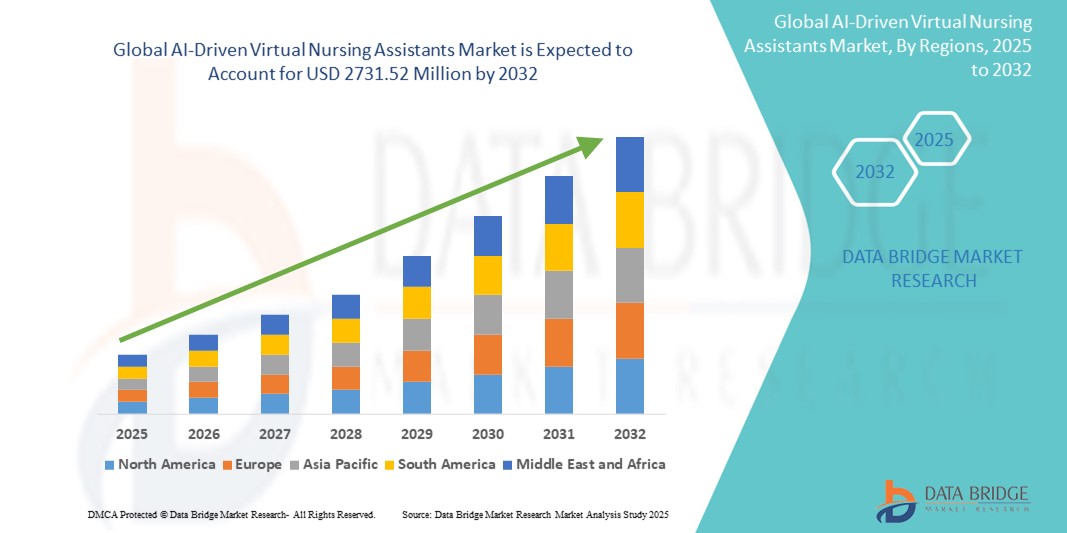
AI-Driven Virtual Nursing Assistants Market Size
- The global AI-driven virtual nursing assistants market size was valued at USD 931.1 million in 2024 and is expected to reach USD 2,731.52 million by 2032, at a CAGR of 14.40% during the forecast period
- The market growth is largely fueled by the increasing demand for efficient, round-the-clock patient engagement and monitoring solutions, supported by rapid advancements in artificial intelligence and natural language processing technologies
- Furthermore, the growing burden on healthcare systems, shortage of skilled professionals, and the rise in chronic disease cases are pushing providers to adopt virtual assistants for triage, medication reminders, and administrative support. These converging factors are accelerating the integration of AI-powered nursing tools, thereby significantly boosting the industry’s growth
AI-Driven Virtual Nursing Assistants Market Analysis
- AI-driven virtual nursing assistants, which leverage artificial intelligence to support patients through voice or text-based interfaces, are becoming essential tools in modern healthcare delivery due to their 24/7 availability, scalability, and ability to streamline both clinical and administrative tasks in diverse healthcare environments
- The accelerating demand for virtual nursing assistants is primarily fueled by the global shortage of healthcare professionals, the increasing prevalence of chronic conditions, and the rising need for continuous patient engagement and monitoring beyond hospital settings
- North America dominated the AI-driven virtual nursing assistants market with the largest revenue share of 39.5% in 2024, supported by advanced healthcare infrastructure, strong AI adoption, and a high concentration of tech-driven healthcare startups, particularly in the U.S., where integration with electronic health records (EHRs), telehealth platforms, and smart speakers has driven widespread deployment
- Asia-Pacific is expected to be the fastest-growing region in the AI-driven virtual nursing assistants market during the forecast period due to rapid digital transformation, increasing healthcare access through mobile platforms, and expanding investments in AI-driven health innovations
- Text-to-Speech (TTS) segment dominated the AI-Driven virtual nursing assistants market with a market share of 54.5% in 2024, driven by its ability to deliver natural, real-time verbal responses that enhance patient interaction and accessibility, especially for visually impaired or elderly users
Report Scope and AI-Driven Virtual Nursing Assistants Market Segmentation
|
Attributes |
AI-Driven Virtual Nursing Assistants Key Market Insights |
|
Segments Covered |
|
|
Countries Covered |
North America
Europe
Asia-Pacific
Middle East and Africa
South America
|
|
Key Market Players |
|
|
Market Opportunities |
|
|
Value Added Data Infosets |
In addition to the insights on market scenarios such as market value, growth rate, segmentation, geographical coverage, and major players, the market reports curated by the Data Bridge Market Research also include in-depth expert analysis, pricing analysis, brand share analysis, consumer survey, demography analysis, supply chain analysis, value chain analysis, raw material/consumables overview, vendor selection criteria, PESTLE Analysis, Porter Analysis, and regulatory framework. |
AI-Driven Virtual Nursing Assistants Market Trends
“Enhanced Patient Engagement through AI and Voice-Enabled Interfaces”
- A significant and accelerating trend in the global AI-driven virtual nursing assistants market is the integration of advanced artificial intelligence (AI) and voice-enabled technologies to deliver more personalized and accessible patient care. These assistants are increasingly designed to communicate through natural voice interfaces, improving patient comfort and engagement, especially for elderly or visually impaired users
- For instance, Sensely’s virtual nurse “Molly” leverages voice recognition and avatar-based interaction to triage symptoms and guide patients through follow-up care. Similarly, Amazon’s Alexa-enabled healthcare skills offer medication reminders and wellness tips through voice commands, transforming how users interact with digital health tools
- AI integration allows virtual nursing assistants to continuously learn from patient interactions, adapt communication styles, and deliver context-aware support. For instance, some platforms can analyze symptom patterns to recommend timely follow-ups or escalate care to human providers when needed. This intelligent responsiveness makes AI-driven assistants valuable tools in chronic disease management and preventive care
- The seamless integration with electronic health records (EHRs), telehealth platforms, and mobile applications allows virtual nursing assistants to centralize patient data, automate administrative workflows, and support care coordination across providers. This streamlines healthcare delivery and reduces the burden on human staff
- This trend toward more intelligent, intuitive, and connected care delivery systems is transforming expectations for patient support and healthcare efficiency. Consequently, companies such as Nuance (a Microsoft company), Infermedica, and Babylon are developing AI-powered nursing tools with features such as multilingual support, real-time symptom assessment, and voice-guided care navigation
- The demand for AI-driven virtual nursing assistants with natural interaction capabilities is rapidly increasing across hospitals, home care settings, and insurance platforms, as stakeholders prioritize scalable solutions for personalized, accessible, and continuous care delivery
AI-Driven Virtual Nursing Assistants Market Dynamics
Driver
“Rising Demand Amid Healthcare Workforce Shortage and Chronic Disease Burden”
- The growing global shortage of healthcare professionals, combined with rising rates of chronic illnesses and aging populations, is a major driver of demand for AI-driven virtual nursing assistants. These digital tools provide scalable, 24/7 support that helps bridge gaps in care delivery and patient monitoring
- For instance, in February 2024, Microsoft and Epic Systems expanded their collaboration to integrate generative AI into clinical workflows, highlighting the industry's move toward automated support systems in hospitals. Such partnerships are accelerating the adoption of virtual nursing assistants across care settings
- As healthcare systems seek efficient ways to reduce provider workload and maintain patient engagement outside hospital walls, virtual nursing assistants offer capabilities such as appointment reminders, symptom triage, and post-discharge guidance. These tools enhance care continuity, reduce unnecessary visits, and improve patient outcomes
- Furthermore, the increasing use of telehealth and remote care models has made virtual assistants essential components of digital health strategies, offering cost-effective ways to extend care into homes while maintaining clinical oversight. Their ability to interface with patient portals and mobile apps aligns with the broader push for consumer-driven healthcare experiences
Restraint/Challenge
“Data Privacy Concerns and Regulatory Compliance Complexities”
- Concerns over data privacy, security, and regulatory compliance present significant challenges to the widespread adoption of AI-driven virtual nursing assistants. These platforms collect sensitive health information, making them potential targets for cyber threats and raising concerns about HIPAA and GDPR compliance
- For instance, high-profile breaches involving healthcare data have made providers cautious about deploying AI tools that process and store patient information via cloud or mobile systems
- Addressing these concerns through end-to-end encryption, robust access controls, transparent data practices, and regulatory alignment is critical to building stakeholder trust. Companies such as Sensely and Babylon emphasize their security protocols and data governance frameworks to reassure healthcare clients and users
- In addition, the complexity and variability of global healthcare regulations can delay implementation across regions, especially when AI systems need to align with local clinical protocols or language standards
- High development costs for advanced features such as natural language processing and multi-language support may also limit adoption in resource-constrained environments
- Overcoming these hurdles will require regulatory clarity, investment in secure AI infrastructure, and user education on virtual assistant safety and utility
AI-Driven Virtual Nursing Assistants Market Scope
The market is segmented on the basis of technology, deployment, application, and end user.
- By Technology
On the basis of technology, the AI-driven virtual nursing assistants market is segmented into automatic speech recognition (ASR), text-to-speech (TTS), text-based interface, natural language processing (NLP), and others. The Text-to-speech (TTS) segment dominated the market with the largest revenue share of 54.5% in 2024, driven by its ability to deliver natural, real-time verbal responses that improve user engagement and accessibility, particularly among elderly or visually impaired patients. TTS enhances the conversational capabilities of virtual assistants, making them more interactive and patient-friendly within both clinical and home care environments.
The automatic speech recognition (ASR) segment is expected to witness the fastest growth from 2025 to 2032, fueled by rising demand for voice-enabled systems that can accurately interpret patient input and respond conversationally. ASR enhances the efficiency of digital triage, symptom checking, and health assessments, supporting hands-free interaction across various healthcare settings
- By Deployment
On the basis of deployment, the market is segmented into cloud-based, on-premise, and hybrid. The cloud-based segment held the largest market revenue share in 2024, accounting for over 85% of the total market. This dominance is driven by the cost-effectiveness, scalability, and ease of integration that cloud platforms offer, enabling healthcare providers to deploy AI-driven assistants quickly without heavy IT infrastructure investments. Cloud solutions also support real-time data updates and centralized patient record access.
The on-premise segment is expected to witness the fastest CAGR from 2025 to 2032, particularly in environments where data security and regulatory compliance are critical, such as government hospitals and specialty clinics. On-premise deployment allows institutions full control over patient data, which is a priority in regions with strict data protection laws
- By Application
On the basis of application, the market is segmented into symptom checking & virtual triage, appointment scheduling & reminders, medication management, medical information retrieval, patient engagement & education, clinical decision support, administrative support, and remote monitoring. The Medical Information Retrieval segment dominated the market with a revenue share of over 30% in 2024, as AI-driven assistants are increasingly used to provide instant, accurate, and accessible medical information to patients and healthcare providers. This function is critical in reducing administrative burden and ensuring consistent health communication.
The symptom checking & virtual triage segment is anticipated to witness the fastest CAGR from 2025 to 2032, driven by the growing need for 24/7 self-assessment tools and early diagnosis support. These AI tools enable patients to report symptoms, receive triage guidance, and be directed to appropriate care pathways, reducing unnecessary ER visits and supporting telehealth expansion.
- By End User
On the basis of end user, the market is segmented into Hospitals & Clinics, Patients, Healthcare Payers (Insurance Companies), Pharmaceutical & Life Sciences Companies, and Others. The Healthcare Payers segment held the largest market share in 2024, as insurance companies increasingly leverage virtual nursing assistants to streamline member communication, handle claims inquiries, and offer preventive care reminders. These tools reduce call center workloads and improve customer satisfaction by providing round-the-clock support.
The Patients segment is expected to witness the fastest growth from 2025 to 2032, driven by rising adoption of AI-based personal health assistants for home care, chronic disease management, and medication reminders. With growing health awareness and the convenience of mobile health solutions, patients are becoming key adopters of virtual nursing technology for everyday health interaction
AI-Driven Virtual Nursing Assistants Market Regional Analysis
- North America dominated the AI-driven virtual nursing assistants market with the largest revenue share of 39.5% in 2024, supported by advanced healthcare infrastructure, strong AI adoption, and a high concentration of tech-driven healthcare startups, particularly in the U.S., where integration with electronic health records (EHRs), telehealth platforms, and smart speakers has driven widespread deployment
- Consumers and healthcare providers in the region highly value the 24/7 support, personalized care, and seamless integration of virtual nursing assistants with electronic health records (EHRs), telehealth platforms, and mobile health apps
- This widespread adoption is further supported by a tech-savvy population, a rising chronic disease burden, and increasing demand for efficient, scalable healthcare delivery—positioning AI-driven virtual assistants as a vital solution for both clinical and home-care environment
U.S. AI-Driven Virtual Nursing Assistants Market Insight
The U.S. AI-driven virtual nursing assistants market captured the largest revenue share of 82% in 2024 within North America, driven by the early adoption of digital health technologies, strong investment in AI infrastructure, and growing demand for remote patient care solutions. Healthcare providers are leveraging AI assistants to automate administrative tasks, enhance patient communication, and reduce clinical burden. Integration with EHR systems and telehealth platforms, along with rising use of voice-enabled assistants, is significantly contributing to market growth.
Europe AI-Driven Virtual Nursing Assistants Market Insight
The Europe AI-driven virtual nursing assistants market is projected to expand at a substantial CAGR during the forecast period, fueled by rising healthcare digitization and the need to support aging populations. Government-led digital health initiatives and strict data protection regulations are encouraging the development of compliant, AI-powered solutions. The region is seeing increased adoption across primary care, chronic disease management, and elderly care, with virtual assistants integrated into mobile health platforms and hospital systems to enhance service delivery.
U.K. AI-Driven Virtual Nursing Assistants Market Insight
The U.K. AI-driven virtual nursing assistants market is expected to grow at a noteworthy CAGR, driven by the National Health Service’s (NHS) emphasis on digital transformation and the rising demand for cost-effective patient engagement tools. Increasing concern over healthcare staff shortages and growing consumer comfort with AI-driven services are encouraging both public and private healthcare providers to adopt virtual assistants for triage, scheduling, and patient education across hospital and home care settings.
Germany AI-Driven Virtual Nursing Assistants Market Insight
The Germany AI-driven virtual nursing assistants market is anticipated to grow at a considerable CAGR, supported by the country’s strong emphasis on digital health, regulatory innovation, and technological advancement. Germany’s healthcare system is investing in AI tools that ensure secure, scalable, and multilingual patient interactions. Demand is particularly strong for assistants that integrate with national health infrastructure while meeting strict data privacy requirements, making Germany a key European market for AI-based care technologies.
Asia-Pacific AI-Driven Virtual Nursing Assistants Market Insight
The Asia-Pacific AI-driven virtual nursing assistants market is poised to grow at the fastest CAGR of 26.2% from 2025 to 2032, fueled by increasing healthcare demand, smartphone penetration, and government support for digital health. Countries such as China, Japan, and India are experiencing rapid adoption of AI in healthcare, especially in remote care, symptom checking, and chronic condition management. Local innovation, multilingual support, and affordability are key drivers expanding market access across the region.
Japan AI-Driven Virtual Nursing Assistants Market Insight
The Japan AI-driven virtual nursing assistants market is gaining traction due to the country’s advanced healthcare infrastructure, high-tech readiness, and the urgent need to support an aging population. AI-powered assistants are being adopted in hospitals, elder care facilities, and home health services, offering voice-enabled interaction and seamless integration with medical IoT systems. The market is also supported by government initiatives to promote AI in elder care and improve access to digital health solutions.
India AI-Driven Virtual Nursing Assistants Market Insight
The India AI-driven virtual nursing assistants market accounted for the largest market revenue share in Asia-Pacific in 2024, driven by the country’s vast healthcare needs, rising smartphone adoption, and growing focus on health accessibility. Virtual assistants are increasingly used in telemedicine platforms, rural outreach, and chronic disease monitoring. India’s cost-sensitive market is fueling demand for AI-driven tools that are affordable, multilingual, and scalable—supporting healthcare delivery in both urban and underserved regions.
AI-Driven Virtual Nursing Assistants Market Share
The AI-Driven virtual nursing assistants industry is primarily led by well-established companies, including:
- Sensely, Inc. (U.S.)
- Infermedica (Poland)
- Microsoft Corporation (U.S.)
- Nuance Communications, Inc. (U.S.)
- HealthTap, Inc. (U.S.)
- Amazon.com, Inc. (U.S.)
- Google LLC (U.S.)
- Syllable Corporation (U.S.)
- Catalia Health, Inc. (U.S.)
- ADA Health GmbH (Germany)
- Hyro Inc. (U.S.)
- Florence Healthcare, Inc. (U.S.)
- Buoy Health, Inc. (U.S.)
- Well Health Inc. (U.S.)
- Binah.ai Ltd. (Israel)
- GYANT, Inc. (U.S.)
- K Health, Inc. (U.S.)
- Komodo Health, Inc. (U.S.)
- eVisit, Inc. (U.S.)
What are the Recent Developments in Global AI-Driven Virtual Nursing Assistants Market?
- In April 2024, Microsoft and Epic Systems expanded their collaboration to integrate generative AI into electronic health record (EHR) workflows, enabling more efficient clinical documentation and patient engagement through virtual assistants. This advancement reflects a broader push to incorporate intelligent automation in healthcare systems, enhancing care coordination, reducing provider workload, and improving patient interaction through conversational AI technologies
- In March 2024, Sensely, a leading developer of avatar- and voice-enabled virtual health assistants, partnered with Cigna Healthcare to launch an updated AI-driven assistant capable of multilingual patient support and symptom triage. The enhanced platform enables payers to deliver personalized, scalable care navigation solutions, highlighting the growing importance of AI-driven tools in improving access and satisfaction across health insurance ecosystems
- In March 2024, Babylon Health rolled out new AI-powered symptom checker updates in select European markets, offering greater diagnostic accuracy and real-time triage recommendations. These improvements, powered by machine learning and natural language processing, are designed to optimize patient journeys in primary care settings, reduce unnecessary clinic visits, and streamline digital consultations—advancing Babylon’s mission to make quality healthcare more accessible
- In February 2024, Infermedica, an AI healthtech company, released its Medical Guidance Platform 2.0, an enhanced version of its virtual health assistant platform for healthcare providers and insurers. This update introduces AI-driven tools for personalized patient guidance, symptom analysis, and improved clinical decision support, demonstrating the industry’s growing reliance on intelligent virtual interfaces to support overwhelmed healthcare systems
- In January 2024, HealthTap, a U.S.-based telehealth provider, launched its AI-enabled virtual nurse assistant within its mobile app to streamline pre-consultation workflows and patient Q&A. The feature uses conversational AI to address common health inquiries, collect preliminary health data, and reduce physician time spent on administrative tasks. This development reflects the increasing integration of AI assistants into consumer health platforms, improving service efficiency and user experience

- Interactive Data Analysis Dashboard
- Company Analysis Dashboard for high growth potential opportunities
- Research Analyst Access for customization & queries
- Competitor Analysis with Interactive dashboard
- Latest News, Updates & Trend analysis
- Harness the Power of Benchmark Analysis for Comprehensive Competitor Tracking
Data collection and base year analysis are done using data collection modules with large sample sizes. The stage includes obtaining market information or related data through various sources and strategies. It includes examining and planning all the data acquired from the past in advance. It likewise envelops the examination of information inconsistencies seen across different information sources. The market data is analysed and estimated using market statistical and coherent models. Also, market share analysis and key trend analysis are the major success factors in the market report. To know more, please request an analyst call or drop down your inquiry.
The key research methodology used by DBMR research team is data triangulation which involves data mining, analysis of the impact of data variables on the market and primary (industry expert) validation. Data models include Vendor Positioning Grid, Market Time Line Analysis, Market Overview and Guide, Company Positioning Grid, Patent Analysis, Pricing Analysis, Company Market Share Analysis, Standards of Measurement, Global versus Regional and Vendor Share Analysis. To know more about the research methodology, drop in an inquiry to speak to our industry experts.
Data Bridge Market Research is a leader in advanced formative research. We take pride in servicing our existing and new customers with data and analysis that match and suits their goal. The report can be customized to include price trend analysis of target brands understanding the market for additional countries (ask for the list of countries), clinical trial results data, literature review, refurbished market and product base analysis. Market analysis of target competitors can be analyzed from technology-based analysis to market portfolio strategies. We can add as many competitors that you require data about in the format and data style you are looking for. Our team of analysts can also provide you data in crude raw excel files pivot tables (Fact book) or can assist you in creating presentations from the data sets available in the report.













