


What is the Global AI in Energy Market Size and Growth Rate?
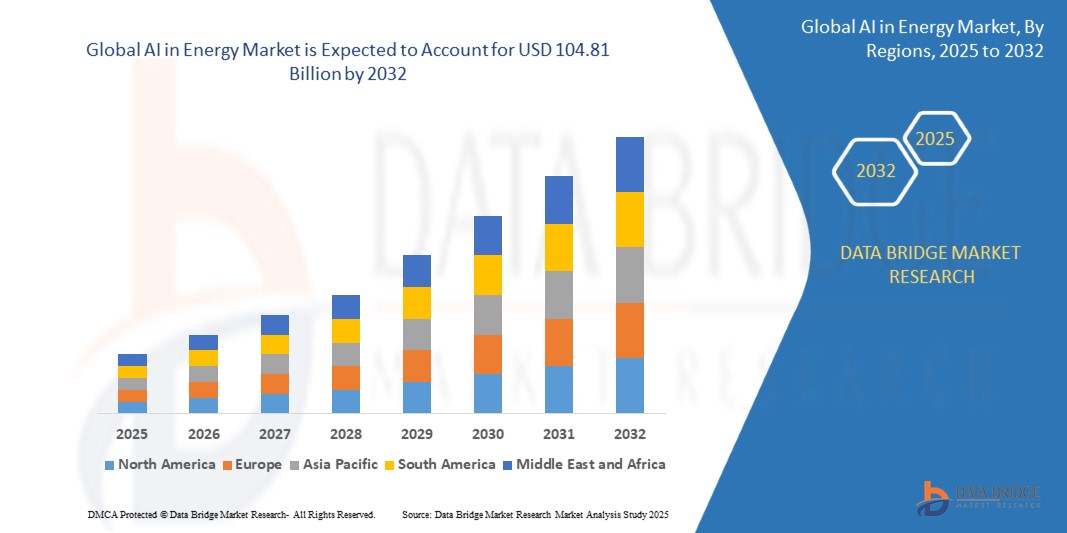
- The global AI in energy market size was valued at USD 9.40 billion in 2024 and is expected to reach USD 104.81 billion by 2032, at a CAGR of 35.18% during the forecast period
- Market growth is driven by the increasing deployment of AI technologies to optimize energy production, distribution, and consumption, alongside the integration of AI with smart grids and renewable energy systems
- In addition, the rising demand for efficient, cost-effective, and sustainable energy solutions is accelerating AI adoption, positioning it as a critical enabler of digital transformation in the energy sector
What are the Major Takeaways of AI in Energy Market?
- AI solutions, including predictive analytics, robotics, and automation, are transforming the energy industry by improving operational efficiency, reducing downtime, and enabling intelligent decision-making across renewable and non-renewable segments
- The growing emphasis on renewable energy management, demand forecasting, and grid modernization is propelling AI adoption, with utilities and enterprises leveraging AI to meet evolving sustainability and regulatory goals
- North America dominated the AI in energy market with the largest revenue share of 43.21% in 2024, driven by the increasing adoption of AI solutions for energy optimization, grid management, and renewable integration
- Asia-Pacific (APAC) AI in energy market is poised to grow at the fastest CAGR of 9.36% from 2025 to 2032, driven by rapid urbanization, rising electricity demand, and AI-enabled digitalization in countries such as China, Japan, and India
- The solutions segment dominated the AI in energy market with the largest market revenue share of 72.4% in 2024, driven by the widespread adoption of AI-powered platforms and tools for optimizing energy production, distribution, and consumption
Report Scope and AI in Energy Market Segmentation
|
Attributes |
AI in Energy Key Market Insights |
|
Segments Covered |
|
|
Countries Covered |
North America
Europe
Asia-Pacific
Middle East and Africa
South America
|
|
Key Market Players |
|
|
Market Opportunities |
|
|
Value Added Data Infosets |
In addition to the insights on market scenarios such as market value, growth rate, segmentation, geographical coverage, and major players, the market reports curated by the Data Bridge Market Research also include in-depth expert analysis, pricing analysis, brand share analysis, consumer survey, demography analysis, supply chain analysis, value chain analysis, raw material/consumables overview, vendor selection criteria, PESTLE Analysis, Porter Analysis, and regulatory framework. |
What is the Key Trend in the AI in Energy Market?
Intelligent Energy Optimization through AI and IoT Integration
- A prominent trend shaping the global AI in energy market is the integration of AI with IoT-enabled energy systems to deliver intelligent optimization, predictive maintenance, and enhanced operational efficiency. This convergence is transforming how energy is produced, distributed, and consumed
- For instance, Siemens Energy leverages AI-powered platforms to analyze grid data in real-time, enabling smarter demand-supply balancing, while Schneider Electric’s EcoStruxure applies AI to optimize renewable energy usage across industrial facilities
- AI integration allows utilities to predict equipment failures, automate energy flows, and reduce costs through smart forecasting. Companies such as GE Vernova employ AI-driven digital twins to simulate grid behavior and improve renewable integration
- These advancements enable a unified approach where operators can monitor and control assets alongside storage and distribution systems through a single interface, creating a more resilient and efficient energy ecosystem
- The shift toward AI-driven optimization is redefining expectations for sustainability and efficiency in energy operations. As a result, companies such as ABB are developing AI-based platforms that integrate renewable energy, storage, and grid management into cohesive solutions
- Growing demand for smarter, greener, and more adaptive energy infrastructure is accelerating the adoption of AI in energy systems across both developed and emerging markets
What are the Key Drivers of AI in Energy Market?
- Increasing demand for energy efficiency and sustainability, coupled with rising adoption of renewable energy sources, is fueling the deployment of AI-powered solutions to optimize generation and consumption
- For instance, in March 2024, Schneider Electric launched an AI-driven microgrid solution to enhance renewable integration and reduce carbon emissions, reflecting how industry leaders are prioritizing sustainable innovation
- AI enables real-time demand forecasting, anomaly detection, and autonomous control, helping utilities and enterprises meet regulatory mandates and cost reduction goals
- The growing trend of smart grids and decentralized energy systems is making AI a cornerstone for energy management, driving adoption in both industrial and residential sectors
- Furthermore, increasing investments in digitization and automation are pushing energy companies to adopt AI for predictive analytics, asset performance management, and operational optimization, strengthening market growth
Which Factor is challenging the Growth of the AI in Energy Market?
- Cybersecurity risks and data privacy concerns associated with connected energy systems present significant challenges to market expansion. As AI platforms rely on vast amounts of data and interconnected devices, they are vulnerable to hacking and unauthorized access
- For instance, high-profile cyberattacks on energy grids have highlighted potential weaknesses, causing some utilities to hesitate in fully adopting AI-driven systems
- Addressing these risks through robust encryption, secure cloud architectures, and AI-driven threat detection is essential for building trust. Companies such as ABB and Siemens are actively investing in cybersecurity frameworks to mitigate these vulnerabilities
- In addition, the high implementation costs of AI solutions, particularly advanced platforms requiring digital infrastructure upgrades, remain a barrier in developing regions. While modular AI solutions are making deployments more affordable, the perceived premium of AI technology can limit adoption among smaller players
- Overcoming these challenges through affordable AI models, industry-wide security standards, and consumer education will be critical to achieving sustainable growth in the AI in energy market
How is the AI in Energy Market Segmented?
The market is segmented on the basis of type, communication protocol, unlocking mechanism, and application.
• By Type
On the basis of type, the AI in energy market is segmented into Solutions and Services. The Solutions segment dominated the AI in energy market with the largest market revenue share of 72.4% in 2024, driven by the widespread adoption of AI-powered platforms and tools for optimizing energy production, distribution, and consumption. Solutions such as predictive analytics, digital twins, and intelligent grid management are increasingly utilized by utilities and enterprises to enhance operational efficiency and meet sustainability goals. The rising integration of AI solutions with IoT devices and cloud-based systems further strengthens this segment’s dominance.
The Services segment is anticipated to witness the fastest growth rate of 29.1% from 2025 to 2032, fueled by the increasing demand for AI implementation, system integration, and ongoing support. Energy providers and industrial users are relying on managed services to ensure seamless deployment and continuous optimization of AI technologies, particularly as energy infrastructures become more complex and decentralized.
• By Application
On the basis of application, the AI in energy market is segmented into Robotics, Renewable Energy Management, Demand Forecasting, Safety Security & Infrastructure, and Others. The Renewable Energy Management segment accounted for the largest market revenue share of 38.6% in 2024, driven by the growing emphasis on decarbonization and the need for intelligent systems to balance renewable sources such as wind and solar with grid demand. AI-powered platforms are enabling enhanced forecasting, automated energy storage utilization, and improved grid stability, making this segment pivotal to global sustainability efforts.
The Robotics segment is expected to witness the fastest CAGR from 2025 to 2032, driven by advancements in AI-enabled autonomous systems for inspection, maintenance, and optimization of energy assets. Robotics applications are gaining traction across offshore wind farms, solar panel cleaning, and oil & gas operations, improving safety and reducing operational costs.
Which Region Holds the Largest Share of the AI in Energy Market?
- North America dominated the AI in energy market with the largest revenue share of 43.21% in 2024, driven by the increasing adoption of AI solutions for energy optimization, grid management, and renewable integration
- Utilities and enterprises in the region value the operational efficiency, predictive capabilities, and seamless integration of AI technologies with IoT-enabled energy systems
- This leadership is further supported by high investments in digital infrastructure, strong regulatory support for clean energy, and the rapid adoption of smart grid initiatives, positioning AI as a core enabler of sustainable energy transitions
U.S. AI in Energy Market Insight
The U.S. AI in energy market captured 81% of North America’s revenue share in 2024, fueled by the swift deployment of AI-powered platforms across renewable energy, oil & gas, and utilities. Companies are prioritizing predictive maintenance, demand forecasting, and carbon reduction initiatives, while rising investments in smart grids and microgrids further drive adoption. Government programs promoting clean energy and digital transformation amplify growth, making the U.S. a global leader in AI-driven energy innovation.
Europe AI in Energy Market Insight
Europe is projected to expand at a substantial CAGR throughout the forecast period, driven by stringent energy efficiency regulations and ambitious decarbonization targets. Adoption of AI for renewable management, grid stability, and demand response is accelerating as countries modernize energy infrastructure. European enterprises are increasingly integrating AI solutions to meet EU Green Deal goals, with strong uptake across industrial and commercial applications.
U.K. AI in Energy Market Insight
The U.K. AI in energy market is anticipated to grow at a noteworthy CAGR, driven by initiatives such as Net Zero 2050 and rapid deployment of AI for renewable forecasting and energy storage optimization. The expansion of smart meter programs and AI-powered grid management systems supports the country’s transition to a low-carbon energy system, fostering adoption across utilities and commercial sectors.
Germany AI in Energy Market Insight
The Germany AI in energy market is expected to expand at a considerable CAGR, underpinned by the Energiewende policy promoting renewable integration and digital grid modernization. AI-driven predictive analytics, automation, and digital twins are gaining traction in industrial applications, while strong investments in hydrogen and smart grids further boost demand. Germany’s emphasis on innovation and sustainability positions it as a key AI energy hub in Europe.
Which Region is the Fastest Growing Region in the AI in Energy Market?
Asia-Pacific (APAC) AI in energy market is poised to grow at the fastest CAGR of 9.36% from 2025 to 2032, driven by rapid urbanization, rising electricity demand, and AI-enabled digitalization in countries such as China, Japan, and India. Government initiatives promoting renewable energy expansion and smart grid projects are accelerating AI adoption, while the region’s role as a manufacturing hub for AI hardware and energy solutions enhances affordability and accessibility.
Japan AI in Energy Market Insight
Japan’s AI in energy market is gaining momentum due to its high-tech ecosystem, aging infrastructure, and push for carbon neutrality by 2050. AI is increasingly used for renewable forecasting, automated grid balancing, and robotics for energy asset maintenance. The integration of AI with IoT-enabled devices and microgrids supports energy resilience and efficiency, making Japan a leader in advanced energy solutions.
China AI in Energy Market Insight
China accounted for the largest market revenue share in APAC in 2024, driven by massive investments in smart grids, AI-powered renewable projects, and digital energy platforms. AI is central to the country’s smart city initiatives and its strategy to achieve carbon neutrality by 2060. Strong domestic manufacturing capabilities and aggressive adoption of AI-driven predictive analytics and automation make China a global growth engine for the AI in energy market.
Which are the Top Companies in AI in Energy Market?
The AI in energy industry is primarily led by well-established companies, including:
- Siemens AG (Germany)
- Alpiq AG (Switzerland)
- SmartCloud Inc. (U.S.)
- ABB Group (Switzerland)
- General Electric (U.S.)
- Hazama Ando Corporation (Japan)
- Atos SE (France)
- AppOrchid Inc. (U.S.)
- Zen Robotics Ltd. (Finland)
- Origami Energy Ltd. (U.K.)
- Flex Ltd. (Singapore)
- Schneider Electric (France)
What are the Recent Developments in Global AI in Energy Market?
- In May 2025, Enphase Energy, Inc. introduced its IQ® Energy Management system in France, designed to integrate with Enphase solar and battery systems for intelligent energy optimization across dynamic electricity rates and third-party devices such as EV chargers, heat pumps, and electric water heaters. This launch strengthens Enphase’s position in the European smart energy solutions market
- In March 2025, EPRI, NVIDIA, and their collaborators launched an open power AI consortium to revolutionize energy operations, focusing on developing AI applications to address challenges such as increased distributed energy resources and rising electric grid loads. This initiative is expected to accelerate AI innovation in the global energy sector
- In January 2025, SolarEdge unveiled an AI-powered energy management system that connects via a household’s local area network (LAN) to communicate with inverters, EV chargers, heat pumps, and SolarEdge servers. This development enhances SolarEdge’s role in advancing connected and intelligent energy solutions
- In February 2023, ABB Group formed a strategic partnership with Microsoft to develop AI-powered industrial automation solutions applicable to the energy sector. This collaboration positions both companies to drive digital transformation in industrial and energy operations
- In February 2023, General Electric emphasized its ongoing commitment to AI for predictive maintenance in the energy sector through industry publications. This focus reinforces GE’s strategy to enhance operational efficiency and reliability in energy infrastructure

- Interactive Data Analysis Dashboard
- Company Analysis Dashboard for high growth potential opportunities
- Research Analyst Access for customization & queries
- Competitor Analysis with Interactive dashboard
- Latest News, Updates & Trend analysis
- Harness the Power of Benchmark Analysis for Comprehensive Competitor Tracking
Data collection and base year analysis are done using data collection modules with large sample sizes. The stage includes obtaining market information or related data through various sources and strategies. It includes examining and planning all the data acquired from the past in advance. It likewise envelops the examination of information inconsistencies seen across different information sources. The market data is analysed and estimated using market statistical and coherent models. Also, market share analysis and key trend analysis are the major success factors in the market report. To know more, please request an analyst call or drop down your inquiry.
The key research methodology used by DBMR research team is data triangulation which involves data mining, analysis of the impact of data variables on the market and primary (industry expert) validation. Data models include Vendor Positioning Grid, Market Time Line Analysis, Market Overview and Guide, Company Positioning Grid, Patent Analysis, Pricing Analysis, Company Market Share Analysis, Standards of Measurement, Global versus Regional and Vendor Share Analysis. To know more about the research methodology, drop in an inquiry to speak to our industry experts.
Data Bridge Market Research is a leader in advanced formative research. We take pride in servicing our existing and new customers with data and analysis that match and suits their goal. The report can be customized to include price trend analysis of target brands understanding the market for additional countries (ask for the list of countries), clinical trial results data, literature review, refurbished market and product base analysis. Market analysis of target competitors can be analyzed from technology-based analysis to market portfolio strategies. We can add as many competitors that you require data about in the format and data style you are looking for. Our team of analysts can also provide you data in crude raw excel files pivot tables (Fact book) or can assist you in creating presentations from the data sets available in the report.













