


What is the AI in Laboratory Solution Market Size and Growth Rate?
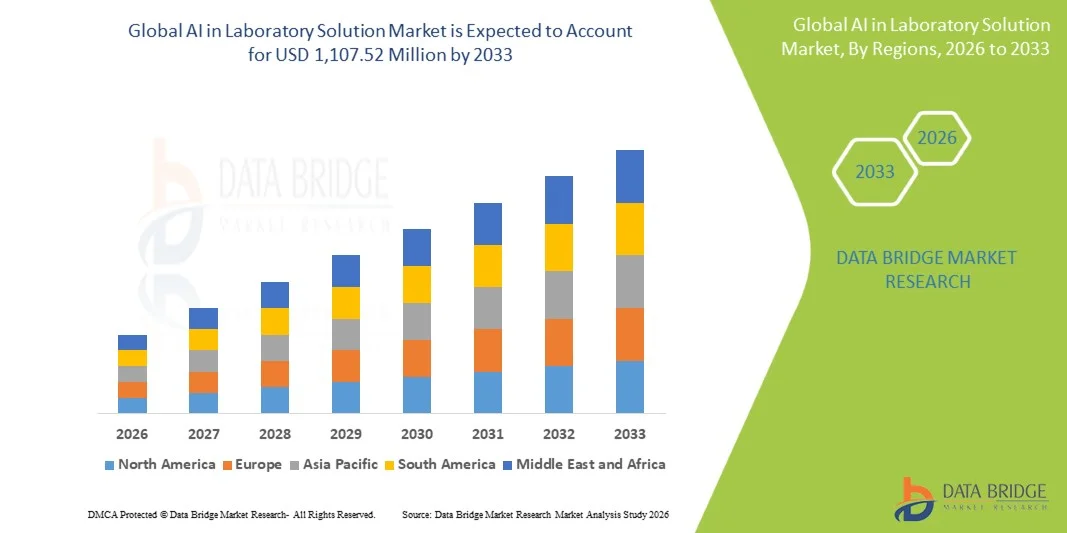
- As per Data Bridge Market Research analysis, the AI in laboratory solution market was valued at USD 431.65 million in 2025 and is projected to reach USD 1,107.52 million by 2033, growing at a CAGR of 12.50% from 2026 to 2033.
- The market is experiencing consistent growth driven by increasing adoption of artificial intelligence in laboratory workflows, rising demand for automated and data-driven analysis, advancements in machine learning and natural language processing, and expanding applications across pharmaceutical, biotechnology, clinical diagnostics, and research laboratories.
- The increasing volume and complexity of laboratory data, combined with the need to improve analytical efficiency, accuracy, and workflow productivity, is compelling pharmaceutical companies, academic institutions, contract research organizations, and diagnostic laboratories to adopt AI-enabled solutions. Machine learning and natural language processing technologies are increasingly being integrated into laboratory processes to support data interpretation, clinical diagnostics, research and development, and quality control.
Market Size & Forecast
- Global Market Value (2025): USD 431.65 Million
- Expected Market Value (2033): USD 1,107.52 Million
- Forecast CAGR (2026–2033): 12.50%
- Leading Region in 2025: North America
- Fastest Growing Region: Asia Pacific
What are the Major Takeaways of the AI in Laboratory Solution Market?
- North America dominated the AI in laboratory solution market with the largest revenue share of 46.38% in 2025, supported by a strong pharmaceutical and biotechnology sector, advanced laboratory infrastructure, and high adoption of AI-enabled research and diagnostic technologies.
- Asia-Pacific is expected to be the fastest-growing region at a CAGR of 15.28% from 2026 to 2033, fueled by increasing life sciences investments, expanding laboratory automation, growing genomic research, and rising adoption of AI technologies across China, Japan, and India.
- The hardware segment led the market with a 35.6% share in 2025, driven by increasing deployment of AI-integrated analytical instruments, imaging systems, robotic sample handlers, and automated laboratory platforms
- Software are the fastest-growing component type, projected to register a CAGR of 13.5%, reflecting the surge in adoption of AI-powered data analytics, laboratory information management systems, workflow orchestration tools, and predictive modeling platforms.
- The predictive analytics segment dominated the technology category with a 35.16% revenue share in 2025, led by widespread use of predictive models for stability monitoring, instrument maintenance, quality monitoring, and laboratory planning.
- Data analysis and interpretation accounted for 35% of the market share in 2025, preferred by the increasing volume and complexity of laboratory-generated data.
- The research and development laboratories segment is the fastest-growing laboratory type category, with a CAGR of 19%, driven by increasing adoption of AI-assisted experimentation, automated workflows, advanced data analysis, and computational research tools
Report Scope and AI in Laboratory Solution Market Segmentation
|
Attributes |
AI in Laboratory Solution Key Market Insights |
|
Segments Covered |
|
|
Countries Covered |
North America
Europe
Asia-Pacific
Middle East and Africa
South America
|
|
Key Market Players |
|
|
Market Opportunities |
|
|
Value Added Data Infosets |
In addition to the insights on market scenarios such as market value, growth rate, segmentation, geographical coverage, and major players, the market reports curated by the Data Bridge Market Research also include in-depth expert analysis, patient epidemiology, pipeline analysis, pricing analysis, and regulatory framework. |
What is the Key Trend in the AI in Laboratory Solution Market?
- Laboratories are increasingly adopting AI-driven autonomous experimentation and laboratory automation to accelerate research workflows, optimize experimental conditions, improve reproducibility, and reduce the time required for iterative scientific discovery.
- For instance, in February 2025, research article published in Scientific Reports describing an autonomous laboratory that combines robotics and AI to conduct biotechnology experiments through a closed loop of culturing, sample preparation, measurement, analysis, and hypothesis formulation; the system used Bayesian optimization to improve experimental conditions.
- Real-time data capture and AI-driven analysis enable laboratories to continuously evaluate experimental results, identify patterns, optimize parameters, and automatically determine subsequent experimental steps.
- Pharmaceutical, biotechnology, materials science, and academic laboratories are increasingly integrating AI, robotics, and high-throughput experimentation to establish self-driving laboratory environments capable of executing complex workflows with limited human intervention.
- For instance, in November 2023, researchers at Lawrence Berkeley National Laboratory reported the A-Lab, an autonomous laboratory combining robotics, machine learning, natural-language models, and active learning to synthesize inorganic materials. Over 17 days of continuous operation, the system produced 36 compounds from 57 targets, demonstrating the growing use of AI-enabled autonomous experimentation in laboratory research
- As laboratories increasingly prioritize faster experimentation, reproducibility, and data-driven scientific discovery, the adoption of AI-enabled autonomous laboratory solutions is expected to accelerate, reinforcing intelligent automation as a core component of next-generation research infrastructure.
What are the Key Drivers of the AI in Laboratory Solution Market?
- The rapid growth of laboratory data and increasing complexity of scientific experiments has significantly increased demand for AI-powered analytical and automation solutions capable of processing large datasets, identifying patterns, and supporting faster experimental decision-making.
- For instance, in August 2025, the U.S. National Science Foundation announced up to USD 100 million to establish a network of AI-enabled programmable cloud laboratories, supporting automated experiment design, laboratory preparation, data collection, analysis, and interpretation across biotechnology, materials science, chemistry, and other laboratory sciences.
- Pharmaceutical companies, biotechnology organizations, research institutes, and materials laboratories are integrating AI with robotics and automated instruments to reduce experimental cycles, improve reproducibility, and accelerate discovery and development activities.
- For instance, in July 2024, AstraZeneca highlighted its iLab in Gothenburg, Sweden, a prototype fully automated medicinal chemistry laboratory integrating AI, machine learning, robotics and automated synthesis to accelerate the design-make-test-analyse cycle of drug discovery.
- With scientific organizations increasingly relying on automated experimentation and intelligent data analysis to improve research productivity, AI-enabled laboratory solutions will remain important for accelerating discovery, optimizing workflows, and supporting next-generation laboratory operations.
Which Factors are Challenging the Growth of the AI in Laboratory Solution Market?
- AI-enabled laboratory solutions require substantial investment in digital infrastructure, automated instruments, data systems, interoperability, and specialized technical expertise, creating adoption barriers for laboratories with limited resources.
- For instance, in December 2024, researchers in npj Digital Medicine reported that AI-based clinical decision-support tools face challenges from changing model performance across settings and over time, as well as insufficient regulatory frameworks for ensuring safety, effectiveness, and equity.
- These implementation requirements can restrict adoption among smaller laboratories and institutions, particularly where legacy instruments, fragmented datasets, limited IT infrastructure, and insufficient AI expertise make integration more difficult.
- For instance, in August 2024, a Nature Medicine analysis found that regulatory authorization does not necessarily mean that AI health tools have undergone adequate clinical validation, highlighting validation and evidence-generation challenges that can slow the adoption of AI-enabled laboratory and healthcare solutions.
- The absence of standardized laboratory data formats and interfaces, combined with interoperability, workforce training, validation, and regulatory requirements, continues to complicate the integration of AI solutions into existing laboratory workflows, slowing broader market adoption.
How is the AI in Laboratory Solution Market Segmented?
The AI in laboratory solution market is segmented on the basis of component, technology, application, and laboratory type.
- By Component
On the basis of component, the AI in laboratory solution market is segmented into software, hardware, and services. The hardware segment dominated the market with 35.6% share in 2025, driven by increasing deployment of AI-integrated analytical instruments, imaging systems, robotic sample handlers, and automated laboratory platforms. AI-enabled hardware allows laboratories to perform real-time analysis and automated sample processing within established workflows. Pharmaceutical, clinical, and research laboratories are increasingly investing in intelligent instruments to improve throughput and analytical consistency. Integration of sensors, imaging systems, robotics, and embedded AI is further expanding the functionality of laboratory equipment. Hardware-based solutions can also reduce manual intervention and support continuous monitoring of laboratory processes.
The software segment is projected to register the fastest growth at 13.5% CAGR during forecast period, supported by rising adoption of AI-powered data analytics, laboratory information management systems, workflow orchestration tools, and predictive modeling platforms. Software solutions provide the intelligence layer needed to analyze laboratory data generated by instruments and connected systems. They allow laboratories to integrate AI capabilities without replacing their entire existing hardware infrastructure. Increasing demand for automated data interpretation and digital laboratory workflows is strengthening software adoption. Cloud-connected platforms are also enabling laboratories to access AI capabilities across multiple research and operational environments. The increasing volume of structured and unstructured laboratory data is creating additional demand for advanced software tools
- By Technology
On the basis of technology, the AI in laboratory solution market is segmented into machine learning, deep learning, natural language processing, computer vision, generative AI, and predictive analytics. The predictive analytics segment dominated the market with a 35.16% share in 2025, supported by widespread use of predictive models for stability monitoring, instrument maintenance, quality monitoring, and laboratory planning. Predictive analytics allows laboratories to identify patterns in historical and real-time data and support earlier detection of potential abnormalities. The technology fits well with established laboratory workflows because it can provide recommendations while retaining human oversight. Pharmaceutical and biotechnology laboratories are using predictive models to improve operational planning and research productivity. Predictive analytics can also support review-by-exception workflows by highlighting unusual laboratory results for further assessment.
The generative AI segment is projected to register the fastest growth at a 16.57% CAGR, during forecast period, driven by increasing adoption of AI copilots, natural-language interfaces, and intelligent scientific information retrieval. Generative AI allows researchers to interact with laboratory records and scientific information using natural-language queries. The technology can assist with protocol development, documentation, knowledge retrieval, and interpretation of complex laboratory information. Vendors are increasingly integrating large language model capabilities into laboratory information management systems and electronic laboratory notebooks. Generative AI can also help researchers navigate large volumes of experimental and scientific information more efficiently. Growing interest in AI-assisted research workflows is expanding the technology beyond experimental applications into routine laboratory operations.
- By Application
On the basis of application, the AI in laboratory solution market is segmented into laboratory automation, data analysis and interpretation, drug discovery and development, sample management, image analysis, quality control and assurance, laboratory workflow optimization, and predictive maintenance. The data analysis and interpretation segment dominated the market with 35% share in 2025, supported by the increasing volume and complexity of laboratory-generated data. AI-based analytical tools enable researchers and laboratory professionals to identify patterns, correlations, anomalies, and actionable insights from complex datasets. These capabilities are particularly valuable in pharmaceutical, biotechnology, clinical, and research laboratories. AI can process large datasets more rapidly than conventional manual approaches and support more consistent interpretation. Integration with laboratory information systems and electronic laboratory notebooks is further improving access to analytical capabilities.
The drug discovery and development segment is projected to register the fastest growth at 16% CAGR during forecast period, driven by increasing use of AI for target identification, compound screening, experimental design, and candidate prioritization. Pharmaceutical and biotechnology laboratories are using AI to connect computational predictions with physical laboratory experiments. AI-enabled systems can help researchers prioritize experiments and reduce unnecessary laboratory iterations. Integration of AI with robotics and automated laboratory instruments is supporting faster design-make-test-analyze cycles. The growing complexity of molecular and biological datasets is also increasing the need for advanced computational tools during drug development. AI can support the identification of relationships across molecular, experimental, and biological information that may be difficult to evaluate manually.
- By Laboratory Type
On the basis of laboratory type, the AI in laboratory solution market is segmented into clinical laboratories, research and development laboratories, pharmaceutical and biotechnology laboratories, academic and research laboratories, industrial laboratories, and diagnostic laboratories. The pharmaceutical and biotechnology laboratories segment dominated the market with a 35.56% share in 2025, supported by substantial research activity, complex laboratory workflows, and the need to accelerate scientific development. These laboratories generate extensive experimental datasets that are well suited to AI-powered analysis and automation. Pharmaceutical companies are increasingly applying AI across drug discovery, laboratory workflow optimization, quality management, and experimental analysis. Biotechnology laboratories similarly use AI for genomics, molecular research, high-throughput experimentation, and biological data interpretation. Existing laboratory information systems and digital research platforms also provide infrastructure for integrating AI capabilities.
The research and development laboratories segment is projected to register the fastest growth at 19% CAGR during forecast period, driven by increasing adoption of AI-assisted experimentation, automated workflows, advanced data analysis, and computational research tools. R&D laboratories generate large and diverse datasets that require rapid processing and interpretation. AI can help researchers identify patterns, optimize experimental conditions, and prioritize subsequent experiments. Integration with robotics and automated instruments is also enabling more continuous and data-driven experimentation. Academic, pharmaceutical, biotechnology, and materials research organizations are increasingly developing connected laboratory environments that combine AI with automation. Growing investment in high-throughput research and autonomous experimentation is further expanding the role of AI in R&D laboratories.
Which Region Holds the Largest Share of the AI in Laboratory Solution Market?
- North America dominated the AI in laboratory solution market with the largest revenue share of 46.38% in 2025, supported by a strong pharmaceutical and biotechnology sector, advanced laboratory infrastructure, and high adoption of AI-enabled research and diagnostic technologies.
- The region also benefits from extensive adoption of AI-enabled laboratory information systems, advanced data analytics, automated laboratory workflows, and research technologies, particularly across the United States. Strong pharmaceutical R&D activity and increasing demand for AI-based analysis and workflow automation continue to strengthen North America’s leadership position in the global market.
U.S. AI in Laboratory Solution Market Insight
The U.S. AI in laboratory solution market is witnessing strong growth due to rising investments in artificial intelligence, laboratory automation, pharmaceutical research, and advanced data analytics. The country’s mature pharmaceutical and biotechnology ecosystem, along with increasing adoption of AI-powered laboratory software, robotics, and intelligent analytical systems, is driving demand across research, clinical, and diagnostic applications. In addition, strong investments in drug discovery, genomics, and autonomous experimentation are accelerating the integration of AI into laboratory workflows.
Asia-Pacific AI in Laboratory Solution Market Insight
The Asia-Pacific AI in laboratory solution market is expected to witness rapid growth, driven by increasing investments in pharmaceutical and biotechnology research, expanding laboratory infrastructure, and rising adoption of artificial intelligence across countries such as China, India, and Japan. Growing demand for laboratory automation, advanced data analysis, and high-throughput research technologies is supporting regional market expansion. In addition, increasing investments in drug discovery, genomics, and digital laboratory infrastructure are accelerating AI adoption across pharmaceutical, academic, and research laboratories.
Japan AI in Laboratory Solution Market Insight
The Japan AI in laboratory solution market is witnessing consistent growth due to rising investments in artificial intelligence, pharmaceutical research, laboratory automation, and advanced healthcare technologies. Pharmaceutical companies, biotechnology organizations, and research institutes are increasingly adopting AI-enabled systems for data analysis, drug discovery, experimental optimization, and laboratory workflow management. Moreover, increasing integration of robotics, machine learning, and automated analytical technologies, together with Japan’s strong focus on scientific innovation and precision medicine, is further contributing to market growth.
China AI in Laboratory Solution Market Insight
The China AI in laboratory solution market is growing rapidly, driven by increasing investments in biotechnology, pharmaceutical research, laboratory automation, and artificial intelligence infrastructure. Growing adoption of AI-enabled data analytics, automated experimentation, and intelligent laboratory platforms across pharmaceutical, academic, and research organizations is significantly boosting market demand. In addition, rising investments in genomics, drug discovery, and high-throughput research, combined with rapid development of domestic AI technologies, are strengthening China’s position as a major market for AI-enabled laboratory solutions.
U.K. AI in Laboratory Solution Market Insight
The U.K. AI in laboratory solution market is experiencing steady growth, supported by rising adoption of artificial intelligence in pharmaceutical research, clinical laboratories, biotechnology, and scientific research applications. Increasing investments in laboratory automation and AI-enabled data analysis are contributing to market growth, while research institutions and life sciences companies are increasingly exploring intelligent laboratory workflows. Furthermore, integration of machine learning, generative AI, robotics, and advanced laboratory information systems is improving research productivity and analytical capabilities, supporting the U.K.’s role in AI-enabled laboratory innovation.
Germany AI in Laboratory Solution Market Insight
The Germany AI in laboratory solution market is expanding steadily due to the country’s strong pharmaceutical and biotechnology sector, advanced research capabilities, and increasing adoption of next-generation laboratory technologies. Pharmaceutical companies, research organizations, and industrial laboratories are increasingly utilizing AI for data analysis, drug discovery, laboratory automation, and quality management activities. Continuous advancements in machine learning, robotics, computer vision, and laboratory information systems, along with Germany’s strong focus on scientific research and industrial digitalization, are further driving market growth.
Which are the Top Companies in AI in Laboratory Solution Market?
The AI in laboratory solution industry is primarily led by well-established companies, including:
- Benchling, Inc. (U.S.)
- Sapio Sciences, LLC (U.S.)
- LabVantage Solutions, Inc. (U.S.)
- Dotmatics Limited (U.K.)
- LabWare, Inc. (U.S.)
- BioData, Inc. (U.S.)
- Scispot Inc. (Canada)
- CloudLIMS, Inc. (U.S.)
- Thermo Fisher Scientific Inc. (U.S.)
- Agilent Technologies, Inc. (U.S.)
- Waters Corporation (U.S.)
- Revvity, Inc. (U.S.)
- Bruker Corporation (U.S.)
- Shimadzu Corporation (Japan)
- QIAGEN N.V. (Netherlands)
- Bio-Rad Laboratories, Inc. (U.S.)
- Eppendorf SE (Germany)
- Hamilton Company (U.S.)
- Tecan Trading AG (Switzerland)
- Illumina, Inc. (U.S.)
What are Latest Developments in AI in Laboratory Solution Market?
- In September 2025, Sapio Sciences launched Sapio ELN, an AI-powered third-generation electronic laboratory notebook designed to function as an AI co-scientist for researchers. The platform incorporates agentic and generative AI to help scientists plan, design, and analyze experiments while maintaining scientific rigor and compliance. The launch demonstrates the increasing integration of generative AI and laboratory informatics into research workflows.
- In July 2025, Labcorp launched Test Finder, a generative AI-powered tool developed with Amazon Web Services to help healthcare providers search and identify appropriate laboratory tests using natural-language questions. The solution uses Amazon Bedrock and large language model technology to interpret clinical queries and provide curated laboratory test recommendations, demonstrating the application of generative AI to laboratory testing workflows.
- In July 2025, Plaxonic launched LIMSera, an AI-powered Laboratory Information Management System designed to automate laboratory workflows, streamline sample tracking, and centralize laboratory data. The platform was introduced as a flexible LIMS solution available through SaaS or self-hosted deployment, bringing intelligent automation and AI capabilities into laboratory information management.
- In March 2023, Nagi Bioscience launched SydLab One, an automated high-content screening solution for drugs, chemicals, and other substances using microorganisms. The product combines Organism-on-Chip microfluidics with robotics, machine learning, imaging, and biological analysis to automate culture, treatment, imaging, and multiphenotypic analysis within a single laboratory device.
- In January 2023, Insilico Medicine launched its sixth-generation Intelligent Robotics Drug Discovery Laboratory in Suzhou, China. The AI-powered laboratory integrates robotics and automated workflows for target discovery, compound screening, precision medicine development, and translational research, strengthening the use of AI-driven automation in pharmaceutical laboratory operations.

- Interactive Data Analysis Dashboard
- Company Analysis Dashboard for high growth potential opportunities
- Research Analyst Access for customization & queries
- Competitor Analysis with Interactive dashboard
- Latest News, Updates & Trend analysis
- Harness the Power of Benchmark Analysis for Comprehensive Competitor Tracking
Data collection and base year analysis are done using data collection modules with large sample sizes. The stage includes obtaining market information or related data through various sources and strategies. It includes examining and planning all the data acquired from the past in advance. It likewise envelops the examination of information inconsistencies seen across different information sources. The market data is analysed and estimated using market statistical and coherent models. Also, market share analysis and key trend analysis are the major success factors in the market report. To know more, please request an analyst call or drop down your inquiry.
The key research methodology used by DBMR research team is data triangulation which involves data mining, analysis of the impact of data variables on the market and primary (industry expert) validation. Data models include Vendor Positioning Grid, Market Time Line Analysis, Market Overview and Guide, Company Positioning Grid, Patent Analysis, Pricing Analysis, Company Market Share Analysis, Standards of Measurement, Global versus Regional and Vendor Share Analysis. To know more about the research methodology, drop in an inquiry to speak to our industry experts.
Data Bridge Market Research is a leader in advanced formative research. We take pride in servicing our existing and new customers with data and analysis that match and suits their goal. The report can be customized to include price trend analysis of target brands understanding the market for additional countries (ask for the list of countries), clinical trial results data, literature review, refurbished market and product base analysis. Market analysis of target competitors can be analyzed from technology-based analysis to market portfolio strategies. We can add as many competitors that you require data about in the format and data style you are looking for. Our team of analysts can also provide you data in crude raw excel files pivot tables (Fact book) or can assist you in creating presentations from the data sets available in the report.













