


AI-Powered Surgical Simulators Market Size
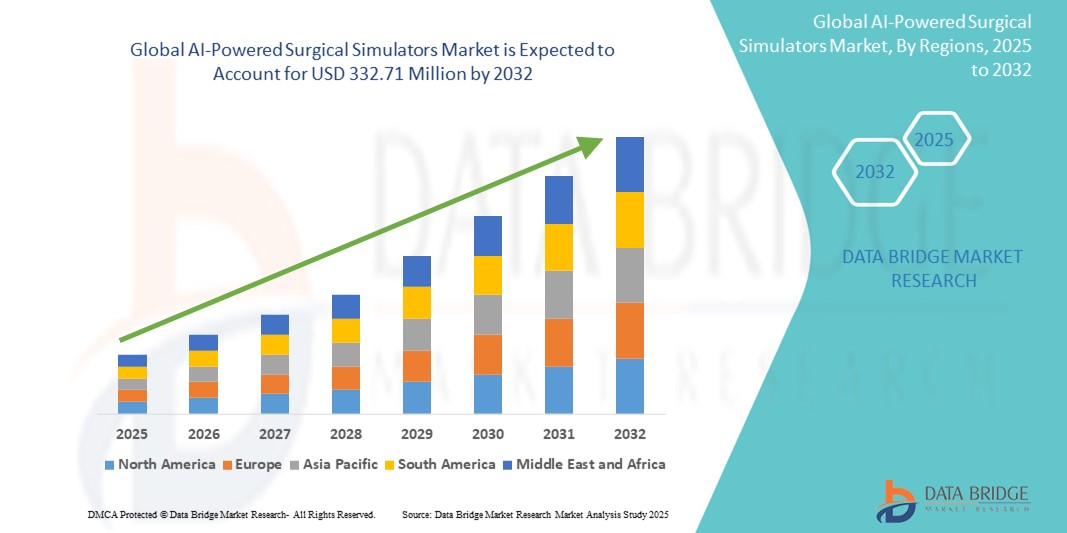
- The global AI-powered surgical simulators market size was valued at USD 87.23 million in 2024 and is expected to reach USD 332.71 million by 2032, at a CAGR of 18.20% during the forecast period
- The market growth is largely fueled by the increasing global demand for highly skilled surgeons, especially with the rise of complex and minimally invasive surgical procedures, coupled with a growing emphasis on patient safety and reduced medical errors
- Furthermore, the rising awareness and adoption of simulation-based training in medical curricula, alongside substantial investments in healthcare infrastructure and R&D by both public and private entities, are accelerating the uptake of AI-powered surgical simulator solutions, thereby significantly boosting the industry's growth
AI-Powered Surgical Simulators Market Analysis
- AI-powered surgical simulators, offering highly realistic and adaptive training environments, are becoming indispensable tools in modern medical education and surgical skill development. Their ability to provide personalized feedback, track performance, and replicate complex scenarios is significantly enhancing surgical precision and patient safety
- The surging demand for AI-powered surgical simulators is primarily driven by the escalating need for highly skilled surgeons capable of performing complex and minimally invasive procedures, the growing emphasis on patient safety, and technological advancements in virtual reality (VR), augmented reality (AR), and haptic feedback systems. The increasing incidence of chronic diseases, requiring surgical interventions, also contributes to this demand by expanding the pool of surgeons needing advanced training
- North America dominates the AI-powered surgical simulators market with the largest revenue share of 35.93% in 2024, characterized by its well-established healthcare infrastructure, early adoption of advanced medical technologies, substantial R&D investments by leading simulation firms, and a strong focus on enhancing surgical training
- Asia-Pacific is expected to be the fastest growing region in the AI-powered surgical simulators market during the forecast period due to increasing healthcare expenditures, a rapidly expanding patient pool, government initiatives promoting simulation-based training
- 3D Printing segment dominates the AI-powered surgical simulators market with a market share of 50.5% in 2024, driven by customizable models, enhanced realism, and increased demand for precision training
Report Scope and AI-Powered Surgical Simulators Market Segmentation
|
Attributes |
AI-Powered Surgical Simulators Key Market Insights |
|
Segments Covered |
|
|
Countries Covered |
North America
Europe
Asia-Pacific
Middle East and Africa
South America
|
|
Key Market Players |
|
|
Market Opportunities |
|
|
Value Added Data Infosets |
In addition to the insights on market scenarios such as market value, growth rate, segmentation, geographical coverage, and major players, the market reports curated by the Data Bridge Market Research also include in-depth expert analysis, pricing analysis, brand share analysis, consumer survey, demography analysis, supply chain analysis, value chain analysis, raw material/consumables overview, vendor selection criteria, PESTLE Analysis, Porter Analysis, and regulatory framework. |
AI-Powered Surgical Simulators Market Trends
“Hyper-Realistic and Adaptive Learning through Advanced AI and Haptics”
- A significant and accelerating trend in the global AI-powered surgical simulators market is the continuous drive towards hyper-realism through the deep integration of advanced AI algorithms and highly sophisticated haptic feedback systems. This fusion of technologies is dramatically enhancing the immersion and effectiveness of surgical training
- For instance, leading simulator manufacturers are developing platforms that utilize AI to dynamically adjust surgical scenarios based on trainee performance, providing real-time, personalized feedback on force application, tissue manipulation, and procedural steps. Haptic feedback devices are becoming increasingly precise, replicating the subtle tactile sensations of different tissues, bone drilling, and suturing with unprecedented accuracy
- AI integration in surgical simulators enables features such as intelligent performance assessment, identifying specific areas for improvement, and providing adaptive learning pathways. This goes beyond simple pass/fail metrics to offer detailed insights into a trainee's strengths and weaknesses, tailoring subsequent practice sessions to address specific skill gaps. For instance, some advanced simulators can detect inefficient movements or excessive force, offering immediate visual and haptic cues to correct technique
- The seamless integration of AI with advanced haptic feedback, combined with high-fidelity virtual reality (VR) and augmented reality (AR) environments, facilitates a truly immersive and hands-on training experience that closely mimics real-world surgical conditions. This allows trainees to develop muscle memory and refine fine motor skills in a safe, repeatable, and objective environment
- The demand for AI-powered surgical simulators that offer hyper-realistic and adaptative learning experiences is growing rapidly across medical schools, hospitals, and specialized training centers, as healthcare systems increasingly prioritize high-quality, standardized surgical education and patient safety
AI-Powered Surgical Simulators Market Dynamics
Driver
“Increasing Demand for Minimally Invasive and Complex Surgical Procedures, Coupled with an Unwavering Focus on Patient Safety”
- The escalating global demand for surgeons proficient in minimally invasive surgical (MIS) and other highly complex procedures is a primary driver for the surging adoption of AI-powered surgical simulators. MIS offers numerous patient benefits, including smaller incisions, less pain, shorter hospital stays, and quicker recovery times, making it a preferred approach. However, these procedures require exceptionally precise skills and a steeper learning curve compared to traditional open surgery
- For instance, the increasing prevalence of chronic diseases such as cancer, cardiovascular diseases, and musculoskeletal disorders necessitates a growing volume of surgical interventions, many of which are now performed using advanced MIS techniques. This creates an urgent need for effective and scalable training solutions that can rapidly equip surgeons with the necessary expertise
- Furthermore, the unwavering global focus on patient safety and the imperative to reduce medical errors are significantly propelling the market. AI-powered simulators provide a risk-free, highly realistic environment where surgeons can repeatedly practice complex procedures, make and learn from mistakes without any harm to real patients. This proactive approach enhances individual competence and team coordination, leading to better surgical outcomes and fewer complications
- The inherent ability of AI-powered simulators to provide objective, data-driven performance feedback, identify skill gaps, and offer personalized learning pathways makes them indispensable tools for continuous surgical education and competency assessment.
- Regulatory bodies and healthcare institutions are increasingly recognizing the value of simulation-based training in achieving and maintaining surgical proficiency, further contributing to market growth. The convenience of practicing anytime, anywhere (especially with cloud-based solutions) and the ability to train on a vast array of patient-specific scenarios are key factors propelling the adoption of these advanced training systems in both academic and clinical settings
Restraint/Challenge
“High Initial Costs and Complex Integration Challenges”
- A significant restraint on the widespread adoption of AI-powered surgical simulators is their high initial capital expenditure and the inherent complexity of integrating these advanced systems into existing healthcare and academic infrastructures. While the long-term benefits in terms of improved surgical outcomes and reduced errors are clear, the upfront investment can be prohibitive for many institutions, especially smaller clinics or those in developing regions
- For instance, setting up a comprehensive simulation lab with high-fidelity AI-powered simulators, haptic devices, and VR/AR equipment can range from hundreds of thousands to several million dollars. This initial cost often includes not only the hardware and software but also the necessary space development or remodeling, and ongoing expenses for maintenance, software updates, and training for instructors
- Furthermore, integrating these sophisticated AI-powered simulators with existing hospital IT systems, electronic health records (EHR), and training management platforms presents significant technical and logistical challenges. Compatibility issues can arise, requiring substantial investments in software adjustments and staff training to ensure seamless workflow and data exchange
- The intricate nature of AI algorithms, particularly those requiring vast datasets for training and real-time processing for dynamic scenarios, adds to the development and operational costs
- The need for continuous updates and upgrades to keep pace with rapid technological advancements also contributes to the total cost of ownership. This financial barrier and the technical hurdles can limit access to high-quality, AI-driven surgical training, particularly in regions with constrained healthcare budgets
AI-Powered Surgical Simulators Market Scope
The market is segmented on the basis of product type, application, technology, and end user
By Product Type (Technology-based Simulators, Model-based Simulators and Computer-based Simulators), Application (Cardiac Surgery, Gastroenterology, Neurosurgery, Orthopedic Surgery, Reconstructive Surgery, Oncology Surgery, Transplant, and Others), Technology (Virtual Patient Simulation and 3D Printing), End user (Academic Institutes, Hospitals, Military Organizations, and Research Organizations)
- By Product Type
On the basis of product type, the AI-powered surgical simulators market is segmented into Technology-based Simulators, Model-based Simulators, and Computer-based Simulators. Technology-based simulators held the largest market share in 2024. This dominance is driven by the increasing integration of AI, VR, AR, and haptic feedback to create highly immersive and realistic training environments. These simulators offer a superior level of realism and interactivity compared to traditional methods, making them highly desirable for complex surgical training. The continuous advancements in these underlying technologies, constantly pushing the boundaries of fidelity and adaptive learning, further solidify their leading position.
Technology-based simulators are also anticipated to be the fastest-growing segment from 2025 to 2032. While VR has been dominant, AR-based simulators are gaining significant traction. AR overlays digital information onto real-world environments, offering unique opportunities for training on physical models with digital guidance or for in-situ training within actual operating rooms (without patient involvement). The ability to combine physical interaction with digital augmentation provides a hybrid approach that is increasingly appealing for advanced training.
- By Application
On the basis of application, the AI-powered surgical simulators market is segmented into cardiac surgery, gastroenterology, neurosurgery, orthopedic surgery, reconstructive surgery, oncology surgery, transplant, and others. The orthopedic surgery segment held the highest market share in 2024, driven by the high volume of orthopedic procedures performed globally, coupled with the increasing complexity of these surgeries and the growing emphasis on simulation-based training for orthopedic residents. The need for precise skill development in procedures such as joint replacements and fracture repairs fuels the demand for specialized orthopedic simulators.
The reconstructive surgery segment is expected to witness a rapid growth rate during the forecast period. This growth is attributed to the rising demand for enhanced training solutions for complex reconstructive procedures, including facial, craniofacial, and breast reconstruction. The intricate nature and high stakes of these surgeries make realistic simulation crucial for surgeon proficiency and patient safety.
- By Technology
On the basis of technology, the AI-powered surgical simulators market is segmented into virtual patient simulation and 3D printing. The 3D printing segment dominated the AI-powered surgical simulators market with a market share of 50.5% in 2024, driven by customizable models, enhanced realism, and increased demand for precision training.
The 3D printing segment also holds a substantial market share from 2025 to 2032, growth is fueled by the increasing awareness regarding the benefits of creating highly realistic, patient-specific anatomical models for surgical planning and hands-on training. 3D printed models, often combined with AI for patient-specific modeling, allow surgeons to physically rehearse complex cases.
- By End User
On the basis of end user, the AI-powered surgical simulators market is segmented into academic institutes, hospitals, military organizations, and research organizations. Academic institutes held the largest market share in 2024. This is due to their critical role in surgical education and research, where simulation-based training is increasingly becoming a mandatory component of medical curricula. Universities and medical schools are primary adopters for educating future surgeons
The hospitals segment is expected to witness the fastest CAGR from 2025 to 2032, as they are key end-users for the continuous professional development and skill enhancement of their resident surgeons and practicing staff. Hospitals invest in simulators to ensure their surgical teams maintain proficiency in current techniques and adapt to new procedures, ultimately aiming to improve patient outcomes and safety.
AI-Powered Surgical Simulators Market Regional Analysis
- North America dominates the AI-powered surgical simulators market with the largest revenue share of 35.93% in 2024, driven by its well-established healthcare infrastructure, early adoption of advanced medical technologies, substantial R&D investments by leading simulation firms, and a strong focus on enhancing surgical training
- Consumers and healthcare institutions in the region highly prioritize patient safety and continuous skill development for surgeons, leading to a strong demand for sophisticated simulation tools
- This widespread adoption is further supported by the presence of key industry players, favorable government initiatives promoting simulation-based training, and the increasing volume of minimally invasive surgical procedures, establishing AI-powered surgical simulators as a critical component of surgical training in both academic and clinical settings.The U.S. leads this regional market, characterized by early adoption of advanced technologies and innovations from both established firms and startups
U.S. AI-Powered Surgical Simulators Market Insight
The U.S. AI-powered surgical simulators market largest revenue share in 2024 fueled by the rapid adoption of advanced medical technologies and the expanding emphasis on high-fidelity surgical training. Healthcare institutions and medical schools are increasingly prioritizing the enhancement of surgical skills through intelligent, immersive simulation systems. The growing preference for patient safety and the demand for highly skilled surgeons capable of performing complex procedures, combined with robust investments in R&D by leading medical technology companies, further propels the AI-powered surgical simulator industry. Moreover, the increasing integration of AI within surgical robotics and its application in personalized surgical planning are significantly contributing to the market's expansion
Europe AI-Powered Surgical Simulators Market Insight
The Europe AI-powered surgical simulators market is projected to expand at a substantial CAGR throughout the forecast period, primarily driven by increasing investments in healthcare infrastructure, stringent regulations emphasizing patient safety, and the escalating need for enhanced surgical proficiency. The rising adoption of robotic-assisted surgeries across Europe, coupled with the demand for advanced training methodologies, is fostering the adoption of AI-powered simulators. European healthcare systems are also drawn to the efficiency and reduced complication rates these technologies offer. The region is experiencing significant growth across academic institutes and hospitals, with AI-powered simulators being incorporated into both established training programs and new surgical residency curricula
U.K. AI-Powered Surgical Simulators Market Insight
The U.K. AI-powered surgical simulators market is anticipated to grow at a noteworthy CAGR during the forecast period, driven by the escalating emphasis on medical education and a desire for heightened surgical precision and patient safety within the National Health Service (NHS). In addition, concerns regarding surgical errors and the increasing complexity of procedures are encouraging both academic institutions and hospitals to choose AI-driven simulation solutions. The UK’s embrace of technological advancements in VR/AR, alongside its robust medical research infrastructure, is expected to continue to stimulate market growth
Germany AI-Powered Surgical Simulators Market Insight
The Germany AI-powered surgical simulators market is expected to expand at a considerable CAGR during the forecast period fueled by increasing awareness of the benefits of simulation-based training and the demand for technologically advanced, high-fidelity solutions. Germany’s well-developed healthcare infrastructure, combined with its emphasis on innovation and quality in medical education, promotes the adoption of AI-powered surgical simulators, particularly in university hospitals and specialized training centers. The integration of AI-powered simulators with advancements in minimally invasive surgery is also becoming increasingly prevalent, aligning with local healthcare priorities for efficiency and patient outcomes
Asia-Pacific AI-Powered Surgical Simulators Market Insight
The Asia-Pacific AI-powered surgical simulators market is poised to grow at the fastest CAGR during the forecast period, driven by increasing healthcare investments, rising disposable incomes, and rapid technological advancements in countries such as China, Japan, and India. The region's growing inclination towards adopting advanced medical technologies, supported by government initiatives promoting digitalization and improving healthcare access, is driving the adoption of AI-powered surgical simulators. Furthermore, as APAC emerges as a hub for medical device manufacturing and technological innovation, the affordability and accessibility of advanced simulation solutions are expanding to a wider base of medical professionals
Japan AI-Powered Surgical Simulators Market Insight
The Japan AI-powered surgical simulators market is gaining momentum due to the country’s high-tech culture, rapid urbanization, and an increasing demand for highly skilled surgeons. The Japanese market places a significant emphasis on precision and patient safety, and the adoption of AI-powered simulators is driven by the growing number of complex surgical procedures and the integration of advanced technologies such as AI and VR/AR in medical training. The collaboration between academic institutions and industry players to develop innovative simulation platforms is fueling growth. Moreover, Japan's aging population is likely to spur demand for continuous training to manage age-related conditions requiring surgical intervention
India AI-Powered Surgical Simulators Market Insight
The India AI-powered surgical simulators market is experiencing significant growth, attributed to the country's expanding healthcare sector, rapid urbanization, and high rates of technological adoption. India is witnessing a surge in medical colleges and hospitals investing in simulation labs, and AI-powered simulators are becoming increasingly popular for training in various surgical specialties. The push towards enhancing medical education standards and the availability of increasingly affordable, yet advanced, simulation options, alongside strong domestic manufacturing and research efforts, are key factors propelling the market in India
AI-Powered Surgical Simulators Market Share
The AI-powered surgical simulators industry is primarily led by well-established companies, including:
- Surgical Science Sweden AB (Sweden)
- Mentice AB (Sweden)
- VirtaMed AG (Switzerland)
- Laerdal Medical (Norway)
- 3D Systems, Inc. (U.S.)
- Materialise (Belgium)
- Stratasys (Israel)
- Gaumard Scientific (U.S.)
- Simulab Corporation (U.S.)
- Fundamental Surgery (U.K.)
- Theator Inc. (U.S.)
- Alcon (U.S.)
- Intuitive Surgical, Inc. (U.S.)
- Medtronic (Ireland)
- Stryker (U.S.)
- Smith+Nephew (U.K.)
- Zimmer Biomet (U.S.)
- Activ Surgical (U.S.)
- FEops nv (Belgium)
Latest Developments in Global AI-Powered Surgical Simulators Market
- In July 2024, Materialise, a leader in medical visualization and 3D printing, acquired FEops, a company specializing in predictive simulation for structural heart interventions. This strategic move aims to combine Materialise's expertise in personalized solutions with FEops' advanced simulation capabilities, providing clinicians with more comprehensive insights into patient anatomy for improved structural heart procedures
- In June 2024, Stratasys Ltd. introduced the J5 Digital Anatomy 3D printer. This new system is designed to meet the growing need for cost-effective and highly accurate anatomical models, supporting hospitals, medical device manufacturers, and research institutions in enhancing patient outcomes, streamlining operations, and accelerating product development cycles
- In April 2022, Alcon launched the Alcon Fidelis Virtual Reality Ophthalmic Surgical Simulator. This portable VR tool is specifically designed for cataract surgery trainees, offering a realistic virtual operating room setting with haptic feedback to accurately replicate the experience of performing cataract surgery. It's integrated within the Alcon Experience Academy
- In September 2021, CAE Healthcare entered into a partnership with RCSI University of Medicine and Health Sciences to advance healthcare technology, education, and research through simulation methodologies. As part of this collaboration, the RCSI SIM Centre for Simulation Education and Research received recognition as a certified Centre of Excellence, making it the first such designation in Europe
- In March 2023, the University of Southern California (USC) Viterbi School of Engineering announced that Professor Yan Liu and Dr. Andrew Hung received a USD 3 million award from the National Institutes of Health. This funding is dedicated to advancing their research on AI tools specifically designed to measure and improve surgeons' technical skills during complex procedures such as radical prostatectomy using deep learning. This highlights a clear trend towards AI for objective and nuanced skill assessment

- Interactive Data Analysis Dashboard
- Company Analysis Dashboard for high growth potential opportunities
- Research Analyst Access for customization & queries
- Competitor Analysis with Interactive dashboard
- Latest News, Updates & Trend analysis
- Harness the Power of Benchmark Analysis for Comprehensive Competitor Tracking
Data collection and base year analysis are done using data collection modules with large sample sizes. The stage includes obtaining market information or related data through various sources and strategies. It includes examining and planning all the data acquired from the past in advance. It likewise envelops the examination of information inconsistencies seen across different information sources. The market data is analysed and estimated using market statistical and coherent models. Also, market share analysis and key trend analysis are the major success factors in the market report. To know more, please request an analyst call or drop down your inquiry.
The key research methodology used by DBMR research team is data triangulation which involves data mining, analysis of the impact of data variables on the market and primary (industry expert) validation. Data models include Vendor Positioning Grid, Market Time Line Analysis, Market Overview and Guide, Company Positioning Grid, Patent Analysis, Pricing Analysis, Company Market Share Analysis, Standards of Measurement, Global versus Regional and Vendor Share Analysis. To know more about the research methodology, drop in an inquiry to speak to our industry experts.
Data Bridge Market Research is a leader in advanced formative research. We take pride in servicing our existing and new customers with data and analysis that match and suits their goal. The report can be customized to include price trend analysis of target brands understanding the market for additional countries (ask for the list of countries), clinical trial results data, literature review, refurbished market and product base analysis. Market analysis of target competitors can be analyzed from technology-based analysis to market portfolio strategies. We can add as many competitors that you require data about in the format and data style you are looking for. Our team of analysts can also provide you data in crude raw excel files pivot tables (Fact book) or can assist you in creating presentations from the data sets available in the report.













