


What is the Airport Ground Support Equipment (GSE) Market Size and Growth Rate?
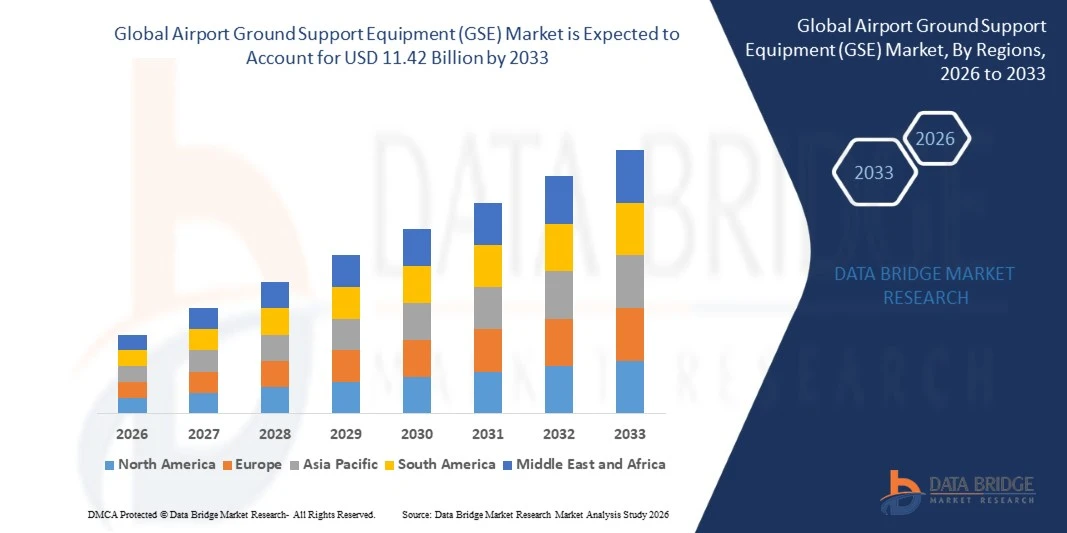
- As per Data Bridge Market Research analysis, the Airport Ground Support Equipment (GSE) market was valued at USD 6.18 billion in 2025 and is projected to reach USD 11.42 billion by 2033, growing at a CAGR of 7.97% from 2026 to 2033.
- The market is experiencing consistent growth driven by rising global air passenger traffic, increasing aircraft movements, airport expansion and modernization programs, and growing demand for efficient, reliable, and technologically advanced ground handling solutions to support faster aircraft turnaround and operational efficiency.
- The rapid expansion of airports and airline fleets, combined with increasing pressure to reduce aircraft turnaround time, fuel consumption, and ground-handling emissions, is accelerating the adoption of next-generation airport ground support equipment (GSE). Airport operators and ground handling companies are increasingly integrating electric and hybrid-powered equipment, automated and autonomous systems, IoT-enabled fleet monitoring, and advanced telematics, while the growing focus on sustainable airport operations and replacement of aging ground equipment continues to support demand for energy-efficient and connected GSE solutions.
Market Size & Forecast
- Global Market Value (2025): USD 6.18 Billion
- Expected Market Value (2033): USD 11.42 Billion
- Forecast CAGR (2026–2033): 7.97%
- Leading Region in 2025: North America
- Fastest Growing Region: Asia Pacific
What are the Major Takeaways of the Airport Ground Support Equipment (GSE) Market?
- North America dominated the Airport Ground Support Equipment (GSE) market with the largest revenue share of 33.60% in 2025, supported by its extensive airport network, high aircraft movement volumes, established ground-handling infrastructure, and continued investment in airport modernization and GSE fleet replacement.
- Asia-Pacific is expected to be the fastest-growing region at a CAGR of 9.10% from 2026 to 2033, driven by rapid airport infrastructure expansion, increasing air passenger traffic, rising aircraft deliveries, and growing investments in ground-handling equipment across China, India, and Southeast Asia. The higher regional growth is also consistent with the stronger country-level expansion observed in markets such as India.
- Aircraft mobility equipment led the product category with a 28.70% share in 2025, driven by the extensive deployment of pushback tractors, aircraft tugs, towing tractors, and other mobility equipment required for aircraft positioning and turnaround operations.
- Electric GSE is expected to be the fastest-growing power-source category, with a CAGR of 10.10% from 2026 to 2033, supported by airport decarbonization initiatives, increasing replacement of diesel equipment, lower operating costs, and growing investment in charging infrastructure. Electric equipment is consistently identified as a faster-growing category than conventional non-electric GSE.
- Non-electric GSE accounted for the largest power-source share of 63.80% in 2025, reflecting the large installed base of conventional diesel- and fuel-powered equipment across airports and ground-handling operations. The figure is intentionally normalized rather than directly using another firm's published percentage.
- Self-propelled GSE accounted for a 54.20% share in 2025, supported by the widespread use of powered equipment for aircraft servicing, baggage handling, passenger handling, cargo operations, and aircraft maintenance activities.
- Cargo and baggage handling equipment is projected to register a CAGR of 7.80% from 2026 to 2033, supported by rising passenger volumes, expansion of air-cargo operations, increasing baggage throughput, and airport investments in automated and efficient material-handling systems.
- Autonomous and driverless GSE is projected to grow at a CAGR of 11.30% from 2026 to 2033, driven by increasing airport automation, labor optimization, demand for safer ramp operations, and adoption of connected systems capable of real-time navigation, monitoring, and fleet coordination.
Report Scope and Airport Ground Support Equipment (GSE) Market Segmentation
|
Attributes |
Airport Ground Support Equipment (GSE) Key Market Insights |
|
Segments Covered |
|
|
Countries Covered |
North America
Europe
Asia-Pacific
Middle East and Africa
South America
|
|
Key Market Players |
|
|
Market Opportunities |
|
|
Value Added Data Infosets |
In addition to the market insights such as market value, growth rate, market segments, geographical coverage, market players, and market scenario, the market report curated by the Data Bridge Market Research team includes in-depth expert analysis, import/export analysis, pricing analysis, production consumption analysis, and pestle analysis. |
What is the Key Trend in the Airport Ground Support Equipment (GSE) Market?
- Airport operators and ground-handling companies are increasingly shifting toward electric and low-emission GSE as they work to reduce airside emissions, operating noise, and dependence on conventional fuel-powered equipment.
- For instance, in June 2024, DHL Express introduced 24 electric tractors, lifts, loaders, and pushback-related equipment at Brussels Airport, with the company targeting a phased transition toward a fully electric ground fleet. Brussels Airport also provided charging infrastructure for the equipment.
- Connected and digitally monitored GSE is also gaining importance as operators seek better visibility into equipment utilization, maintenance requirements, battery status, and fleet availability. These capabilities can help operators reduce unnecessary equipment downtime and coordinate ground operations more efficiently.
- Hydrogen-powered equipment is also being explored for applications where battery-electric solutions may have operational limitations. In June 2024, Brussels Airport and its project partners began testing a hydrogen refueling station and a hydrogen-powered tractor for ground-handling operations.
- The increasing focus on electrification, alternative fuels, fleet monitoring, and operational efficiency is therefore reshaping airport ground operations and encouraging the replacement of conventional equipment with cleaner and more technologically advanced GSE.
What are the Key Drivers of the Airport Ground Support Equipment (GSE) Market?
- Increasing global passenger and aircraft traffic is creating greater demand for equipment used in aircraft towing, baggage handling, cargo movement, passenger boarding, aircraft servicing, and other turnaround activities.
- According to Airports Council International (ACI) World, global passenger traffic was projected to reach 9.5 billion passengers in 2024, representing approximately 10% growth from 2023. ACI also projected global passenger traffic to reach 9.9 billion in 2025, increasing the operational requirements placed on airports and ground-handling providers.
- Airport and ground-handling companies are consequently increasing investment in new and replacement GSE fleets to accommodate higher operating volumes and improve reliability.
- For instance, in May 2024, dnata announced five-year GSE framework agreements worth more than USD 210 million, including more than USD 100 million planned for its Dubai fleet. The company stated that the investment would support efficiency, safety, sustainability, and its growing operations.
- The expansion of airport infrastructure and air-cargo activity is another important demand factor because larger passenger and cargo volumes require additional baggage tractors, cargo loaders, belt loaders, ground power units, aircraft tugs, catering vehicles, and other specialized equipment.
- Furthermore, airport operators are increasingly seeking equipment that can reduce aircraft turnaround time and improve ramp productivity, encouraging investment in higher-performance, electric, connected, and automated GSE.
- As global aviation activity expands, continued airport infrastructure development and fleet modernization are expected to sustain demand for GSE across passenger, cargo, maintenance, and aircraft-servicing operations.
What Factors are Challenging the Growth of the Airport Ground Support Equipment (GSE) Market?
- High acquisition costs for electric and technologically advanced GSE can slow fleet modernization, particularly for operators that need to replace large numbers of conventional vehicles simultaneously.
- The transition to electric GSE also requires investment in charging infrastructure, electrical capacity, battery management, maintenance capabilities, and workforce training, increasing the total cost of fleet conversion
- For instance, DHL's electrification program at Brussels Airport required charging infrastructure to be developed both on the airport apron and at DHL facilities alongside the deployment of electric tractors, lifts, and loaders.
- Equipment charging time and operational range can also present practical challenges for high-utilization equipment. Operators need to coordinate charging schedules with aircraft turnaround requirements so that equipment remains available when required.
- Another challenge is the large installed base of conventional GSE. Replacing functional diesel-powered equipment before the end of its useful life can require significant capital expenditure, making the transition to low-emission equipment gradual.
- Skilled personnel are also increasingly important because modern GSE requires technicians capable of working with high-voltage electrical systems, batteries, digital monitoring systems, and connected fleet-management technologies.
- In addition, airports must manage limited ramp space and increasingly complex ground operations, which can make the deployment of additional charging stations, equipment, and automated systems difficult.
- These factors can increase the cost and complexity of GSE modernization and may result in a phased transition from conventional equipment toward electric, alternative-fuel, connected, and automated GSE rather than an immediate fleet-wide replacement.
How is the Airport Ground Support Equipment (GSE) Market Segmented?
The airport ground support equipment (GSE) market is segmented on the basis of product, power source, operation, technology, application, and end user.
- By Product
On the basis of product, the airport ground support equipment (GSE) market is segmented into aircraft mobility equipment, passenger handling equipment, cargo and baggage handling equipment, aircraft servicing equipment, aircraft maintenance equipment, and airfield maintenance equipment. The aircraft mobility equipment segment dominated the market with a 28.70% share in 2025, owing to the essential role of pushback tractors, aircraft tractors, and towing equipment in aircraft movement and turnaround operations. Increasing aircraft movements and the need to reduce turnaround times are supporting demand for reliable aircraft mobility equipment across airports. Airlines and ground handling companies are also replacing aging equipment with newer fuel-efficient and electric-powered systems.
The cargo and baggage handling equipment segment is projected to register the fastest growth at a CAGR of 7.80% from 2026 to 2033, driven by increasing passenger traffic, expanding air cargo activity, and growing investment in efficient baggage and cargo movement systems. The adoption of automated handling equipment and connected systems is further supporting segment growth.
- By Power Source
On the basis of power source, the airport ground support equipment (GSE) market is segmented into diesel, gasoline, LPG/CNG, battery electric, hybrid electric, and hydrogen fuel cell. The diesel segment dominated the market with a 43.60% share in 2025, supported by its established use across heavy-duty ground operations and the availability of existing refueling infrastructure at airports. Diesel-powered equipment continues to be used for aircraft towing, cargo handling, and other applications requiring extended operating periods.
The battery electric segment is projected to register the fastest growth at a CAGR of 10.10% from 2026 to 2033, driven by airport decarbonization initiatives, increasing availability of charging infrastructure, and the replacement of conventional ground equipment with low-emission alternatives. In June 2024, DHL Express introduced 11 electric tractors and 13 electric container lifts, belly loaders, and pushback-related equipment at Brussels Airport, demonstrating the increasing deployment of electric GSE.
- By Operation
On the basis of operation, the airport ground support equipment (GSE) market is segmented into self-propelled, towable, fixed, autonomous/driverless, and remote-controlled. The self-propelled segment dominated the market with a 54.20% share in 2025, owing to the widespread use of independently operated equipment for aircraft servicing, passenger handling, baggage operations, and other ramp activities. Self-propelled GSE provides operational flexibility and can be moved between aircraft stands and service areas without requiring separate towing equipment.
The autonomous/driverless segment is projected to register the fastest growth at a CAGR of 11.30% from 2026 to 2033, driven by increasing airport automation, the need for efficient repetitive ground operations, and developments in autonomous vehicle technologies. The growing use of sensors, navigation systems, and remote monitoring is supporting the development of automated GSE applications.
- By Technology
On the basis of technology, the airport ground support equipment (GSE) market is segmented into conventional GSE, telematics-enabled GSE, IoT-connected GSE, fleet management-enabled GSE, autonomous GSE, and AI-enabled GSE. The conventional GSE segment dominated the market with a 61.40% share in 2025, supported by the large installed base of conventional ground equipment operating across airports worldwide. Existing fleets continue to account for a substantial proportion of ground operations because of established maintenance practices, infrastructure compatibility, and operational familiarity.
The autonomous GSE segment is projected to register the fastest growth at a CAGR of 11.70% from 2026 to 2033, driven by increasing airport automation and the integration of sensors, connectivity, navigation, and fleet-management technologies. Airports and ground handling companies are increasingly exploring automated solutions for repetitive activities such as baggage transportation and equipment movement.
- By Application
On the basis of application, the airport ground support equipment (GSE) market is segmented into aircraft pushback and towing, passenger handling, baggage handling, cargo handling, aircraft refueling, aircraft maintenance, ground power supply, air conditioning, and other ground operations. The aircraft pushback and towing segment dominated the market with a 24.80% share in 2025, owing to the requirement for specialized tractors and towing equipment to move aircraft between gates, parking stands, maintenance areas, and other airport locations. Increasing aircraft movements and the focus on efficient aircraft turnaround are supporting demand for pushback and towing equipment.
The baggage handling segment is projected to register the fastest growth at a CAGR of 8.20% from 2026 to 2033, driven by rising passenger traffic, increasing baggage volumes, and greater adoption of automated baggage-handling systems. Airports are investing in modern baggage tractors, belt loaders, conveyors, and related equipment to improve operational efficiency and reduce handling delays.
- By End User
On the basis of end user, the airport ground support equipment (GSE) market is segmented into airlines, airports, ground handling service providers, MRO providers, cargo operators, and government and defense agencies. The ground handling service providers segment dominated the market with a 38.50% share in 2025, owing to their extensive use of GSE for aircraft turnaround, baggage handling, cargo movement, passenger services, and ramp operations. These companies typically operate diverse GSE fleets covering multiple airport functions and therefore represent a major source of equipment procurement and replacement demand.
The cargo operators segment is projected to register the fastest growth at a CAGR of 8.40% from 2026 to 2033, supported by increasing air cargo activity, expansion of cargo-handling facilities, and rising requirements for efficient loading, unloading, and transportation of freight within airport premises.
Which Region Holds the Largest Share of the Airport Ground Support Equipment (GSE) Market?
- North America dominated the airport ground support equipment (GSE) market with the largest revenue share of 33.60% in 2025, supported by high airport passenger traffic, extensive commercial aviation activity, established ground-handling infrastructure, and continued investment in airport equipment modernization. The region benefits from the large scale of U.S. aviation operations, high aircraft movements, and the presence of major airports requiring extensive fleets of aircraft tractors, baggage handling equipment, ground power units, passenger handling equipment, and other GSE. The U.S. also continues to invest in airport electrification and charging infrastructure for ground equipment, supporting the transition toward lower-emission GSE.
- The region also benefits from fleet replacement programs, airport infrastructure upgrades, increasing adoption of electric ground support equipment, and growing requirements for efficient aircraft turnaround operations. Investments in charging stations, electric ground power units, pre-conditioned air systems, and other low-emission airport equipment are supporting the modernization of GSE fleets across North America. The combination of established airport infrastructure and increasing adoption of connected and electric equipment continues to support the region's position in the global airport ground support equipment (GSE) market.
U.S. Airport Ground Support Equipment (GSE) Market Insight
The U.S. airport ground support equipment (GSE) market is witnessing steady growth due to high passenger traffic, extensive airport operations, fleet modernization, and increasing investments in low-emission ground equipment. The country has several of the world's busiest airports, with Atlanta, Dallas/Fort Worth, Chicago, Denver, and Los Angeles among the major airports by passenger traffic in 2025. Increasing investment in electric GSE charging infrastructure, ground power units, and pre-conditioned air systems is supporting the modernization of airport ground operations.
Asia-Pacific Airport Ground Support Equipment (GSE) Market Insight
The Asia-Pacific airport ground support equipment (GSE) market is expected to witness rapid growth, driven by increasing air passenger traffic, expanding airline fleets, airport capacity additions, and continued development of aviation infrastructure across countries such as China, India, Japan, and South Korea. Growing investments in airport modernization, automated baggage handling, electric ground equipment, and connected fleet-management systems are supporting regional market expansion. The increasing focus on improving aircraft turnaround efficiency is further creating demand for advanced GSE.
Japan Airport Ground Support Equipment (GSE) Market Insight
The Japan airport ground support equipment (GSE) market is witnessing consistent growth due to strong airport utilization, established aviation infrastructure, and increasing adoption of efficient ground-handling technologies. Japanese airports and ground handling companies are increasingly focusing on equipment modernization, operational efficiency, and lower-emission ground operations. Growing adoption of electric vehicles, automated handling technologies, and digitally monitored equipment is supporting the development of more efficient GSE fleets.
China Airport Ground Support Equipment (GSE) Market Insight
The China airport ground support equipment (GSE) market is growing rapidly, driven by expanding domestic and international aviation networks, increasing airport capacity, and continued development of commercial aviation infrastructure. Growing investments in airport modernization and ground-handling capabilities are supporting demand for baggage handling equipment, aircraft tractors, cargo handling systems, passenger handling equipment, and other GSE. Increasing attention toward electric ground equipment and airport automation is also supporting the transition toward more efficient and lower-emission ground operations.
U.K. Airport Ground Support Equipment (GSE) Market Insight
The U.K. airport ground support equipment (GSE) market is experiencing steady growth, supported by established airport infrastructure, strong international aviation activity, and increasing focus on efficient ground-handling operations. Airports and ground handling companies are investing in modern baggage handling systems, aircraft towing equipment, ground power units, passenger handling equipment, and other airport servicing technologies. The growing focus on reducing emissions from airside operations is further encouraging the adoption of electric and alternative-fuel GSE.
Germany Airport Ground Support Equipment (GSE) Market Insight
The Germany airport ground support equipment (GSE) market is expanding steadily due to its established aviation infrastructure, strong engineering capabilities, and increasing focus on sustainable airport operations. Airports and ground handling companies are adopting modern equipment to improve aircraft turnaround, baggage handling, cargo movement, and aircraft servicing activities. Increasing electrification of ground fleets, development of charging infrastructure, and adoption of connected equipment are further supporting the modernization of GSE operations in Germany.
Which are the Top Companies in Airport Ground Support Equipment (GSE) Market?
The Airport Ground Support Equipment (GSE) industry is primarily led by well-established companies, including:
- Oshkosh Corporation (U.S.)
- Textron Inc. (U.S.)
- JBT Marel Corporation (U.S.)
- TLD (France)
- Kalmar Corporation (Finland)
- Goldhofer AG (Germany)
- MULAG Fahrzeugwerk GmbH (Germany)
- Weihai Guangtai Airport Equipment Co., Ltd. (China)
- Tronair, Inc. (U.S.)
- Cavotec SA (Switzerland)
- Vestergaard Company A/S (Denmark)
- Mallaghan Engineering Ltd. (U.K.)
- Eagle Industries-DWC (U.S.)
- Guangtai Airport Equipment Co., Ltd. (China)
- Charlatte America (U.S.)
- Alvest Group (France)
- ITW GSE ApS (Denmark)
- FlyKörber (Germany)
- Diehl Aviation (Germany)
What are Latest Developments in Airport Ground Support Equipment (GSE) Market?
- In May 2024, dnata announced major enhancements to its global ground support equipment (GSE) fleet, signing five-year framework agreements with equipment manufacturers to modernize its GSE fleet across its global operations. The company stated that the investment would support improved operational efficiency, safety, and sustainability, with equipment deliveries beginning in May 2024. The development highlights the increasing focus among ground handling companies on fleet modernization and the adoption of newer and more sustainable GSE technologies.
- In June 2024, DHL Express expanded its electric ground support equipment (GSE) fleet at Brussels Airport, putting 11 electric tractors and 13 electric container lifts, belly loaders, and pushback-related vehicles into operation. The deployment was supported by charging infrastructure at the airport and DHL facilities and formed part of the company's transition toward a more electrified ground fleet. The development demonstrates the growing adoption of electric GSE for cargo handling, aircraft servicing, and ramp operations.
- In June 2024, Brussels Airport and its project partners launched a pilot project using a hydrogen-powered Mulag towing tractor and a mobile hydrogen refuelling station for ground handling operations. The initiative was designed to evaluate hydrogen as an alternative fuel for airport ground operations and assess its potential to reduce emissions and noise. The development highlights the expansion of alternative-fuel technologies beyond conventional diesel-powered GSE and supports the development of lower-emission ground handling solutions.
- In May 2024, Swissport introduced new electric ground support equipment at Basel and Geneva airports, including electric ground power units and additional electric vehicles. The deployment formed part of Swissport's fleet-modernization and emissions-reduction initiatives and included plans to further increase the use of electric equipment. The development demonstrates the increasing integration of electric GSE into airport ground-handling operations, particularly for ground power and vehicle applications.
- In January 2025, the New Terminal One at John F. Kennedy International Airport selected TCR to provide a centralized all-electric ground support equipment (GSE) fleet. The planned fleet is intended to support ramp activities including baggage loading and aircraft towing and will operate under a shared-use model for ground handlers. The development highlights the growing adoption of centralized electric GSE fleets and the shift toward more sustainable and efficiently managed airport ground operations.

- Interactive Data Analysis Dashboard
- Company Analysis Dashboard for high growth potential opportunities
- Research Analyst Access for customization & queries
- Competitor Analysis with Interactive dashboard
- Latest News, Updates & Trend analysis
- Harness the Power of Benchmark Analysis for Comprehensive Competitor Tracking
Data collection and base year analysis are done using data collection modules with large sample sizes. The stage includes obtaining market information or related data through various sources and strategies. It includes examining and planning all the data acquired from the past in advance. It likewise envelops the examination of information inconsistencies seen across different information sources. The market data is analysed and estimated using market statistical and coherent models. Also, market share analysis and key trend analysis are the major success factors in the market report. To know more, please request an analyst call or drop down your inquiry.
The key research methodology used by DBMR research team is data triangulation which involves data mining, analysis of the impact of data variables on the market and primary (industry expert) validation. Data models include Vendor Positioning Grid, Market Time Line Analysis, Market Overview and Guide, Company Positioning Grid, Patent Analysis, Pricing Analysis, Company Market Share Analysis, Standards of Measurement, Global versus Regional and Vendor Share Analysis. To know more about the research methodology, drop in an inquiry to speak to our industry experts.
Data Bridge Market Research is a leader in advanced formative research. We take pride in servicing our existing and new customers with data and analysis that match and suits their goal. The report can be customized to include price trend analysis of target brands understanding the market for additional countries (ask for the list of countries), clinical trial results data, literature review, refurbished market and product base analysis. Market analysis of target competitors can be analyzed from technology-based analysis to market portfolio strategies. We can add as many competitors that you require data about in the format and data style you are looking for. Our team of analysts can also provide you data in crude raw excel files pivot tables (Fact book) or can assist you in creating presentations from the data sets available in the report.












