


What is the Ambulatory Care Medical Software Market Size and Growth Rate?
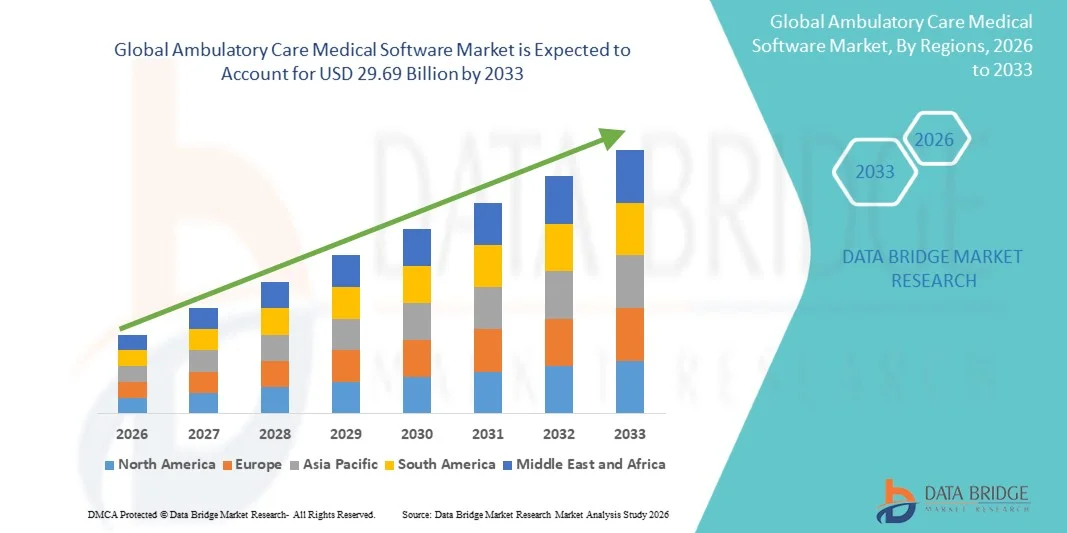
- As per Data Bridge Market Research analysis, the ambulatory care medical software market was valued at USD 9.28 billion in 2025 and is projected to reach USD 29.69 billion by 2033, growing at a CAGR of 15.65% from 2026 to 2033.
- The market is experiencing consistent growth driven by the shift toward lower-cost outpatient and community-based care, increasing adoption of cloud-based healthcare software, growing demand for interoperability, and expanding use of revenue cycle management, patient engagement, and population health solutions.
- The increasing migration of procedures from inpatient facilities to ambulatory settings, combined with rising demand for efficient clinical documentation, scheduling, billing, and patient management, is compelling physician offices, specialty clinics, and ambulatory surgery centers to adopt advanced medical software. Cloud-based platforms, AI/ML-enabled solutions, and interoperable systems are increasingly replacing fragmented legacy systems, offering scalable, automated, and integrated environments for outpatient care delivery.
Market Size & Forecast
- Global Market Value (2025): USD 9.28 Billion
- Expected Market Value (2033): USD 29.69 Billion
- Forecast CAGR (2026–2033): 15.65%
- Leading Region in 2025: North America
- Fastest Growing Region: Asia Pacific
What are the Major Takeaways of the Ambulatory Care Medical Software Market?
- North America dominated the ambulatory care medical software market with the largest revenue share of 41.1% in 2025, supported by mature healthcare IT infrastructure, established reimbursement systems, and widespread adoption of digital clinical and administrative solutions.
- Asia-Pacific is expected to be the fastest-growing region at a CAGR of 16.7% from 2026 to 2033, fueled by expanding outpatient healthcare infrastructure, digital health initiatives, and increasing adoption of medical software across emerging healthcare systems.
- The ambulatory EHR/EMR software segment led the market with a 28.5% share in 2025, driven by increasing adoption of digital patient records, demand for efficient clinical documentation, improved interoperability, streamlined outpatient workflow
- Population health & analytics software are the fastest-growing product type, projected to register a CAGR of 16.4%, reflecting the surge in demand for data-driven care management, predictive analytics, chronic disease monitoring, and coordinated outpatient healthcare delivery.
- The mobile applications segment dominated the technology category with a 27.6% revenue share in 2025, led by the increasing use of smartphones in healthcare, demand for remote access to patient records, convenient patient engagement, and the growing adoption of digital healthcare services.
- Clinical documentation accounted for 30.0% of the market share in 2025, preferred by healthcare providers seeking efficient patient record management, accurate clinical data capture, streamlined documentation workflows, and reduced administrative burdens.
- The remote patient monitoring segment is the fastest-growing application category, with a CAGR of 17.0%, driven by increasing demand for continuous patient monitoring, rising prevalence of chronic diseases, expansion of virtual care, greater adoption of connected medical devices
Report Scope and Ambulatory Care Medical Software Market Segmentation
|
Attributes |
Ambulatory Care Medical Software Key Market Insights |
|
Segments Covered |
|
|
Countries Covered |
North America
Europe
Asia-Pacific
Middle East and Africa
South America
|
|
Key Market Players |
|
|
Market Opportunities |
|
|
Value Added Data Infosets |
In addition to the insights on market scenarios such as market value, growth rate, segmentation, geographical coverage, and major players, the market reports curated by the Data Bridge Market Research also include in-depth expert analysis, patient epidemiology, pipeline analysis, pricing analysis, and regulatory framework. |
What is the Key Trend in the Ambulatory Care Medical Software Market?
- Ambulatory care providers are increasingly adopting AI-powered clinical documentation and workflow automation software to reduce administrative workloads, streamline EHR interactions, and allow clinicians to spend more time on patient care.
- For instance, in March 2025, Microsoft introduced Dragon Copilot, combining ambient listening, generative AI, and voice recognition to automate clinical documentation, surface medical information, and perform administrative tasks across ambulatory and other care settings. Microsoft reported that clinicians using its ambient AI capabilities saved about five minutes per encounter.
- Ambient AI software enables real-time capture of patient-clinician conversations, converting interactions into structured clinical notes and supporting automated orders, referrals, summaries, and other EHR-related workflows.
- Cloud-based and AI-enabled ambulatory platforms are increasingly integrating clinical, administrative, and patient-management functions into unified digital environments, reducing dependence on fragmented legacy systems and improving workflow efficiency.
- For instance, in August 2025, Oracle launched its next-generation Oracle Health EHR for ambulatory providers in the U.S., incorporating contextual and conversational AI with voice-based workflows to help clinicians retrieve patient information and reduce administrative burden.
- As ambulatory organizations continue prioritizing automation, clinician efficiency, interoperability, and patient-centered digital workflows, adoption of AI-enabled medical software is expected to accelerate, reinforcing intelligent software as a core component of modern outpatient care.
What are the Key Drivers of the Ambulatory Care Medical Software Market?
- The rapid expansion of outpatient and ambulatory care delivery has increased demand for medical software capable of managing electronic health records, scheduling, billing, clinical documentation, patient engagement, and care coordination across distributed care settings.
- For instance, in May 2026, CMS announced 29 early adopters for its Electronic Prior Authorization Acceleration initiative, including EHR developers such as athenahealth, eClinicalWorks, Epic, MEDITECH, Modernizing Medicine, Oracle, and TruBridge, alongside physician practices and health systems. The initiative addresses workflow and technical barriers to electronic prior authorization and is intended to reduce administrative burden on clinicians.
- Ambulatory providers, physician practices, specialty clinics, and surgery centers are increasingly integrating interoperable software platforms to exchange patient information efficiently across providers, applications, payers, pharmacies, and diagnostic systems.
- For instance, in June 2025, CMS announced initiatives to build foundational infrastructure for a digital healthcare ecosystem, including a dynamic interoperable national provider directory, expanded Blue Button 2.0 API functionality, general availability of the Data at the Point of Care pilot, and enhanced trusted data exchange. These initiatives support greater interoperability and digital information exchange across healthcare providers.
- With healthcare organizations increasingly relying on digital records, interoperable data exchange, and automated clinical workflows to improve outpatient efficiency, ambulatory medical software will remain essential for modernizing care delivery and supporting coordinated patient management.
Which Factors are Challenging the Growth of the Ambulatory Care Medical Software Market?
- Healthcare cybersecurity and patient-data privacy requirements create significant challenges for ambulatory medical software providers because EHRs and connected applications store large volumes of sensitive electronic protected health information.
- For instance, in July 2025, HHS announced a HIPAA settlement with Syracuse ASC, an ambulatory surgery center in New York, following a ransomware investigation involving potential violations of the HIPAA Security and Breach Notification Rules, highlighting cybersecurity risks faced by ambulatory organizations.
- Smaller physician practices and ambulatory organizations can face higher costs and operational complexity when implementing cybersecurity controls, system upgrades, access management, encryption, and regulatory compliance measures.
- For instance, in April 2025, HHS announced a USD 600,000 settlement with PIH Health following a phishing attack that resulted in a breach affecting nearly 200,000 individuals, demonstrating the financial and operational consequences associated with protecting electronic health information.
- The increasing sophistication of cyberattacks, together with stringent privacy requirements and the need for continuous security investment, can raise the total cost and complexity of medical software deployment, particularly for smaller ambulatory providers and resource-constrained healthcare organizations.
How is the Ambulatory Care Medical Software Market Segmented?
The ambulatory care medical software market is segmented on the basis of product type, technology, application, and end user.
- By Product Type
On the basis of product type, the market is segmented into ambulatory EHR/EMR software, practice management software, revenue cycle management software, patient engagement software, telehealth software, referral management software, population health & analytics software, e-prescribing software, and ambulatory surgery center management software. Ambulatory EHR/EMR software dominated the market with share of 28.5% in 2025. These systems support digital clinical documentation and patient record management in outpatient settings. They help healthcare providers access patient histories and clinical information efficiently. Ambulatory EHR/EMR platforms integrate with scheduling, billing, and e-prescribing workflows. Growing demand for interoperable electronic health records supports adoption across physician offices and specialty clinics.
Population health & analytics software is the fastest-growing segment, registering an CAGR of 16.4% during forecast period. These solutions help providers analyze patient populations and identify healthcare trends. They support risk stratification, preventive care, and chronic disease management. Integration with electronic health records enables access to broader clinical datasets. Advanced analytics and artificial intelligence improve clinical decision-making and care coordination. Growing emphasis on value-based care is expected to support demand for population health and analytics solutions.
- By Technology
On the basis of technology, the market is segmented into AI/ML enabled, voice recognition, mobile applications, IoMT enabled, and API enabled. Mobile applications dominated the market with share of 27.6% in 2025. Mobile applications provide healthcare professionals with convenient access to clinical and administrative information. They support appointment management, patient communication, and remote access to medical records. Mobile-enabled platforms improve flexibility for physicians working across outpatient locations. Patients can also use applications for scheduling, notifications, and digital engagement. Growing smartphone usage and demand for convenient healthcare access support market adoption.
AI/ML Enabled technology is the fastest-growing segment, registering CAGR of 16.5% during forecast period. Artificial intelligence supports clinical documentation, workflow automation, and decision support. Machine learning tools can identify patterns in patient data and assist with risk assessment. AI-enabled software helps reduce repetitive administrative activities for healthcare professionals. Ambient documentation and conversational interfaces are increasing the use of AI in ambulatory workflows. Continued development of healthcare AI solutions is expected to support adoption across outpatient facilities.
- By Application
On the basis of application, the market is segmented into clinical documentation, appointment management, E-Prescribing, clinical decision support, remote patient monitoring, analytics and reporting, patient portal and engagement, and referral management. Clinical documentation dominated the market with share of 30.0% in 2025. Clinical documentation is a fundamental function of ambulatory medical software. It enables physicians to record patient consultations, diagnoses, treatment plans, and follow-up information. Digital documentation supports continuity of care across outpatient departments and specialty clinics. Integration with electronic health records improves access to patient information. Demand for efficient documentation and workflow automation supports the widespread adoption of these solutions.
Remote patient monitoring is the fastest-growing application, registering CAGR of 17.0% during forecast period. Remote patient monitoring software enables providers to track patient information outside traditional clinical settings. These platforms can support chronic disease management and post-treatment follow-up. Integration with connected medical devices facilitates the collection of patient-generated health data. Remote monitoring helps healthcare organizations maintain communication with patients between appointments. Increasing interest in virtual care and decentralized healthcare delivery is expected to support application growth.
- By End User
On the basis of end user, the market is segmented into physician offices, specialty clinics, ambulatory surgery centers, diagnostic centers, and outpatient departments. Physician offices dominated the market with share of 46.3% in 2025. Physician offices represent a major setting for outpatient consultations and routine medical services. These facilities use software for clinical documentation, scheduling, billing, and patient communication. Ambulatory medical software helps physician offices manage administrative and clinical workflows. Cloud-based solutions provide scalability for practices with different operational requirements. Increasing demand for efficient outpatient care delivery supports software adoption among physician offices.
Ambulatory surgery centers are the fastest-growing end-user segment, registering CAGR of 16.2% during forecast period. Ambulatory surgery centers are increasingly adopting digital systems to manage surgical workflows and patient records. Software solutions support scheduling, documentation, billing, and post-operative follow-up. Integration with electronic health records improves information exchange between providers and facilities. The movement of selected procedures from inpatient hospitals to outpatient settings supports ASC expansion. Increasing emphasis on operational efficiency and coordinated surgical care is expected to drive software adoption in ambulatory surgery centers.
Which Region Holds the Largest Share of the Ambulatory Care Medical Software Market?
- North America dominated the ambulatory care medical software market with the largest revenue share of 41.1% in 2025, supported by mature healthcare IT infrastructure, established reimbursement systems, and widespread adoption of digital clinical and administrative solutions.
- The region also benefits from extensive interoperability requirements, established value-based care systems, and increasing adoption of AI-enabled healthcare software across physician offices, specialty clinics, and ambulatory surgery centers. Growing demand for integrated clinical documentation, patient engagement, revenue cycle management, and data exchange solutions continues to strengthen North America’s leadership position in the global market.
U.S. Ambulatory Care Medical Software Market Insight
The U.S. ambulatory care medical software market is witnessing strong growth due to widespread adoption of electronic health records, advanced healthcare IT infrastructure, and increasing demand for interoperable digital healthcare solutions. The country’s mature outpatient care ecosystem, along with growing adoption of cloud-based, AI-enabled, and mobile healthcare software, is driving demand across physician offices, specialty clinics, and ambulatory surgery centers. In addition, increasing emphasis on value-based care, clinical documentation, revenue cycle management, and patient engagement is accelerating software adoption across ambulatory healthcare providers.
Asia-Pacific Ambulatory Care Medical Software Market Insight
The Asia-Pacific ambulatory care medical software market is expected to witness rapid growth, driven by increasing healthcare digitization, expanding private healthcare networks, and rising investments in digital health infrastructure across countries such as China, India, and Japan. Growing adoption of electronic health records, cloud-based platforms, telehealth, and mobile healthcare applications is supporting regional market expansion. In addition, national digital health initiatives, increasing chronic disease management needs, and demand for scalable and interoperable outpatient software solutions are accelerating adoption across healthcare providers.
Japan Ambulatory Care Medical Software Market Insight
The Japan ambulatory care medical software market is witnessing consistent growth due to rising investments in healthcare digitization, electronic medical records, and advanced outpatient care technologies. Healthcare providers are increasingly adopting cloud-based platforms, interoperable systems, and analytics solutions to improve clinical documentation, care coordination, and patient management. Moreover, the country’s aging population, increasing demand for chronic disease management, and focus on digitally enabled healthcare delivery are further contributing to market growth in Japan.
China Ambulatory Care Medical Software Market Insight
The China ambulatory care medical software market is growing rapidly, driven by increasing healthcare digitization, expanding outpatient networks, and government focus on electronic medical records and healthcare information infrastructure. Growing adoption of cloud-based, AI-enabled, and interoperable software platforms across hospitals and outpatient facilities is significantly boosting market demand. In addition, rising healthcare technology investments, increasing demand for efficient patient management, and continued development of digital health infrastructure are supporting the expansion of ambulatory care medical software in China.
U.K. Ambulatory Care Medical Software Market Insight
The U.K. ambulatory care medical software market is experiencing steady growth, supported by continued healthcare digitization, established outpatient infrastructure, and increasing adoption of interoperable digital health platforms. Growing investments in cloud-based EHR systems, patient engagement technologies, and data-sharing solutions are contributing to market growth. Furthermore, increasing emphasis on improving outpatient capacity, coordinated care, and secure health information exchange is strengthening demand for advanced ambulatory care medical software across the U.K.
Germany Ambulatory Care Medical Software Market Insight
The Germany ambulatory care medical software market is expanding steadily due to the country’s established healthcare infrastructure, increasing digital health investments, and continued modernization of electronic health records. Healthcare providers are increasingly utilizing cloud-based and interoperable software solutions for clinical documentation, patient management, scheduling, and care coordination. Continuous advancement in AI-enabled healthcare technologies, data exchange capabilities, and digital health infrastructure, along with growing emphasis on secure and coordinated outpatient care, is further driving market growth in Germany.
Which are the Top Companies in Ambulatory Care Medical Software Market?
The ambulatory care medical software industry is primarily led by well-established companies, including:
- athenahealth, Inc. (U.S.)
- eClinicalWorks (U.S.)
- Epic Systems Corporation (U.S.)
- NextGen Healthcare, Inc. (U.S.)
- Oracle (U.S.)
- Veradigm LLC (U.S.)
- MEDITECH (U.S.)
- Greenway Health, LLC (U.S.)
- Tebra Technologies, Inc. (U.S.)
- CareCloud Corporation (U.S.)
- Modernizing Medicine, Inc. (U.S.)
- AdvancedMD (U.S.)
- Elation Health, Inc. (U.S.)
- Qualifacts (U.S.)
- RXNT (U.S.)
- Practice EHR (U.S.)
- Waystar (U.S.)
- Commure (U.S.)
- Canvas Medical, Inc. (U.S.)
- Azalea Health Innovations, Inc. (U.S.)
What are Latest Developments in Ambulatory Care Medical Software Market?
- In February 2025, athenahealth and Abridge announced a partnership to integrate ambient listening and generative AI capabilities into athenahealth’s ambulatory care solutions. The collaboration is designed to support real-time clinical documentation and reduce administrative workloads for ambulatory care practices, strengthening the integration of AI into outpatient healthcare workflows.
- In February 2025, Cleveland Clinic announced the rollout of Ambience Healthcare’s AI platform for clinical documentation, clinical documentation integrity, and point-of-care coding. The platform generates medical notes from patient appointments and provides after-visit summaries, supporting physicians in reducing documentation workloads across ambulatory settings.
- In October 2024, Oracle unveiled its next-generation EHR, designed to embed AI across clinical workflows. The platform incorporates AI capabilities to automate processes, provide point-of-care insights, and simplify appointment preparation, documentation, and follow-up for physicians and healthcare staff.
- In April 2023, eClinicalWorks announced the integration of ChatGPT, cognitive services, and machine-learning models from Azure OpenAI Service into its EHR and practice-management solutions. The development expanded AI capabilities within ambulatory healthcare software while focusing on usability, security, and patient safety.
- In June 2022, MEDITECH announced that Expanse Ambulatory became available to independent and physician-owned practices. The web- and touch-based ambulatory EHR and practice-management solution was designed to provide flexible clinical workflows and enable practices to use the platform without requiring an Expanse EHR in a hospital environment.

- Interactive Data Analysis Dashboard
- Company Analysis Dashboard for high growth potential opportunities
- Research Analyst Access for customization & queries
- Competitor Analysis with Interactive dashboard
- Latest News, Updates & Trend analysis
- Harness the Power of Benchmark Analysis for Comprehensive Competitor Tracking
Data collection and base year analysis are done using data collection modules with large sample sizes. The stage includes obtaining market information or related data through various sources and strategies. It includes examining and planning all the data acquired from the past in advance. It likewise envelops the examination of information inconsistencies seen across different information sources. The market data is analysed and estimated using market statistical and coherent models. Also, market share analysis and key trend analysis are the major success factors in the market report. To know more, please request an analyst call or drop down your inquiry.
The key research methodology used by DBMR research team is data triangulation which involves data mining, analysis of the impact of data variables on the market and primary (industry expert) validation. Data models include Vendor Positioning Grid, Market Time Line Analysis, Market Overview and Guide, Company Positioning Grid, Patent Analysis, Pricing Analysis, Company Market Share Analysis, Standards of Measurement, Global versus Regional and Vendor Share Analysis. To know more about the research methodology, drop in an inquiry to speak to our industry experts.
Data Bridge Market Research is a leader in advanced formative research. We take pride in servicing our existing and new customers with data and analysis that match and suits their goal. The report can be customized to include price trend analysis of target brands understanding the market for additional countries (ask for the list of countries), clinical trial results data, literature review, refurbished market and product base analysis. Market analysis of target competitors can be analyzed from technology-based analysis to market portfolio strategies. We can add as many competitors that you require data about in the format and data style you are looking for. Our team of analysts can also provide you data in crude raw excel files pivot tables (Fact book) or can assist you in creating presentations from the data sets available in the report.













