


Angiosarcoma Treatment Market Size
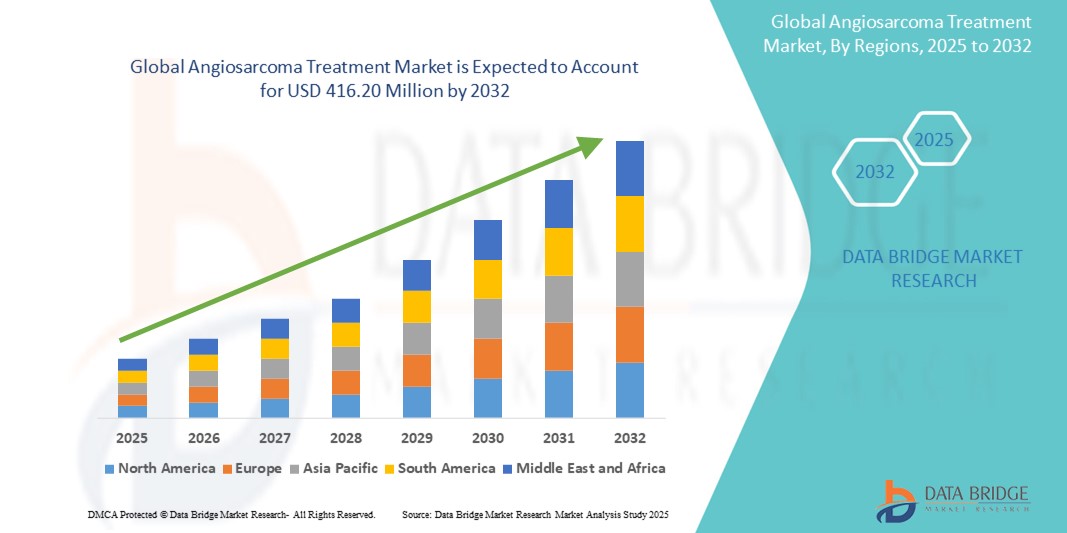
- The global angiosarcoma treatment market size was valued at USD 279.56 million in 2024 and is expected to reach USD 416.20 million by 2032, at a CAGR of 5.10% during the forecast period
- The market growth is primarily driven by the increasing incidence of angiosarcoma, advancements in targeted therapies, and growing awareness about rare cancers, which are collectively promoting early diagnosis and intervention
- Moreover, the rising number of clinical trials, strategic collaborations between pharmaceutical companies, and ongoing R&D investments are accelerating the development of novel treatment options. These critical factors are significantly enhancing therapeutic outcomes, thereby supporting the rapid expansion of the angiosarcoma treatment industry
Angiosarcoma Treatment Market Analysis
- Angiosarcoma treatment encompasses a range of therapeutic approaches aimed at managing this rare and aggressive cancer, with chemotherapy, radiation therapy, and targeted drug therapies being the primary modalities used across various healthcare settings to improve survival and quality of life
- The increasing prevalence of soft tissue sarcomas, enhanced awareness about rare cancers, and growing emphasis on early detection and precision medicine are driving the demand for advanced angiosarcoma treatments globally
- North America dominated the angiosarcoma treatment market with the largest revenue share of 42.5% in 2024, supported by well-established healthcare infrastructure, high diagnostic rates, and strong research funding, particularly in the U.S., where increased clinical trial activity and the adoption of novel targeted therapies are accelerating patient access to effective treatment options
- Asia-Pacific is expected to be the fastest growing region in the angiosarcoma treatment market during the forecast period due to improving cancer care facilities, rising healthcare spending, and increasing focus on rare disease management across developing nations
- The chemotherapy segment dominated the angiosarcoma treatment market with a market share of 45.1% in 2024, driven by its broad applicability, availability, and integration with combination therapy regimens used in both early-stage and metastatic cases
Report Scope and Angiosarcoma Treatment Market Segmentation
|
Attributes |
Angiosarcoma Treatment Key Market Insights |
|
Segments Covered |
|
|
Countries Covered |
North America
Europe
Asia-Pacific
Middle East and Africa
South America
|
|
Key Market Players |
|
|
Market Opportunities |
|
|
Value Added Data Infosets |
In addition to the insights on market scenarios such as market value, growth rate, segmentation, geographical coverage, and major players, the market reports curated by the Data Bridge Market Research also include in-depth expert analysis, pricing analysis, brand share analysis, consumer survey, demography analysis, supply chain analysis, value chain analysis, raw material/consumables overview, vendor selection criteria, PESTLE Analysis, Porter Analysis, and regulatory framework. |
Angiosarcoma Treatment Market Trends
“Precision Medicine and Targeted Therapy Advancements”
- A prominent and evolving trend in the global angiosarcoma treatment market is the increased application of precision medicine and targeted therapies, aiming to improve patient outcomes through individualized treatment plans based on genetic and molecular profiling. This trend is reshaping how rare and aggressive cancers such as angiosarcoma are approached clinically
- For instance, drugs such as Pazopanib and Bevacizumab have shown promise by targeting specific angiogenesis pathways, helping to slow tumor growth in patients with advanced angiosarcoma. Similarly, ongoing trials of checkpoint inhibitors such as Pembrolizumab and Nivolumab highlight the role of immunotherapy in managing certain subtypes
- The growing availability of next-generation sequencing (NGS) technologies enables clinicians to better understand tumor mutations and select optimal treatment options, leading to more personalized and effective interventions. In addition, patient registries and collaborative oncology research are playing a pivotal role in gathering real-world evidence to support treatment innovations
- Increased collaboration between academic institutions, research organizations, and pharmaceutical companies is driving the development of novel agents specifically designed to inhibit tumor-specific pathways. This collaborative model is also helping to identify biomarkers that may predict therapeutic response, further supporting the movement toward individualized treatment regimens
- The shift toward evidence-based, precision-targeted therapies is transforming patient management in the angiosarcoma landscape and setting new standards for clinical care. Consequently, companies are focusing on rare cancer pipelines, developing biologics, small-molecule inhibitors, and immune-based therapies aimed at addressing the unmet needs in this complex oncology segment
- The growing recognition of precision oncology's potential in angiosarcoma management is driving both funding and interest across the healthcare ecosystem, resulting in a pipeline rich with novel, targeted treatment candidates expected to influence future clinical practice significantly
Angiosarcoma Treatment Market Dynamics
Driver
“Rising Incidence and Research in Rare Cancers”
- The increasing incidence of angiosarcoma and rising global awareness about rare cancers are key drivers supporting the growth of the angiosarcoma treatment market. Improved diagnostic capabilities and the expansion of cancer registries have enabled more accurate detection and tracking of such rare malignancies
- For instance, in 2024, a multi-institutional initiative led by the Rare Cancers Research Foundation announced new funding for a global clinical trial network focused on soft tissue sarcomas, including angiosarcoma. These types of partnerships and funding mechanisms are accelerating clinical development efforts
- The high mortality and aggressive nature of angiosarcoma necessitate the development of advanced treatment options. Governments and non-profits are increasingly investing in rare disease research, helping to close the therapeutic gap through grants and orphan drug designations
- In addition, increasing collaboration between oncologists, pathologists, and genomic research facilities allows for better tumor characterization, thereby enabling targeted therapy decisions and reducing treatment trial-and-error
- Growing support from regulatory bodies in terms of expedited drug approvals and financial incentives for orphan drugs is also spurring innovation, making treatment options more accessible for patients in need. These combined factors are leading to a more dynamic and responsive research environment in the angiosarcoma space
Restraint/Challenge
“Limited Treatment Accessibility and Diagnostic Complexity”
- The rarity of angiosarcoma presents inherent challenges, including delayed diagnoses, limited therapeutic options, and inconsistent treatment outcomes, which collectively restrain market growth. Due to its aggressive behavior and the lack of standardized protocols, many patients are diagnosed at advanced stages when treatment is less effective
- For instance, studies have shown that misdiagnosis or diagnostic delays are common with angiosarcoma due to its similarity in presentation to benign vascular lesions, complicating early intervention strategies
- Access to advanced therapies such as immunotherapy or gene-targeted treatments is often limited to specialized cancer centers, which may not be readily available in low- and middle-income regions. This results in unequal patient access and variable care quality globally
- In addition, the high cost of targeted therapies, coupled with the need for comprehensive diagnostic testing (such as genomic profiling), imposes a significant financial burden on both patients and healthcare systems
- Pharmaceutical companies also face hurdles in conducting large-scale clinical trials due to the small patient population, making it difficult to generate robust efficacy data. The lack of sufficient patient recruitment and long-term data slows drug development and regulatory approvals
- Addressing these challenges will require improved awareness campaigns, investments in diagnostic infrastructure, cross-border clinical trial networks, and policies to ensure equitable access to breakthrough therapies across geographies
Angiosarcoma Treatment Market Scope
The market is segmented on the basis of treatment, location of instigation, end-users, and distribution channel.
- By Treatment
On the basis of treatment, the angiosarcoma treatment market is segmented into surgery, radiotherapy, chemotherapy, targeted therapy, and immunotherapy. The chemotherapy segment dominated the market with the largest market revenue share of 45.1% in 2024, owing to its widespread use in both localized and metastatic angiosarcoma cases. Chemotherapy remains a frontline treatment modality due to its ability to manage tumor growth and improve short-term outcomes in aggressive disease forms. The availability of agents such as paclitaxel and doxorubicin, which are commonly used in angiosarcoma protocols, reinforces its clinical preference.
The targeted therapy segment is anticipated to witness the fastest growth rate from 2025 to 2032, driven by growing advancements in molecular oncology and increased adoption of therapies that inhibit specific angiogenesis pathways. These treatments provide more personalized care with reduced systemic toxicity, leading to higher acceptance in both first-line and refractory cases.
- By Location of Instigation
On the basis of location of instigation, the angiosarcoma treatment market is segmented into hemangiosarcoma and lymphangiosarcoma. The hemangiosarcoma segment dominated the market with the largest market revenue share in 2024, primarily due to its higher incidence rate and broader clinical awareness. It frequently affects vital organs such as the liver, heart, and spleen, prompting aggressive intervention. The diagnostic clarity and histological visibility of hemangiosarcoma further contribute to its dominance in clinical treatment settings.
The lymphangiosarcoma segment is anticipated to witness the fastest growth rate from 2025 to 2032, supported by an increase in secondary lymphedema-related cases and a rising number of patients with post-surgical complications, particularly among breast cancer survivors. The ongoing efforts to improve diagnostic accuracy and treatment access for this rare variant are expected to support segmental growth.
- By End-Users
On the basis of end-users, the angiosarcoma treatment market is segmented into hospitals, homecare, specialty centres, and others. The hospital segment dominated the market with the largest market revenue share in 2024, due to the availability of comprehensive oncology care, advanced imaging technologies, and multidisciplinary expertise required for rare cancer management. Hospitals are often the first point of care for diagnosis, treatment planning, and emergency interventions in angiosarcoma cases.
The specialty centres segment is anticipated to witness the fastest growth rate from 2025 to 2032, driven by increased demand for precision medicine, dedicated oncology programs, and patient access to clinical trials. Specialty centers provide focused, high-quality care for complex conditions and are becoming central hubs for rare cancer treatment and research.
- By Distribution Channel
On the basis of distribution channel, the angiosarcoma treatment market is segmented into hospital pharmacy, online pharmacy, and retail pharmacy. The hospital pharmacy segment held the largest market revenue share in 2024, attributed to the centralized administration of intravenous drugs, controlled handling of oncologic agents, and immediate availability of supportive medications during in-patient and out-patient care.
The online pharmacy segment is expected to witness the fastest CAGR from 2025 to 2032, fueled by the rising adoption of digital health platforms, convenience in chronic medication management, and increasing use of home-based care in oncology. Online pharmacies also provide better accessibility to hard-to-find cancer drugs, especially in remote or underserved areas.
Angiosarcoma Treatment Market Regional Analysis
- North America dominated the angiosarcoma treatment market with the largest revenue share of 42.5% in 2024, supported by well-established healthcare infrastructure, high diagnostic rates, and strong research funding
- Patients in the region benefit from early access to emerging therapies, availability of specialized cancer centers, and a well-established framework for clinical trials, which collectively contribute to improved treatment outcomes and higher market adoption
- The market's growth is further supported by strong regulatory incentives for orphan drugs, widespread insurance coverage, and heightened awareness of rare cancers, positioning North America as a leader in angiosarcoma treatment development and access
U.S. Angiosarcoma Treatment Market Insight
The U.S. angiosarcoma treatment market captured the largest revenue share of 83% in 2024 within North America, fueled by early diagnosis, advanced healthcare infrastructure, and access to innovative oncology treatments. The high prevalence of clinical research institutions and comprehensive cancer centers enables timely identification and treatment of rare cancers such as angiosarcoma. Moreover, the availability of FDA-approved orphan drugs, growing utilization of genomic profiling, and patient access to cutting-edge immunotherapy and targeted therapy further propel market growth. Collaborative efforts between research organizations and pharmaceutical companies continue to expand treatment options, strengthening the country’s leadership in rare cancer care.
Europe Angiosarcoma Treatment Market Insight
The Europe angiosarcoma treatment market is projected to expand at a substantial CAGR throughout the forecast period, primarily driven by increasing healthcare awareness and strong regulatory support for orphan disease management. The European Medicines Agency’s orphan drug designation framework, coupled with a rising number of rare cancer-focused clinical trials, supports therapeutic innovation. European countries are witnessing increased investment in precision medicine and centralized cancer treatment networks. In addition, national cancer control strategies are improving access to early diagnosis and specialist care, particularly in countries such as Germany, France, and the U.K., contributing to market expansion.
U.K. Angiosarcoma Treatment Market Insight
The U.K. angiosarcoma treatment market is anticipated to grow at a noteworthy CAGR during the forecast period, supported by NHS-backed rare cancer initiatives and expanding access to molecular diagnostics. Rising public awareness and cancer registry accuracy are helping identify angiosarcoma cases earlier. The U.K.’s strong clinical trial environment and robust oncology infrastructure are encouraging the development and adoption of advanced therapeutics. Moreover, the country's strategic focus on rare diseases, as outlined in its Genomics England and 10-Year Cancer Plan, is expected to accelerate treatment accessibility and research funding.
Germany Angiosarcoma Treatment Market Insight
The Germany angiosarcoma treatment market is expected to expand at a considerable CAGR during the forecast period, driven by well-developed medical research infrastructure and a growing emphasis on rare cancer therapeutics. The country's focus on precision oncology and digital health integration is enhancing early detection and patient-specific treatment planning. Germany's commitment to universal healthcare and its support for innovative drug development through academic-pharma collaborations are positioning the country as a key player in the European angiosarcoma treatment landscape.
Asia-Pacific Angiosarcoma Treatment Market Insight
The Asia-Pacific angiosarcoma treatment market is poised to grow at the fastest CAGR of 23.6% during the forecast period of 2025 to 2032, driven by rapid improvements in oncology care access, rising cancer incidence, and increased healthcare investments in countries such as China, Japan, and India. Governments are prioritizing rare disease treatment through national policies and insurance coverage expansion. Growing adoption of diagnostic technologies and increased participation in international clinical trials are helping to close treatment gaps. The rise of public-private partnerships and medical tourism further contributes to the region’s market growth potential.
Japan Angiosarcoma Treatment Market Insight
The Japan angiosarcoma treatment market is gaining momentum due to its advanced biomedical sector, aging population, and well-integrated healthcare delivery system. The Japanese market places strong emphasis on early cancer detection and minimally invasive therapies. National health insurance coverage for rare disease treatment and government initiatives to promote orphan drug development are accelerating market expansion. In addition, Japan’s leadership in cancer genomics and precision therapy is fostering the adoption of biomarker-based treatments for angiosarcoma, improving therapeutic outcomes.
India Angiosarcoma Treatment Market Insight
The India angiosarcoma treatment market accounted for the largest market revenue share in Asia-Pacific in 2024, attributed to increasing healthcare expenditure, improved diagnostic infrastructure, and the rising burden of rare cancers. India's large population base, coupled with the growing presence of tertiary cancer hospitals, is facilitating better disease awareness and treatment access. Initiatives under the National Rare Disease Policy and the Ayushman Bharat health scheme are helping bridge affordability gaps. In addition, the availability of generic oncology drugs and international collaboration in rare cancer research is supporting market growth in both urban and semi-urban regions.
Angiosarcoma Treatment Market Share
The angiosarcoma treatment industry is primarily led by well-established companies, including:
- Merck & Co., Inc. (U.S.)
- Pfizer Inc. (U.S.)
- Novartis AG (Switzerland)
- Lilly (U.S.)
- F. Hoffmann-La Roche Ltd (Switzerland)
- Bristol-Myers Squibb Company (U.S.)
- AstraZeneca (U.K.)
- Sanofi (France)
- SpringWorks Therapeutics, Inc. (U.S.)
- EUSA Pharma (U.K.)
- Deciphera Pharmaceuticals, Inc. (U.S.)
- Seagen Inc. (U.S.)
- Ipsen S.A. (France)
- GSK plc (U.K.)
- BeiGene, Ltd. (China)
- ImmunoGen, Inc. (U.S.)
- Blueprint Medicines Corporation (U.S.)
- Innovent Biologics, Inc. (China)
- Swedish Orphan Biovitrum AB (Sweden)
- Exelixis, Inc. (U.S.)
What are the Recent Developments in Global Angiosarcoma Treatment Market?
- In May 2024, EUSA Pharma (a Recordati company) announced the expansion of its angiosarcoma-focused research program with new clinical trials evaluating the efficacy of tacrolimus-based targeted therapy in treating advanced hemangiosarcoma. This initiative aims to explore immune-modulating pathways and underscores the company’s commitment to developing effective solutions for rare and aggressive cancers. The trials are expected to provide critical data that could reshape treatment guidelines for late-stage angiosarcoma patients
- In April 2024, SpringWorks Therapeutics entered a collaborative agreement with several sarcoma research networks across North America and Europe to study the application of its gamma-secretase inhibitors in soft tissue sarcomas, including angiosarcoma. The partnership is focused on harnessing pathway-specific inhibition to disrupt tumor progression and highlights the growing role of precision medicine in rare oncology therapeutics
- In March 2024, Merck & Co., Inc. initiated a Phase II clinical trial assessing the use of Keytruda (pembrolizumab) in combination with anti-angiogenic agents for the treatment of recurrent angiosarcoma. The study reflects the rising interest in combining immunotherapy with anti-vascular therapies to improve treatment efficacy and patient outcomes in this aggressive tumor type
- In February 2024, the Sarcoma Alliance for Research through Collaboration (SARC) announced the launch of a global angiosarcoma patient registry, aimed at consolidating clinical data, treatment outcomes, and genetic information. This initiative is expected to accelerate research, inform therapeutic development, and improve clinical decision-making through real-world evidence
- In January 2024, Deciphera Pharmaceuticals presented promising preclinical data on a novel pan-kinase inhibitor, specifically targeting pathways involved in vascular tumor growth, including angiosarcoma. The findings were shared at the American Society of Clinical Oncology (ASCO) Rare Cancers Symposium and demonstrated strong potential in reducing tumor proliferation. This development aligns with the increasing demand for innovative therapies tailored to the complex biology of angiosarcoma

- Interactive Data Analysis Dashboard
- Company Analysis Dashboard for high growth potential opportunities
- Research Analyst Access for customization & queries
- Competitor Analysis with Interactive dashboard
- Latest News, Updates & Trend analysis
- Harness the Power of Benchmark Analysis for Comprehensive Competitor Tracking
Data collection and base year analysis are done using data collection modules with large sample sizes. The stage includes obtaining market information or related data through various sources and strategies. It includes examining and planning all the data acquired from the past in advance. It likewise envelops the examination of information inconsistencies seen across different information sources. The market data is analysed and estimated using market statistical and coherent models. Also, market share analysis and key trend analysis are the major success factors in the market report. To know more, please request an analyst call or drop down your inquiry.
The key research methodology used by DBMR research team is data triangulation which involves data mining, analysis of the impact of data variables on the market and primary (industry expert) validation. Data models include Vendor Positioning Grid, Market Time Line Analysis, Market Overview and Guide, Company Positioning Grid, Patent Analysis, Pricing Analysis, Company Market Share Analysis, Standards of Measurement, Global versus Regional and Vendor Share Analysis. To know more about the research methodology, drop in an inquiry to speak to our industry experts.
Data Bridge Market Research is a leader in advanced formative research. We take pride in servicing our existing and new customers with data and analysis that match and suits their goal. The report can be customized to include price trend analysis of target brands understanding the market for additional countries (ask for the list of countries), clinical trial results data, literature review, refurbished market and product base analysis. Market analysis of target competitors can be analyzed from technology-based analysis to market portfolio strategies. We can add as many competitors that you require data about in the format and data style you are looking for. Our team of analysts can also provide you data in crude raw excel files pivot tables (Fact book) or can assist you in creating presentations from the data sets available in the report.












