


What is the Anti-Aging Services Market Size and Growth Rate?
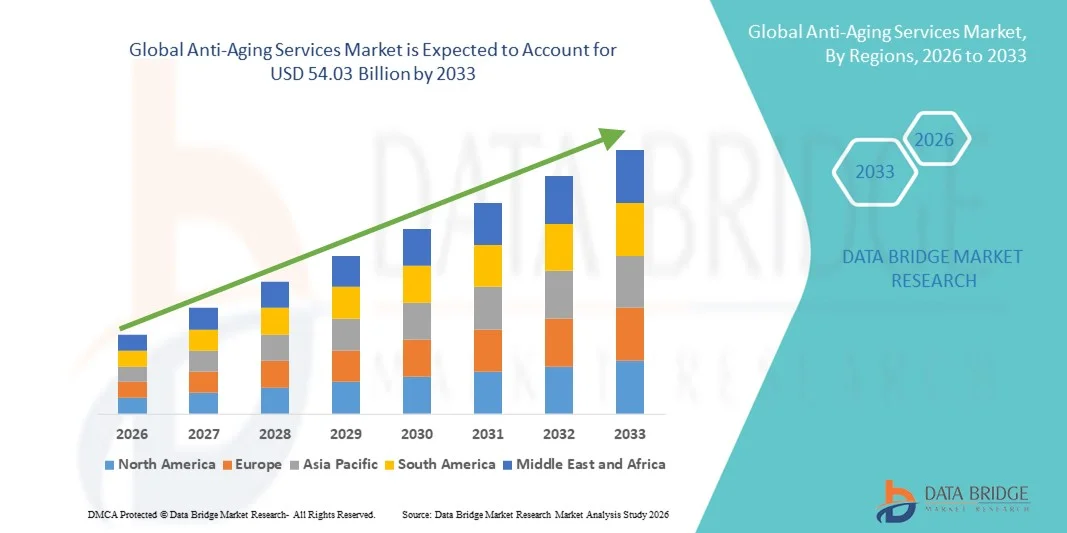
- As per Data Bridge Market Research Analysis the global anti-aging services market size was valued at USD 35.53 billion in 2025 and is expected to reach USD 54.03 billion by 2033, at a CAGR of 5.38% during the forecast period
- The market growth is largely fueled by increasing awareness and adoption of advanced aesthetic treatments, wellness programs, and personalized healthcare solutions, driven by rising disposable income and a growing focus on healthy aging
- Furthermore, surging consumer demand for non-invasive, effective, and technology-driven anti-aging solutions is positioning these services as an essential part of lifestyle and wellness regimes. These converging factors are accelerating the uptake of anti-aging services, thereby significantly boosting the industry's growth
Market Size & Forecast
Global Market Value (2025): USD 35.53 billion
Expected Market Value (2033): USD 54.03 billion
Forecast CAGR (2026–2033): 5.38%
What are the Major Takeaways of Anti-Aging Services Market?
- Anti-aging services, offering treatments and solutions aimed at reducing signs of aging and enhancing overall wellness, are increasingly integral to modern lifestyle and healthcare routines in both residential and clinical settings due to their effectiveness, personalization, and integration with cosmetic and wellness programs
- The escalating demand for anti-aging services is primarily fueled by rising consumer awareness of aging prevention, growing focus on aesthetic appearance, and increasing preference for minimally invasive and technologically advanced treatments such as Botox, dermal fillers, chemical peels, and laser-based therapies
- North America dominated the anti-aging services market with the largest revenue share of 40.7% in 2025, characterized by high disposable incomes, early adoption of aesthetic and wellness services, and a strong presence of key market players, with the U.S. witnessing substantial growth in dermatology clinics, hospitals, and wellness centers offering specialized anti-aging treatments
- Asia-Pacific is expected to be the fastest growing region in the anti-aging services market during the forecast period due to rising urbanization, increasing disposable incomes, and growing consumer interest in cosmetic and preventive healthcare services
- Botox treatment segment dominated the anti-aging services market with a market share of 32.9% in 2025, driven by its widespread acceptance, effectiveness in reducing wrinkles, and growing adoption across both clinical and salon-based service providers
Report Scope and Anti-Aging Services Market Segmentation
|
Attributes |
Anti-Aging Services Key Market Insights |
|
Segments Covered |
|
|
Countries Covered |
North America
Europe
Asia-Pacific
Middle East and Africa
South America
|
|
Key Market Players |
|
|
Market Opportunities |
|
|
Value Added Data Infosets |
In addition to the insights on market scenarios such as market value, growth rate, segmentation, geographical coverage, and major players, the market reports curated by the Data Bridge Market Research also include in-depth expert analysis, patient epidemiology, pipeline analysis, pricing analysis, and regulatory framework |
What is the Key Trend in the Anti-Aging Services Market?
Integration of Advanced Technologies and Personalized Treatments
- A key trend in the global anti-aging services market is the increasing incorporation of AI, laser technologies, and personalized treatment plans, enhancing treatment efficacy and patient experience
- For instance, SkinTech AI systems analyze skin condition and recommend customized treatment regimens for Botox, chemical peels, and dermal fillers based on individual needs and age-related concerns
- AI and laser technology integration enables practitioners to predict treatment outcomes, optimize dosage, and monitor progress over time. For instance, devices such as PicoSure laser use AI-guided settings to improve skin rejuvenation results with minimal downtime
- The adoption of non-invasive and minimally invasive procedures, combined with digital health monitoring, facilitates more precise, effective, and convenient anti-aging care for clients seeking safe alternatives to surgical interventions
- This trend toward data-driven, technology-enhanced, and personalized treatments is reshaping consumer expectations for cosmetic wellness, prompting providers such as SkinCeuticals Medspa to offer AI-enabled skin diagnostics and customized anti-aging plans
- The demand for technologically advanced and personalized anti-aging services is increasing rapidly across clinics, dermatology centers, and wellness facilities, as consumers prioritize efficacy, safety, and individualized care
- Collaborations between technology companies and dermatology clinics to develop wearable skin monitoring devices are emerging, allowing real-time tracking of skin health and treatment effectiveness
Anti-Aging Services Market Dynamics
Driver
Rising Awareness of Aging Prevention and Cosmetic Wellness
- The increasing focus on appearance, aging prevention, and overall wellness is a key driver for the growing demand for anti-aging services
- For instance, in March 2025, Allergan introduced advanced Botox formulations targeting age-related facial wrinkles, emphasizing non-invasive cosmetic solutions
- As consumers become more conscious of skin aging and early intervention benefits, treatments such as Botox, dermal fillers, and chemical peels are gaining popularity among diverse demographics
- Furthermore, rising disposable incomes and the growing number of aesthetic clinics and wellness centers are supporting broader access to anti-aging services across urban and semi-urban areas
- The desire for safe, effective, and non-surgical solutions for maintaining youthful appearance is encouraging consumers to seek regular anti-aging treatments, driving growth across service providers
- Increasing media exposure, influencer endorsements, and health-conscious lifestyles are further propelling demand, making anti-aging services a mainstream wellness and cosmetic choice globally
- The rise of male grooming and wellness trends is expanding the consumer base, increasing demand for anti-aging procedures among men in metropolitan regions
- Integration of holistic wellness services, such as nutrition counseling and lifestyle management, alongside aesthetic treatments is attracting health-conscious consumers seeking comprehensive anti-aging solutions
Restraint/Challenge
High Costs and Regulatory Compliance Concerns
- The high treatment costs and complex regulatory requirements are significant challenges limiting the market expansion of anti-aging services
- For instance, stringent FDA regulations for injectable products and laser devices require extensive testing and approvals, increasing operational costs for service providers
- Many consumers remain hesitant to adopt high-cost procedures such as Botox, dermal fillers, and laser-based therapies due to affordability concerns and uncertainty about long-term results
- Providers must comply with regional licensing, hygiene, and safety standards, which can delay service rollout or increase procedural costs, particularly in emerging markets
- While some clinics offer more affordable options or package deals, premium treatments with advanced technology remain inaccessible to price-sensitive customers
- Overcoming these barriers through cost optimization, regulatory navigation, and consumer education about treatment safety and effectiveness will be crucial for sustained market growth
- Limited availability of trained professionals and skilled dermatologists in certain regions poses challenges to service quality and market expansion
- Potential side effects, contraindications, or misuse of anti-aging treatments can lead to reputational risks for providers, affecting consumer confidence and adoption rates
How is the Anti-Aging Services Market Segmented?
The market is segmented on the basis of type, demographics, and service providers.
- By Type
On the basis of type, the anti-aging services market is segmented into microdermabrasion, breast augmentation, liposuction, chemical peel, sclerotherapy, intense pulsed light, botox treatment, dermal fillers, and others. The Botox Treatment segment dominated the market with the largest revenue share of 32.9% in 2025, driven by its widespread acceptance, effectiveness in reducing wrinkles, and minimally invasive nature. Consumers often prioritize Botox due to its fast results, low downtime, and ability to target multiple facial areas. The segment also benefits from strong brand recognition and repeated usage cycles, encouraging patient loyalty. Dermatology clinics and medspas frequently offer bundled packages including Botox treatments, further increasing adoption. Technological advancements and refined formulations have enhanced safety and efficacy, boosting consumer confidence. The growing influence of social media and cosmetic trends has also elevated Botox as a preferred anti-aging treatment worldwide.
The Dermal Fillers segment is anticipated to witness the fastest growth rate of 21% from 2026 to 2033, fueled by increasing adoption among younger demographics and rising demand for facial contouring and volume enhancement. Dermal fillers provide customizable solutions for addressing fine lines, volume loss, and skin sagging, making them highly appealing to aesthetics-conscious consumers. The segment’s growth is further supported by advancements in biocompatible and long-lasting filler materials. Clinics are offering minimally invasive procedures with immediate results, which enhances consumer convenience. Marketing campaigns emphasizing natural-looking outcomes are driving consumer confidence. Moreover, growing awareness and availability of non-surgical facial enhancement options are increasing adoption across urban centers globally.
- By Demographics
On the basis of demographics, the anti-aging services market is segmented into baby boomers, generation X, and generation Y. The Baby Boomers segment dominated the market in 2025 due to their heightened focus on maintaining youthful appearance and higher disposable income. This demographic often seeks both preventive and corrective anti-aging treatments, including Botox, dermal fillers, and chemical peels. Baby Boomers typically prefer established clinics with a proven track record for safety and efficacy. Aging-related skin concerns such as wrinkles, fine lines, and sagging drive regular repeat visits. The segment benefits from personalized treatment plans that cater to individual skin needs. Moreover, social visibility and media influence encourage ongoing investment in anti-aging solutions for this age group.
The Generation Y segment is expected to witness the fastest growth from 2026 to 2033, driven by rising awareness of preventive cosmetic care and influence from social media aesthetics trends. This younger demographic increasingly adopts treatments such as chemical peels, microdermabrasion, and non-invasive fillers to maintain skin health and appearance. Generation Y consumers are tech-savvy and prefer clinics offering digital consultations, personalized skincare, and innovative treatment options. Marketing campaigns targeting lifestyle enhancement and early intervention resonate strongly with this group. Their willingness to invest in both preventive and enhancement treatments is driving rapid market expansion. Growing beauty consciousness and peer influence in urban areas are further accelerating adoption.
- By Service Providers
On the basis of service providers, the anti-aging services market is segmented into hospitals, dermatology clinics, salons, and others. The Dermatology Clinics segment dominated the market with the largest revenue share of 37% in 2025, supported by specialized expertise, access to advanced technologies, and comprehensive treatment options. Consumers often prefer clinics for their safety standards, certified practitioners, and ability to provide multiple anti-aging solutions under one roof. Clinics frequently offer combination packages, loyalty programs, and follow-up care, enhancing patient retention. The availability of minimally invasive procedures such as Botox, dermal fillers, and laser treatments drives consistent demand. Clinics also invest in marketing and digital platforms to educate consumers about treatment benefits, increasing adoption. Advanced training programs for practitioners ensure high service quality and effectiveness.
The Salons segment is anticipated to witness the fastest growth rate of 20% from 2026 to 2033, fueled by increasing consumer interest in affordable and convenient anti-aging services such as microdermabrasion, chemical peels, and IPL treatments. Salons offer flexibility, quicker access, and lower-cost options compared to medical facilities, attracting younger demographics and first-time users. Integration of technology-driven services such as skin analysis tools and booking apps enhances customer experience. Beauty-conscious consumers increasingly combine wellness and aesthetic treatments during salon visits. Marketing collaborations and loyalty programs further drive repeat usage. The growing trend of self-care and preventive beauty practices in urban areas supports accelerated growth for salon-based anti-aging services
Which Region Holds the Largest Share of the Anti-Aging Services Market?
- North America dominated the anti-aging services market with the largest revenue share of 40.7% in 2025, characterized by high disposable incomes, early adoption of aesthetic and wellness services, and a strong presence of key market players
- Consumers in the region highly value the effectiveness, safety, and minimally invasive nature of treatments such as Botox, dermal fillers, chemical peels, and laser therapies
- This widespread adoption is further supported by high disposable incomes, a strong presence of dermatology clinics and wellness centers, and growing awareness of advanced anti-aging technologies, establishing anti-aging services as a preferred solution for both clinical and cosmetic wellness needs
U.S. Anti-Aging Services Market Insight
The U.S. anti-aging services market captured the largest revenue share of 82% in 2025 within North America, fueled by increasing consumer focus on aesthetics, wellness, and preventive healthcare. Consumers are increasingly prioritizing non-invasive and minimally invasive treatments such as Botox, dermal fillers, and chemical peels. The growing preference for personalized treatment plans, digital skin consultations, and tech-enabled clinics further propels market growth. Moreover, the integration of advanced technologies such as AI-assisted skin analysis and laser therapies is significantly contributing to the market’s expansion.
Europe Anti-Aging Services Market Insight
The Europe anti-aging services market is projected to expand at a substantial CAGR throughout the forecast period, primarily driven by rising awareness of cosmetic wellness and a growing preference for non-surgical treatments. Urbanization, higher disposable incomes, and the demand for technologically advanced treatments are fostering the adoption of anti-aging services. European consumers are also drawn to the convenience, safety, and effectiveness of clinic-based solutions. The region is experiencing significant growth across dermatology clinics, hospitals, and aesthetic centers, with treatments being incorporated into both preventive and corrective wellness programs.
U.K. Anti-Aging Services Market Insight
The U.K. anti-aging services market is anticipated to grow at a noteworthy CAGR during the forecast period, driven by the increasing focus on appearance, wellness, and lifestyle aesthetics. Rising concerns regarding early aging signs and consumer preference for minimally invasive procedures are encouraging adoption. The U.K.’s robust healthcare infrastructure, coupled with the growing presence of dermatology clinics and wellness centers, is expected to continue to stimulate market growth. Increasing digital awareness and e-commerce-enabled access to anti-aging services are further accelerating adoption among younger demographics.
Germany Anti-Aging Services Market Insight
The Germany anti-aging services market is expected to expand at a considerable CAGR during the forecast period, fueled by heightened awareness of cosmetic wellness and non-invasive procedures. Germany’s well-developed healthcare and aesthetic infrastructure, combined with a strong focus on quality and safety standards, promotes the adoption of advanced treatments such as dermal fillers, Botox, and chemical peels. Consumers prefer solutions that are effective, minimally invasive, and backed by professional expertise. Integration of technology-driven skin diagnostics and personalized treatment plans is becoming increasingly prevalent, aligning with local expectations for premium services.
Asia-Pacific Anti-Aging Services Market Insight
The Asia-Pacific anti-aging services market is poised to grow at the fastest CAGR of 24% during the forecast period of 2026 to 2033, driven by rising disposable incomes, urbanization, and growing beauty consciousness in countries such as China, Japan, and India. Increasing awareness of cosmetic and preventive wellness, coupled with the adoption of modern dermatology clinics and salon-based treatments, is driving market growth. Government initiatives promoting wellness and lifestyle healthcare are further supporting the adoption of anti-aging services. In addition, growing affordability and accessibility of advanced non-invasive procedures are expanding the consumer base across APAC.
Japan Anti-Aging Services Market Insight
The Japan anti-aging services market is gaining momentum due to the country’s aging population, high focus on aesthetics, and widespread adoption of advanced technologies. Consumers are increasingly seeking convenient, safe, and minimally invasive treatments, particularly in urban centers. Clinics are integrating AI-based skin analysis, laser treatments, and personalized care programs to enhance treatment outcomes. The cultural emphasis on youthfulness and preventive healthcare is further boosting demand. Growing awareness about holistic wellness and aesthetic services in both residential and commercial sectors is contributing to market growth.
India Anti-Aging Services Market Insight
The India anti-aging services market accounted for the largest revenue share in Asia-Pacific in 2025, attributed to the country’s rising middle-class population, increasing disposable incomes, and heightened awareness of aesthetic wellness. Non-invasive treatments such as chemical peels, Botox, and microdermabrasion are becoming increasingly popular across dermatology clinics, salons, and hospitals. The growing presence of trained professionals, affordable treatment options, and expansion of wellness centers are key factors propelling market growth. Increasing urbanization and the trend toward preventive and lifestyle-based healthcare are further driving adoption in India.
Which are the Top Companies in Anti-Aging Services Market?
The Anti-Aging Services industry is primarily led by well-established companies, including:
- Calico Life Sciences LLC (U.S.)
- Elysium Health (U.S.)
- Juvenescence Ltd. (U.K.)
- Life Biosciences, Inc. (U.S.)
- Sierra Sciences, LLC (U.S.)
- Resverlogix Corp. (Canada)
- BioAge Labs, Inc. (U.S.)
- AgeX Therapeutics, Inc. (U.S.)
- The Longevity Company (U.S.)
- Aesthetic Solutions Inc. (U.S.)
- Anti-Aging Medical & Laser Clinic (Canada)
- Clinical Skincare (Canada)
- Cutis Dermatology (Canada)
- Dermamagnetica Clinic (Canada)
- Elan Aesthetics Inc. (Canada)
- Estique Clinic (Canada)
- Evolus (U.S.)
- Glow Anti-Aging Clinic (Canada)
- Sinclair Pharma (U.K.)
What are Latest Developments in Anti-Aging Services Market?
- In June 2025, The FDA accepted a supplemental approval (sPMA) application from Allergan (AbbVie) to expand the use of SKINVIVE by JUVÉDERM to treat horizontal neck lines. If approved, it would become the first HA injectable specifically indicated for improving neck appearance, representing a meaningful extension of the product’s aesthetic use
- In June 2025, (plated)™ Skin Science, part of Rion Aesthetics, inaugurated a state-of-the-art 14,000 sq ft manufacturing facility in Rochester, MN, dedicated to producing its proprietary platelet-derived exosomes (Renewosome™ technology). The scale-up is in response to surging demand, underscoring the growing commercial traction for exosome-based anti-aging skincare
- In May 2023, SKINVIVE™ by JUVÉDERM (an AbbVie / Allergan product) received U.S. FDA approval for improving skin smoothness on the cheeks in adults over 21. This is significant because it’s the first hyaluronic acid (HA) intradermal micro‑droplet injection, designed specifically to improve skin texture, not add volume, and gives results that can last up to six months
- In September 2022, Rion Aesthetics published clinical data from its Platelets On Skin Health (POSH) study (conducted in partnership with the Mayo Clinic) showing that its (plated)™ exosome‑based serum produced statistically significant improvements in wrinkles, redness, brown spots, and skin luminosity in just 6 weeks
- In September 2021, Jeff Bezos, along with Yuri Milner and other high-profile investors, backed the launch of Altos Labs, a biotech startup dedicated to “cellular reprogramming” to reverse aging at the cellular level. The company’s mission is to restore cell health by programming cells to a more youthful state, which could fundamentally change how we treat age-related decline

- Interactive Data Analysis Dashboard
- Company Analysis Dashboard for high growth potential opportunities
- Research Analyst Access for customization & queries
- Competitor Analysis with Interactive dashboard
- Latest News, Updates & Trend analysis
- Harness the Power of Benchmark Analysis for Comprehensive Competitor Tracking
Data collection and base year analysis are done using data collection modules with large sample sizes. The stage includes obtaining market information or related data through various sources and strategies. It includes examining and planning all the data acquired from the past in advance. It likewise envelops the examination of information inconsistencies seen across different information sources. The market data is analysed and estimated using market statistical and coherent models. Also, market share analysis and key trend analysis are the major success factors in the market report. To know more, please request an analyst call or drop down your inquiry.
The key research methodology used by DBMR research team is data triangulation which involves data mining, analysis of the impact of data variables on the market and primary (industry expert) validation. Data models include Vendor Positioning Grid, Market Time Line Analysis, Market Overview and Guide, Company Positioning Grid, Patent Analysis, Pricing Analysis, Company Market Share Analysis, Standards of Measurement, Global versus Regional and Vendor Share Analysis. To know more about the research methodology, drop in an inquiry to speak to our industry experts.
Data Bridge Market Research is a leader in advanced formative research. We take pride in servicing our existing and new customers with data and analysis that match and suits their goal. The report can be customized to include price trend analysis of target brands understanding the market for additional countries (ask for the list of countries), clinical trial results data, literature review, refurbished market and product base analysis. Market analysis of target competitors can be analyzed from technology-based analysis to market portfolio strategies. We can add as many competitors that you require data about in the format and data style you are looking for. Our team of analysts can also provide you data in crude raw excel files pivot tables (Fact book) or can assist you in creating presentations from the data sets available in the report.













