What is the Global Anti-Pollution Ingredients Market Size and Growth Rate?
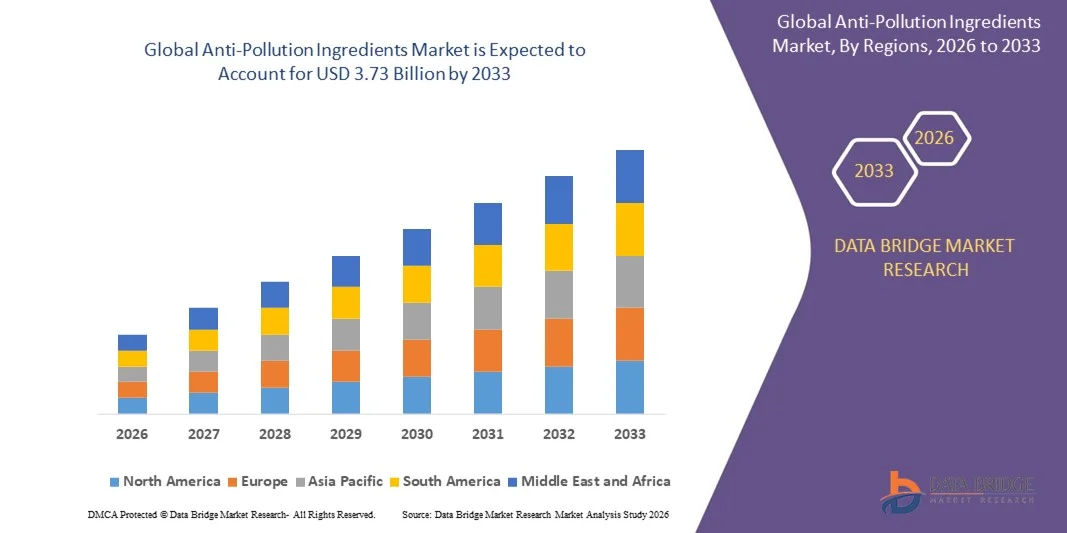
- As per Data Bridge Market Research Analysis the global anti-pollution ingredients market size was valued at USD 2.09 billion in 2025 and is expected to reach USD 3.73 billion by 2033, at a CAGR of 7.5% during the forecast period
- Major factors that are expected to boost the growth of the anti-pollution ingredients market in the forecast period are the extreme increase in the assimilation of the active, functional ingredients in personal care (PC) and cosmetic products, with an anti-pollution effect, the growing of the customer alertness about the side effects of pollution on the skin and the increasing demand for rising demand for natural and organic cosmetics which high in vitamins and antioxidants
Market Size & Forecast
- Global Market Value (2025): USD 2.09 Billion
- Expected Market Value (2033): USD 3.73 Billion
- Forecast CAGR (2026–2033): 7.5%
What are the Major Takeaways of Anti-Pollution Ingredients Market?
- The launching of innovative products and technologies by the manufacturers, the rise in the premature aging, skin damage, inflammation and clogged pores and so forth and the growing understanding about the skin care products amongst people are some of the factors anticipated to propel the growth of the anti-pollution ingredients market
- Moreover, the increasing demand for environment-friendly and ayurvedic products, high consumption of products that are high in anti-pollution ingredients and the growing of the consumer inclination towards the preventative skin and hair care are some of the other factors responsible for augmenting the growth of the anti-pollution ingredients market in the timeline period. In addition, the rise in the modern population will further provide potential opportunities for the growth of the anti-pollution ingredients market in the near future
- Asia-Pacific dominated the anti-pollution ingredients market with a 42.65% revenue share in 2025, driven by rising urbanization, increasing air pollution, and growing consumer awareness regarding skin and hair protection in countries such as China, Japan, India, South Korea, and Southeast Asia
- North America is projected to register the fastest CAGR of 11.65% from 2026 to 2033, driven by growing interest in eco-friendly, natural, and vegan personal care products in the U.S. and Canada
- The Activated Charcoal segment dominated the market with a 38.7% share in 2025, driven by its high adsorption capacity, detoxifying properties, and widespread incorporation in skin and hair care formulations
Report Scope and Anti-Pollution Ingredients Market Segmentation
|
Attributes |
Anti-Pollution Ingredients Key Market Insights |
|
Segments Covered |
|
|
Countries Covered |
North America
Europe
Asia-Pacific
Middle East and Africa
South America
|
|
Key Market Players |
|
|
Market Opportunities |
|
|
Value Added Data Infosets |
In addition to the insights on market scenarios such as market value, growth rate, segmentation, geographical coverage, and major players, the market reports curated by the Data Bridge Market Research also include in-depth expert analysis, pricing analysis, brand share analysis, consumer survey, demography analysis, supply chain analysis, value chain analysis, raw material/consumables overview, vendor selection criteria, PESTLE Analysis, Porter Analysis, and regulatory framework. |
What is the Key Trend in the Anti-Pollution Ingredients Market?
Rising Demand for Innovative, Multi-Functional, and Sustainable Anti-Pollution Ingredients
- The anti-pollution ingredients market is witnessing strong adoption of multifunctional actives, encapsulated formulations, and sustainable compounds designed to protect skin from environmental aggressors, UV radiation, blue light, and air pollutants
- Manufacturers are introducing high-efficacy botanical extracts, marine-based molecules, and nanotechnology-enabled ingredients that offer antioxidant, anti-inflammatory, and barrier-strengthening benefits
- Growing consumer preference for clean-label, natural, and eco-friendly skincare products is driving adoption across personal care brands, premium cosmetics, and dermo-cosmetic formulations
- For instance, companies such as DSM, BASF, Croda, and Lonza have expanded their anti-pollution ingredient portfolios with multifunctional actives, bio-based antioxidants, and encapsulated delivery systems for enhanced skin penetration
- Increasing need for formulations that protect against urban pollution, oxidative stress, and premature aging is accelerating product innovation and market growth
- As consumers become more aware of environmental stressors, Anti-Pollution Ingredients will remain vital for skincare product differentiation and sustainable beauty solutions
What are the Key Drivers of Anti-Pollution Ingredients Market?
- Rising consumer awareness of pollution-induced skin damage and increasing demand for preventive skincare products are driving market growth
- For instance, in 2025, leading companies such as BASF, Croda, and Givaudan expanded their anti-pollution ingredient lines with bioactive extracts, encapsulated antioxidants, and multifunctional actives for skincare applications
- Growing adoption of natural and plant-derived ingredients in personal care, cosmetics, and dermo-cosmetic products boosts demand globally across the U.S., Europe, and Asia-Pacific
- Technological advancements in microencapsulation, nanoemulsions, and sustainable sourcing have improved ingredient stability, efficacy, and skin absorption, strengthening market adoption
- Rising interest in multifunctional skincare solutions that combine anti-aging, hydration, and pollution protection accelerates incorporation of innovative actives
- Supported by steady investments in R&D, dermatological testing, and sustainable sourcing practices, the Anti-Pollution Ingredients market is expected to witness strong long-term growth
Which Factor is Challenging the Growth of the Anti-Pollution Ingredients Market?
- High costs associated with premium, multifunctional, and encapsulated ingredients restrict adoption among small skincare brands and emerging markets
- For instance, during 2024–2025, fluctuations in raw material prices, limited availability of bioactive extracts, and longer supply chain lead times increased formulation costs for several global vendors
- Complexity in formulating stable, effective, and skin-compatible products increases the need for specialized R&D and testing facilities
- Limited awareness among consumers in emerging regions regarding ingredient efficacy and environmental impact slows adoption
- Competition from conventional antioxidants, synthetic preservatives, and multifunctional cosmeceutical actives creates pricing pressure and reduces product differentiation
- To address these issues, companies are focusing on cost-optimized formulations, sustainable sourcing, encapsulated delivery systems, and consumer education to increase global adoption of Anti-Pollution Ingredients
How is the Anti-Pollution Ingredients Market Segmented?
The market is segmented on the basis of product, application, and distribution channel.
- By Product
On the basis of product, the anti-pollution ingredients market is segmented into Activated Charcoal, Algae and Kelp, Chinese Herbs, Antioxidants, Minerals, Polymer-Based Ingredients, and Others. The Activated Charcoal segment dominated the market with a 38.7% share in 2025, driven by its high adsorption capacity, detoxifying properties, and widespread incorporation in skin and hair care formulations. Activated Charcoal is extensively used in face masks, cleansers, shampoos, and conditioners to remove pollutants, heavy metals, and excess oils from skin and hair, enhancing product efficacy and consumer appeal.
The Polymer-Based Ingredients segment is projected to grow at the fastest CAGR from 2026 to 2033, fueled by increasing demand for advanced film-forming agents, sustained-release delivery systems, and multifunctional polymers that protect against environmental aggressors. Rising innovation in polymer encapsulation technologies, combined with growing interest in protective cosmetic solutions, is accelerating adoption across premium and mass-market product lines.
- By Application
On the basis of application, the market is segmented into Skin Care and Hair Care. The Skin Care segment dominated the market with a 57.2% share in 2025, driven by strong consumer preference for anti-pollution face creams, serums, sunscreens, and masks. Increasing awareness of urban pollution, UV exposure, blue light, and particulate matter is fueling demand for ingredients that provide antioxidant, anti-inflammatory, and barrier-protective benefits.
The Hair Care segment is expected to grow at the fastest CAGR from 2026 to 2033, propelled by rising adoption of shampoos, conditioners, and leave-in treatments formulated to protect hair from pollution-induced damage, UV stress, and oxidative degradation. Growth in premium hair care products, coupled with the rising trend of eco-friendly and plant-derived actives, is accelerating market penetration across both developed and emerging regions.
- By Distribution Channel
On the basis of distribution channel, the anti-pollution ingredients market is segmented into Hypermarket or Supermarket, Specialty Stores, Independent Stores, Online Stores, and Others. The Online Stores segment dominated the market with a 34.5% share in 2025, supported by growing e-commerce penetration, easy access to global brands, and increasing consumer preference for convenient shopping experiences. Online platforms also allow brands to showcase detailed product information, highlight ingredient efficacy, and promote eco-friendly certifications, strengthening adoption.
The Specialty Stores segment is projected to grow at the fastest CAGR from 2026 to 2033, driven by rising interest in premium, niche, and dermatologist-recommended products. Specialty retail channels enable focused customer engagement, personalized recommendations, and experiential marketing, which accelerates the uptake of advanced anti-pollution ingredients across skin and hair care categories.
Which Region Holds the Largest Share of the Anti-Pollution Ingredients Market?
- Asia-Pacific dominated the anti-pollution ingredients market with a 42.65% revenue share in 2025, driven by rising urbanization, increasing air pollution, and growing consumer awareness regarding skin and hair protection in countries such as China, Japan, India, South Korea, and Southeast Asia. Rapid growth in the personal care and cosmetics sector, coupled with rising disposable incomes and preference for natural and plant-based ingredients, is fueling demand across premium and mass-market formulations
- Leading regional players are innovating with algae-based, herbal, and polymer-based anti-pollution actives, enhancing product efficacy against particulate matter, UV damage, and oxidative stress, which strengthens Asia-Pacific’s market dominance
- High population density, strong e-commerce penetration, and active government regulations on environmental sustainability further boost regional growth
China Anti-Pollution Ingredients Market Insight
China is the largest contributor to the region, supported by strong skincare and hair care consumption, booming cosmetics manufacturing, and increasing adoption of natural anti-pollution ingredients. Rising urban pollution, high consumer awareness, and local production capabilities drive extensive market penetration.
Japan Anti-Pollution Ingredients Market Insight
Japan shows steady growth due to advanced cosmetics technology, high-quality manufacturing, and strong adoption of premium and functional personal care products. Consumer preference for innovative formulations with antioxidant and protective benefits reinforces long-term expansion.
India Anti-Pollution Ingredients Market Insight
India is emerging as a major growth hub, fueled by rapid urbanization, rising disposable income, and expanding personal care markets. Growth in skincare and hair care sectors, coupled with increasing use of natural and plant-based actives, supports strong market adoption.
South Korea Anti-Pollution Ingredients Market Insight
South Korea contributes significantly due to high demand for functional cosmetics, advanced product development, and a strong focus on K-beauty trends. Adoption of anti-pollution formulations for skin and hair care accelerates regional growth.
North America Anti-Pollution Ingredients Market
North America is projected to register the fastest CAGR of 11.65% from 2026 to 2033, driven by growing interest in eco-friendly, natural, and vegan personal care products in the U.S. and Canada. Rising awareness of environmental stressors, increasing product innovation, and strong e-commerce penetration are accelerating market adoption. Leading companies focus on research-backed, multifunctional anti-pollution ingredients to cater to premium consumers, supporting rapid regional growth.
U.S. Anti-Pollution Ingredients Market Insight
The U.S. is a major contributor, supported by rising consumer preference for natural and effective anti-pollution skincare and hair care products. High investments in product R&D and the popularity of clean-label formulations boost market penetration.
Canada Anti-Pollution Ingredients Market Insight
Canada contributes significantly with growing awareness of pollution-related skin damage and rising adoption of premium, plant-based personal care solutions. Expansion of specialty retail and online distribution channels further enhances growth.
Which are the Top Companies in Anti-Pollution Ingredients Market?
The anti-pollution ingredients industry is primarily led by well-established companies, including:
- AOBiome (U.S.)
- The Lubrizol Corporation (U.S.)
- CoDIF International S.A.S. (France)
- Procter & Gamble (U.S.)
- TULA Life INC (U.S.)
- Dow (U.S.)
- SILAB (France)
- Lancôme (France)
- Sederma S.A. (France)
- THE AVON COMPANY (U.S.)
- BioSpectrum (U.S.)
- Ashland (U.S.)
- AMSilk GmbH (Germany)
- Solabia Group (France)
- Algues et Mer (France)
- Lucas Meyer Cosmetics Canada, Inc. (Canada)
- Symrise AG (Germany)
- Beiersdorf AG (Germany)
- Shiseido Company (Japan)
- Amway Corp. (U.S.)
- Unilever (U.K.)
- The Estée Lauder Companies Inc. (U.S.)
- L’Oréal S.A. (France)
- Kao Corporation (Japan)
- Colgate-Palmolive Company (U.S.)

- Interactive Data Analysis Dashboard
- Company Analysis Dashboard for high growth potential opportunities
- Research Analyst Access for customization & queries
- Competitor Analysis with Interactive dashboard
- Latest News, Updates & Trend analysis
- Harness the Power of Benchmark Analysis for Comprehensive Competitor Tracking
Data collection and base year analysis are done using data collection modules with large sample sizes. The stage includes obtaining market information or related data through various sources and strategies. It includes examining and planning all the data acquired from the past in advance. It likewise envelops the examination of information inconsistencies seen across different information sources. The market data is analysed and estimated using market statistical and coherent models. Also, market share analysis and key trend analysis are the major success factors in the market report. To know more, please request an analyst call or drop down your inquiry.
The key research methodology used by DBMR research team is data triangulation which involves data mining, analysis of the impact of data variables on the market and primary (industry expert) validation. Data models include Vendor Positioning Grid, Market Time Line Analysis, Market Overview and Guide, Company Positioning Grid, Patent Analysis, Pricing Analysis, Company Market Share Analysis, Standards of Measurement, Global versus Regional and Vendor Share Analysis. To know more about the research methodology, drop in an inquiry to speak to our industry experts.
Data Bridge Market Research is a leader in advanced formative research. We take pride in servicing our existing and new customers with data and analysis that match and suits their goal. The report can be customized to include price trend analysis of target brands understanding the market for additional countries (ask for the list of countries), clinical trial results data, literature review, refurbished market and product base analysis. Market analysis of target competitors can be analyzed from technology-based analysis to market portfolio strategies. We can add as many competitors that you require data about in the format and data style you are looking for. Our team of analysts can also provide you data in crude raw excel files pivot tables (Fact book) or can assist you in creating presentations from the data sets available in the report.