


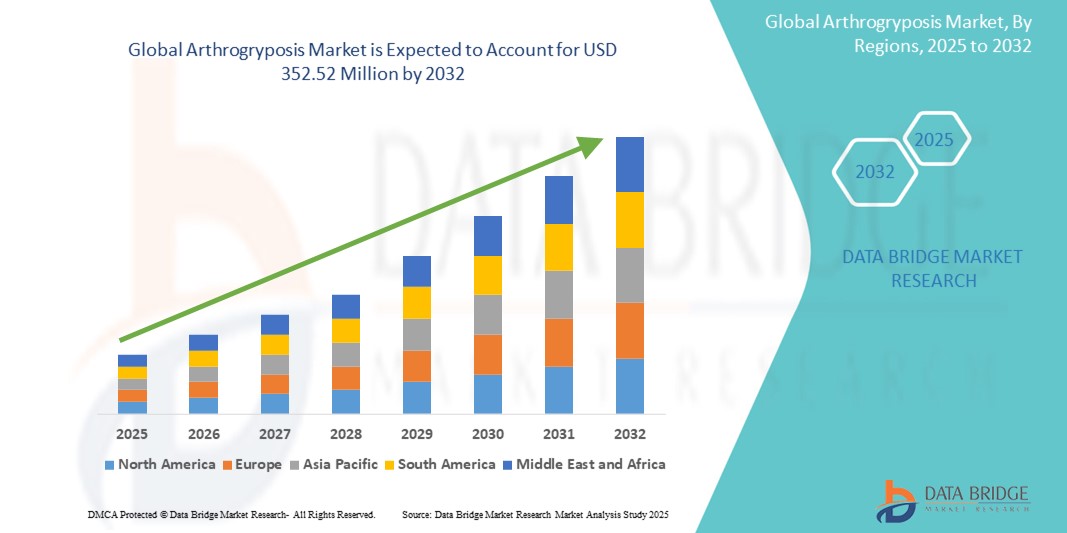
Arthrogryposis Market Size
- The global arthrogryposis market size was valued at USD 263.60 million in 2024 and is expected to reach USD 352.52 million by 2032, at a CAGR of 3.70% during the forecast period
- The market growth is largely driven by increasing awareness and early diagnosis of congenital musculoskeletal disorders, along with advancements in surgical techniques, physiotherapy, and assistive technologies for improved mobility outcomes in affected individuals
- Furthermore, rising demand for multidisciplinary treatment approaches, including orthotic management, genetic counseling, and pediatric orthopedic expertise, is positioning arthrogryposis care as a specialized medical need. These combined factors are fostering research investments and innovations, thereby accelerating market expansion globally
Arthrogryposis Market Analysis
- Arthrogryposis, a rare congenital condition characterized by joint contractures and muscle weakness, is gaining increasing attention in pediatric and orthopedic care due to its lifelong impact on mobility and quality of life, prompting the development of early intervention programs, specialized surgical approaches, and advanced rehabilitative therapies in both hospital and outpatient settings
- The growing demand for effective arthrogryposis treatment is primarily driven by improved neonatal screening, enhanced access to genetic diagnostics, and greater awareness among healthcare providers and caregivers about multidisciplinary management strategies
- North America dominated the arthrogryposis market with the largest revenue share of 38.9% in 2024, supported by advanced healthcare infrastructure, higher healthcare spending, and an active research landscape, particularly in the U.S., where pediatric orthopedic centers and genetic research institutions are spearheading innovation in personalized care and novel surgical techniques
- Asia-Pacific is expected to be the fastest growing region in the arthrogryposis market during the forecast period due to growing healthcare investments, improving diagnostic capabilities, and increasing government focus on rare disease treatment
- Surgery segment dominated the arthrogryposis market with a market share of 43% in 2024, driven by its effectiveness in correcting joint deformities and enhancing mobility outcomes in moderate to severe cases
Report Scope and Arthrogryposis Market Segmentation
|
Attributes |
Arthrogryposis Key Market Insights |
|
Segments Covered |
|
|
Countries Covered |
North America
Europe
Asia-Pacific
Middle East and Africa
South America
|
|
Key Market Players |
|
|
Market Opportunities |
|
|
Value Added Data Infosets |
In addition to the insights on market scenarios such as market value, growth rate, segmentation, geographical coverage, and major players, the market reports curated by the Data Bridge Market Research also include in-depth expert analysis, pricing analysis, brand share analysis, consumer survey, demography analysis, supply chain analysis, value chain analysis, raw material/consumables overview, vendor selection criteria, PESTLE Analysis, Porter Analysis, and regulatory framework. |
Arthrogryposis Market Trends
“Technological Advancements in Orthopedic Interventions and Assistive Devices”
- A significant and accelerating trend in the global arthrogryposis market is the growing adoption of advanced orthopedic technologies and personalized assistive devices, aimed at improving mobility, surgical precision, and long-term patient outcomes
- For instance, 3D-printed orthoses and custom-fitted braces are increasingly being developed to match individual anatomical needs, enhancing comfort and rehabilitation efficiency. Similarly, computer-assisted surgical planning and minimally invasive procedures are being adopted to correct joint deformities more accurately
- Technologies such as wearable rehabilitation tools and remote physiotherapy platforms are also enabling continuous at-home care and improved monitoring of therapeutic progress. For instance, dynamic splinting systems now offer real-time adjustments to joint alignment, reducing the need for multiple corrective surgeries
- The integration of multidisciplinary treatment approaches through digital health platforms allows orthopedic surgeons, physical therapists, and genetic specialists to collaboratively manage complex cases. This coordinated care model is improving functional recovery and quality of life for arthrogryposis patients
- Companies and institutions focusing on rare conditions are increasingly investing in the development of specialized tools and mobility aids designed for arthrogryposis. For instance, pediatric orthopedic centers are collaborating with biotech firms to create age-appropriate devices and surgical implants
- The trend toward personalized, technology-driven care is transforming the arthrogryposis treatment landscape, leading to better outcomes, expanded therapeutic options, and increased accessibility to advanced care across developed and emerging healthcare markets
Arthrogryposis Market Dynamics
Driver
“Rising Early Diagnosis and Multidisciplinary Treatment Demand”
- The increasing emphasis on early diagnosis of congenital musculoskeletal disorders, combined with growing awareness of multidisciplinary treatment options, is a major driver of the arthrogryposis market
- For instance, advancements in prenatal screening and neonatal imaging are enabling earlier identification of joint contractures, leading to timely medical intervention and customized care planning for affected infants. Multidisciplinary care involving orthopedic surgeons, genetic counselors, physiotherapists, and occupational therapists is now considered essential in managing arthrogryposis effectively, resulting in growing demand for integrated treatment models
- Healthcare policy shifts and rare disease advocacy initiatives are also improving access to early-stage treatments and funding for research, encouraging greater adoption of both surgical and non-surgical solutions
- Increasing awareness among caregivers, along with improved healthcare infrastructure and diagnostic capabilities in developing regions, is further expected to support sustained market growth over the forecast period
Restraint/Challenge
“Limited Accessibility and High Treatment Costs in Low-Income Regions”
- One of the primary challenges restraining the arthrogryposis market is the limited availability of specialized care and the high cost of treatment, particularly in low- and middle-income countries
- For instance, advanced surgical procedures and custom orthotic devices remain expensive and largely inaccessible in many underserved areas due to lack of skilled professionals, insufficient funding, and inadequate healthcare facilities
- While early diagnosis and intervention are growing in developed nations, late detection and minimal therapeutic support in resource-constrained settings often lead to lifelong disability and reduced quality of life for affected individuals
- The cost burden associated with long-term rehabilitation, assistive devices, and repeated surgeries also presents a financial challenge for families and healthcare systems
- Overcoming these barriers will require global collaborations to expand specialist training, subsidize medical equipment, and implement community-based care programs aimed at improving affordability and access to quality treatment for arthrogryposis patients worldwide
Arthrogryposis Market Scope
The market is segmented on the basis of type, treatment type, and distribution channel.
- By Type
On the basis of type, the arthrogryposis market is segmented into Distal Arthrogryposis Type 2A, Distal Arthrogryposis Type 2B, Distal Arthrogryposis Type 3, Distal Arthrogryposis Type 4 (Scoliosis), Distal Arthrogryposis Type 4, Type 5, Type 6, Type 7, Type 8, Type 9, and Type 10. Distal Arthrogryposis Type 2A dominated the market with the largest revenue share of 21.3% in 2024, attributed to its comparatively higher prevalence and clearer diagnostic criteria among the various subtypes. This type is characterized by congenital joint contractures and recognizable phenotypic features, leading to earlier diagnosis and greater treatment intervention.
Distal Arthrogryposis Type 3 is anticipated to witness the fastest growth rate from 2025 to 2032 due to increasing advancements in genetic testing and a growing number of documented cases. This segment is also benefiting from rising awareness of craniofacial and limb deformities associated with the condition, leading to improved diagnosis and focused treatment approaches
- By Treatment Type
On the basis of treatment type, the arthrogryposis market is segmented into surgery, physical therapy, occupational therapists, imaging diagnostics, and CT scan. Surgery led the segment with the highest market share of 43% in 2024, driven by its vital role in correcting joint contractures and deformities, particularly in severe cases where mobility is severely restricted. Surgical intervention is often essential for improving functional outcomes and quality of life in pediatric and adolescent patients.
Physical therapy is expected to witness the fastest CAGR from 2025 to 2032, fueled by increased adoption of non-invasive rehabilitation strategies aimed at improving joint mobility, muscle strength, and independence in daily activities. Growing awareness of early intervention and advancements in therapy tools and techniques are further accelerating this segment’s growth.
- By Distribution Channel
On the basis of distribution channel, the arthrogryposis market is segmented into hospital pharmacies, retail pharmacies, online pharmacies, and others. Hospital pharmacies dominated the market with the largest revenue share of 46.9% in 2024, supported by the centralized treatment of arthrogryposis within specialized healthcare facilities where integrated care—including diagnostics, surgery, and therapy—is offered under one roof.
Online Pharmacies are projected to witness the fastest growth rate over the forecast period due to increasing patient inclination toward digital healthcare platforms, improved delivery logistics, and the availability of prescribed orthopedic and assistive devices through online channels. The growing adoption of telemedicine and e-prescriptions is also contributing to the rapid rise of this segment
Arthrogryposis Market Regional Analysis
- North America dominated the arthrogryposis market with the largest revenue share of 38.9% in 2024, supported by advanced healthcare infrastructure, higher healthcare spending, and an active research landscape, particularly in the U.S., where pediatric orthopedic centers and genetic research institutions are spearheading innovation in personalized care and novel surgical techniques
- Patients and healthcare providers in the region benefit from access to multidisciplinary care teams, innovative surgical technologies, and custom orthotic solutions that enhance long-term mobility and quality of life for individuals with arthrogryposis
- This strong market presence is further reinforced by high healthcare spending, increased awareness of rare diseases, and supportive policies for specialized treatments, positioning North America as a key contributor to advancements in arthrogryposis care across both clinical and research domains
U.S. Arthrogryposis Market Insight
The U.S. arthrogryposis market captured the largest revenue share of 74.6% in 2024 within North America, fueled by early adoption of advanced diagnostic tools, widespread availability of multidisciplinary pediatric care, and strong support from national rare disease policies. The presence of specialized orthopedic centers, along with robust research funding and access to genetic counseling, significantly supports timely intervention. In addition, public and private sector collaboration in awareness campaigns and clinical advancements further propels the U.S. arthrogryposis market growth.
Europe Arthrogryposis Market Insight
The Europe arthrogryposis market is projected to grow at a substantial CAGR throughout the forecast period, driven by increasing awareness of congenital musculoskeletal disorders and enhanced healthcare accessibility. Rising emphasis on early intervention and integrated treatment pathways is accelerating demand for surgical correction, physical therapy, and orthotic support. Furthermore, EU support for rare disease research and collaborative initiatives across healthcare systems in France, Germany, and the Nordics are expected to sustain market expansion.
U.K. Arthrogryposis Market Insight
The U.K. arthrogryposis market is anticipated to grow at a noteworthy CAGR during the forecast period, supported by robust public healthcare infrastructure and initiatives aimed at early diagnosis and intervention. Increased focus on pediatric orthopedic services and national frameworks for rare disease management are enhancing access to multidisciplinary care. In addition, the National Health Service (NHS) is integrating advanced therapy tools and expanding support for families, fueling market growth across clinical and rehabilitation segments.
Germany Arthrogryposis Market Insight
The Germany arthrogryposis market is expected to expand at a considerable CAGR during the forecast period, driven by a strong emphasis on medical innovation, early diagnosis, and surgical precision. The country’s advanced healthcare system supports high standards in orthopedic care, genetic testing, and post-operative rehabilitation. Government and academic collaboration in rare disease research and access to cutting-edge assistive devices are further contributing to the steady growth of the arthrogryposis market in Germany.
Asia-Pacific Arthrogryposis Market Insight
The Asia-Pacific arthrogryposis market is poised to grow at the fastest CAGR of 8.7% during the forecast period of 2025 to 2032, propelled by rising awareness, improving healthcare access, and a growing pediatric population in countries such as China, India, and Japan. National initiatives in rare disease care, along with increasing investment in pediatric surgery and rehabilitation, are driving market development. Enhanced diagnostics, coupled with local production of orthopedic devices, is making treatment more accessible and affordable across the region.
Japan Arthrogryposis Market Insight
The Japan arthrogryposis market is gaining traction due to the country’s advanced healthcare technologies, increasing focus on early-stage pediatric care, and commitment to lifelong functional support. Integration of robotics, 3D-printed orthoses, and AI-assisted diagnostics is reshaping treatment delivery. Japan’s aging yet tech-forward society is also investing in inclusive infrastructure and accessible care models that support children and families managing congenital conditions such as arthrogryposis.
India Arthrogryposis Market Insight
The India arthrogryposis market accounted for the largest market revenue share in Asia Pacific in 2024, driven by rapid urbanization, growing middle-class healthcare spending, and a surge in pediatric care facilities. Rising awareness of congenital conditions, along with public health initiatives and increased access to physiotherapy and orthopedic surgery, is supporting market growth. The emergence of local manufacturers offering affordable orthotic devices and surgical tools is also helping expand treatment accessibility across diverse population segments.
Arthrogryposis Market Share
The arthrogryposis industry is primarily led by well-established companies, including:
- Zimmer Biomet (U.S.)
- Stryker (U.S.)
- Johnson & Johnson Services, Inc. (U.S.)
- Smith + Nephew (U.K.)
- Medtronic (Ireland)
- OrthoPediatrics Corp. (U.S.)
- Ottobock SE & Co. KGaA (Germany)
- NuVasive, Inc. (U.S.)
- DJO Global, Inc. (U.S.)
- EOS imaging S.A. (France)
- Wright Medical Group N.V. (Netherlands)
- Arthrex, Inc. (U.S.)
- B. Braun SE (Germany)
- Shimmer Research, Ltd. (Ireland)
- Ekso Bionics Holdings, Inc. (U.S.)
- Hocoma AG (Switzerland)
- Tyromotion GmbH (Austria)
- Shriners Hospitals for Children (U.S.)
- Nemours Children’s Health System (U.S.)
- Great Ormond Street Hospital for Children NHS Foundation Trust (U.K.)
What are the Recent Developments in Global Arthrogryposis Market?
- In May 2023, Shriners Children's Hospital in the U.S. announced the expansion of its multidisciplinary arthrogryposis program, integrating advanced surgical planning tools, 3D-printing for custom orthotic devices, and telehealth platforms to enhance access and continuity of care. This initiative reflects the growing emphasis on patient-centered, technology-driven solutions in rare congenital conditions and reinforces Shriners’ role as a global leader in pediatric orthopedic care
- In April 2023, Great Ormond Street Hospital (GOSH), U.K., launched a collaborative clinical research program focused on the genetic profiling of arthrogryposis multiplex congenita (AMC). Partnering with European rare disease consortia, the initiative aims to identify genotype-phenotype correlations that can guide personalized treatment strategies and inform early diagnostic protocols, marking a critical advancement in arthrogryposis precision medicine
- In March 2023, Nemours Children’s Health, a leading pediatric health system in the U.S., piloted a virtual rehabilitation platform specifically for children with arthrogryposis. The platform provides remote access to tailored physical and occupational therapy programs, offering an innovative solution to geographic and mobility barriers. This reflects a broader trend of integrating digital health technologies into long-term management of congenital musculoskeletal disorders
- In February 2023, AIIMS Delhi (India) launched a national awareness and early detection campaign targeting congenital conditions, including arthrogryposis, in collaboration with pediatric orthopedic societies. The program focuses on improving frontline healthcare provider education, expanding screening in rural areas, and encouraging early referral to specialist centers—addressing a critical gap in early intervention within developing regions
- In January 2023, Boston Children’s Hospital introduced robotic-assisted surgery into its arthrogryposis treatment portfolio, enhancing precision in joint contracture release procedures. This cutting-edge integration of robotics into pediatric orthopedics represents a significant step forward in reducing surgical risks, shortening recovery times, and improving long-term functional outcomes for children affected by severe joint limitations

- Interactive Data Analysis Dashboard
- Company Analysis Dashboard for high growth potential opportunities
- Research Analyst Access for customization & queries
- Competitor Analysis with Interactive dashboard
- Latest News, Updates & Trend analysis
- Harness the Power of Benchmark Analysis for Comprehensive Competitor Tracking
Data collection and base year analysis are done using data collection modules with large sample sizes. The stage includes obtaining market information or related data through various sources and strategies. It includes examining and planning all the data acquired from the past in advance. It likewise envelops the examination of information inconsistencies seen across different information sources. The market data is analysed and estimated using market statistical and coherent models. Also, market share analysis and key trend analysis are the major success factors in the market report. To know more, please request an analyst call or drop down your inquiry.
The key research methodology used by DBMR research team is data triangulation which involves data mining, analysis of the impact of data variables on the market and primary (industry expert) validation. Data models include Vendor Positioning Grid, Market Time Line Analysis, Market Overview and Guide, Company Positioning Grid, Patent Analysis, Pricing Analysis, Company Market Share Analysis, Standards of Measurement, Global versus Regional and Vendor Share Analysis. To know more about the research methodology, drop in an inquiry to speak to our industry experts.
Data Bridge Market Research is a leader in advanced formative research. We take pride in servicing our existing and new customers with data and analysis that match and suits their goal. The report can be customized to include price trend analysis of target brands understanding the market for additional countries (ask for the list of countries), clinical trial results data, literature review, refurbished market and product base analysis. Market analysis of target competitors can be analyzed from technology-based analysis to market portfolio strategies. We can add as many competitors that you require data about in the format and data style you are looking for. Our team of analysts can also provide you data in crude raw excel files pivot tables (Fact book) or can assist you in creating presentations from the data sets available in the report.












