


Musculoskeletal Disorders Drugs Market Size
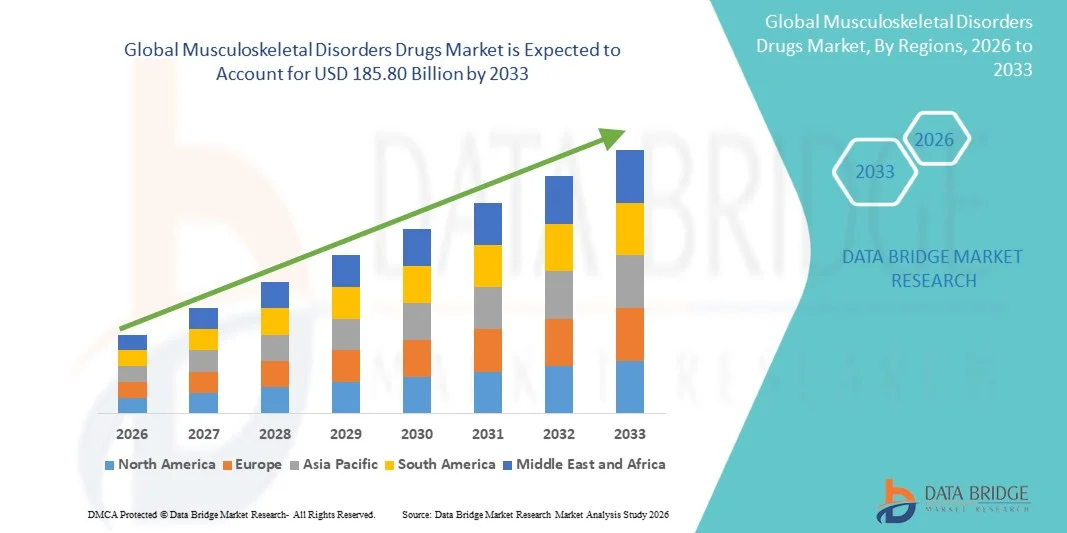
- The global musculoskeletal disorders drugs market size was valued at USD 121.07 billion in 2025 and is expected to reach USD 185.80 billion by 2033, at a CAGR of 5.50% during the forecast period
- The market growth is largely driven by the increasing prevalence of musculoskeletal conditions such as osteoarthritis, rheumatoid arthritis, osteoporosis, and chronic back pain, along with a growing aging population more susceptible to these disorders
- Furthermore, advancements in drug development, including biologics, targeted therapies, and improved pain management medications, along with rising healthcare expenditure and improved diagnosis rates, are contributing to market expansion and strengthening the adoption of musculoskeletal disorder treatments worldwide
Musculoskeletal Disorders Drugs Market Analysis
- Musculoskeletal disorders drugs, used for the treatment of conditions such as rheumatoid arthritis, osteoarthritis, osteoporosis, psoriatic arthritis, fibromyalgia, and ankylosing spondylitis, are increasingly essential in modern healthcare due to their role in managing pain, reducing inflammation, slowing disease progression, and improving patient mobility and quality of life across diverse patient populations
- The escalating demand for musculoskeletal disorder drugs is primarily driven by the rising prevalence of chronic conditions such as osteoarthritis and rheumatoid arthritis, an aging global population, sedentary lifestyles, and increasing awareness, diagnosis rates, and access to treatment options, alongside growing reliance on long-term pharmacological management
- North America dominated the musculoskeletal disorders drugs market with the largest revenue share of 41.8% in 2025, supported by advanced healthcare infrastructure, high healthcare spending, strong presence of key pharmaceutical companies, and widespread adoption of prescription medications for conditions such as rheumatoid arthritis and osteoporosis, particularly in the United States
- Asia-Pacific is expected to be the fastest growing region in the musculoskeletal disorders drugs market during the forecast period due to rapid urbanization, increasing geriatric population, improving healthcare access, and rising awareness and diagnosis of musculoskeletal conditions across emerging economies
- Medication segment dominated the musculoskeletal disorders drugs market with a significant market share of 68.5% in 2025, driven by its widespread use as the first-line treatment approach across various conditions
Report Scope and Musculoskeletal Disorders Drugs Market Segmentation
|
Attributes |
Musculoskeletal Disorders Drugs Key Market Insights |
|
Segments Covered |
|
|
Countries Covered |
North America
Europe
Asia-Pacific
Middle East and Africa
South America
|
|
Key Market Players |
|
|
Market Opportunities |
|
|
Value Added Data Infosets |
In addition to the insights on market scenarios such as market value, growth rate, segmentation, geographical coverage, and major players, the market reports curated by the Data Bridge Market Research also include in-depth expert analysis, patient epidemiology, pipeline analysis, pricing analysis, and regulatory framework |
Musculoskeletal Disorders Drugs Market Trends
“Advancements in Biologics and Targeted Therapies”
- A significant and accelerating trend in the global musculoskeletal disorders drugs market is the increasing adoption of biologics and targeted therapies for the treatment of conditions such as rheumatoid arthritis, psoriatic arthritis, and ankylosing spondylitis. This shift is significantly improving treatment efficacy and patient outcomes
- For instance, drugs such as adalimumab and etanercept are widely used biologics that target specific inflammatory pathways, offering more precise treatment compared to conventional therapies. Similarly, newer JAK inhibitors provide oral targeted treatment options for autoimmune musculoskeletal disorders
- Biologic and targeted therapies work by selectively inhibiting immune system components involved in inflammation, thereby reducing disease progression and improving long-term disease management. These therapies also help in minimizing flare-ups and improving patient quality of life over time
- The growing integration of advanced drug delivery systems and combination therapies is enabling more personalized and effective treatment approaches for musculoskeletal disorders. Through a combination of biologics, DMARDs, and supportive therapies, clinicians can better manage complex and chronic conditions
- This trend towards more precise, disease-modifying, and patient-centric treatment options is fundamentally reshaping expectations in musculoskeletal care. Consequently, pharmaceutical companies are increasingly investing in R&D to develop next-generation biologics and biosimilars with improved safety and efficacy profiles
- The demand for advanced musculoskeletal disorder drugs is growing rapidly across both developed and emerging markets, as healthcare providers increasingly prioritize long-term disease control, improved patient outcomes, and reduced dependency on symptomatic treatments
Musculoskeletal Disorders Drugs Market Dynamics
Driver
“Rising Prevalence of Chronic Musculoskeletal Conditions and Aging Population”
- The increasing prevalence of chronic musculoskeletal conditions among the aging global population, coupled with rising cases of lifestyle-related disorders, is a significant driver for the heightened demand for musculoskeletal disorder drugs
- For instance, in recent years, the growing incidence of osteoarthritis and rheumatoid arthritis among elderly populations has led to increased prescriptions of disease-modifying drugs and long-term pain management therapies across healthcare systems
- As life expectancy increases and sedentary lifestyles become more common, patients are experiencing a higher burden of joint degeneration, bone loss, and inflammatory disorders, which require continuous pharmacological intervention
- Furthermore, improved diagnostic capabilities and greater awareness among patients and healthcare providers are leading to earlier detection and treatment initiation, thereby increasing drug consumption and market growth
- The availability of advanced treatment options, including biologics, biosimilars, and combination drug regimens, along with expanding healthcare access in emerging economies, is further propelling the adoption of musculoskeletal disorder drugs across both hospital and retail pharmacy channels
- In addition, increasing healthcare expenditure and government initiatives supporting chronic disease management are further accelerating patient access to musculoskeletal therapies and boosting overall market expansion
Restraint/Challenge
“High Treatment Costs and Adverse Effects of Long-Term Therapies”
- Concerns surrounding the high cost of advanced musculoskeletal disorder drugs, particularly biologics and long-term therapies, pose a significant challenge to broader market penetration, especially in cost-sensitive and developing regions
- For instance, biologic therapies used for rheumatoid arthritis and other autoimmune conditions often involve prolonged treatment cycles with substantial cumulative costs, limiting accessibility for uninsured or underinsured patient populations
- In addition, long-term use of certain musculoskeletal drugs can lead to adverse effects such as gastrointestinal complications, infections, and immunosuppression, raising safety concerns among both patients and healthcare providers
- Addressing these challenges through the development of cost-effective biosimilars, improved insurance coverage, and enhanced pharmacovigilance is crucial for expanding patient access and ensuring treatment adherence
- While increasing availability of generic drugs and biosimilars is helping reduce costs, the overall economic burden of chronic treatment and potential side effects can still hinder widespread adoption of advanced therapies in certain regions
- Overcoming these challenges through pricing strategies, patient assistance programs, and continued innovation in safer and more affordable treatment options will be essential for sustained market growth
- Furthermore, stringent regulatory approval processes and the need for extensive clinical trials for advanced therapies can delay market entry, adding to development costs and limiting the speed of innovation adoption in certain regions
Musculoskeletal Disorders Drugs Market Scope
The market is segmented on the basis of type, treatment type, route of administration, end-users, and distribution channel.
- By Type
On the basis of type, the musculoskeletal disorders drugs market is segmented into rheumatoid arthritis, osteoporosis, osteoarthritis, psoriatic arthritis, fibromyalgia, ankylosing spondylitis, and others. The rheumatoid arthritis segment dominated the market with the largest market revenue share of 29.6% in 2025, driven by the high global prevalence of autoimmune inflammatory disorders and the widespread use of long-term disease-modifying antirheumatic drugs (DMARDs) and biologics. Increasing diagnosis rates, availability of advanced targeted therapies, and strong clinical guidelines supporting early treatment initiation further contribute to its dominance. In addition, the chronic nature of the disease ensures sustained demand for continuous medication, reinforcing its leading market position.
The osteoarthritis segment is anticipated to witness the fastest growth rate of 8.9% from 2026 to 2033, fueled by the rising aging population, increasing obesity rates, and growing incidence of joint degeneration worldwide. Osteoarthritis is one of the most common musculoskeletal conditions, and the increasing need for pain management, anti-inflammatory drugs, and emerging disease-modifying therapies is accelerating its growth. Advancements in injectable therapies, improved diagnostic rates, and expanding patient awareness are further supporting the rapid expansion of this segment across both developed and emerging markets.
- By Treatment Type
On the basis of treatment type, the market is segmented into medication, surgery, and therapy. The medication segment dominated the market with the largest market revenue share of 68.5% in 2025, driven by its role as the first-line and most widely adopted treatment approach for musculoskeletal disorders. Medications such as NSAIDs, corticosteroids, DMARDs, and biologics are extensively prescribed for managing inflammation, pain, and disease progression. The non-invasive nature of pharmacological treatment, along with its accessibility through hospital and retail pharmacies, contributes significantly to its dominance in both acute and chronic care settings.
The therapy segment is anticipated to witness the fastest growth rate of 9.3% from 2026 to 2033, driven by the increasing integration of physical therapy, occupational therapy, and rehabilitation programs in musculoskeletal disorder management. Rising awareness of non-pharmacological interventions, growing emphasis on holistic treatment approaches, and the need to improve mobility and functional outcomes are fueling demand. In addition, therapy is often used in combination with medications, making it an essential component of long-term disease management strategies.
- By Route of Administration
On the basis of route of administration, the market is segmented into oral, parenteral, and others. The oral segment dominated the market with the largest market revenue share of 57.4% in 2025, driven by the widespread use of orally administered drugs such as NSAIDs, analgesics, and certain DMARDs for convenient and long-term treatment. Oral medications are preferred due to ease of administration, patient compliance, cost-effectiveness, and availability in both branded and generic forms. Their extensive use in outpatient settings further strengthens their dominant position in the market.
The parenteral segment is anticipated to witness the fastest growth rate of 10.1% from 2026 to 2033, fueled by the increasing adoption of biologics and injectable therapies for moderate to severe musculoskeletal disorders. Parenteral administration allows for higher bioavailability and targeted delivery, making it essential for advanced treatments such as monoclonal antibodies. The growing pipeline of injectable biologics and rising use in hospital and specialty clinic settings are key factors driving the rapid growth of this segment.
- By End-Users
On the basis of end-users, the market is segmented into hospitals, specialty clinics, and others. The hospitals segment dominated the market with the largest market revenue share of 52.3% in 2025, driven by the high volume of patient admissions for diagnosis, treatment initiation, and management of complex musculoskeletal conditions. Hospitals are equipped with advanced diagnostic infrastructure, specialized healthcare professionals, and access to a wide range of medications, including biologics and injectable therapies, making them the primary point of care for severe cases.
The specialty clinics segment is anticipated to witness the fastest growth rate of 9.7% from 2026 to 2033, driven by the increasing preference for specialized care in orthopedic, rheumatology, and pain management clinics. These clinics offer focused expertise, personalized treatment plans, and shorter waiting times, making them attractive for patients requiring ongoing management of chronic musculoskeletal conditions. The rising number of specialty clinics, particularly in urban areas, and growing patient inclination toward outpatient care are supporting this segment’s rapid growth.
On the basis of distribution channel, the market is segmented into hospital pharmacy, retail pharmacy, and others. The hospital pharmacy segment dominated the market with the largest market revenue share of 48.6% in 2025, driven by the high dependence on hospitals for prescription drugs, particularly for biologics and injectable medications used in inpatient and specialty care settings. Hospital pharmacies ensure controlled dispensing, proper monitoring, and immediate availability of critical medications, which is essential for managing chronic and severe musculoskeletal disorders.
The retail pharmacy segment is anticipated to witness the fastest growth rate of 8.6% from 2026 to 2033, fueled by increasing outpatient prescriptions, growing accessibility of medications, and expansion of organized pharmacy chains. Retail pharmacies provide convenience, easy access to over-the-counter drugs, and prescription refills for long-term treatments, making them a preferred distribution channel for chronic disease management. The rising penetration of e-pharmacies and home delivery services is further accelerating growth in this segment.
Musculoskeletal Disorders Drugs Market Regional Analysis
- North America dominated the musculoskeletal disorders drugs market with the largest revenue share of 41.8% in 2025, supported by advanced healthcare infrastructure, high healthcare spending, strong presence of key pharmaceutical companies
- Patients and healthcare providers in the region highly value early diagnosis, advanced treatment options, and widespread availability of prescription medications for conditions such as rheumatoid arthritis, osteoarthritis, and osteoporosis
- This widespread adoption is further supported by high healthcare expenditure, strong presence of leading pharmaceutical companies, favorable reimbursement policies, and a well-established clinical ecosystem, establishing musculoskeletal disorder drugs as a standard and essential component of long-term disease management
U.S. Musculoskeletal Disorders Drugs Market Insight
The U.S. musculoskeletal disorders drugs market captured the largest revenue share of 78% in 2025 within North America, driven by a high prevalence of chronic conditions such as rheumatoid arthritis, osteoarthritis, and osteoporosis, along with advanced healthcare infrastructure. Patients are increasingly prioritizing early diagnosis and long-term disease management through innovative therapies, including biologics and targeted treatments. The growing preference for specialty care, combined with strong reimbursement policies and widespread insurance coverage, further propels the adoption of musculoskeletal disorder drugs. Moreover, the presence of leading pharmaceutical companies and continuous advancements in drug development are significantly contributing to the market’s expansion.
Europe Musculoskeletal Disorders Drugs Market Insight
The Europe musculoskeletal disorders drugs market is projected to expand at a substantial CAGR throughout the forecast period, primarily driven by the rising aging population and increasing prevalence of chronic musculoskeletal conditions. The region benefits from strong healthcare systems, structured reimbursement frameworks, and growing awareness regarding early diagnosis and treatment. European patients and healthcare providers increasingly favor advanced therapies, including biologics and biosimilars, for improved clinical outcomes. The market is also witnessing significant growth across hospital and specialty care settings, supported by government initiatives aimed at improving access to effective and affordable treatment options.
U.K. Musculoskeletal Disorders Drugs Market Insight
The U.K. musculoskeletal disorders drugs market is anticipated to grow at a noteworthy CAGR during the forecast period, driven by increasing cases of arthritis and osteoporosis, along with a strong focus on preventive healthcare and early intervention. The National Health Service (NHS) plays a key role in providing access to musculoskeletal treatments, supporting widespread adoption of prescription medications. In addition, rising awareness about chronic pain management and improved diagnostic capabilities are encouraging timely treatment initiation. The availability of both branded drugs and biosimilars, along with growing investment in healthcare infrastructure, is expected to continue stimulating market growth.
Germany Musculoskeletal Disorders Drugs Market Insight
The Germany musculoskeletal disorders drugs market is expected to expand at a considerable CAGR during the forecast period, fueled by a growing elderly population and increasing incidence of degenerative bone and joint disorders. Germany’s well-established healthcare infrastructure, emphasis on innovation, and strong pharmaceutical industry presence support the adoption of advanced therapies, including biologics and targeted drugs. Patients in the country demonstrate a high preference for effective and evidence-based treatments, particularly in hospital and specialty clinic settings. In addition, rising healthcare expenditure and focus on long-term disease management are contributing to the sustained growth of the market.
Asia-Pacific Musculoskeletal Disorders Drugs Market Insight
The Asia-Pacific musculoskeletal disorders drugs market is poised to grow at the fastest CAGR of 9.8% during the forecast period of 2026 to 2033, driven by increasing urbanization, rising disposable incomes, and a rapidly growing aging population in countries such as China, Japan, and India. The region is witnessing a surge in awareness regarding musculoskeletal conditions and improved access to healthcare services. Government initiatives aimed at expanding healthcare infrastructure and increasing affordability of medications are further supporting market growth. In addition, the presence of a large patient pool and growing penetration of generic and biosimilar drugs are making treatments more accessible across both urban and rural areas.
Japan Musculoskeletal Disorders Drugs Market Insight
The Japan musculoskeletal disorders drugs market is gaining momentum due to the country’s rapidly aging population and high prevalence of age-related conditions such as osteoporosis and osteoarthritis. The healthcare system in Japan emphasizes early diagnosis, preventive care, and advanced treatment approaches, driving the adoption of innovative drugs, including biologics and targeted therapies. Integration of advanced medical technologies and strong focus on patient-centric care are further supporting market growth. In addition, Japan’s well-developed pharmaceutical industry and increasing use of long-term therapies in both hospital and outpatient settings are contributing to sustained demand.
India Musculoskeletal Disorders Drugs Market Insight
The India musculoskeletal disorders drugs market accounted for the largest market revenue share in Asia Pacific in 2025, attributed to the country’s large population base, rising middle class, and increasing prevalence of musculoskeletal conditions due to changing lifestyles and aging demographics. India is witnessing growing awareness about chronic disease management and improved access to healthcare services across urban and semi-urban regions. The availability of cost-effective generic drugs, expansion of retail and hospital pharmacy networks, and government initiatives to improve healthcare accessibility are key factors propelling market growth. In addition, increasing penetration of specialty clinics and rising healthcare spending are further supporting the adoption of musculoskeletal disorder treatments.
Musculoskeletal Disorders Drugs Market Share
The Musculoskeletal Disorders Drugs industry is primarily led by well-established companies, including:
- Merck & Co., Inc. (U.S.)
- AbbVie Inc. (U.S.)
- Pfizer Inc. (U.S.)
- Eli Lilly and Company (U.S.)
- Novartis AG (Switzerland)
- Sanofi (France)
- Johnson & Johnson Services, Inc. (U.S.)
- GSK plc (U.K.)
- Amgen Inc. (U.S.)
- AstraZeneca plc (U.K.)
- Boehringer Ingelheim International GmbH (Germany)
- Horizon Therapeutics plc (Ireland)
- Eisai Co., Ltd. (Japan)
- Biogen Inc. (U.S.)
- Sino Biopharmaceutical Limited (China)
- Teva Pharmaceutical Industries Ltd. (Israel)
- Mitsubishi Tanabe Pharma Corporation (Japan)
- Bayer AG (Germany)
- UCB S.A. (Belgium)
- Flexion Therapeutics, Inc. (U.S.)
What are the Recent Developments in Global Musculoskeletal Disorders Drugs Market?
- In March 2026, the U.S. Food and Drug Administration (FDA) approved Bristol Myers Squibb’s Sotyktu® (deucravacitinib) for the treatment of adults with active psoriatic arthritis, marking the first TYK2 inhibitor approved for this indication and offering a new oral treatment option for musculoskeletal autoimmune disease. This approval was based on positive results from pivotal Phase 3 clinical trials demonstrating significant improvements in disease activity
- In January 2026, Eli Lilly reported that a combination of its weight-loss drug Zepbound and psoriatic arthritis treatment Taltz significantly improved both arthritis symptoms and weight loss in a late-stage clinical trial, demonstrating enhanced clinical outcomes compared to Taltz alone and highlighting a novel integrated therapeutic approach for psoriatic arthritis patients with obesity comorbidities
- In December 2025, Adaptive Biotechnologies signed non-exclusive research collaboration agreements with Pfizer worth up to USD 890 million to advance rheumatoid arthritis research, leveraging immune cell sequencing technology to support drug discovery and development for autoimmune and musculoskeletal condition
- In October 2025, AbbVie announced that its arthritis drug Rinvoq demonstrated superior efficacy over Humira in a head-to-head clinical trial for rheumatoid arthritis, showing significantly better patient response rates and reinforcing the shift toward next-generation immunology therapies in musculoskeletal care
- In September 2025, AbbVie announced that its immunology drug Rinvoq will retain market exclusivity until 2037, extending protection against generic competition and securing long-term revenue potential for this key rheumatoid arthritis treatment, which supports continued investment and development in musculoskeletal therapeutics

- Interactive Data Analysis Dashboard
- Company Analysis Dashboard for high growth potential opportunities
- Research Analyst Access for customization & queries
- Competitor Analysis with Interactive dashboard
- Latest News, Updates & Trend analysis
- Harness the Power of Benchmark Analysis for Comprehensive Competitor Tracking
Data collection and base year analysis are done using data collection modules with large sample sizes. The stage includes obtaining market information or related data through various sources and strategies. It includes examining and planning all the data acquired from the past in advance. It likewise envelops the examination of information inconsistencies seen across different information sources. The market data is analysed and estimated using market statistical and coherent models. Also, market share analysis and key trend analysis are the major success factors in the market report. To know more, please request an analyst call or drop down your inquiry.
The key research methodology used by DBMR research team is data triangulation which involves data mining, analysis of the impact of data variables on the market and primary (industry expert) validation. Data models include Vendor Positioning Grid, Market Time Line Analysis, Market Overview and Guide, Company Positioning Grid, Patent Analysis, Pricing Analysis, Company Market Share Analysis, Standards of Measurement, Global versus Regional and Vendor Share Analysis. To know more about the research methodology, drop in an inquiry to speak to our industry experts.
Data Bridge Market Research is a leader in advanced formative research. We take pride in servicing our existing and new customers with data and analysis that match and suits their goal. The report can be customized to include price trend analysis of target brands understanding the market for additional countries (ask for the list of countries), clinical trial results data, literature review, refurbished market and product base analysis. Market analysis of target competitors can be analyzed from technology-based analysis to market portfolio strategies. We can add as many competitors that you require data about in the format and data style you are looking for. Our team of analysts can also provide you data in crude raw excel files pivot tables (Fact book) or can assist you in creating presentations from the data sets available in the report.












