Circumvent the Tariff challenges with an agile supply chain Consulting
Supply Chain Ecosystem Analysis now part of DBMR Reports
Global Automotive Braking Systems Market
Market Size in USD Billion
CAGR :
%
USD
28.92 Billion
USD
61.54 Billion
2024
2032
Forecast Period
2025 –2032
Market Size(Base Year)
USD
28.92 Billion
Market Size (Forecast Year)
USD
61.54 Billion
CAGR
%
Major Markets Players
Robert Bosch GmbH
ZF Friedrichshafen AGContinental AG
Autoliv Inc.
AISIN SEIKI Co.Ltd.
Mando Corp.
Global Automotive Braking Systems Market Segmentation, By Type (Disc and Drum), Technology (Antilock Braking System (ABS), Traction Control System (TCS), Electronic Stability Control (ESC), and Electronic Brake Force Distribution (EBD)), Vehicle Type (Passenger ICE Vehicle, Commercial ICE Vehicle, and Electric Vehicle), Sales Channel (OEM and Aftermarket) - Industry Trends and Forecast to 2032
Automotive Braking Systems Market Size
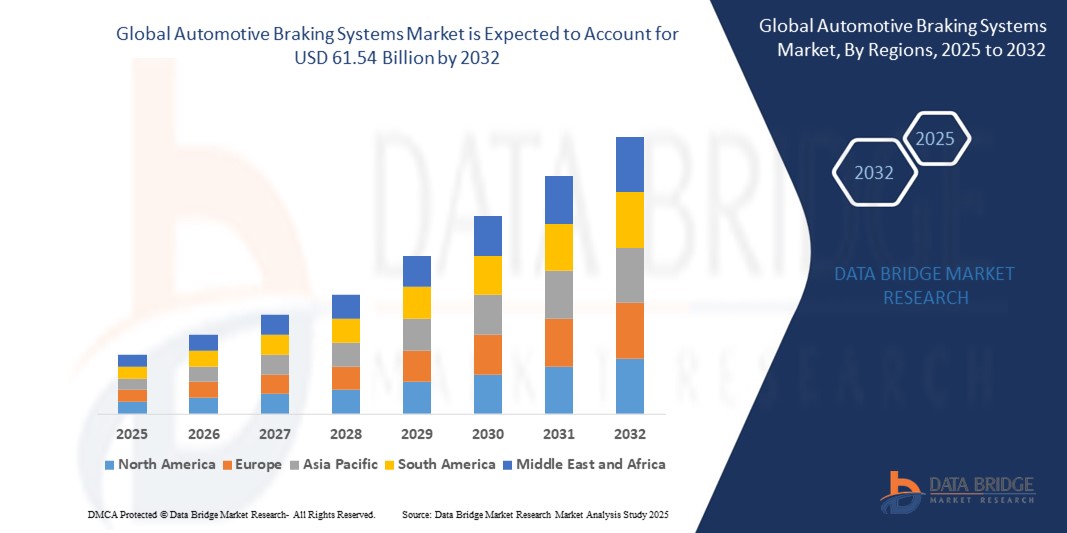
The global Automotive Braking Systems market size was valued at USD 28.92 billion in 2024 and is projected to reach USD 61.54 billion by 2032, registering a robust CAGR of 11.4% during the forecast period
The market growth is primarily driven by increasing adoption of advanced driver-assistance systems (ADAS) and stringent safety regulations globally, which are accelerating the integration of sophisticated braking technologies such as ABS, ESC, EBD, and TCS across passenger and commercial vehicles
Additionally, growing consumer demand for enhanced vehicle safety, improved braking performance, and rising production of electric and autonomous vehicles are further fueling market expansion
Automotive Braking Systems Market Analysis
The automotive braking system is a structure that constrains motion. It is one of the most essential control systems in a vehicle. It is a connection of collective components. The braking system consumes energy from the stirring parts and eases down the vehicle with the aid of friction
Factors for example road disaster deaths and increasing of the automotive aftermarket are one of the factors boosting automotive braking system market. Moreover, the deficient rate is anticipated to restrict the growth of the automotive braking system market
Asia-Pacific dominates the Automotive Braking Systems market with the largest revenue share of 38.7% in 2025, driven by rapid urbanization, expanding automotive production, and rising demand for advanced vehicle safety technologies. Countries like China, Japan, and India are key contributors, supported by government regulations mandating enhanced vehicle safety features and increasing consumer awareness
Europe is expected to be the fastest growing region in the Automotive Braking Systems market during the forecast period, registering a CAGR of 8.5% from 2025 to 2032. Growth is fueled by technological innovations, strict safety regulations imposed by the European Union, and the widespread adoption of electric and autonomous vehicles.
The Antilock Braking System (ABS) segment dominates the Automotive Braking Systems market with the largest market revenue share of 46.8% in 2025, attributed to its essential role in enhancing vehicle safety by preventing wheel lock-up during emergency braking and improving driver control
Report Scope and Automotive Braking Systems Market Segmentation
Attributes
Automotive Braking Systems Key Market Insights
Segments Covered
By Type: Disc, Drum
By Technology: Antilock Braking System (ABS), Traction Control System (TCS), Electronic Stability Control (ESC), Electronic Brake Force Distribution (EBD)
By Vehicle Type: Passenger ICE Vehicle, Commercial ICE Vehicle, Electric Vehicle
By Sales Channel: OEM, Aftermarket
Countries Covered
North America
U.S.
Canada
Mexico
Europe
Germany
France
U.K.
Netherlands
Switzerland
Belgium
Russia
Italy
Spain
Turkey
Rest of Europe
Asia-Pacific
China
Japan
India
South Korea
Singapore
Malaysia
Australia
Thailand
Indonesia
Philippines
Rest of Asia-Pacific
Middle East and Africa
Saudi Arabia
U.A.E.
South Africa
Egypt
Israel
Rest of Middle East and Africa
South America
Brazil
Argentina
Rest of South America
Key Market Players
Robert Bosch GmbH (Germany)
ZF Friedrichshafen AG (Germany)
Continental AG (Germany)
Autoliv Inc. (Sweden)
AISIN SEIKI Co., Ltd. (Japan)
Mando Corp. (South Korea)
BorgWarner Inc. (U.S.)
WABCO (U.S.) (Note: Acquired by ZF Friedrichshafen AG in 2020)
Nissin Kogyo Co., Ltd. (Japan)
Haldex (Sweden)
AKEBONO BRAKE INDUSTRY CO., LTD. (Japan)
DENSO CORPORATION (Japan)
Knorr-Bremse AG (Germany)
Market Opportunities
Integration of Advanced Driver-Assistance Systems (ADAS)
Growing Demand in Electric and Hybrid Vehicles
Value Added Data Infosets
In addition to the insights on market scenarios such as market value, growth rate, segmentation, geographical coverage, and major players, the market reports curated by the Data Bridge Market Research also include in-depth expert analysis, pricing analysis, brand share analysis, consumer survey, demography analysis, supply chain analysis, value chain analysis, raw material/consumables overview, vendor selection criteria, PESTLE Analysis, Porter Analysis, and regulatory framework.
Automotive Braking Systems Market Trends
“Transition to Brake-by-Wire and Regenerative Braking Systems”
A significant and accelerating trend in the global Automotive Braking Systems market is the widespread transition towards brake-by-wire technology and the enhanced integration of regenerative braking systems, especially driven by the rapid electrification of vehicles. This shift is fundamentally reshaping how braking is managed, emphasizing efficiency, safety, and compatibility with advanced vehicle architectures.
For instance, in March 2025, ZF and Brembo announced the launch of new brake-by-wire systems, signaling a move away from traditional hydraulic brakes to electronic components. Similarly, Continental is showcasing its "Future Brake System" roadmap towards fully electro-mechanical braking at Auto Shanghai 2025, highlighting solutions for electrified and autonomous driving.
Brake-by-wire systems replace mechanical and hydraulic linkages with electronic signals, offering faster response times, reduced weight, and greater flexibility for integration with other vehicle control systems like ADAS (Advanced Driver-Assistance Systems) and autonomous driving functions. This enables more precise control and the potential for new safety features.
Concurrently, the increasing popularity of electric and hybrid vehicles is driving the optimization of regenerative braking technology. This system captures kinetic energy during deceleration and converts it back into electrical energy to recharge the battery, significantly improving energy efficiency and extending vehicle range.
The seamless integration of these technologies allows for a more cohesive and intelligent braking experience, where the system can intelligently blend regenerative braking with friction braking to optimize performance and energy recovery. This is crucial for meeting stringent environmental regulations, like Euro 7, which now address non-exhaust emissions from brakes.
This trend towards more integrated, intelligent, and energy-efficient braking solutions is not only enhancing vehicle performance and safety but also playing a critical role in the broader shift towards sustainable mobility.
Automotive Braking Systems Market Dynamics
Driver
“Stringent Safety Regulations and Rising ADAS Integration”
The Automotive Braking Systems market is significantly driven by increasingly stringent global safety regulations and the widespread integration of Advanced Driver-Assistance Systems (ADAS). Governments and regulatory bodies worldwide are implementing stricter mandates for vehicle safety, compelling automakers to incorporate advanced braking technologies as standard features
For instance, the proposed amendments by the Ministry of Road Transport in India, to be effective from April 2026, will make Advanced Emergency Braking Systems (AEBS), Driver Drowsiness and Attention Warning Systems (DDAWS), and Lane Departure Warning Systems (LDWS) mandatory for all new passenger vehicles with over eight seats, buses, and trucks. Similarly, organizations like Euro NCAP continue to update their safety rating protocols, influencing manufacturers to adopt features like AEB and Electronic Stability Control (ESC) to achieve higher star ratings
These regulations, coupled with a rising consumer awareness and demand for enhanced vehicle safety, are propelling the adoption of advanced braking solutions. ADAS features like automatic emergency braking (AEB), adaptive cruise control, and collision avoidance systems rely heavily on sophisticated braking mechanisms, necessitating continuous innovation in the market
The focus on reducing road accidents and fatalities globally, as evidenced by initiatives like the UN Decade of Action for Road Safety 2021-2030, further reinforces the need for more effective and proactive braking systems. This regulatory push, combined with technological advancements in ADAS, is a major catalyst for market growth
The trend towards autonomous and semi-autonomous vehicles also plays a crucial role, as these vehicles demand highly reliable and precise braking systems for their safe operation, further accelerating the development and integration of advanced braking technologies
Restraint/Challenge
“High Cost of Advanced Systems and Integration Complexity”
The Automotive Braking Systems market faces a significant restraint in the form of the high initial costs associated with advanced braking technologies, particularly brake-by-wire systems and comprehensive ADAS integration. These costs can deter mass-market adoption, especially in price-sensitive segments or emerging economies.
For instance, while features like Anti-lock Braking Systems (ABS) and Electronic Stability Control (ESC) are increasingly standard, the introduction of more complex systems like Automatic Emergency Braking (AEB) and fully integrated brake-by-wire technology significantly elevates vehicle manufacturing costs. This premium is often passed on to consumers, making vehicles equipped with such advanced systems less affordable.
Furthermore, the complexity of integrating these sophisticated electronic braking systems with existing vehicle architectures, including mechanical, electrical, and software components, presents considerable engineering challenges. This complexity extends to ensuring fail-safe redundancy, robust cybersecurity, and seamless communication between various vehicle modules, increasing development time and expenses.
Cybersecurity concerns, while a distinct challenge, also contribute to the overall cost and complexity, as robust measures are required to protect these interconnected braking systems from potential hacking or malfunctions, which could have severe safety implications.
While regulations are pushing for greater adoption of these technologies, the balance between meeting safety mandates and maintaining affordability remains a critical hurdle for widespread market penetration, especially for Original Equipment Manufacturers (OEMs) targeting diverse consumer bases.
Automotive Braking Systems Market Scope
The market is segmented on the basis of type, technology, vehicle type, and sales channel.
By Type
The disc brake segment held the largest market revenue share in 2025, primarily due to its superior stopping power, heat dissipation, and performance in diverse driving conditions. Disc brakes are widely adopted in passenger vehicles and high-performance automobiles due to their durability and lower maintenance requirements. As vehicle safety regulations strengthen globally, manufacturers are increasingly integrating disc brakes as standard equipment in new models.
The drum brake segment is expected to witness a notable CAGR from 2025 to 2032, owing to its cost-effectiveness and continued usage in commercial and economy vehicles, particularly in emerging markets. Despite being older technology, drum brakes are valued for their simplicity and effectiveness in low-speed, high-load applications like trucks and trailers.
By Technology
On the basis of technology, the Automotive Braking Systems market is segmented into Antilock Braking System (ABS), Traction Control System (TCS), Electronic Stability Control (ESC), and Electronic Brake Force Distribution (EBD). The Antilock Braking System (ABS) segment dominated the Automotive Braking Systems market with the largest revenue share of 46.8% in 2025, driven by stringent safety regulations and increasing consumer awareness about vehicle stability and crash prevention. ABS plays a crucial role in preventing wheel lock-up during sudden braking, enhancing control and reducing the risk of accidents
The ESC segment is expected to witness the fastest CAGR from 2025 to 2032. ESC helps maintain directional stability during extreme steering maneuvers and is becoming mandatory in many countries. The system’s capability to reduce rollover risk and improve vehicle control significantly enhances its adoption rate across vehicle classes.
By Vehicle Type
On the basis of vehicle type, the market is segmented into Passenger ICE Vehicles, Commercial ICE Vehicles, and Electric Vehicles (EVs). The Passenger ICE Vehicles segment dominated the market in 2025 due to the high volume of vehicle production and widespread implementation of advanced braking technologies in this category. Rising consumer demand for enhanced driving safety and comfort also supports this segment’s growth.
The Electric Vehicles segment is anticipated to witness the highest CAGR from 2025 to 2032, fueled by the global transition to electrified transportation. EV manufacturers are emphasizing regenerative braking systems paired with traditional braking for efficiency and energy recovery, thereby increasing demand for smart, electronically controlled brake systems.
By Sales Channel
On the basis of sales channel, the market is segmented into OEM and Aftermarket. The OEM segment accounted for the largest revenue share in 2025, supported by increasing vehicle production and the integration of advanced braking technologies at the manufacturing stage. OEMs are focusing on enhancing the safety and performance of new vehicle models, which drives demand for factory-installed braking systems.
The Aftermarket segment is projected to grow at a steady CAGR during the forecast period, driven by rising vehicle parc, routine maintenance needs, and the demand for cost-effective brake replacements. Older vehicles and fleet operators continue to rely on the aftermarket for system upgrades and part replacements.
Automotive Braking Systems Market Regional Analysis
Asia-Pacific dominates the Automotive Braking Systems market with the largest revenue share of 38.7% in 2024, driven by rapid urbanization, increasing vehicle production, and growing government regulations focused on vehicle safety
Consumers and manufacturers in the region are increasingly adopting advanced braking technologies such as ABS, ESC, and EBD to enhance vehicle safety and comply with stringent safety standards
This widespread adoption is further supported by rising disposable incomes, expanding automotive manufacturing hubs in countries like China, India, Japan, and South Korea, and growing awareness about road safety, establishing advanced braking systems as essential components across passenger and commercial vehicles
China Automotive Braking Systems Market Insight
The China Automotive Braking Systems market captured the largest revenue share of 34.89% within the Asia-Pacific region in 2025, driven by rapid growth in the automotive manufacturing sector and increasing government regulations on vehicle safety. Consumers and manufacturers alike are focusing on advanced braking technologies to enhance safety, especially with the rise of electric vehicles and connected cars. The expanding urban population, rising disposable incomes, and strong adoption of smart vehicle technologies are fueling market growth.
North America Automotive Braking Systems Market Insight
The North American Automotive Braking Systems market is projected to grow at a robust CAGR throughout the forecast period, driven by increasing demand for advanced vehicle safety features and stringent government regulations on automotive safety. Rising consumer awareness about connected car technologies and the adoption of smart braking solutions in both passenger and commercial vehicles are fueling market expansion. The region is witnessing strong growth due to high disposable incomes, technological innovation, and widespread adoption of electric and autonomous vehicles, which incorporate sophisticated braking systems for enhanced control and safety.
U.S. Automotive Braking Systems Market Insight
The U.S. Automotive Braking Systems market is expected to experience significant growth during the forecast period, propelled by the country’s large automotive industry, strict safety standards, and increasing demand for connected and autonomous vehicles. Consumers and manufacturers alike are prioritizing enhanced safety features such as ABS, ESC, and electronic brake force distribution. The growing trend of smart vehicle integration, including driver assistance technologies and IoT connectivity, further supports market development across both passenger and commercial vehicle segments.
Canada Automotive Braking Systems Market Insight
The Canadian Automotive Braking Systems market is forecast to grow steadily, supported by government initiatives promoting vehicle safety and road accident reduction. Increasing urbanization and demand for modernized transportation solutions are driving the adoption of advanced braking technologies. Furthermore, the expansion of electric vehicle infrastructure and incentives for eco-friendly vehicles contribute to the growing demand for innovative braking systems that ensure safety and efficiency. Canadian consumers and fleet operators are adopting these technologies to improve vehicle control and reduce accidents.
Europe Automotive Braking Systems Market Insight
The Europe Automotive Braking Systems market is projected to grow steadily at a CAGR of around 8.5% in 2025, driven by stringent vehicle safety regulations, increasing urbanization, and growing consumer awareness about advanced automotive safety features. Countries such as Germany, the UK, and France are leading the adoption of cutting-edge braking technologies, supported by robust automotive manufacturing industries and innovation in electric and autonomous vehicles. Additionally, government initiatives promoting road safety and emission reduction are propelling investments in advanced braking systems. The increasing integration of smart vehicle technologies with braking systems is accelerating market expansion across the region.
Germany Automotive Braking Systems Market Insight
The German Automotive Braking Systems market is experiencing strong growth due to the country’s status as Europe’s automotive hub and its focus on innovation and sustainability. Germany’s automotive manufacturers are investing heavily in advanced braking technologies like ABS, ESC, and EBD to meet stringent EU safety standards. The market growth is further supported by rising consumer demand for safer, eco-friendly vehicles, including electric and hybrid models. Integration of braking systems with driver assistance and autonomous driving technologies is fueling demand in both passenger and commercial vehicle segments.
UK Automotive Braking Systems Market Insight
The UK Automotive Braking Systems market is growing significantly, driven by increased urbanization and government mandates for vehicle safety features. The market benefits from a mature automotive industry and high consumer awareness of vehicle safety and smart technology. The adoption of connected car technologies and advancements in electric vehicles are pushing demand for sophisticated braking systems. Furthermore, rising investments in smart transportation infrastructure and smart city initiatives are expected to enhance market growth in the UK.
Automotive Braking Systems Market Share
The Automotive Braking Systems industry is primarily led by well-established companies, including:
Robert Bosch GmbH (Germany)
ZF Friedrichshafen AG (Germany)
Continental AG (Germany)
Autoliv Inc. (Sweden)
AISIN SEIKI Co., Ltd. (Japan)
Mando Corp. (South Korea)
BorgWarner Inc. (U.S.)
WABCO (U.S.) (Note: Acquired by ZF Friedrichshafen AG in 2020)
Nissin Kogyo Co., Ltd. (Japan)
Haldex (Sweden)
AKEBONO BRAKE INDUSTRY CO., LTD. (Japan)
DENSO CORPORATION (Japan)
Knorr-Bremse AG (Germany)
Latest Developments in Global Automotive Braking Systems Market
In April 2024, Continental AG announced the supply of its new-generation electronic brake system, the MK 120 ESC, to Chinese automaker Changan. This system, featuring enhanced efficiency, cybersecurity measures, and over-the-air (OTA) update capabilities, marks its first global series production, being integrated into Changan's latest Oshan X5 Plus and Uni-T models
In June 2024, ADVICS Co., Ltd. and Brakes India Private Limited entered into a joint venture to develop advanced braking systems equipped with Electronic Stability Control (ESC) technology. This collaboration aims to enhance vehicle safety standards in the Indian automotive market
In September 2024, Accelera introduced a new braking system specifically designed to enhance the braking performance of electric commercial vehicles. This innovation reflects the company's commitment to improving safety and efficiency in the evolving electric vehicle sector
In July 2023, Itelma LLC inaugurated a new ABS manufacturing unit in Kostroma, Russia. This facility aims to scale up production to meet the growing global demand for Anti-lock Braking Systems, reinforcing the company's position in the automotive safety market
In April 2024, the U.S. National Highway Traffic Safety Administration (NHTSA) announced a regulation requiring all new passenger cars and trucks sold in the U.S. to be equipped with automatic emergency braking (AEB) systems by September 2029. This mandate is expected to enhance road safety by preventing collisions and reducing fatalities
SKU-
Get online access to the report on the World's First Market Intelligence Cloud
Interactive Data Analysis Dashboard
Company Analysis Dashboard for high growth potential opportunities
Research Analyst Access for customization & queries
Competitor Analysis with Interactive dashboard
Latest News, Updates & Trend analysis
Harness the Power of Benchmark Analysis for Comprehensive Competitor Tracking
Research Methodology
Data collection and base year analysis are done using data collection modules with large sample sizes. The stage includes obtaining market information or related data through various sources and strategies. It includes examining and planning all the data acquired from the past in advance. It likewise envelops the examination of information inconsistencies seen across different information sources. The market data is analysed and estimated using market statistical and coherent models. Also, market share analysis and key trend analysis are the major success factors in the market report. To know more, please request an analyst call or drop down your inquiry.
The key research methodology used by DBMR research team is data triangulation which involves data mining, analysis of the impact of data variables on the market and primary (industry expert) validation. Data models include Vendor Positioning Grid, Market Time Line Analysis, Market Overview and Guide, Company Positioning Grid, Patent Analysis, Pricing Analysis, Company Market Share Analysis, Standards of Measurement, Global versus Regional and Vendor Share Analysis. To know more about the research methodology, drop in an inquiry to speak to our industry experts.
Customization Available
Data Bridge Market Research is a leader in advanced formative research. We take pride in servicing our existing and new customers with data and analysis that match and suits their goal. The report can be customized to include price trend analysis of target brands understanding the market for additional countries (ask for the list of countries), clinical trial results data, literature review, refurbished market and product base analysis. Market analysis of target competitors can be analyzed from technology-based analysis to market portfolio strategies. We can add as many competitors that you require data about in the format and data style you are looking for. Our team of analysts can also provide you data in crude raw excel files pivot tables (Fact book) or can assist you in creating presentations from the data sets available in the report.
Claudio Rondena
Group Business Development & Strategic Marketing Director, C.O.C Farmaceutici SRL
"This morning we were involved in the first part, the data presentation of MKT analysis, selected abstract from your work. The board team was really impressed and very appreciated, as well."
David Manning - Thermo Fisher Scientific
Director, Global Strategic Accounts,
Dear Ricky, I want to thank you for the excellent market analysis (LIMS INSTALLED BASE DATA) that you and your team delivered, especially end of year on short notice.
Sachin and Shraddha captured the requirements, determined their path forward and executed quickly.
You, Sachin and Shraddha have been a pleasure to work with – very responsive, professional and thorough.
Your work is much appreciated.
Manager - Market Analytics,
Uriah D. Avila - Zeus Polymer Solutions
Thank you for all the assistance and the level of detail in the market report. We are very pleased with the results and the customization. We would like to continue to do business.
Business Development Manager,
(Pharmaceuticals Partner for Nasal Sprays) | Renaissance Lakewood LLC
DBMR was attentive and engaged while discussing the Global Nasal Spray Market. They understood what we were looking for and was able to provide some examples from the report as requested. DBMR Service team has been responsive as needed. Depending on what my colleagues were looking for, I will recommend your services and would be happy to stay connected in case we can utilize your research in the future.
Business Intelligence and Analytics,
Ipsen Biopharm Limited
We are impressed by the CENTRAL PRECOCIOUS PUBERTY (CPP) TREATMENT report - so a BIG thanks to you colleagues.
Competition Analyst,
Basler Web
I just wanted to share a quick note and let you know that you guys did a really good job. I’m glad I decided to work with you. I shall continue being associated with your company as long as we have market intelligence needs.
Marketing Director,
Buhler Group
It was indeed a good experience, would definitely recommend and come back for future prospects.
COO,
A global leader providing Drug Delivery Services
DBMR did an outstanding job on the Global Drug Delivery project, We were extremely impressed by the simple but comprehensive presentation of the study and the quality of work done. This report really helped us to access untapped opportunities across the globe.
Marketing Director,
Philips Healthcare
The study was customized to our targets and needs with well-defined milestones. We were impressed by the in-depth customization and inclusion of not only major but also minor players across the globe. The DBMR Market position grid helped us to analyze the market in different dimension which was very helpful for the team to get into the minute details.
Product manager,
Fujifilms
Thankful to the team for the amazing coordination, and helping me at the last moment with my presentation. It was indeed a comprehensive report that gave us revenue impacting solution enabling us to plan the right move.
Investor relations,
GE Healthcare
Thank you for the report, and addressing our needs in such short time. DBMR has outdone themselves in this project with such short timeframe.
Market Analyst,
Medincell
We found the results of this study compelling and will help our organization validate a market we are considering to enter. Thank you for a job well done.
Andrew - Senior Global Marketing Manager,
Medtronic (US)
I want to thank you for your help with this report – It’s been very helpful in our business planning and it well organized.
Amarildo - Manager, Global Strategic Alignment
MasterCard
We believe the work done by Data Bridge Team for our requirements in the North America Loyalty Management Market was fantastic and would love to continue working with your team moving forward.
Tor Hammer
Green Nexus LLc
Thank you for your quick response to this unfortunate circumstance. Please extend my thanks to your reach team. I will be contacting you in the future with further projects
I acknowledge the difficulty given by the very short warning for this report, and I think that its quality and your delivering time have been very satisfying.
Obviously, as a provider Data Bridge Market Research will be considered as a plus for future needs of Nippon Gases.
Yuki Kopyl (Asian Business Development Department)
UENO FOOD TECHNO INDUSTRY, LTD. (JAPAN)
Xylose report was very useful for our team. Thank you very much & hope to work with you again in the future