


What is the Automotive Navigation Systems Market Size and Growth Rate?
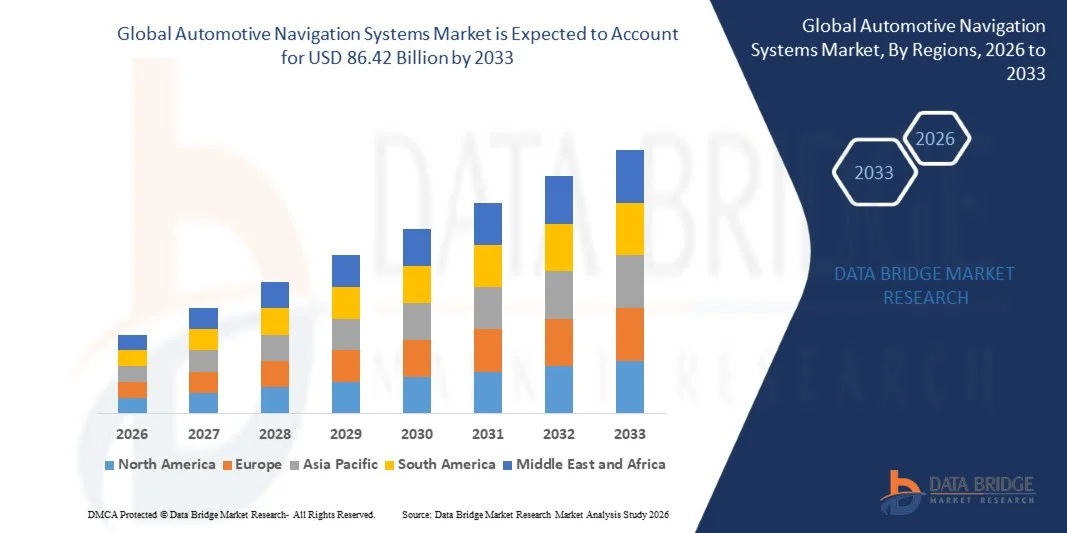
- As per Data Bridge Market Research analysis, the automotive navigation systems market was valued at USD 44.67 billion in 2025 and is projected to reach USD 86.42 billion by 2033, growing at a CAGR of 8.60% from 2026 to 2033.
- The market is experiencing consistent growth driven by rising demand for connected and intelligent vehicles, rapid advancements in navigation and digital mapping technologies, and expanding integration of navigation systems with infotainment, telematics, and advanced driver-assistance systems.
- The increasing adoption of connected vehicles, combined with growing demand for real-time traffic information, route optimization, and location-based services, is compelling automotive manufacturers and consumers to adopt advanced navigation technologies. Embedded and connected navigation systems are increasingly replacing standalone navigation devices, offering real-time updates, smartphone integration, cloud-based services, and more personalized driving experiences.
Market Size & Forecast
- Global Market Value (2025): USD 44.67 Billion
- Expected Market Value (2033): USD 86.42 Billion
- Forecast CAGR (2026–2033): 8.60%
- Leading Region in 2025: North America
- Fastest Growing Region: Asia Pacific
What are the Major Takeaways of the Automotive Navigation Systems Market?
- North America dominated the automotive navigation systems market with the largest revenue share of 30.4% in 2025, supported by high connected-vehicle penetration, increasing adoption of advanced infotainment systems, and strong investments by automotive OEMs in software-defined vehicle platforms.
- Asia-Pacific is expected to be the fastest-growing region at a CAGR of 6.93% from 2026 to 2033, fueled by expanding vehicle production, increasing adoption of connected vehicles, and growing demand for intelligent navigation and location-based services across China, India, Japan, and South Korea.
- The android segment led the market with a 60% share in 2025, driven by its flexibility, broad application ecosystem, and increasing integration with connected infotainment platforms
- Windows computer embedded (Win CE) are the fastest-growing platform type, projected to register a CAGR of 7.5%, reflecting the surge in continued use in existing embedded automotive navigation architectures
- The factory fitted IVS segment dominated the system type category with a 55% revenue share in 2025, led by increasing integration of navigation directly into vehicle infotainment systems.
- Mid-premium passenger vehicle accounted for 35% of the market share in 2025, preferred by increasing incorporation of navigation and connected infotainment features into mid-range vehicles.
- The mobile navigation system segment is the fastest-growing device type category, with a CAGR of 11.0%, driven by widespread smartphone adoption and increasing integration between smartphones and vehicle infotainment systems.
Report Scope and Automotive Navigation Systems Market Segmentation
|
Attributes |
Automotive Navigation Systems Key Market Insights |
|
Segments Covered |
|
|
Countries Covered |
North America
Europe
Asia-Pacific
Middle East and Africa
South America
|
|
Key Market Players |
|
|
Market Opportunities |
|
|
Value Added Data Infosets |
In addition to the market insights such as market value, growth rate, market segments, geographical coverage, market players, and market scenario, the market report curated by the Data Bridge Market Research team includes in-depth expert analysis, import/export analysis, pricing analysis, production consumption analysis, and pestle analysis. |
What is the Key Trend in the Automotive Navigation Systems Market?
- Automotive navigation systems are increasingly evolving into AI-powered, connected navigation platforms that combine real-time traffic, cloud-based mapping, voice interaction, EV charging information, and personalized route guidance to provide more intelligent in-vehicle experiences.
- For instance, in November 2025, Google introduced Gemini-powered navigation features in Google Maps, enabling hands-free conversational driving, route-based place discovery, traffic-disruption reporting, and EV-charger searches.
- Automakers are increasingly integrating navigation software with vehicle-specific data and connected-car ecosystems, allowing systems to consider vehicle status, charging requirements, traffic conditions, and real-time road information when generating routes.
- The integration of navigation with AI assistants, 3D visualization, head-up displays, and driver-assistance functions is creating more immersive navigation experiences while helping drivers interpret complex road environments.
- For instance, in January 2025, BMW unveiled its Panoramic iDrive, incorporating a 3D Head-Up Display capable of projecting navigation and assisted-driving information into the driver’s field of vision, with the system planned for new BMW models from late 2025.
- As automakers increasingly transition toward software-defined and connected vehicles, navigation systems are expected to become central software platforms integrating mapping, AI, infotainment, EV services, and driver assistance, reinforcing their role in next-generation vehicle architectures.
What are the Key Drivers of the Automotive Navigation Systems Market?
- The rapid expansion of connected and software-defined vehicles has significantly increased demand for automotive navigation systems capable of delivering real-time traffic information, cloud-based maps, connected routing, and continuously updated location services.
- For instance, in August 2025, Hyundai Motor India reported that its connected-car technology had evolved to Connected Car Navigation Cockpit (ccNC), with Controller OTA update capability supporting its software-defined vehicle roadmap for the Indian market.
- Automotive OEMs, navigation providers, and technology companies are integrating navigation with EV route planning, charging-station information, vehicle data, and over-the-air software updates to improve route efficiency and connected mobility services.
- For instance, in September 2025, TomTom launched its next-generation Automotive Navigation Application, built on TomTom Orbis Maps and its Navigation SDK, while highlighting access to 2 million charging points for EV navigation and faster integration for automakers.
- The increasing deployment of AI-powered navigation, connected mapping, and real-time road intelligence is strengthening the role of navigation systems in modern vehicle platforms and supporting their integration with infotainment, telematics, ADAS, and autonomous-driving technologies.
Which Factors are Challenging the Growth of the Automotive Navigation Systems Market?
- Connected automotive navigation systems increasingly depend on accurate positioning, continuously updated map data, cloud connectivity, and secure vehicle communications, creating technical and cybersecurity challenges for manufacturers and technology providers.
- For instance, in July 2025, the European Union Agency for the Space Programme launched Galileo OSNMA, a free worldwide navigation-message authentication service designed to provide more robust positioning information amid increasing GNSS interference and spoofing that can affect vehicle navigation systems.
- These challenges can increase system-development complexity and require continuous investment in cybersecurity, data protection, software validation, map maintenance, and resilient positioning technologies, particularly as navigation becomes integrated with other vehicle functions.
- The increasing connectivity of navigation and infotainment systems also expands the potential cyberattack surface, requiring automotive manufacturers to strengthen authentication, software security, data protection, and system resilience throughout the vehicle lifecycle.
- For instance, in September 2025, NHTSA highlighted that growing software complexity and connectivity create abundant attack surfaces in modern vehicles, emphasizing the need for continued automotive cybersecurity measures as connected technologies expand.
- The need to maintain accurate maps, secure connected services, protect location data, and continuously update software therefore remains a significant challenge, potentially increasing lifecycle costs and technical requirements for advanced automotive navigation systems.
How is the Automotive Navigation Systems Market Segmented?
The automotive navigation systems market is segmented on the basis of platform, system type, vehicle type, device type, propulsion, and component
- By Platform
On the basis of platform, the automotive navigation systems market is segmented into windows computer embedded (WIN CE) and android. The android segment dominated the market with share of 60% in 2025, owing to its flexibility, broad application ecosystem, and increasing integration with connected infotainment platforms. Android-based systems enable navigation, multimedia, voice assistance, and connected applications through a common software environment. Automakers can customize these platforms according to vehicle-specific requirements and digital cockpit architectures. Integration with cloud services also enables frequent navigation and software updates. Growing consumer familiarity with Android interfaces is supporting adoption across passenger vehicles.
The windows computer embedded (Win CE) segment is projected to register the fastest growth at CAGR of 7.5% from 2026 to 2033, supported by continued use in existing embedded automotive navigation architectures. Win CE-based systems remain relevant across vehicle platforms where established embedded software infrastructure is already deployed. Their relatively mature architecture supports navigation and infotainment functions with established automotive hardware. Demand for replacement and maintenance of existing systems is supporting continued utilization. Automotive suppliers also benefit from established development and integration frameworks.
- By System Type
On the basis of system type, the automotive navigation systems market is segmented into factory fitted IVS, aftermarket IVS, personal navigation devices, and smartphones. The factory fitted IVS segment dominated the market with share of 55% in 2025, supported by increasing integration of navigation directly into vehicle infotainment systems. Factory-installed navigation provides seamless interaction with vehicle displays, controls, GPS hardware, and connected services. Automakers can optimize navigation software for individual vehicle platforms and integrate it with telematics and ADAS functions. These systems also support real-time traffic information and map updates. Rising consumer demand for connected and technologically advanced vehicles is supporting factory-fitted solutions.
The aftermarket IVS segment is projected to register the fastest growth at a CAGR of 9.5% from 2026 to 2033, driven by demand for navigation upgrades in existing vehicles. Aftermarket systems enable vehicle owners to add navigation, multimedia, smartphone connectivity, and traffic-information capabilities. The growing availability of affordable connected systems is supporting adoption among price-sensitive consumers. Commercial fleets can also use aftermarket systems to improve routing and location tracking. Expansion of e-commerce and logistics is increasing demand for navigation solutions among delivery vehicles.
- By Vehicle Type
On the basis of vehicle type, the automotive navigation systems market is segmented into entry-level passenger vehicle, mid-premium passenger vehicle, luxury passenger vehicle, and commercial vehicle. The mid-premium passenger vehicle segment dominated the market with share of 35% in 2025, supported by increasing incorporation of navigation and connected infotainment features into mid-range vehicles. Automakers are increasingly using digital cockpit technologies to differentiate vehicles in this category. Navigation systems provide route guidance, traffic information, points-of-interest information, and connected services. The segment benefits from a large customer base compared with luxury vehicles. Growing consumer expectations for connected features are encouraging manufacturers to offer integrated navigation beyond premium models.
The commercial vehicle segment is projected to register the fastest growth at a CAGR of 10.0% from 2026 to 2033, driven by growing demand for fleet routing, logistics optimization, and real-time navigation. Commercial operators use navigation systems to reduce unnecessary travel and improve route efficiency. Truck-oriented navigation can incorporate road restrictions, vehicle dimensions, and weight limitations into route planning. Expansion of e-commerce and last-mile delivery is further increasing demand for efficient navigation. Connected navigation can also support fleet monitoring and location-based services.
- By Device Type
On the basis of device type, the automotive navigation systems market is segmented into in-dash, portable, and mobile navigation system. The in-dash segment dominated the market with an share of 55% in 2025, supported by direct integration with vehicle dashboards and infotainment architectures. In-dash navigation provides a dedicated interface for maps, route guidance, traffic information, and points of interest. Modern systems can integrate voice assistance, smartphone connectivity, 3D maps, and real-time traffic services. Integration with vehicle controls and displays provides a seamless navigation experience. Automakers are increasingly incorporating navigation into connected cockpit platforms.
The mobile navigation system segment is projected to register the fastest growth at a CAGR of 11.0% from 2026 to 2033, driven by widespread smartphone adoption and increasing integration between smartphones and vehicle infotainment systems. Smartphone-based navigation provides frequently updated maps, live traffic information, and cloud-connected applications. Consumers can use familiar navigation applications across multiple vehicles without purchasing dedicated navigation hardware. Smartphone connectivity through Android Auto and Apple CarPlay further supports mobile navigation applications inside vehicles. Continuous improvements in mobile mapping services are enhancing navigation functionality.
- By Propulsion
On the basis of propulsion, the automotive navigation systems market is segmented into ICE and electric vehicle. The ICE segment dominated the market with share of 65% in 2025, reflecting the large installed base of internal-combustion-engine vehicles. Navigation systems are widely integrated into conventional passenger cars and commercial vehicles. Existing vehicle fleets also generate demand for aftermarket navigation solutions. ICE vehicles continue to represent a substantial portion of the global vehicle population. Automakers continue to integrate connected navigation into conventional vehicle platforms alongside infotainment and telematics.
The electric vehicle segment is projected to register the fastest growth at a CAGR of 12.0% from 2026 to 2033, driven by increasing demand for EV-specific navigation functions. EV navigation can incorporate battery state, energy consumption, charging-station availability, and charging-stop recommendations into route planning. These functions help drivers manage range and charging requirements during journeys. Growing EV adoption is expanding the addressable market for energy-aware navigation. Navigation systems are increasingly connected with charging networks and vehicle energy-management systems.
- By Component
On the basis of component, the automotive navigation systems market is segmented into hardware, software, and connectivity. The hardware segment dominated the market with a share of 50% in 2025, supported by the requirement for displays, GPS receivers, processors, antennas, and navigation control units. Hardware provides the physical foundation for positioning, map visualization, route calculation, and driver interaction. Increasing adoption of larger and higher-resolution displays is strengthening demand for advanced hardware. More powerful processors enable real-time traffic processing, 3D mapping, and voice-recognition functions. Hardware is also increasingly integrated into broader digital cockpit and infotainment architectures.
The connectivity segment is projected to register the fastest growth at a CAGR of 11.0% from 2026 to 2033, driven by increasing demand for cloud-connected navigation and real-time information services. Connectivity enables navigation systems to receive live traffic, road-condition, weather, and location data. It also supports over-the-air map and software updates without requiring manual system intervention. Integration with 4G, 5G, embedded SIMs, and vehicle communication platforms is expanding navigation functionality. Connected systems can also support dynamic routing and cloud-based location services.
Which Region Holds the Largest Share of the Automotive Navigation Systems Market?
- North America dominated the automotive navigation systems market with the largest revenue share of 30.4% in 2025, supported by high connected-vehicle penetration, increasing adoption of advanced infotainment systems, and strong investments by automotive OEMs in software-defined vehicle platforms.
- The region also benefits from widespread integration of real-time traffic information, cloud-connected navigation, smartphone connectivity, and voice-enabled navigation, while increasing adoption of electric and connected vehicles is strengthening demand for advanced route planning and location-based services. Growing investments in intelligent transportation technologies and digital cockpit systems continue to support North America's strong position in the global automotive navigation systems market.
U.S. Automotive Navigation Systems Market Insight
The U.S. automotive navigation systems market is witnessing strong growth due to rising adoption of connected vehicles, advanced infotainment systems, and software-defined vehicle technologies. The country’s mature automotive ecosystem, along with increasing integration of real-time traffic information, cloud-based navigation, and AI-enabled route optimization, is driving demand across passenger and commercial vehicles. In addition, growing investments by automotive manufacturers in connected digital cockpits and intelligent mobility solutions are accelerating the integration of advanced navigation systems.
Asia-Pacific Automotive Navigation Systems Market Insight
The Asia-Pacific automotive navigation systems market is expected to witness rapid growth, driven by expanding automotive production, increasing connected-vehicle adoption, and rising investments in intelligent transportation technologies across countries such as China, Japan, and South Korea. Growing consumer demand for advanced infotainment, real-time navigation, telematics, and driver assistance features is supporting regional market expansion. In addition, increasing deployment of electric vehicles and next-generation connectivity technologies is accelerating the integration of navigation systems across passenger and commercial vehicles.
Japan Automotive Navigation Systems Market Insight
The Japan automotive navigation systems market is witnessing consistent growth due to the country’s strong automotive manufacturing base, advanced mobility infrastructure, and increasing adoption of connected vehicle technologies. Automotive manufacturers are increasingly integrating navigation with intelligent infotainment, driver assistance, real-time traffic information, and vehicle connectivity systems to enhance the in-vehicle experience. Moreover, continuous advancements in automated driving, digital mapping, and AI-enabled navigation are further contributing to market growth in Japan.
China Automotive Navigation Systems Market Insight
The China automotive navigation systems market is growing rapidly, driven by expanding vehicle production, increasing adoption of connected and electric vehicles, and rising demand for advanced in-vehicle technologies. Growing integration of real-time navigation, intelligent infotainment, digital mapping, and connected mobility services across passenger vehicles is significantly boosting market demand. In addition, increasing investments in autonomous driving, smart mobility infrastructure, and next-generation vehicle connectivity are supporting the rapid development of automotive navigation systems in China.
U.K. Automotive Navigation Systems Market Insight
The U.K. automotive navigation systems market is experiencing steady growth, supported by rising adoption of connected-car services, advanced infotainment platforms, and integrated navigation technologies. Increasing demand for real-time traffic information, cloud-connected services, and personalized route guidance is contributing to market expansion across passenger and commercial vehicles. Furthermore, integration of AI-enabled navigation, over-the-air software updates, and vehicle connectivity technologies is enhancing navigation functionality and supporting continued market development in the U.K.
Germany Automotive Navigation Systems Market Insight
The Germany automotive navigation systems market is expanding steadily due to the country’s strong automotive manufacturing base, advanced mobility technologies, and increasing adoption of connected and automated driving solutions. Automotive manufacturers are increasingly integrating navigation with driver assistance, digital mapping, intelligent infotainment, and point-to-point route guidance to improve the in-vehicle driving experience. Continuous advancements in automated driving, connected mobility, and intelligent transportation systems, along with strong automotive technology development, are further driving market growth in Germany.
Which are the Top Companies in Automotive Navigation Systems Market?
The automotive navigation systems industry is primarily led by well-established companies, including:
- TomTom International BV (Netherlands)
- Garmin Ltd. (U.S.)
- Robert Bosch GmbH (Germany)
- Continental AG (Germany)
- DENSO CORPORATION (Japan)
- AISIN CORPORATION (Japan)
- Pioneer Corporation (Japan)
- JVCKENWOOD Corporation (Japan)
- ALPS ALPINE CO., LTD. (Japan)
- Valeo (France)
- Aptiv (Switzerland)
- Visteon Corporation (U.S.)
- ZF Friedrichshafen AG (Germany)
- Mitsubishi Electric Corporation (Japan)
- HYUNDAI MOBIS (South Korea)
- NVIDIA Corporation (U.S.)
- Qualcomm Technologies, Inc. (U.S.)
- NXP Semiconductors (Netherlands)
- Trimble Inc. (U.S.)
- Mapbox (U.S.)
What are Latest Developments in Automotive Navigation Systems Market?
- In September 2025, TomTom announced the launch of its new Automotive Navigation Application, a ready-to-use solution designed to help automakers integrate customized navigation into vehicle infotainment systems more quickly. The application combines TomTom Orbis Maps, Navigation SDK, a user-interface layer, and vehicle-integration resources, while supporting real-time navigation, EV-optimized routing, and charging-station information. The development reflects the increasing shift toward software-defined vehicle navigation and faster integration of advanced navigation technologies.
- In July 2025, Google announced Rivian Navigation with Google Maps, providing Rivian drivers with Google Maps routing, estimated arrival times, traffic information, satellite imagery, and place information. The navigation system also incorporates Rivian-specific EV functions, including charging-stop planning and Charging Scores. The development demonstrates the growing integration of cloud-based mapping, real-time traffic information, and electric-vehicle capabilities into automotive navigation systems.
- In February 2023, Mercedes-Benz and Google announced a long-term strategic partnership to develop a next-generation navigation experience for Mercedes-Benz vehicles. Mercedes-Benz planned to build its own branded navigation system using Google Maps Platform capabilities, including detailed place information, real-time and predictive traffic information, and automatic rerouting. The development highlights the increasing integration of advanced mapping services into automaker-specific navigation platforms and software-defined vehicle systems.
- In February 2023, Mercedes-Benz also outlined its MB.OS software platform, designed to connect infotainment, automated driving, vehicle functions, and charging technologies within a flexible, updateable vehicle operating system. The platform was developed to support deeper integration of digital services and navigation capabilities with vehicle data and functions. This development underscores the transition of automotive navigation from standalone functionality toward integrated software platforms within connected vehicles.
- In March 2021, Volvo Cars introduced an upgraded XC60 featuring its Android-based infotainment system with integrated Google applications and services, including Google Maps for navigation, Google Assistant, and Google Play. The new system was designed to provide greater connectivity and personalization through an integrated digital-services package, supporting the broader adoption of connected navigation and software-based infotainment in passenger vehicles.

- Interactive Data Analysis Dashboard
- Company Analysis Dashboard for high growth potential opportunities
- Research Analyst Access for customization & queries
- Competitor Analysis with Interactive dashboard
- Latest News, Updates & Trend analysis
- Harness the Power of Benchmark Analysis for Comprehensive Competitor Tracking
Data collection and base year analysis are done using data collection modules with large sample sizes. The stage includes obtaining market information or related data through various sources and strategies. It includes examining and planning all the data acquired from the past in advance. It likewise envelops the examination of information inconsistencies seen across different information sources. The market data is analysed and estimated using market statistical and coherent models. Also, market share analysis and key trend analysis are the major success factors in the market report. To know more, please request an analyst call or drop down your inquiry.
The key research methodology used by DBMR research team is data triangulation which involves data mining, analysis of the impact of data variables on the market and primary (industry expert) validation. Data models include Vendor Positioning Grid, Market Time Line Analysis, Market Overview and Guide, Company Positioning Grid, Patent Analysis, Pricing Analysis, Company Market Share Analysis, Standards of Measurement, Global versus Regional and Vendor Share Analysis. To know more about the research methodology, drop in an inquiry to speak to our industry experts.
Data Bridge Market Research is a leader in advanced formative research. We take pride in servicing our existing and new customers with data and analysis that match and suits their goal. The report can be customized to include price trend analysis of target brands understanding the market for additional countries (ask for the list of countries), clinical trial results data, literature review, refurbished market and product base analysis. Market analysis of target competitors can be analyzed from technology-based analysis to market portfolio strategies. We can add as many competitors that you require data about in the format and data style you are looking for. Our team of analysts can also provide you data in crude raw excel files pivot tables (Fact book) or can assist you in creating presentations from the data sets available in the report.













