What is the Autonomous Farm Robotics Market Size and Growth Rate?
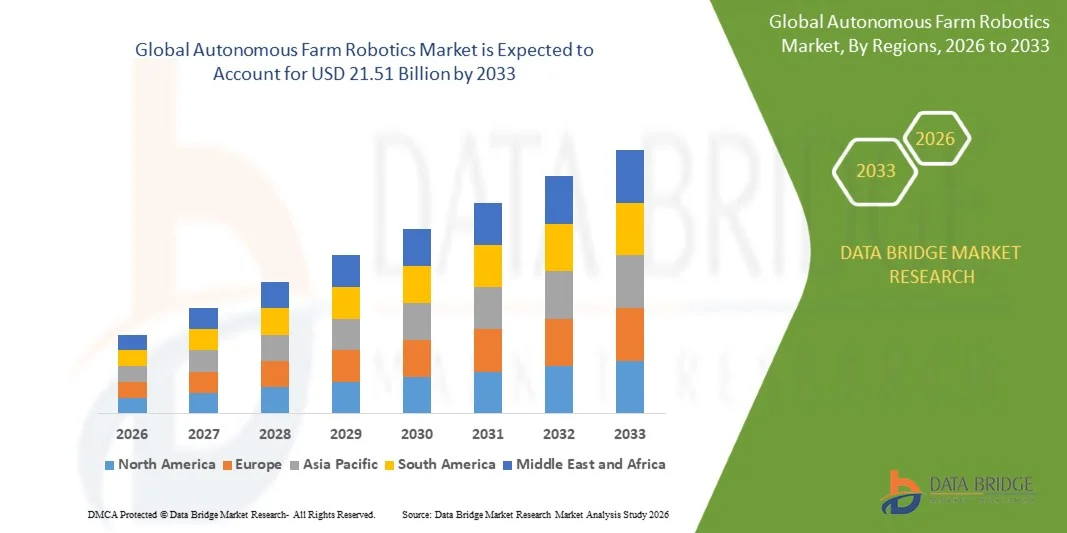
- As per Data Bridge Market Research analysis, the autonomous farm robotics market was valued at USD 3.20 billion in 2025 and is projected to reach USD 21.51 billion by 2033, growing at a CAGR of 26.9% from 2026 to 2033.
- The market is experiencing rapid growth driven by increasing agricultural labor shortages, rising demand for precision farming, growing pressure to improve farm productivity, and rapid advancements in artificial intelligence, computer vision, autonomous navigation, LiDAR, GPS/GNSS, sensors, edge computing, and robotics.
- Autonomous farm robotics are increasingly moving beyond pilot projects toward commercial deployment across field crops, specialty crops, orchards, vineyards, greenhouses, and livestock operations. Autonomous tractors, robotic weeders, agricultural drones, harvesting robots, and autonomous field vehicles are being integrated into farming workflows to perform repetitive and labor-intensive activities with limited human intervention.
- The increasing need to produce more food with fewer workers, while reducing water, fertilizer, pesticide, fuel, and other input requirements, is compelling growers to adopt autonomous robotic technologies. The convergence of robotics with precision agriculture is allowing machines to collect field-level information, interpret environmental conditions, make operational decisions, and execute agricultural tasks with increasing levels of autonomy. Research on agricultural robotics identifies labor shortages, precision agriculture, AI, machine vision, and autonomous machinery as major factors supporting market expansion.
Market Size & Forecast
- Global Market Value (2025): USD 3.20 Billion
- Expected Market Value (2033): USD 21.51 Billion
- Forecast CAGR (2026–2033): 26.9%
- Leading Region in 2025: North America
- Fastest Growing Region: Asia-Pacific
What are the Major Takeaways of the Autonomous Farm Robotics Market?
- North America dominated the global autonomous autonomous farm robotics market with the largest revenue share of 36.28% in 2025, supported by large-scale commercial agriculture, high farm labor costs, strong precision-agriculture infrastructure, high adoption of GPS/GNSS and connected machinery, and the presence of leading agricultural machinery and robotics companies. The region is particularly suited to autonomous systems because large row-crop farms can achieve higher equipment utilization and spread automation investments over extensive cultivated acreage.
- Asia-Pacific is expected to be the fastest-growing region at a CAGR of 27.8% from 2026 to 2033, fueled by agricultural labor shortages, aging farming populations, increasing mechanization, government support for smart agriculture, expanding food-production requirements, and rapid adoption of agricultural drones, autonomous machinery, and AI-enabled farming systems.
- The autonomous tractors segment led the market with a 42.56% share in 2025, reflecting the central role of autonomous tractor platforms as foundational robotic systems for tillage, seeding, spraying, transportation, and field operations. Research on autonomous agricultural robotics also identifies autonomous tractor platforms as the leading type category.
- The drone sprayers is projected to register the fastest growth at a CAGR of 28.8% from 2026 to 2033, supported by increasing use in crop monitoring, mapping, spraying, spreading, crop protection, and field surveillance. DJI reported that more than 500,000 of its agricultural drones were being used across 100 countries as of July 2025, demonstrating the increasing scale of aerial robotics adoption.
- The fully autonomous segment is projected to register the fastest growth at a CAGR of 31.2% from 2026 to 2033, as AI, computer vision, LiDAR, GNSS, sensor fusion, edge computing, and remote monitoring technologies improve. Semi-autonomous systems currently account for the larger installed base because farmers continue to prefer human supervision during the transition toward higher levels of autonomy.
- Large farms are expected to dominate the farm-size category with a market share of 58.78% in 2025, because they have greater capital availability, larger cultivated areas, higher equipment utilization, and stronger economic incentives to automate.
- Hardware is expected to account for the largest offering share with a market share of 58.56% in 2025, because autonomous tractors, robotic vehicles, drones, sensors, cameras, navigation systems, computing units, robotic arms, and other physical components represent the core infrastructure of autonomous farm robotics.
Report Scope and Autonomous Farm Robotics Market Segmentation
|
Attributes |
Autonomous Farm Robotics Key Market Insights |
|
Segments Covered |
|
|
Countries Covered |
North America
Europe
Asia-Pacific
Middle East and Africa
South America
|
|
Key Market Players |
|
|
Market Opportunities |
|
|
Value Added Data Infosets |
|
What is the Key Trend in the Autonomous Farm Robotics Market?
- Artificial intelligence and computer vision are becoming central technologies in autonomous farm robotics, enabling machines to identify crops, weeds, obstacles, terrain conditions, livestock, and other objects without continuous operator input.
- For instance, in January 2025, John Deere introduced multiple autonomous agricultural machines at CES 2025, including the autonomous 9RX tractor for large-scale agriculture and the autonomous 5ML orchard tractor for air-blast spraying. The company's second-generation autonomy technology combines computer vision, AI, and cameras, while the orchard tractor adds LiDAR to improve perception in dense orchard environments.
- The move toward autonomous fleets rather than individual autonomous machines is also emerging as an important trend. Farms are increasingly looking to coordinate tractors, drones, implements, scouting robots, and data platforms so that multiple machines can work together with centralized supervision.
- Precision spraying is becoming a major application for autonomous robotics. AI-enabled vision systems can identify weeds and selectively apply herbicides, reducing unnecessary chemical use while maintaining crop protection effectiveness.
- For instance, John Deere's See & Spray technology uses camera-based machine vision and machine learning to distinguish plants from weeds and selectively activate spray nozzles. Such technologies demonstrate the transition from conventional machine automation toward decision-making autonomy.
- Agricultural drones are also evolving from remotely operated equipment toward increasingly automated systems. Modern drones integrate RTK positioning, radar, LiDAR, computer vision, terrain following, automated flight planning, and precision application technologies.
- For instance, in July 2025, DJI Agriculture globally launched the Agras T100, T70P, and T25P agricultural drones with more intelligent features for automated operations. The Agras T100 supports spraying, spreading, and lifting applications and incorporates LiDAR, millimeter-wave radar, and a multi-camera vision system.
- Autonomous harvesting is another major technology trend, particularly for labor-intensive specialty crops. Advances in soft robotics, robotic grippers, depth perception, machine vision, and AI are improving the ability of robots to locate, assess, pick, and handle delicate crops.
- As farm operators increasingly seek continuous operation, lower labor dependency, precision input application, and improved resource efficiency, autonomous farm robotics is expected to transition from individual task automation toward interconnected multi-robot agricultural ecosystems.
What are the Key Drivers of the Autonomous Farm Robotics Market?
- The rapid shortage and rising cost of agricultural labor is one of the strongest drivers of autonomous farm robotics. Farmers face difficulties finding workers for seasonal and repetitive tasks such as planting, spraying, weeding, harvesting, and crop monitoring.
- For instance, John Deere cited skilled labor availability as a major challenge when introducing its new autonomous agricultural machines in 2025. Its autonomous 9RX tractor is designed to allow farmers to step away from the machine during tillage operations and focus on other farm activities.
- The increasing scale of commercial farms is creating favorable economics for autonomous machinery. Large farms can distribute the capital cost of robotic equipment across thousands of acres and use machines for longer periods during critical planting, spraying, and harvesting windows.
- The rapid development of AI and computer vision is increasing the number of agricultural tasks that can be automated. AI systems can interpret images and sensor information, identify weeds and crops, detect obstacles, optimize routes, and support real-time decision-making.
- The expansion of precision agriculture is another major market driver. Autonomous robots can combine GNSS, cameras, LiDAR, soil sensors, weather information, crop imagery, and farm-management data to perform site-specific operations.
- The increasing cost and environmental impact of agricultural inputs is also supporting adoption. Autonomous spraying and weeding robots can target individual plants or defined areas instead of applying inputs uniformly across entire fields.
- The rapid expansion of agricultural drones is further supporting market growth. DJI reported more than 500,000 of its agricultural drones in use across 100 countries by July 2025, demonstrating the increasing commercial acceptance of automated aerial agricultural platforms.
- The development of robotics-as-a-service models is helping overcome the high upfront cost of robotic equipment. Under these models, farmers can pay for robotic operations based on acreage, hours, or completed tasks instead of purchasing expensive equipment outright.
Which Factors are Challenging the Growth of the Autonomous Farm Robotics Market?
- Advanced autonomous farm robots require significant upfront investment due to the integration of AI processors, cameras, LiDAR, GNSS, sensors, robotic actuators, electric powertrains, batteries, communication systems, and specialized software.
- These high costs can limit adoption among small farms, particularly where farm sizes are fragmented and the return on investment from autonomous machinery is difficult to justify.
- The agricultural operating environment is another major challenge. Unlike structured industrial environments, farms contain uneven terrain, mud, dust, rain, changing illumination, vegetation obstruction, irregular crop spacing, and unpredictable obstacles.
- Autonomous navigation becomes particularly difficult in orchards, vineyards, dense crop environments, and areas where satellite signals are weak or obstructed. Robots therefore increasingly require sensor fusion combining GNSS, cameras, LiDAR, radar, inertial sensors, and other technologies.
- Safety and regulatory requirements also represent important challenges. Autonomous machines operate near farm workers, livestock, vehicles, buildings, and other agricultural equipment, requiring robust obstacle detection, emergency-stop systems, remote supervision, and increasingly standardized safety frameworks.
- Interoperability remains another limitation because autonomous farm machinery from different manufacturers may use proprietary communication protocols, software environments, data structures, and control interfaces.
How is the Autonomous Farm Robotics Market Segmented?
The autonomous farm robotics market is segmented on the basis of robot type, autonomy level, application, farm size, offering, farming environment, and end user.
- By Robot Type
On the basis of robot type, the market is segmented into autonomous tractors, robotic harvesters, weeding robots, drone sprayers, planting & seeding robots, livestock robots, soil & field robots, harvesting drones, and smart farm vehicles. The autonomous tractors segment dominated the market with a 42.56% share in 2025, owing to their ability to perform multiple agricultural operations, including tillage, planting, spraying, field preparation, and transportation, while reducing dependence on human operators. Autonomous tractor platforms are increasingly viewed as the foundational robotic system for large-scale field agriculture because multiple implements can be attached to a single autonomous platform.
The drone sprayers segment is projected to register the fastest growth at a 28.8% CAGR from 2026 to 2033, driven by increasing adoption for crop monitoring, aerial mapping, precision spraying, crop protection, field surveillance, and targeted application of agricultural inputs. Modern agricultural drones combine RTK navigation, cameras, radar, LiDAR, automated flight planning, and intelligent spraying systems, making them increasingly capable of performing agricultural operations with limited operator intervention.
- By Autonomy Level
On the basis of autonomy level, the global autonomous farm robotics market is segmented into semi-autonomous and fully autonomous. The semi-autonomous segment is expected to dominate the market with a 72.11% share in 2025, due to farmers' continued preference for human supervision while using automated navigation, guidance, sensing, implement control, and decision-support functions. Semi-autonomous systems provide a lower-risk pathway toward full automation and can often be integrated into existing farm machinery and workflows.
The fully autonomous segment is projected to register the fastest growth at a 31.2% CAGR from 2026 to 2033, driven by improvements in AI, computer vision, LiDAR, GNSS, sensor fusion, edge computing, obstacle detection, autonomous path planning, and remote monitoring. Fully autonomous systems are increasingly capable of completing defined agricultural operations without a continuously present operator. The commercialization of autonomous tractors and specialized field robots is accelerating the transition from assisted automation toward unattended operations.
- By Application
On the basis of application, the market is segmented into precision farming, labor optimization, productivity improvement, cost reduction, crop monitoring, sustainable agriculture, and farm automation. The precision farming segment represents a major application with a 29.91% share in 2025, because autonomous robots can combine GNSS, sensors, computer vision, imaging, AI, and farm-management data to execute agricultural operations with greater spatial precision. Precision farming allows growers to identify crop and soil variability and apply water, fertilizer, pesticides, and other inputs according to actual field requirements.
The farm automation segment is projected to register the fastest growth at a 29.4% CAGR from 2026 to 2033, driven by increasing demand for autonomous systems capable of performing multiple repetitive agricultural tasks with minimal human intervention. The integration of autonomous tractors, robotic weeders, drones, harvesting robots, and connected farm-management platforms is enabling farms to transition from isolated automated tasks toward integrated autonomous workflows.
- By Farm Size
On the basis of farm size, the market is segmented into small farms, medium-sized farms, and large farms. The large farms segment is expected to dominate the market with a 58.78% share in 2025, due to higher purchasing capacity, large operational areas, greater equipment utilization, and stronger economic incentives for automation. Large farms can distribute the capital cost of autonomous machinery over more acres and can operate equipment during critical agricultural windows when labor availability is limited.
The small and medium-sized farms segments are projected to register the fastest growth at a 29.1% CAGR from 2026 to 2033, driven by increasing adoption of robotics-as-a-service, equipment leasing, shared ownership, cooperative purchasing, pay-per-use models, and lower-cost autonomous platforms. These business models reduce the capital burden and allow smaller farms to access robotic capabilities without purchasing complete systems. The expansion of compact electric robots and modular autonomous platforms is also expected to improve accessibility.
- By Offering
On the basis of offering, the global autonomous farm robotics market is segmented into hardware, software, and services. The hardware segment is expected to dominate the market with a 58.56% share in 2025, due to the growing deployment of autonomous tractors, agricultural drones, robotic harvesters, cameras, sensors, LiDAR, navigation equipment, robotic arms, onboard computing systems, and autonomous field platforms. Hardware represents the physical foundation of autonomous farming, and the relatively high acquisition cost of robotic equipment contributes significantly to its revenue contribution.
The software segment is projected to register the fastest growth at a 27.4% CAGR from 2026 to 2033, driven by increasing demand for AI-based decision-making, autonomous navigation software, fleet-management platforms, crop-recognition systems, remote monitoring, digital mapping, predictive analytics, and robotic-control software. As autonomous systems become more sophisticated, software is increasingly responsible for perception, planning, decision-making, machine coordination, and performance optimization. Software therefore represents an increasingly important source of recurring revenue through subscriptions, updates, analytics, and connected services.
- By Farming Environment
On the basis of farming environment, the market is segmented into outdoor farming, indoor farming, greenhouse farming, and orchard & vineyard farming. The outdoor farming segment is expected to dominate the market with a 68.34% share in 2025, due to the extensive global acreage devoted to field crops and the increasing deployment of autonomous tractors, drones, robotic weeders, precision sprayers, and field robots. Large-scale grain, oilseed, cotton, and other commodity farms provide favorable operating conditions for autonomous machinery because repetitive field operations can generate significant labor and productivity benefits.
The greenhouse farming segment is projected to register the fastest growth at a 27.9% CAGR from 2026 to 2033, driven by increasing demand for automated crop monitoring, harvesting, transportation, pollination, plant handling, and environmental management. Greenhouses provide relatively structured environments in which autonomous robots can operate with greater predictability. The increasing development of controlled-environment agriculture and labor-intensive specialty-crop production is creating additional opportunities for autonomous robotics.
- By End User
On the basis of end user, the global autonomous farm robotics market is segmented into commercial farms & growers, agricultural cooperatives, dairy & livestock farms, greenhouse operators, agricultural service providers, and government & research organizations. The commercial farms & growers segment is expected to dominate the market with a 61.23% share in 2025, due to the large-scale adoption of autonomous tractors, agricultural drones, robotic weeders, precision sprayers, and harvesting systems. Commercial farms generally have larger operational areas, greater access to capital, higher equipment utilization rates, and stronger economic incentives to reduce labor dependency.
The agricultural service providers segment is projected to register the fastest growth at a 30.2% CAGR from 2026 to 2033, driven by the expansion of robotics-as-a-service business models. Service providers can purchase and operate autonomous tractors, drones, robotic weeders, harvesting robots, and monitoring platforms on behalf of multiple farms, allowing growers to access robotic capabilities without bearing the full equipment investment. This model is particularly attractive to small and medium-sized farms and is expected to support broader adoption across fragmented agricultural markets.
Which Region Holds the Largest Share of the Autonomous Farm Robotics Market?
- North America dominated the autonomous farm robotics market and accounted for the largest revenue share of 36.28% in 2025, supported by large-scale commercial farms, high agricultural labor costs, advanced mechanization, widespread adoption of precision agriculture, strong GPS/GNSS infrastructure, and the presence of major agricultural machinery manufacturers and robotics companies. North America is also a major center for autonomous tractor development and commercial deployment.
- The region benefits from rapid adoption of autonomous tractors, AI-powered precision spraying, agricultural drones, robotic field equipment, and connected farm-management platforms. Large row-crop farms provide favorable economics for autonomous systems because equipment can be utilized over extensive acreage and during critical agricultural operating windows.
U.S. Autonomous Farm Robotics Market Insight
The U.S. autonomous farm robotics market is experiencing rapid growth, supported by large-scale commercial farming, agricultural labor shortages, rising labor costs, strong precision-agriculture adoption, and significant investment in autonomous machinery. Autonomous tractors, AI-powered spraying systems, agricultural drones, robotic weeders, and automated harvesting technologies are increasingly being tested and commercialized.
Canada Autonomous Farm Robotics Market Insight
The Canada autonomous farm robotics market is expanding due to large agricultural areas, seasonal labor shortages, high mechanization levels, and increasing adoption of precision agriculture. Autonomous tractors, drones, robotic crop-monitoring platforms, and field robots are expected to gain adoption across grain, oilseed, livestock, and specialty-crop operations. The country's large farms provide favorable economics for autonomous equipment because high machine utilization can help offset the capital cost of robotic platforms.
Europe Autonomous Farm Robotics Market Insight
The Europe autonomous farm robotics market is expanding due to high agricultural labor costs, sustainability requirements, strong environmental policies, advanced agricultural machinery infrastructure, and increasing investment in precision agriculture. Countries including Germany, France, the U.K., the Netherlands, Italy, Spain, Denmark, and Switzerland are developing strong ecosystems around autonomous tractors, agricultural drones, robotic harvesting, vineyard automation, autonomous weeding, and precision spraying.
Germany Autonomous Farm Robotics Market Insight
The Germany autonomous farm robotics market is expanding due to the country's strong agricultural machinery industry, advanced engineering capabilities, agricultural research infrastructure, and increasing investment in autonomous farming technologies. German agricultural machinery manufacturers, robotics developers, and research institutions are increasingly focusing on autonomous navigation, machine vision, field robotics, agricultural data platforms, and AI-enabled machinery. Autonomous systems are particularly attractive as farms face labor availability constraints and increasing pressure to improve productivity.
France Autonomous Farm Robotics Market Insight
France is growing due to labor shortages, specialty-crop production, vineyards, environmental regulations, and increasing interest in precision agriculture. Autonomous systems are gaining relevance in vineyards and specialty crops, where agricultural operations can be labor intensive and terrain can make conventional automation difficult. The country's increasing acceptance of agricultural drones for selected crop-protection applications is also supporting market development. DJI reported that France permits agricultural drones in certain difficult-to-reach vineyard and banana-crop applications.
Asia-Pacific Autonomous Farm Robotics Market Insight
The Asia-Pacific autonomous farm robotics market is expected to witness rapid growth, driven by agricultural labor shortages, aging farming populations, rising food-production requirements, expanding mechanization, government support for smart agriculture, and increasing adoption of drones and autonomous machinery. China, Japan, India, South Korea, and Australia represent major growth markets.
China Autonomous Farm Robotics Market Insight
The China autonomous farm robotics market is growing rapidly due to agricultural modernization, increasing mechanization, government support for smart agriculture, large-scale adoption of agricultural drones, and increasing investment in AI and autonomous machinery. Agricultural drones represent a particularly important area of Chinese agricultural robotics development. The growing use of UAVs for crop monitoring, spraying, mapping, and precision crop protection is creating a large ecosystem for autonomous aerial agriculture.
India Autonomous Farm Robotics Market Insight
India autonomous farm robotics market is expanding due to agricultural labor shortages, increasing demand for mechanization, fragmented farm structures, rising interest in precision agriculture, and government initiatives supporting agricultural technology. Agricultural drones, compact autonomous tractors, robotic weeders, precision sprayers, crop-monitoring robots, and AI-enabled farm-management systems represent major growth opportunities. Robotics-as-a-service, custom hiring, leasing, and cooperative ownership models are expected to be particularly important because many Indian farms operate on relatively small holdings.
Which are the Top Companies in Autonomous Farm Robotics Market?
The autonomous farm robotics industry is primarily led by well-established companies, including:
- Deere & Company (U.S.)
- CNH Industrial N.V. (U.K.)
- Kubota Corporation (Japan)
- Yanmar Holdings Co., Ltd. (Japan)
- AGCO Corporation (U.S.)
- DJI Agriculture (China)
- XAG Co., Ltd. (China)
- Naïo Technologies (France)
- Trimble Inc. (U.S.)
- Topcon Positioning Systems, Inc. (U.S.)
- Small Robot Company (U.K.)
- ecoRobotix SA (Switzerland)
- Verdant Robotics (U.S.)
- Robotics Plus (New Zealand)
- Monarch Tractor (U.S.)
- GUSS Automation (U.S.)
- TerraClear (U.S.)
- Saga Robotics (Norway)
- Blue River Technology (U.S.)
- Carbon Robotics (U.S.)
- FarmWise Labs, Inc. (U.S.)
- SwarmFarm Robotics (Australia)
- FFRobotics (Israel)
- Octinion (Belgium)
- Bluewhite (Israel)
- Burro (U.S.)
- FarmDroid (Denmark)
- Aigen Robotics (U.S.)
- Tortuga AgTech (U.S.)
- AgXeed B.V. (Netherlands)
- Bear Flag Robotics (U.S.)
- John Deere (U.S.)
- CLAAS KGaA mbH (Germany)
- Mahindra & Mahindra Ltd. (India)
- TAFE (India)
What are Latest Developments in Autonomous Farm Robotics Market?
- In January 2025, John Deere unveiled new autonomous agricultural machines at CES 2025, including the autonomous 9RX tractor for large-scale tillage and the autonomous 5ML orchard tractor for air-blast spraying. The second-generation autonomy system combines AI, computer vision, cameras, and advanced sensing, while LiDAR was added to the orchard tractor to improve navigation in dense tree canopies.
- In February 2025, Yamaha Motor announced the creation of Yamaha Agriculture, Inc. in the U.S. and its agreement to acquire New Zealand-based Robotics Plus. Yamaha also integrated assets from Australian agricultural technology company The Yield. The strategy combines agricultural automation with digital agriculture technologies to develop precision-farming solutions. The Robotics Plus acquisition was completed on April 1, 2025.
- In July 2025, DJI Agriculture globally launched the Agras T100, T70P, and T25P agricultural drones. The new generation provides higher payload capabilities, automated operations, improved safety technologies, and support for spraying, spreading, and lifting applications. The Agras T100 incorporates LiDAR, millimeter-wave radar, and a multi-camera vision system.
- In August 2025, DJI Agriculture reported significant expansion of agricultural-drone adoption in Mexico, with spray-drone sales increasing 56 times over six years since 2019. The company reported that its agricultural drones were being operated on 7.1% of Mexican farms, demonstrating the increasing penetration of autonomous aerial farming technologies.
- In November 2025, DJI Agriculture expanded the availability of its latest Agras T100, T70P, and T25P drones into European, Central Asian, and African markets. The company highlighted intelligent automated operations and increasing adoption of drone-based precision farming.

- Interactive Data Analysis Dashboard
- Company Analysis Dashboard for high growth potential opportunities
- Research Analyst Access for customization & queries
- Competitor Analysis with Interactive dashboard
- Latest News, Updates & Trend analysis
- Harness the Power of Benchmark Analysis for Comprehensive Competitor Tracking
Data collection and base year analysis are done using data collection modules with large sample sizes. The stage includes obtaining market information or related data through various sources and strategies. It includes examining and planning all the data acquired from the past in advance. It likewise envelops the examination of information inconsistencies seen across different information sources. The market data is analysed and estimated using market statistical and coherent models. Also, market share analysis and key trend analysis are the major success factors in the market report. To know more, please request an analyst call or drop down your inquiry.
The key research methodology used by DBMR research team is data triangulation which involves data mining, analysis of the impact of data variables on the market and primary (industry expert) validation. Data models include Vendor Positioning Grid, Market Time Line Analysis, Market Overview and Guide, Company Positioning Grid, Patent Analysis, Pricing Analysis, Company Market Share Analysis, Standards of Measurement, Global versus Regional and Vendor Share Analysis. To know more about the research methodology, drop in an inquiry to speak to our industry experts.
Data Bridge Market Research is a leader in advanced formative research. We take pride in servicing our existing and new customers with data and analysis that match and suits their goal. The report can be customized to include price trend analysis of target brands understanding the market for additional countries (ask for the list of countries), clinical trial results data, literature review, refurbished market and product base analysis. Market analysis of target competitors can be analyzed from technology-based analysis to market portfolio strategies. We can add as many competitors that you require data about in the format and data style you are looking for. Our team of analysts can also provide you data in crude raw excel files pivot tables (Fact book) or can assist you in creating presentations from the data sets available in the report.