What is the Bakery Inclusions Market Size and Growth Rate?
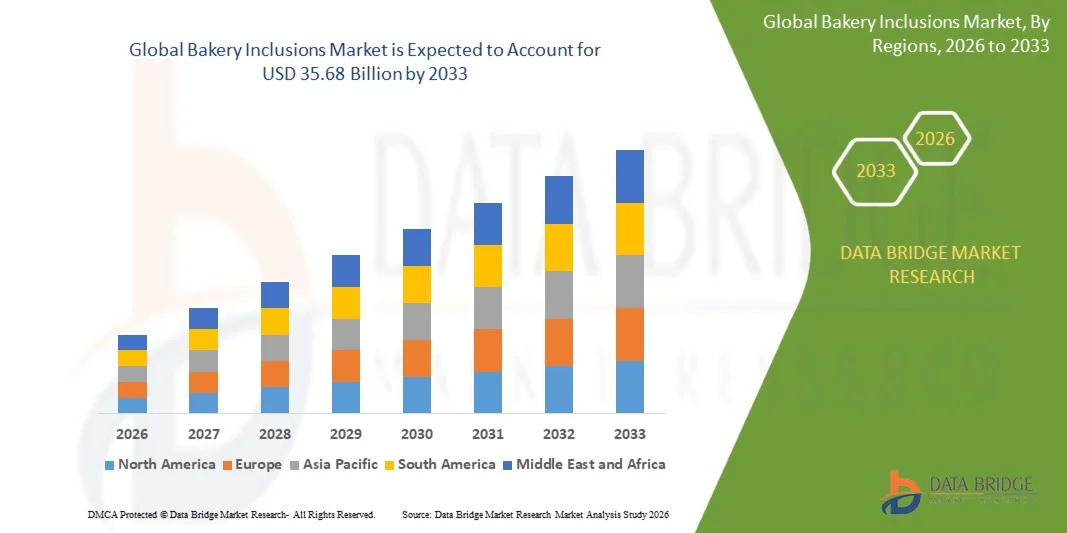
- As per Data Bridge Market Research analysis, the bakery inclusions market was valued at USD 18.93 billion in 2025 and is projected to reach USD 35.68 billion by 2033, growing at a CAGR of 8.30% from 2026 to 2033.
- The market is expanding on the back of rising global demand for premium and indulgent baked goods, the mainstreaming of clean-label and plant-based formulation, and the growing use of inclusions as a low-cost route for manufacturers to differentiate breads, cookies, cakes, and snack bakery products on flavour, texture, and visual appeal.
- Bakery inclusions are discrete ingredient pieces, such as chocolate chunks, dried fruit, nuts, cereal pieces, or flavoured sugar fragments, added into or onto dough and batter before or after baking to deliver sensory differentiation, textural contrast, and, increasingly, functional and nutritional benefits. Advances in heat-stable and bake-stable inclusion technology are allowing these pieces to retain shape, colour, and texture through high-temperature industrial baking, widening their use from artisanal bakeries into large-scale industrial production.
Market Size & Forecast
- Global Market Value (2025): USD 18.93 Billion
- Expected Market Value (2033): USD 35.68 Billion
- Forecast CAGR (2026–2033): 8.30%
- Leading Region in 2025: North America
- Fastest Growing Region: Asia-Pacific
What are the Major Takeaways of the Bakery Inclusions Market?
- North America dominated the global bakery inclusions market with the largest revenue share of 33.85% in 2025, supported by high per-capita consumption of packaged baked goods, an established industrial bakery base, and rapid new product development by leading ingredient suppliers headquartered in the region.
- Asia-Pacific is expected to be the fastest-growing region at a CAGR of 10.2% from 2026 to 2033, driven by rising demand for Western-style baked goods, expanding organised retail bakery chains, and growing disposable income across China, India, and Southeast Asia.
- The chocolate & confectionery chunks segment led the market with a 41.63% share in 2025, owing to sustained consumer preference for chocolate-forward baked goods and continuous innovation by chocolate suppliers in dairy-free, heat-stable, and premium cacao formats.
- Cereal & grain inclusions are the fastest-growing product type, projected to register a CAGR of 9.6%, reflecting rising consumer interest in baked goods positioned around fibre content, whole grains, and functional nutrition.
- The solid & semi-solid form segment dominated the form category with a 68.24% revenue share in 2025, favoured for its ease of handling, dosing accuracy, and compatibility with the widest range of industrial baking processes.
- Conventional inclusions accounted for 85.46% of the market in 2025, but the organic segment is the fastest-growing nature category at a CAGR of 11.4%, as clean-label and organic-certified claims increasingly extend from primary ingredients to inclusion components.
- The muffins & brownies segment is the fastest-growing software category, with a CAGR of 9.4%, driven by premiumisation trends in the bakery snacking category and growing use of layered and topped inclusion formats to create indulgent, bakery-café-style products for retail.
Report Scope and Bakery Inclusions Market Segmentation
|
Attributes |
Bakery Inclusions Key Market Insights |
|
Segments Covered |
|
|
Countries Covered |
North America
Europe
Asia-Pacific
Middle East and Africa
South America
|
|
Key Market Players |
|
|
Market Opportunities |
|
|
Value Added Data Infosets |
In addition to the insights on market scenarios such as market value, growth rate, segmentation, geographical coverage, and major players, the market reports curated by the Data Bridge Market Research also include in-depth expert analysis, pricing analysis, brand share analysis, consumer survey, demography analysis, supply chain analysis, value chain analysis, raw material/consumables overview, vendor selection criteria, PESTLE Analysis, Porter Analysis, and regulatory framework. |
What is the Key Trend in the Bakery Inclusions Market?
- Ingredient suppliers are repositioning their compound chocolate and coating businesses explicitly around the inclusions category, reflecting how central these pieces have become to bakery product differentiation rather than treating them as a secondary ingredient line.
- This shift is visible in supplier portfolio restructuring, premiumisation of core ranges, and the introduction of new formats designed specifically for bakery visual and textural appeal.
- For instance, in May 2026, Barry Callebaut restructured its compound offering into a newly defined “Cacao Coatings & Inclusions” category at the Sweets & Snacks Expo, introducing Cacao Max, a new premium cacao coating range launching with a milk variant and featuring multi-dimensional taste profiles and a silky, smooth-mouthfeel texture.
- Dairy-free and allergen-friendly inclusions are simultaneously expanding beyond niche positioning into mainstream supplier ranges, broadening the applications in which inclusions can be used.
- For instance, in September 2026, Barry Callebaut debuted an expanded dairy-free chocolate portfolio at the Sweets & Snacks Expo in Chicago under its Pathway range, introducing new dark and milk-like dairy-free chocolate inclusions and coatings formulated for use across baked goods, snacks, cereals, and snack bars, allowing manufacturers to carry a dairy-free label claim.
- As suppliers continue to reframe their compound and coating businesses around the inclusions opportunity and extend allergen-friendly formats into mainstream ranges, product differentiation through inclusion technology is expected to remain a primary axis of competition in bakery product development.
What are the Key Drivers of the Bakery Inclusions Market?
- Rising global demand for premium, indulgent, and visually differentiated baked goods is the principal demand driver, since inclusions offer manufacturers a comparatively low-cost route to create distinct flavour and texture combinations without reformulating an entire product.
- Ingredient suppliers are expanding their bakery-specific technical support and product showcases to help bakery manufacturers adopt new inclusion and filling technologies more quickly, shortening the path from ingredient innovation to shelf.
- For instance, in March 2025, Cargill showcased bake-stable fillings and pectin alternatives at the AAHAR 2025 trade fair in India, presenting texture and filling solutions targeted specifically at bakery and dessert applications for the regional market.
- Suppliers are also investing directly in bakery production and demonstration infrastructure to accelerate customer adoption of new inclusion, filling, and improver technologies.
- For instance, in July 2025, Puratos and automation developer AMF Bakery Systems opened a state-of-the-art pilot bakery in New Jersey, providing a facility where bakery customers can trial new ingredient and inclusion technologies alongside automated production equipment under real manufacturing conditions.
- With suppliers continuing to expand technical demonstration capacity and dedicate new product development specifically to bakery-format inclusions, the market is expected to see sustained innovation-led growth through the forecast period.
Which Factors are Challenging the Growth of the Bakery Inclusions Market?
- Inclusions must withstand the mechanical stress of dough mixing and the high temperatures of industrial baking without excessive melting, bleeding of colour or flavour, or loss of shape, which imposes a significant formulation and processing burden on suppliers.
- Achieving bake stability while still delivering the desired premium sensory experience, particularly for chocolate-based inclusions, requires specialised processing technology and raw material selection, which raises production cost and limits the number of suppliers capable of serving large industrial bakery customers at scale.
- Volatile commodity costs for key inputs such as cocoa, nuts, and dried fruit add further pricing pressure, and suppliers have had to explore reformulation and alternative ingredient strategies to manage cost exposure without compromising product quality.
- For instance, in November 2025, Barry Callebaut invested in Planet A Foods, a food technology company producing ChoViva, a non-cocoa chocolate alternative formulated from sunflower seeds and plant-based fats, developed partly in response to sustained high cocoa bean prices and market volatility affecting chocolate-based inclusion formulations.
- The combined burden of bake-stability engineering, premium formulation cost, and volatile key commodity prices continues to constrain margin and limit the pace at which smaller suppliers can compete for large industrial bakery contracts, moderating overall market expansion relative to underlying consumer demand.
How is the Bakery Inclusions Market Segmented?
The bakery inclusions market is segmented on the basis of product type, form, nature, application, functionality, processing technology, end user and distribution channel.
- By Product Type
On the basis of product type, the global bakery inclusions market is segmented into chocolate & confectionery chunks, dried fruit pieces, nuts & seeds, cereal & grain inclusions, and flavoured sugar & caramel pieces. The chocolate & confectionery chunks segment dominated the market with a 41.63% share in 2025, owing to sustained consumer preference for chocolate-forward cookies, muffins, and breads, and continuous supplier investment in dairy-free, heat-stable, and premium cacao chunk and chip formats.
The cereal & grain inclusions segment is projected to register the fastest growth at a CAGR of 9.6% from 2026 to 2033, driven by rising consumer interest in fibre-forward and whole-grain positioned baked goods, and expanding use of ancient grain and seed pieces to support functional nutrition claims.
- By Form
On the basis of form, the global bakery inclusions market is segmented into solid & semi-solid and liquid & paste. The solid & semi-solid segment dominated the market with a share of 68.24% in 2025, favoured for its ease of handling, dosing accuracy on automated production lines, and compatibility with the broadest range of industrial baking processes and equipment.
The liquid & paste segment is expected to witness the fastest CAGR of 9.1% from 2026 to 2033, driven by rising use of fruit and nut pastes as swirl, filling, and layering inclusions in premium cakes, pastries, and artisanal bakery products, where liquid formats enable distinctive visual marbling and layering effects.
- By Nature
On the basis of nature, the global bakery inclusions market is segmented into conventional and organic. The conventional segment dominated the market with a share of 85.46% in 2025, reflecting the broad cost and supply-chain advantages of conventional raw materials across mainstream industrial bakery production.
The organic segment is expected to witness the fastest CAGR of 11.4% from 2026 to 2033, driven by the extension of clean-label and organic-certified positioning from primary bakery ingredients to inclusion components, as premium and artisanal bakery brands seek full-recipe organic certification.
- By Application
On the basis of application, the global bakery inclusions market is segmented into breads & rolls, cookies & biscuits, cakes & pastries, muffins & brownies, and donuts & sweet baked snacks. The cookies & biscuits segment dominated the market with a share of 29.72% in 2025, reflecting the category’s heavy reliance on inclusions for both core flavour identity, such as chocolate chip cookies, and visual shelf differentiation.
The muffins & brownies segment is expected to witness the fastest CAGR of 9.4% from 2026 to 2033, driven by premiumisation trends in the bakery snacking category and growing use of layered and topped inclusion formats to create indulgent, bakery-café-style products for retail.
- By Functionality
On the basis of functionality, the global bakery inclusions market is segmented into flavour & taste enhancement, texture & visual appeal, nutritional fortification, and shelf-life & bake stability. The flavour & taste enhancement segment dominated the market with a share of 44.17% in 2025, reflecting the primary and most established role of inclusions in bakery product development.
The nutritional fortification segment is expected to witness the fastest CAGR of 9.9% from 2026 to 2033, driven by rising use of inclusions as a vehicle for added protein, fibre, and micronutrient content, allowing manufacturers to deliver functional positioning without altering base recipe sensory characteristics.
- By Processing Technology
On the basis of processing technology, the global bakery inclusions market is segmented into enrobing & coating, encapsulation, extrusion & agglomeration, and freeze-drying. The enrobing & coating segment dominated the market with a share of 38.92% in 2025, reflecting its established role in producing chocolate-coated and confectionery-coated inclusion pieces at industrial scale.
The encapsulation segment is expected to witness the fastest CAGR of 10.1% from 2026 to 2033, driven by its growing use in protecting flavour, colour, and functional nutrients through the mechanical and thermal stress of industrial baking, extending the range of ingredients that can be successfully incorporated as bake-stable inclusions.
- By End User
On the basis of end user, the global bakery inclusions market is segmented into industrial bakeries, artisanal & craft bakeries, in-store & retail bakeries, and household & home baking. The industrial bakeries segment dominated the market with a share of 61.38% in 2025, reflecting the concentration of overall inclusion volume in large-scale, high-throughput commercial baking operations supplying retail and foodservice channels.
The artisanal & craft bakeries segment is expected to witness the fastest CAGR of 9.3% from 2026 to 2033, driven by the premiumisation of the independent bakery sector and rising consumer willingness to pay for distinctive, small-batch inclusion combinations not typically available in mass-produced baked goods.
- By Distribution Channel
On the basis of distribution channel, the global bakery inclusions market is segmented into direct sales/B2B and indirect sales/B2C. The direct sales/B2B segment dominated the market with a share of 76.54% in 2025, owing to the concentration of inclusion purchasing among industrial and commercial bakery manufacturers who source directly from ingredient suppliers under long-term supply agreements.
The indirect sales/B2C segment is expected to witness the fastest CAGR of 8.9% from 2026 to 2033, driven by rising home baking activity and expanding retail and online availability of consumer-packaged inclusion products such as baking chips and mix-in pieces.
Which Region Holds the Largest Share of the Bakery Inclusions Market?
- North America dominated the bakery inclusions market and accounted for the largest revenue share of 33.85% in 2025, supported by high per-capita consumption of packaged and premium baked goods, a well-established industrial bakery manufacturing base, and the concentration of leading global ingredient suppliers headquartered in the region.
- The region also benefits from mature retail bakery and foodservice channels that continuously demand new flavour and format innovation, supported by dedicated trade events such as the Sweets & Snacks Expo, which serve as a primary launch platform for new inclusion technologies. Sustained premiumisation of packaged bakery snacking and steady innovation in dairy-free and functional inclusion formats are expected to reinforce North America’s leadership through the forecast period.
U.S. Bakery Inclusions Market Insight
The U.S. bakery inclusions market holds the leading position within North America, underpinned by the scale of the domestic industrial bakery sector and continuous new product activity from major ingredient suppliers. The country hosts leading trade events where suppliers debut new inclusion and coating technologies, and U.S. consumers show sustained demand for indulgent, chocolate-forward, and functionally positioned baked goods. Ongoing investment in bake-stable and dairy-free inclusion technology by suppliers headquartered in the country continues to position the U.S. as the principal innovation hub for the category.
Mexico Bakery Inclusions Market Insight
Mexico’s bakery inclusions market is supported by growing demand for premium, indulgent, and differentiated bakery products, with chocolate and confectionery chunks, dried fruits, nuts, grains, and seeds among the key inclusion categories. Consumer interest in diverse flavors, textures, and visually appealing bakery products is encouraging manufacturers and bakeries to expand inclusion-based offerings. The market is also benefiting from growth in cakes, cookies, pastries, and brownies, while cost pressures from fluctuating raw-material prices remain a challenge.
Asia-Pacific Bakery Inclusions Market Insight
The Asia-Pacific bakery inclusions market is expected to witness the fastest growth globally, driven by rising demand for Western-style baked goods, the rapid expansion of organised retail and chain bakery outlets, and growing disposable income across China, India, and Southeast Asia. Local and multinational bakery chains are increasingly using inclusions to differentiate products in a fast-growing and increasingly competitive retail bakery landscape, while ingredient suppliers are expanding regional manufacturing and technical support capacity to serve rising demand.
China Bakery Inclusions Market Insight
China’s bakery inclusions market is supported by the expanding bakery industry and rising consumer demand for innovative, premium, and indulgent baked products. Chocolate, nuts, dried fruits, seeds, grains, and fruit-based inclusions are increasingly incorporated into cakes, cookies, pastries, breads, and other bakery products to enhance flavor, texture, and visual appeal. Growing urbanization, changing dietary preferences, and the popularity of Western-style bakery products are encouraging manufacturers to introduce diverse inclusion formats. Premiumization, clean-label preferences, and product innovation are expected to remain important market influences.
India Bakery Inclusions Market Insight
The India bakery inclusions market is expanding rapidly, supported by the growth of organised bakery chains, rising urban demand for premium and Western-style baked snacks, and increasing consumer exposure to global bakery trends. Ingredient suppliers have stepped up regional trade-show participation and technical showcases to accelerate adoption of new filling and inclusion technologies among domestic bakery manufacturers, supporting continued category growth across both industrial and artisanal bakery segments.
Which are the Top Companies in Bakery Inclusions Market?
The bakery inclusions industry is primarily led by well-established companies, including:
- Cargill, Incorporated (U.S.)
- Archer Daniels Midland Company (U.S.)
- Barry Callebaut AG (Switzerland)
- Kerry Group plc (Ireland)
- Tate & Lyle PLC (U.K.)
- AGRANA Beteiligungs-AG (Austria)
- Sensient Technologies Corporation (U.S.)
- PURATOS Group NV (Belgium)
- Balchem Inc. (U.S.)
- Georgia Nut Company, Inc. (U.S.)
- Inclusion Technologies LLC (U.S.)
- Nimbus Foods Ltd (U.K.)
- Chaucer Foods Ltd (U.K.)
- Meadow Foods Ltd (U.K.)
- IBK TROPIC, S.A (Spain)
- Taura Natural Ingredients Limited (New Zealand)
- Dawn Food Products, Inc. (U.S.)
- Pecan Deluxe Candy Company (U.S.)
- Olam International Limited (Singapore)
- Döhler Group SE (Germany)
- Ingredion Incorporated (U.S.)
- International Flavors & Fragrances Inc. (U.S.)
- Symrise AG (Germany)
- FoodFlo International Limited (U.K.)
- TruFood Manufacturing, Inc. (U.S.)
- SensoryEffects (U.S.)
- Zeelandia International BV (Netherlands)
- Fabri-Kal Corp. (U.S.)
- Blommer Chocolate Company (U.S.)
- Ravifruit SAS (France)
What are Latest Developments in Bakery Inclusions Market?
- In September 2026, Barry Callebaut debuted an expanded dairy-free chocolate portfolio at the Sweets & Snacks Expo in Chicago under its Pathway range, introducing new dark and milk-like dairy-free chocolate inclusions and coatings for use across chocolates, snacks, cereals, baked goods, and snack bars, allowing manufacturers using the range to carry a dairy-free label claim.
- In May 2026, Barry Callebaut restructured its compound offering into a newly defined “Cacao Coatings & Inclusions” category at the Sweets & Snacks Expo, launching Cacao Max, a new premium cacao coating range debuting with a milk variant and featuring multi-dimensional taste profiles, a silky texture, and a smooth mouthfeel aimed at elevating the compound and inclusions experience.
- In November 2025, Barry Callebaut invested in Planet A Foods, a food technology company that produces ChoViva, a non-cocoa chocolate alternative made from sunflower seeds and plant-based fats, offered in semi-sweet dark, vegan, and white varieties for use across bakery, biscuit, cereal, and chip and chunk inclusion applications, developed partly in response to sustained cocoa price volatility.
- In July 2025, Puratos and automation developer AMF Bakery Systems opened a state-of-the-art pilot bakery in New Jersey, providing a facility where bakery manufacturers can trial new ingredient, inclusion, and filling technologies alongside automated production equipment under commercial manufacturing conditions.
- In May 2025, Puratos introduced Cubease, a concentrated bakery improver designed for compact dosing, supporting smaller handling needs for bakeries using pre-measured flour treatment and improver systems alongside their inclusion and filling formulations.

- Interactive Data Analysis Dashboard
- Company Analysis Dashboard for high growth potential opportunities
- Research Analyst Access for customization & queries
- Competitor Analysis with Interactive dashboard
- Latest News, Updates & Trend analysis
- Harness the Power of Benchmark Analysis for Comprehensive Competitor Tracking
Global Bakery Inclusions Market, Supply Chain Analysis and Ecosystem Framework
To support market growth and help clients navigate the impact of geopolitical shifts, DBMR has integrated in-depth supply chain analysis into its Global Bakery Inclusions Market research reports. This addition empowers clients to respond effectively to global changes affecting their industries. The supply chain analysis section includes detailed insights such as Global Bakery Inclusions Market consumption and production by country, price trend analysis, the impact of tariffs and geopolitical developments, and import and export trends by country and HSN code. It also highlights major suppliers with data on production capacity and company profiles, as well as key importers and exporters. In addition to research, DBMR offers specialized supply chain consulting services backed by over a decade of experience, providing solutions like supplier discovery, supplier risk assessment, price trend analysis, impact evaluation of inflation and trade route changes, and comprehensive market trend analysis.
Data collection and base year analysis are done using data collection modules with large sample sizes. The stage includes obtaining market information or related data through various sources and strategies. It includes examining and planning all the data acquired from the past in advance. It likewise envelops the examination of information inconsistencies seen across different information sources. The market data is analysed and estimated using market statistical and coherent models. Also, market share analysis and key trend analysis are the major success factors in the market report. To know more, please request an analyst call or drop down your inquiry.
The key research methodology used by DBMR research team is data triangulation which involves data mining, analysis of the impact of data variables on the market and primary (industry expert) validation. Data models include Vendor Positioning Grid, Market Time Line Analysis, Market Overview and Guide, Company Positioning Grid, Patent Analysis, Pricing Analysis, Company Market Share Analysis, Standards of Measurement, Global versus Regional and Vendor Share Analysis. To know more about the research methodology, drop in an inquiry to speak to our industry experts.
Data Bridge Market Research is a leader in advanced formative research. We take pride in servicing our existing and new customers with data and analysis that match and suits their goal. The report can be customized to include price trend analysis of target brands understanding the market for additional countries (ask for the list of countries), clinical trial results data, literature review, refurbished market and product base analysis. Market analysis of target competitors can be analyzed from technology-based analysis to market portfolio strategies. We can add as many competitors that you require data about in the format and data style you are looking for. Our team of analysts can also provide you data in crude raw excel files pivot tables (Fact book) or can assist you in creating presentations from the data sets available in the report.