


What is the Battery Technologies for Implantable Medical Devices Market Size and Growth Rate?
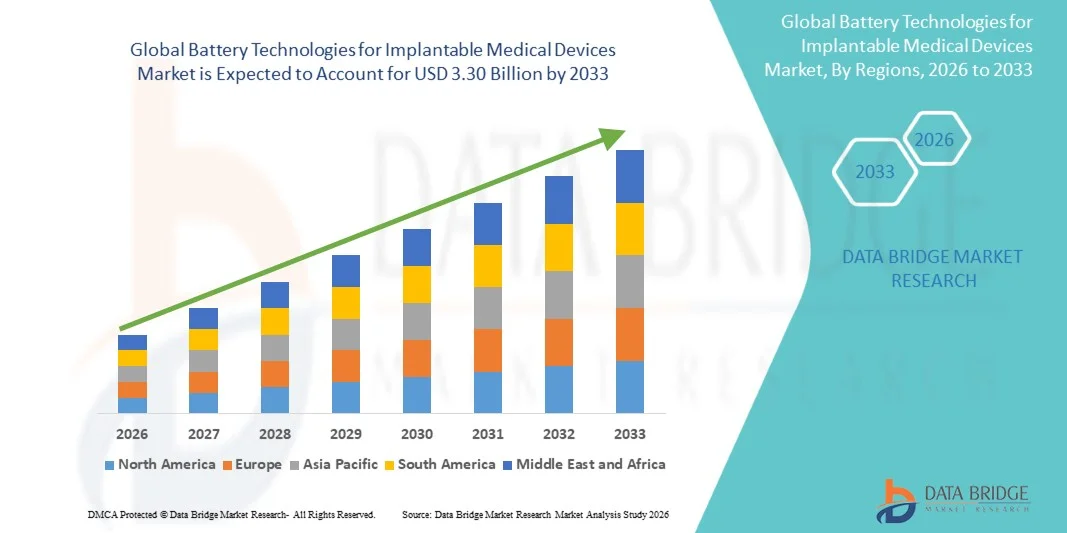
- As per Data Bridge Market Research analysis, the battery technologies for implantable medical devices market was valued at USD 1.48 billion in 2025 and is projected to reach USD 3.30 billion by 2033, growing at a CAGR of 10.40% from 2026 to 2033.
- The market is expanding on the back of the rising global prevalence of cardiac and neurological disorders, growing implantation volumes for pacemakers, defibrillators, and neurostimulators, and accelerating commercialization of solid-state and miniaturized battery technologies purpose-built for life-critical, long-duration implants.
- Batteries for implantable medical devices are highly specialized power sources engineered to deliver decades of reliable, leak-free operation inside the human body under strict biocompatibility, safety, and miniaturization constraints that far exceed those of conventional consumer batteries. Historically dominated by primary lithium-iodine and lithium-silver vanadium oxide chemistries developed for pacemakers and defibrillators, the market is now being reshaped by the commercial emergence of solid-state micro-batteries, which eliminate liquid electrolyte and associated thermal runaway risk while enabling smaller device form factors for neurostimulation and sensing applications.
Market Size & Forecast
- Global Market Value (2025): USD 1.48 Billion
- Expected Market Value (2033): USD 3.30 Billion
- Forecast CAGR (2026–2033): 10.40%
- Leading Region in 2025: North America
- Fastest Growing Region: Asia-Pacific
What are the Major Takeaways of the Battery Technologies for Implantable Medical Devices Market?
- North America dominated the global battery technologies for implantable medical devices market with the largest revenue share of 41.28% in 2025, supported by high implantation rates of cardiac and neurostimulation devices, the concentration of leading device and battery manufacturers, and an established regulatory pathway for active implantable medical devices.
- Asia-Pacific is expected to be the fastest-growing region at a CAGR of 13.1% from 2026 to 2033, driven by rising cardiovascular disease burden, expanding access to implantable device therapy, and growing domestic battery and medical device manufacturing capacity across China, Japan, and South Korea.
- The lithium-iodine segment led the battery chemistry category with a 34.85% share in 2025, owing to its decades-long track record as the standard power source for pacemakers, its excellent volumetric energy density, and its predictable end-of-life voltage decline that provides a reliable replacement indicator.
- Solid-state batteries are the fastest-growing chemistry segment, projected to register a CAGR of 16.8%, reflecting rapid commercialization progress by specialist developers and the technology’s inherent safety and miniaturization advantages for next-generation implants.
- The primary (non-rechargeable) battery segment dominated the power type category with a 72.64% revenue share in 2025, favoured for its simplicity, long shelf life, and proven reliability in low-power, long-duration applications such as pacemakers.
- Cardiac pacemakers accounted for 31.72% of the market by device type in 2025, but neurostimulators represent the fastest-growing device segment at a CAGR of 13.9%, reflecting the rapid expansion of spinal cord stimulation and neuromodulation therapies.
- The thin-film/micro battery form factor is the fastest-growing design category, with a CAGR of 15.2%, driven by demand for smaller implant footprints in neurostimulation and sensor applications enabled by solid-state manufacturing processes.
Report Scope and Battery Technologies for Implantable Medical Devices Market Segmentation
|
Attributes |
Battery Technologies for Implantable Medical Devices Key Market Insights |
|
Segments Covered |
|
|
Countries Covered |
North America
Europe
Asia-Pacific
Middle East and Africa
South America
|
|
Key Market Players |
|
|
Market Opportunities |
|
|
Value Added Data Infosets |
In addition to the insights on market scenarios such as market value, growth rate, segmentation, geographical coverage, and major players, the market reports curated by the Data Bridge Market Research also include in-depth expert analysis, patient epidemiology, pipeline analysis, pricing analysis, and regulatory framework. |
What is the Key Trend in the Battery Technologies for Implantable Medical Devices Market?
- Solid-state battery technology is moving from laboratory development into initial commercial production specifically for active implantable medical devices, marking a structural shift away from decades of reliance on liquid-electrolyte primary lithium chemistries.
- This shift is being led by specialist thin-film battery developers who have identified implantable neurostimulation and sensing devices as an early commercial beachhead, given the technology’s safety and miniaturization advantages over conventional cells.
- For instance, in February 2026, Ilika plc commenced its first commercial revenue-generating deliveries of Stereax M300 solid-state battery electrodes to Cirtec Medical, a rechargeable 3.5V, 300 µAh micro solid-state battery designed for active implantable medical devices, with the company reporting 21 customers evaluating the product across applications including neuromodulation.
- At the same time, developers are extending solid-state architecture upward into higher-capacity, power-intensive implant categories previously served only by conventional lithium chemistries.
- For instance, in mid-2026, French manufacturer ITEN launched a development program under the SOLIMED project within Europe’s IPCEI Tech4Cure initiative to adapt its all-ceramic solid-state battery technology for Class III implantable cardiac pumps and neurostimulators, targeting 600 Wh/L energy density, over 2 Ah capacity, elimination of thermal runaway risk, and 80% wireless charge recovery in under 20 minutes.
- As solid-state technology continues to progress from pilot production into qualified commercial supply across both low-power neurostimulation and high-capacity cardiac applications, it is expected to represent the primary axis of innovation and competitive differentiation in the implantable battery market through the forecast period.
What are the Key Drivers of the Battery Technologies for Implantable Medical Devices Market?
- The rising global prevalence of cardiac arrhythmias, heart failure, and neurological disorders is directly increasing implantation volumes for pacemakers, defibrillators, and neurostimulators, each of which requires a purpose-built, long-life battery to function.
- Device manufacturers and specialist battery developers continue to showcase new power solutions for miniaturized and next-generation active implants at major medical technology industry events, accelerating awareness and adoption of new battery platforms among device OEMs.
- For instance, in January 2026, Integer Holdings Corporation showcased innovations in neuromodulation and miniaturized active implantable medical devices, reinforcing demand for compact, high-reliability battery technologies suited to the industry’s continued push toward smaller implant form factors.
- Academic and industrial research into higher-energy-density electrode materials is also progressing, offering a pathway to extend device longevity and reduce the frequency of replacement surgeries, which carry infection and lead-failure risk.
- For instance, in June 2025, researchers from McGill University reported that modifying the anode with a small amount of neodymium increased battery energy density by approximately 20%, providing a potential pathway toward higher-energy batteries for implantable medical applications while researchers continued to investigate the underlying safety and performance characteristics.
- With disease prevalence rising, device manufacturers actively showcasing next-generation power platforms, and research continuing to push energy density higher without compromising safety, demand for advanced implantable battery technology is expected to remain strong throughout the forecast period.
Which Factors are Challenging the Growth of the Battery Technologies for Implantable Medical Devices Market?
- Implantable batteries must meet exceptionally demanding requirements, including long-term biocompatibility, hermetic sealing, resistance to body fluids, compact size, and multi-year reliability. These stringent requirements make battery development and qualification technically complex and limit the number of suppliers capable of meeting the specifications required for life-sustaining implantable devices.
- Battery-related failure remains a significant concern because premature depletion can compromise the operation of pacemakers, implantable cardioverter-defibrillators, and cardiac resynchronization therapy devices. Battery or device replacement may require an invasive procedure, increasing clinical and economic burdens and creating a particularly high reliability threshold for new battery chemistries and designs.
- For instance, in April 2025, the U.S. FDA recorded a premature battery-depletion event involving Boston Scientific's VALITUDE X4 CRT-P cardiac resynchronization therapy pacemaker. The device's power consumption had increased to 336% within approximately five months, resulting in rapid battery depletion; subsequent analysis identified an abnormality in an oxide layer within an integrated-circuit component as the cause. The device was ultimately explanted and replaced.
- The stringent testing, validation, and regulatory requirements associated with implantable battery technologies further extend development timelines and increase the cost of introducing new chemistries and designs. Consequently, concerns over premature depletion, device reliability, and the clinical consequences of battery failure can slow the adoption of newer battery technologies and favor established solutions with extensive reliability records.
How is the Battery Technologies for Implantable Medical Devices Market Segmented?
The battery technologies for implantable medical devices market is segmented on the basis of battery chemistry, power type, device type, capacity, design & form factor, end user and distribution channel.
- By Battery Chemistry
On the basis of battery chemistry, the global battery technologies for implantable medical devices market is segmented into lithium-iodine, lithium-manganese dioxide, lithium-silver vanadium oxide, lithium-carbon monofluoride, solid-state batteries, and rechargeable lithium-ion. The lithium-iodine segment dominated the market with a 34.85% share in 2025, owing to its decades-long status as the standard power source for cardiac pacemakers, excellent volumetric energy density, and a predictable end-of-life voltage decline that provides clinicians with a clear replacement indicator.
The solid-state batteries segment is projected to register the fastest growth at a CAGR of 16.8% from 2026 to 2033, driven by rapid commercialization progress from specialist developers and the technology’s inherent safety advantages, including elimination of liquid electrolyte and associated thermal runaway risk, alongside its suitability for miniaturized implant form factors.
- By Power Type
On the basis of power type, the global battery technologies for implantable medical devices market is segmented into primary (non-rechargeable) batteries and rechargeable batteries. The primary batteries segment dominated the market with a share of 72.64% in 2025, favoured for its simplicity, extended shelf life, and proven multi-decade reliability record in low-power, long-duration applications such as pacemakers and cochlear implants.
The rechargeable batteries segment is expected to witness the fastest CAGR of 13.4% from 2026 to 2033, driven by rising demand for higher-power devices such as spinal cord stimulators and cardiac assist pumps, where wireless recharging extends device service life and reduces the frequency of battery-related replacement surgery.
- By Device Type
On the basis of device type, the global battery technologies for implantable medical devices market is segmented into cardiac pacemakers, implantable cardioverter defibrillators, neurostimulators, cochlear implants, implantable drug delivery pumps, and ventricular assist devices. The cardiac pacemakers segment dominated the market with a share of 31.72% in 2025, reflecting the high global implantation volume of pacemakers and their status as the original and most established application for implantable battery technology.
The neurostimulators segment is expected to witness the fastest CAGR of 13.9% from 2026 to 2033, driven by the rapid expansion of spinal cord stimulation, deep brain stimulation, and vagus nerve stimulation therapies, and by the growing suitability of miniaturized solid-state batteries for this device category.
- By Capacity
On the basis of capacity, the global battery technologies for implantable medical devices market is segmented into below 500 mAh, 500–1000 mAh, and above 1000 mAh. The below 500 mAh segment dominated the market with a share of 46.93% in 2025, reflecting the low power requirements of pacemakers, neurostimulators, and other chronically implanted low-drain devices.
The above 1000 mAh segment is expected to witness the fastest CAGR of 12.6% from 2026 to 2033, driven by rising demand for power-intensive implants such as ventricular assist devices and high-output defibrillators, which require substantially greater stored energy and discharge capability.
- By Design & Form Factor
On the basis of design and form factor, the global battery technologies for implantable medical devices market is segmented into coin/button cell, cylindrical cell, and thin-film/micro battery. The coin/button cell segment dominated the market with a share of 41.56% in 2025, owing to its established manufacturing base and compatibility with the compact, hermetically sealed housings used in pacemakers and similar devices.
The thin-film/micro battery segment is expected to witness the fastest CAGR of 15.2% from 2026 to 2033, driven by demand for smaller implant footprints in neurostimulation and sensor applications, enabled by solid-state, semiconductor-style manufacturing processes capable of producing batteries at millimetre scale.
- By End User
On the basis of end user, the global battery technologies for implantable medical devices market is segmented into hospitals, ambulatory surgical centers, and specialty cardiac & neurology clinics. The hospitals segment dominated the market with a share of 58.31% in 2025, reflecting the concentration of complex implantation and replacement procedures within hospital-based cardiac catheterization and neurosurgical facilities.
The ambulatory surgical centers segment is expected to witness the fastest CAGR of 11.7% from 2026 to 2033, driven by the ongoing shift of selected implantation and device replacement procedures toward outpatient settings as device miniaturization reduces procedural complexity.
- By Distribution Channel
On the basis of distribution channel, the global battery technologies for implantable medical devices market is segmented into direct sales to device OEMs and contract manufacturing & component supply. The direct sales to device OEMs segment dominated the market with a share of 68.47% in 2025, reflecting the deeply integrated, long-term product qualification relationships between specialized battery developers and implantable device manufacturers.
The contract manufacturing & component supply segment is expected to witness the fastest CAGR of 12.2% from 2026 to 2033, driven by growing outsourcing of electrode and cell production by emerging solid-state battery developers to specialist medical device contract manufacturers as they scale toward commercial volumes.
Which Region Holds the Largest Share of the Battery Technologies for Implantable Medical Devices Market?
- North America dominated the battery technologies for implantable medical devices market and accounted for the largest revenue share of 41.28% in 2025, supported by high implantation rates of cardiac and neurostimulation devices, the concentration of leading device and battery manufacturers headquartered in the region, and an established, well-defined regulatory pathway for active implantable medical devices.
- The region also benefits from deep collaborative relationships between hospital systems, device OEMs, and specialist battery developers, supporting rapid clinical evaluation and adoption of next-generation battery technologies. Continued new product showcases and commercial launches by regionally headquartered suppliers are expected to reinforce North America’s leadership through the forecast period.
U.S. Battery Technologies for Implantable Medical Devices Market Insight
The U.S. battery technologies for implantable medical devices market holds the leading position within North America, underpinned by the scale of the domestic cardiac and neurostimulation device industry and the concentration of major implantable battery developers and contract manufacturers in the country. U.S. clinicians and device OEMs show strong engagement with emerging solid-state battery platforms, supported by an extensive research base spanning academic institutions and specialist battery developers. Continued domestic commercialization activity, including new electrode supply agreements and device showcases, is reinforcing the country’s position as the primary innovation and commercialization hub for the category.
Canada Battery Technologies for Implantable Medical Devices Market Insight
Canada’s market for battery technologies in implantable medical devices is growing steadily, fueled by an aging population and rising rates of cardiovascular and neurological disorders. Solid-state, lithium-carbon monofluoride, and rechargeable lithium-ion cells dominate applications in pacemakers, ICDs, and neurostimulators. Growth is propelled by demands for miniaturization, wireless charging, and extended operational lifespans. However, adoption speed is moderated by Health Canada’s strict device approval processes and high initial procurement costs for next-generation bio-compatible power sources.
Asia-Pacific Battery Technologies for Implantable Medical Devices Market Insight
The Asia-Pacific battery technologies for implantable medical devices market is expected to witness the fastest growth globally, driven by rising cardiovascular disease burden, expanding access to implantable cardiac and neurostimulation device therapy, and growing domestic battery and medical device manufacturing capacity across China, Japan, and South Korea. Established Japanese battery manufacturers with decades of experience in primary lithium cell production continue to support the region’s substantial share of global implantable battery component supply, while rising regional healthcare investment is expanding access to advanced implant therapies.
China Battery Technologies for Implantable Medical Devices Market Insight
China’s market for implantable medical device batteries is accelerating, propelled by rapid population aging, high cardiovascular disease burdens, and "Made in China 2030" localization mandates. While traditional lithium-carbon monofluoride power cells dominate pacemakers, rechargeable lithium-ion and emerging solid-state chemistries are scaling fast to support high-drain neurostimulators and active implants. Growth centers on miniaturization, extended operational lifespans, and wireless charging. However, long NMPA regulatory review cycles and cost barriers in regional hospitals remain key adoption challenges.
India Battery Technologies for Implantable Medical Devices Market Insight
India’s market for implantable medical device batteries is accelerating, driven by a high cardiovascular disease burden, expanding private healthcare, and government initiatives like the Production-Linked Incentive (PLI) scheme. Primary lithium-carbon monofluoride cells dominate cardiac pacemakers, while rechargeable lithium-ion solutions scale for neurostimulators. Growth centers on miniaturization and extended operational lifespans. However, heavy reliance on imported medical-grade cells, high initial costs, and NPPA price controls on active implants constrain wider adoption.
Which are the Top Companies in Battery Technologies for Implantable Medical Devices Market?
The battery technologies for implantable medical devices industry is primarily led by well-established companies, including:
- Integer Holdings Corporation (U.S.)
- EaglePicher Technologies, LLC (U.S.)
- Medtronic plc (Ireland)
- Abbott Laboratories (U.S.)
- Boston Scientific Corporation (U.S.)
- Biotronik SE & Co. KG (Germany)
- Ilika plc (U.K.)
- ITEN S.A. (France)
- Cirtec Medical Corporation (U.S.)
- Quallion LLC (U.S.)
- NGK Insulators, Ltd. (Japan)
- Panasonic Energy Co., Ltd. (Japan)
- Maxell, Ltd. (Japan)
- Saft Groupe SAS (France)
- EnerSys (U.S.)
- Ultralife Corporation (U.S.)
- RRC power solutions GmbH (Germany)
- ZOLL Medical Corporation (U.S.)
- LivaNova PLC (U.K.)
- Vaporsens, Inc. (U.S.)
- Nuvectra Corporation (U.S.)
- Lynntech, Inc. (U.S.)
- Enovix Corporation (U.S.)
- Solid Power, Inc. (U.S.)
- Wilson Greatbatch Technologies (U.S.)
What are Latest Developments in Battery Technologies for Implantable Medical Devices Market?
- In February 2026, Ilika plc delivered its first commercial-grade Stereax electrodes to Cirtec Medical, fulfilling its initial revenue-generating purchase order for the supply of electrodes used in Stereax M300 micro solid-state batteries for active implantable medical device applications, following the commercial supply arrangement initiated with Cirtec in January 2026.
- In May 2026, ITEN launched a development program to adapt its all-ceramic solid-state battery technology for Class III implantable medical devices, including cardiac pumps and neurostimulators, operating under the SOLIMED project within Europe’s IPCEI Tech4Cure initiative and targeting 600 Wh/L energy density, over 2 Ah capacity, and 80% wireless charge recovery in under 20 minutes.
- In January 2026, Integer Holdings Corporation showcased innovations in neuromodulation and miniaturized active implantable medical devices, reinforcing demand for compact, high-reliability battery technologies as the industry continues to pursue smaller implant form factors.
- In July 2026, Ilika plc disclosed that its Stereax M300 rechargeable 3.5V, 300 µAh micro solid-state battery platform for active implantable medical devices was being evaluated by 21 customers, with the company having commenced production of commercial samples and begun generating its first Stereax-related revenue.

- Interactive Data Analysis Dashboard
- Company Analysis Dashboard for high growth potential opportunities
- Research Analyst Access for customization & queries
- Competitor Analysis with Interactive dashboard
- Latest News, Updates & Trend analysis
- Harness the Power of Benchmark Analysis for Comprehensive Competitor Tracking
Data collection and base year analysis are done using data collection modules with large sample sizes. The stage includes obtaining market information or related data through various sources and strategies. It includes examining and planning all the data acquired from the past in advance. It likewise envelops the examination of information inconsistencies seen across different information sources. The market data is analysed and estimated using market statistical and coherent models. Also, market share analysis and key trend analysis are the major success factors in the market report. To know more, please request an analyst call or drop down your inquiry.
The key research methodology used by DBMR research team is data triangulation which involves data mining, analysis of the impact of data variables on the market and primary (industry expert) validation. Data models include Vendor Positioning Grid, Market Time Line Analysis, Market Overview and Guide, Company Positioning Grid, Patent Analysis, Pricing Analysis, Company Market Share Analysis, Standards of Measurement, Global versus Regional and Vendor Share Analysis. To know more about the research methodology, drop in an inquiry to speak to our industry experts.
Data Bridge Market Research is a leader in advanced formative research. We take pride in servicing our existing and new customers with data and analysis that match and suits their goal. The report can be customized to include price trend analysis of target brands understanding the market for additional countries (ask for the list of countries), clinical trial results data, literature review, refurbished market and product base analysis. Market analysis of target competitors can be analyzed from technology-based analysis to market portfolio strategies. We can add as many competitors that you require data about in the format and data style you are looking for. Our team of analysts can also provide you data in crude raw excel files pivot tables (Fact book) or can assist you in creating presentations from the data sets available in the report.













