


What is the Biphasic External Defibrillator Market Size and Growth Rate?
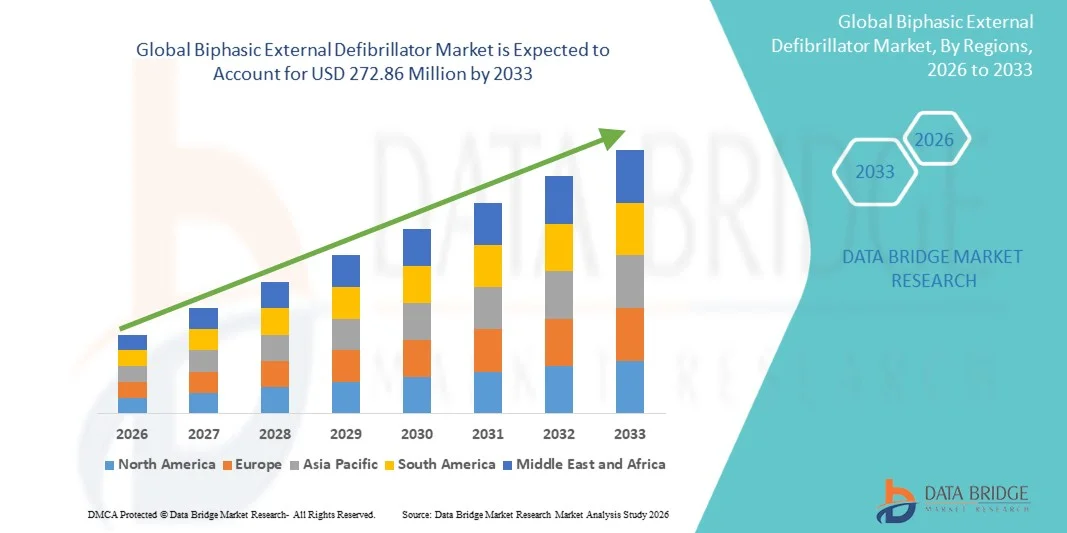
- As per Data Bridge Market Research analysis, the biphasic external defibrillator market was valued at USD 132.50 million in 2025 and is projected to reach USD 272.86 million by 2033, growing at a CAGR of 9.45% from 2026 to 2033.
- The market is experiencing consistent growth driven by rising demand for advanced cardiac emergency care, increasing adoption of biphasic waveform technology, and expanding deployment of automated external defibrillators across hospitals, emergency medical services, workplaces, and public-access locations.
- The increasing incidence of sudden cardiac arrest globally, combined with expanding public-access defibrillation initiatives and improvements in connected and automated defibrillator technologies, is compelling healthcare providers and organizations to adopt advanced biphasic external defibrillators. Automated devices and next-generation waveform technologies are increasingly replacing older systems, offering effective energy delivery, ease of operation, and improved readiness for rapid cardiac intervention.
Market Size & Forecast
- Global Market Value (2025): USD 132.50 Million
- Expected Market Value (2033): USD 272.86 Million
- Forecast CAGR (2026–2033): 9.45%
- Leading Region in 2025: North America
- Fastest Growing Region: Asia Pacific
What are the Major Takeaways of the Biphasic External Defibrillator Market?
- North America dominated the biphasic external defibrillator market with the largest revenue share of 41.9% in 2025, supported by a high prevalence of cardiovascular diseases, favorable public-access defibrillation initiatives, and strong adoption of advanced emergency medical technologies.
- Asia-Pacific is expected to be the fastest-growing region at a CAGR of 10.6% from 2026 to 2033, fueled by improving healthcare infrastructure, increasing awareness of sudden cardiac arrest, expanding public AED deployment programs, and rising healthcare investments across China, India, and Japan.
- The automated external defibrillator (AEDs) segment led the market with a 39.5% share in 2025, driven by widespread deployment across hospitals, airports, schools, offices, sports facilities, and other public locations.
- Wearable external defibrillator are the fastest-growing product type, projected to register a CAGR of 11.0%, reflecting the surge in demand for continuous cardiac monitoring among patients at temporary risk of sudden cardiac arrest.
- The biphasic truncated exponential (BTE) waveform segment dominated the technology type category with a 63.0% revenue share in 2025, led by its widespread adoption across automated external defibrillators and hospital-based emergency defibrillation systems.
- Hospitals & clinics accounted for 53.4% of the market share in 2025, preferred by the high volume of cardiac emergency cases requiring immediate defibrillation and advanced life-support interventions
- The rectilinear biphasic waveform segment is the fastest-growing technology category, with a CAGR of 10.5%, driven by increasing adoption in advanced hospital defibrillators and emergency medical service applications.
Report Scope and Biphasic External Defibrillator Market Segmentation
|
Attributes |
Biphasic External Defibrillator Key Market Insights |
|
Segments Covered |
|
|
Countries Covered |
North America
Europe
Asia-Pacific
Middle East and Africa
South America
|
|
Key Market Players |
|
|
Market Opportunities |
|
|
Value Added Data Infosets |
In addition to the insights on market scenarios such as market value, growth rate, segmentation, geographical coverage, and major players, the market reports curated by the Data Bridge Market Research also include in-depth expert analysis, patient epidemiology, pipeline analysis, pricing analysis, and regulatory framework. |
What is the Key Trend in the Biphasic External Defibrillator Market?
- Healthcare providers and public-access programs are increasingly adopting advanced biphasic external defibrillators with real-time CPR guidance, automated rhythm analysis, connectivity, and simplified operation to improve emergency response and patient outcomes.
- For instance, in March 2024, Stryker launched the LIFEPAK CR2 automated external defibrillator in India, featuring real-time CPR coaching, automatic rhythm analysis, QUIK-STEP electrodes, and escalating biphasic energy up to 360 joules, reflecting the shift toward easier-to-use and feedback-enabled defibrillation system
- Real-time CPR feedback and rapid rhythm analysis enable rescuers to improve compression quality, minimize pauses before shock delivery, and accelerate emergency intervention during sudden cardiac arrest.
- Hospitals, emergency medical services, workplaces, schools, and public facilities are increasingly deploying connected AEDs to expand early defibrillation coverage and improve device readiness outside traditional clinical environments.
- For instance, in October 2025, Philips, Securitas, and Medic Assist announced a strategic partnership to integrate Philips AEDs into Securitas’ guarding solutions, with remote monitoring to ensure AEDs remain maintained and ready for use, supporting the trend toward connected and readily accessible defibrillation systems.
- As healthcare systems and public organizations continue prioritizing rapid cardiac intervention and accessible emergency care, adoption of connected and user-friendly biphasic external defibrillators is expected to accelerate, reinforcing AED deployment as a core component of sudden cardiac arrest response.
What are the Key Drivers of the Biphasic External Defibrillator Market?
- The rising incidence of out-of-hospital cardiac arrest has significantly increased demand for rapidly deployable biphasic external defibrillators capable of delivering timely shocks and supporting effective CPR in emergency situations.
- For instance, in November 2024, the American Heart Association reported that an analysis of 198,869 witnessed out-of-hospital cardiac arrests found that bystander CPR within two minutes was associated with an 81% greater chance of survival to hospital discharge, highlighting the importance of rapid community response and immediate access to AEDs.
- Governments, workplaces, schools, transportation facilities, and community organizations are expanding public-access defibrillation programs to reduce treatment delays and improve survival before professional emergency medical services arrive.
- For instance, in August 2025, the American Heart Association and Indianapolis International Airport announced a first-of-its-kind cardiac emergency response plan covering more than 10.5 million passengers and 11,000 employees annually. The airport has 70 AEDs on site and began providing free CPR/AED training to employees and tenants, demonstrating the growing emphasis on rapid access to defibrillation in high-traffic public environments.
- With sudden cardiac arrest continuing to create substantial emergency-care demand and public-access initiatives expanding globally, biphasic external defibrillators will remain indispensable for strengthening early intervention and improving community cardiac response.
What Factors are Challenging the Growth of the Biphasic External Defibrillator Market?
- Biphasic external defibrillators require substantial investment in device procurement, replacement electrodes, batteries, maintenance, inspections, software updates, and regulatory compliance, increasing total ownership costs for end users.
- For instance, in December 2024, a Houston school district case highlighted the financial and operational burden of AED maintenance after an inspection found expired electrode pads; the district subsequently reported that 170 of its 1,038 AEDs were nonfunctional, demonstrating the challenge of keeping large AED fleets continuously operational.
- These financial and operational requirements can limit adoption among smaller healthcare facilities, workplaces, schools, and organizations in price-sensitive markets where budgets for emergency medical equipment remain constrained.
- Regulatory requirements also increase the ongoing burden for organizations because AEDs must remain operational, inspected, maintained, and supported throughout their service life, particularly when deployed across decentralized public-access locations.
- For instance, in November 2022, the U.S. FDA reported that manufacturers of previously cleared AED accessories, including batteries and electrode pads, were required to obtain premarket approval, while certain non-compliant accessories could no longer be marketed.
- The high capital expenditure and recurring maintenance obligations associated with biphasic external defibrillators therefore continue to restrict adoption, particularly among smaller organizations and price-sensitive markets, despite increasing awareness of early defibrillation.
How is the Biphasic External Defibrillator Market Segmented?
The biphasic external defibrillator market is segmented on the basis of product type, technology, and end user.
- By Product Type
On the basis of product type, the biphasic external defibrillator market is segmented into automated external defibrillator (AEDs), manual external defibrillator, transcutaneous external defibrillator, and wearable external defibrillator. The automated external defibrillator (AEDs) segment dominated the market with a 39.5% share in 2025, driven by widespread deployment across hospitals, airports, schools, offices, sports facilities, and other public locations. These devices are designed for rapid emergency intervention through automated rhythm analysis and guided shock delivery. Their ease of operation allows both trained professionals and lay responders to initiate defibrillation during sudden cardiac arrest. Government initiatives supporting public-access defibrillation are further expanding AED installations globally. Technological improvements such as real-time CPR feedback, wireless connectivity, and automated self-testing are enhancing device reliability and usability.
The wearable external defibrillator segment is projected to register the fastest growth at a CAGR of 11.0% from 2026 to 2033, driven by increasing demand for continuous cardiac monitoring among patients at temporary risk of sudden cardiac arrest. These devices provide protection outside hospitals while allowing patients to maintain normal daily activities. Their ability to automatically detect dangerous arrhythmias and deliver therapeutic shocks supports rapid intervention when conventional medical supervision is unavailable. Rising cardiovascular disease prevalence and growing demand for non-invasive cardiac protection are strengthening adoption. Technological advances in lightweight designs, wireless monitoring, and remote physician connectivity are further improving patient acceptance. Increasing use as bridge therapy before implantable cardioverter-defibrillator implantation is also supporting demand.
- By Technology
On the basis of technology, the biphasic external defibrillator market is segmented into biphasic truncated exponential (BTE) waveform, rectilinear biphasic waveform, and others. The biphasic truncated exponential (BTE) waveform segment dominated the market with a 63.0% share in 2025, owing to its widespread adoption across automated external defibrillators and hospital-based emergency defibrillation systems. BTE technology delivers electrical shocks using lower energy levels while maintaining high defibrillation effectiveness. Its established clinical performance and extensive validation have encouraged widespread adoption among healthcare providers. Leading manufacturers continue integrating BTE technology into their defibrillator portfolios, strengthening market penetration. The technology also enables impedance-compensated shock delivery, improving treatment effectiveness across diverse patient populations
The rectilinear biphasic waveform segment is anticipated to witness the fastest growth at a CAGR of 10.5% from 2026 to 2033, driven by increasing adoption in advanced hospital defibrillators and emergency medical service applications. This waveform delivers a constant current profile that supports consistent shock delivery across patients with varying thoracic impedance levels. Healthcare providers increasingly prefer advanced rectilinear biphasic systems for emergency and complex resuscitation procedures. Continuous product innovations integrating intelligent energy escalation, patient monitoring, and resuscitation analytics are further supporting adoption. Rising investments in technologically advanced emergency-care infrastructure are accelerating demand. Ongoing clinical research and improvements in waveform optimization are expected to strengthen future utilization.
- By End User
On the basis of end user, the biphasic external defibrillator market is segmented into hospitals & clinics, emergency medical services (EMS), public access defibrillator (PAD), and home care settings. The hospitals & clinics segment dominated the market with a 53.4% share in 2025, supported by the high volume of cardiac emergency cases requiring immediate defibrillation and advanced life-support interventions. Hospitals remain major purchasers because emergency departments, intensive care units, and specialized cardiac-care centers require readily available defibrillation equipment. Increasing cardiovascular disease burden and cardiac emergencies are sustaining demand for advanced external defibrillators. Healthcare providers are also replacing aging devices with connected systems featuring CPR feedback, patient monitoring, and improved workflow capabilities. Continuous investment in emergency-care infrastructure and compliance with resuscitation standards are further supporting procurement.
The public access defibrillator (PAD) segment is expected to witness the fastest growth at an 10.0% CAGR from 2026 to 2033, driven by increasing government initiatives and public-access programs aimed at improving AED availability outside healthcare facilities. Public-access defibrillators are increasingly being installed in airports, schools, workplaces, shopping centers, transportation hubs, sports facilities, and other high-traffic locations. Their deployment helps reduce the time between cardiac arrest and first defibrillation before emergency medical services arrive. Rising awareness of sudden cardiac arrest and increasing CPR-AED training are encouraging organizations to establish community emergency-response programs. Connected AED technologies are also improving device readiness through remote monitoring, location tracking, and maintenance alerts. Government mandates and workplace safety policies are further supporting installations across public environments.
Which Region Holds the Largest Share of the Biphasic External Defibrillator Market?
- North America dominated the biphasic external defibrillator market with the largest revenue share of 41.9% in 2025, supported by a high prevalence of cardiovascular diseases, favorable public-access defibrillation initiatives, and strong adoption of advanced emergency medical technologies.
- The region also benefits from high healthcare expenditure, established emergency medical services, increasing deployment of AEDs across public and workplace settings, and the presence of leading defibrillator manufacturers. Growing awareness of early defibrillation, supportive resuscitation guidelines, and continued investments in emergency cardiac-care infrastructure continue to strengthen North America's leadership position in the global market.
U.S. Biphasic External Defibrillator Market Insight
The U.S. biphasic external defibrillator market is witnessing strong growth due to rising adoption of automated external defibrillators, public-access defibrillation programs, and advanced emergency cardiac-care technologies. The country’s mature healthcare infrastructure, along with increasing deployment of connected and technologically advanced defibrillation systems, is driving demand across hospitals, emergency medical services, workplaces, and public facilities. In addition, growing emphasis on improving sudden cardiac arrest response and expanding AED availability is accelerating adoption across healthcare and community settings.
Asia-Pacific Biphasic External Defibrillator Market Insight
The Asia-Pacific biphasic external defibrillator market is expected to witness rapid growth, driven by rising healthcare investments, increasing awareness of sudden cardiac arrest, and expanding public-access defibrillation infrastructure across countries such as China, India, and Japan. Growing adoption of automated and advanced biphasic defibrillation technologies, along with increasing demand for accessible emergency cardiac-care solutions, is supporting regional market expansion. In addition, increasing healthcare infrastructure development and government-supported AED deployment initiatives are accelerating adoption across hospitals, emergency services, public facilities, and community settings.
Japan Biphasic External Defibrillator Market Insight
The Japan biphasic external defibrillator market is witnessing consistent growth due to rising investments in advanced emergency medical technologies, public-access AED infrastructure, and cardiac-care solutions. Healthcare providers, emergency medical services, and public facilities are increasingly adopting sophisticated defibrillation systems for rapid cardiac response and improved patient outcomes. Moreover, increasing adoption of automated defibrillation technologies and Japan’s established public-access AED ecosystem are further contributing to market growth.
China Biphasic External Defibrillator Market Insight
The China biphasic external defibrillator market is growing rapidly, driven by expanding healthcare infrastructure, increasing awareness regarding sudden cardiac arrest, and rising government focus on improving emergency medical response. Growing adoption of automated and advanced biphasic defibrillation systems across hospitals, public facilities, transportation hubs, and emergency services is significantly boosting market demand. In addition, rising investments in public-access AED deployment, increasing healthcare modernization, and growing emphasis on improving early cardiac intervention are positioning China as an important growth market for biphasic external defibrillators.
U.K. Biphasic External Defibrillator Market Insight
The U.K. biphasic external defibrillator market is experiencing steady growth, supported by rising adoption of AEDs in public-access locations, healthcare facilities, workplaces, and emergency medical services. Increasing investments in advanced defibrillation infrastructure and growing demand for rapid, reliable cardiac emergency response solutions are contributing to market growth. Furthermore, continued adoption of automated and connected defibrillation technologies is improving emergency preparedness and response efficiency, positioning the U.K. as an important market for advanced external defibrillation systems.
Germany Biphasic External Defibrillator Market Insight
The Germany biphasic external defibrillator market is expanding steadily due to the country’s advanced healthcare infrastructure, established emergency medical services, and increasing adoption of next-generation cardiac-care technologies. Hospitals, emergency medical organizations, and public facilities are increasingly utilizing biphasic defibrillators for emergency cardiac response and patient care. Continuous advancements in automated defibrillation, device connectivity, and emergency response technologies, along with strong emphasis on healthcare quality and patient safety, are further driving market growth in Germany.
Which are the Top Companies in Biphasic External Defibrillator Market?
The biphasic external defibrillator industry is primarily led by well-established companies, including:
- ZOLL Medical Corporation (U.S.)
- Stryker (U.S.)
- Koninklijke Philips N.V. (Netherlands)
- NIHON KOHDEN CORPORATION (Japan)
- Shenzhen Mindray Bio-Medical Electronics Co., Ltd. (China)
- SCHILLER AG (Switzerland)
- Defibtech LLC (U.S.)
- MEDIANA Co., Ltd. (South Korea)
- CU Medical Systems, Inc. (South Korea)
- Instramed Indústria Médico Hospitalar Ltda. (Brazil)
- GS Elektromedizinische Geräte G. Stemple GmbH (Germany)
- A.M.I. Italia S.r.l. (Italy)
- PROGETTI S.r.l. (Italy)
- Osatu S. Coop. (Spain)
- Jousing Medical Co., Ltd. (China)
- RadianQbio Co., Ltd. (South Korea)
- Shenzhen Comen Medical Instruments Co., Ltd. (China)
- BPL Medical Technologies (India)
- Fukuda Denshi Co., Ltd. (Japan)
- Silverline Meditech Pvt. Ltd. (India)
What are Latest Developments in Biphasic External Defibrillator Market?
- In September 2025, ZOLL Medical announced that its ZOLL Zenix monitor/defibrillator received U.S. FDA premarket approval, introducing a new professional defibrillation platform designed for EMS and hospital settings with a large touchscreen, real-time clinical feedback, and streamlined workflows. The development strengthens ZOLL’s professional defibrillator portfolio and reflects continued advancement toward more intuitive and connected emergency cardiac-care systems.
- In March 2024, Stryker launched the next-generation LIFEPAK CR2 automated external defibrillator in India at the Criticare National Conference, incorporating QUIK-STEP electrodes, a Shock Advisory System, and real-time CPR coaching to support faster and more effective cardiac-arrest response. The launch highlights the increasing integration of user guidance, automated rhythm analysis, and advanced defibrillation capabilities into external AED systems.
- In January 2023, Avive Solutions announced FDA premarket approval for its Avive Connect AED, a portable automated external defibrillator integrating cellular, Wi-Fi, GPS, and Bluetooth connectivity with remote maintenance capabilities and emergency-response data sharing. The approval marked the entry of a highly connected AED platform designed to improve device accessibility, monitoring, and coordination with emergency responders.
- In October 2022, the U.S. FDA approved the Avive Automated External Defibrillator and associated pad and training cartridges, authorizing the portable AED for emergency treatment of sudden cardiac arrest. The approval represented an important regulatory milestone for connected AED technology and supported the commercialization of Avive’s external defibrillation system in the U.S. market.
- In January 2021, ZOLL Medical announced that its ZOLL AED 3 and ZOLL AED 3 BLS automated external defibrillators received five-star recognition from World of Safety & Health Asia for innovative technology supporting rescuers during cardiac emergencies. The recognition highlighted features including Real CPR Help, RapidShock analysis, Wi-Fi connectivity, and CPR guidance, demonstrating continued development of intelligent AED technologies for professional and lay rescuers.

- Interactive Data Analysis Dashboard
- Company Analysis Dashboard for high growth potential opportunities
- Research Analyst Access for customization & queries
- Competitor Analysis with Interactive dashboard
- Latest News, Updates & Trend analysis
- Harness the Power of Benchmark Analysis for Comprehensive Competitor Tracking
Data collection and base year analysis are done using data collection modules with large sample sizes. The stage includes obtaining market information or related data through various sources and strategies. It includes examining and planning all the data acquired from the past in advance. It likewise envelops the examination of information inconsistencies seen across different information sources. The market data is analysed and estimated using market statistical and coherent models. Also, market share analysis and key trend analysis are the major success factors in the market report. To know more, please request an analyst call or drop down your inquiry.
The key research methodology used by DBMR research team is data triangulation which involves data mining, analysis of the impact of data variables on the market and primary (industry expert) validation. Data models include Vendor Positioning Grid, Market Time Line Analysis, Market Overview and Guide, Company Positioning Grid, Patent Analysis, Pricing Analysis, Company Market Share Analysis, Standards of Measurement, Global versus Regional and Vendor Share Analysis. To know more about the research methodology, drop in an inquiry to speak to our industry experts.
Data Bridge Market Research is a leader in advanced formative research. We take pride in servicing our existing and new customers with data and analysis that match and suits their goal. The report can be customized to include price trend analysis of target brands understanding the market for additional countries (ask for the list of countries), clinical trial results data, literature review, refurbished market and product base analysis. Market analysis of target competitors can be analyzed from technology-based analysis to market portfolio strategies. We can add as many competitors that you require data about in the format and data style you are looking for. Our team of analysts can also provide you data in crude raw excel files pivot tables (Fact book) or can assist you in creating presentations from the data sets available in the report.













