


What is the Global Breakthrough Immunotherapy Drug Market Size and Growth Rate?
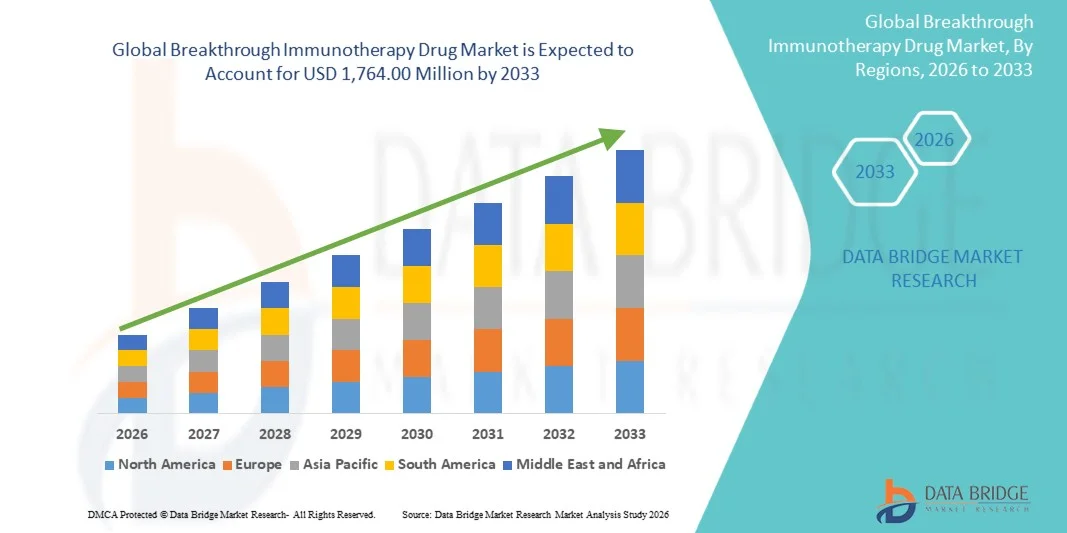
- The global breakthrough immunotherapy drug market size was valued at USD billion in 2025 and is expected to reach USD 1,764.00 million by 2033, at a CAGR of 10.50% during the forecast period
- The market growth is largely driven by rapid advancements in immuno-oncology, rising approvals of breakthrough-designated therapies, and strong R&D investments focused on next-generation biologics, cell therapies, and precision immunotherapies
- Furthermore, increasing prevalence of cancer and complex autoimmune diseases, along with growing demand for targeted, highly effective, and durable treatment options, is positioning breakthrough immunotherapy drugs as a cornerstone of modern therapeutic strategies, thereby significantly accelerating overall market growth
What are the Major Takeaways of Breakthrough Immunotherapy Drug Market?
- Breakthrough immunotherapy drugs, designed to harness and modulate the body’s immune system to treat complex and life-threatening diseases, are becoming central to modern therapeutic strategies, particularly in oncology and autoimmune disorders, due to their targeted mechanisms, durable clinical responses, and potential to significantly improve patient outcomes
- The escalating demand for breakthrough immunotherapy drugs is primarily driven by the rising global burden of cancer and immune-mediated diseases, increasing regulatory support for breakthrough therapy designations, and substantial investments in advanced biologics, cell therapies, and precision medicine approaches
- North America dominated the breakthrough immunotherapy drug market with the largest revenue share of 48.6% in 2025, supported by a strong biopharmaceutical R&D ecosystem, early adoption of innovative therapies, favorable reimbursement frameworks, and a high concentration of leading pharmaceutical and biotechnology companies, with the U.S. accounting for the majority of approvals and clinical trial activity
- Asia-Pacific is expected to be the fastest-growing region in the breakthrough immunotherapy drug market during the forecast period due to expanding healthcare infrastructure, rising healthcare expenditure, growing cancer incidence, and increasing participation of China, Japan, and South Korea in immunotherapy research and commercialization
- The immune checkpoint inhibitor segment dominated the breakthrough immunotherapy drug market with a market share of 52.9% in 2025, driven by its proven clinical efficacy across multiple cancer indications, expanding label approvals, and strong adoption as both monotherapy and combination therapy in standard oncology treatment regimens
Report Scope and Breakthrough Immunotherapy Drug Market Segmentation
|
Attributes |
Breakthrough Immunotherapy Drug Key Market Insights |
|
Segments Covered |
|
|
Countries Covered |
North America
Europe
Asia-Pacific
Middle East and Africa
South America
|
|
Key Market Players |
|
|
Market Opportunities |
|
|
Value Added Data Infosets |
In addition to the insights on market scenarios such as market value, growth rate, segmentation, geographical coverage, and major players, the market reports curated by the Data Bridge Market Research also include in-depth expert analysis, patient epidemiology, pipeline analysis, pricing analysis, and regulatory framework |
Breakthrough Immunotherapy Drug Market Trends
“Expansion of Next-Generation Targets and Precision Immunotherapy”
- A significant and accelerating trend in the global breakthrough immunotherapy drug market is the shift toward next-generation immune targets and precision-based approaches, including novel checkpoint pathways, bispecific antibodies, and personalized cell therapies, aimed at improving efficacy and reducing treatment resistance
- For instance, several next-generation checkpoint inhibitors targeting LAG-3, TIGIT, and other emerging pathways have entered late-stage clinical trials, demonstrating improved outcomes when used alone or in combination with established PD-1/PD-L1 therapies
- Advances in biomarker-driven patient selection and genomic profiling are enabling more precise deployment of breakthrough immunotherapies, improving response rates and minimizing unnecessary exposure. For instance, biomarker-guided use of checkpoint inhibitors is increasingly influencing treatment decisions across multiple cancer types
- The integration of artificial intelligence and advanced analytics into immunotherapy research is streamlining drug discovery, optimizing clinical trial design, and accelerating regulatory approvals, supporting faster commercialization of breakthrough therapies
- This trend toward more targeted, data-driven, and personalized immunotherapy development is reshaping treatment paradigms. Consequently, leading biopharmaceutical companies are investing heavily in precision immuno-oncology platforms, combination regimens, and adaptive clinical trials
- The demand for highly effective, durable, and personalized breakthrough immunotherapies continues to rise across oncology and select autoimmune indications, reinforcing this trend as a core driver of long-term market evolution
Breakthrough Immunotherapy Drug Market Dynamics
Driver
“Rising Cancer Burden and Strong Regulatory Support for Breakthrough Therapies”
- The increasing global incidence of cancer and immune-mediated disorders, combined with strong regulatory incentives for breakthrough therapy designation, is a major driver accelerating demand for innovative immunotherapy drugs
- For instance, regulatory agencies such as the U.S. FDA and EMA continue to grant breakthrough and fast-track designations to immunotherapy candidates that demonstrate substantial improvement over existing treatments, significantly reducing development timelines
- As conventional therapies often show limited durability or high toxicity, breakthrough immunotherapies offer targeted mechanisms, long-lasting responses, and improved survival outcomes, driving rapid adoption among clinicians and healthcare providers
- Furthermore, increased public and private investment in biopharmaceutical R&D, coupled with expanding clinical trial activity, is strengthening the development pipeline for advanced immunotherapy drugs worldwide
- The growing acceptance of immunotherapy as a frontline or combination treatment option, supported by favorable reimbursement policies in developed markets, is further propelling market growth across hospitals and specialized cancer centers
Restraint/Challenge
“High Treatment Costs and Complex Manufacturing Requirements”
- The high cost of breakthrough immunotherapy drugs, particularly cell-based and personalized therapies, presents a significant challenge to widespread adoption, especially in cost-sensitive and emerging healthcare markets
- For instance, CAR-T cell therapies and advanced biologics require complex manufacturing, cold-chain logistics, and specialized clinical infrastructure, leading to elevated treatment prices and limited accessibility
- The complexity of production and administration also increases the burden on healthcare systems, requiring highly trained personnel, advanced facilities, and stringent quality controls, which can slow market penetration
- In addition, variability in patient response, immune-related adverse events, and long-term safety concerns necessitate extensive post-marketing surveillance and ongoing clinical evaluation, adding to overall development costs
- Overcoming these challenges through manufacturing innovation, cost-optimization strategies, expanded reimbursement coverage, and scalable production technologies will be critical for enabling broader global adoption and sustained growth of the breakthrough immunotherapy drug market
How is the Breakthrough Immunotherapy Drug Market Segmented?
The market is segmented on the basis of drug type, route of administration, end user, and distribution channel.
- By Drug
On the basis of drug, the global breakthrough immunotherapy drug market is segmented into immune checkpoint inhibitors, monoclonal antibodies, bispecific antibodies, antibody–drug conjugates (ADCs), CAR-T cell therapies, TCR & other adoptive cell therapies, cancer vaccines, cytokines & immune modulators, oncolytic virus therapies, and other novel immunotherapies. The immune checkpoint inhibitors segment dominated the market with the largest revenue share of 52.9% in 2025, driven by their strong clinical efficacy across multiple cancer indications and widespread adoption as standard-of-care therapies. These drugs have demonstrated durable responses and improved survival outcomes in cancers such as lung cancer, melanoma, and renal cell carcinoma. Their extensive regulatory approvals, expanding label indications, and increasing use in combination regimens have further strengthened their dominance. In addition, strong physician familiarity and established reimbursement frameworks in developed markets continue to support high utilization rates. The presence of blockbuster drugs and ongoing lifecycle management strategies also contribute to sustained revenue generation.
The CAR-T cell therapies segment is expected to witness the fastest growth rate during the forecast period, fueled by rapid advancements in cell engineering, manufacturing scalability, and expanding indications beyond hematological malignancies. Increasing clinical success in difficult-to-treat cancers and ongoing trials targeting solid tumors are accelerating adoption. Growing investments from pharmaceutical companies and strategic collaborations are improving accessibility and reducing production timelines. Moreover, regulatory support for innovative cell therapies and rising patient awareness are driving faster uptake. As manufacturing costs gradually decline and clinical infrastructure expands, CAR-T therapies are anticipated to experience robust growth globally.
- By Route of Administration
On the basis of route of administration, the market is segmented into intravenous, subcutaneous, intramuscular, intratumoral, and others. The intravenous (IV) segment dominated the market in 2025 due to its widespread use for administering complex biologics, monoclonal antibodies, and cell-based immunotherapies. IV administration allows precise dosage control and rapid systemic distribution, which is critical for breakthrough immunotherapy drugs. Hospitals and oncology centers are well-equipped for IV infusion, supporting its continued dominance. In addition, most approved immunotherapy drugs were initially developed for IV delivery, reinforcing established clinical practices. The reliability and familiarity of IV administration among healthcare professionals further sustain this segment’s leading position.
The subcutaneous (SC) segment is projected to grow at the fastest CAGR over the forecast period, driven by increasing demand for patient-friendly and time-efficient treatment options. Subcutaneous formulations reduce administration time, improve patient comfort, and lower healthcare resource utilization. Advances in drug formulation technologies are enabling the development of effective SC versions of existing IV therapies. Furthermore, the shift toward outpatient care and home-based treatment models is accelerating adoption. These advantages are positioning subcutaneous delivery as a key growth driver in the market.
- By End User
On the basis of end user, the market is segmented into hospitals, specialty & oncology clinics, research & academic institutes, and outpatient infusion centers. The hospitals segment held the largest market revenue share in 2025, driven by their advanced infrastructure and ability to manage complex immunotherapy treatments. Hospitals serve as primary centers for cancer diagnosis, immunotherapy administration, and management of treatment-related adverse events. The availability of multidisciplinary care teams and advanced diagnostic facilities supports higher patient volumes. In addition, most breakthrough immunotherapies require close monitoring during initial administration, favoring hospital-based treatment. Strong reimbursement mechanisms in hospital settings further reinforce this segment’s dominance.
The outpatient infusion centers segment is expected to witness the fastest growth during the forecast period due to the growing shift toward cost-effective and patient-centric care models. These centers offer reduced treatment costs, shorter wait times, and improved patient convenience compared to hospitals. The increasing availability of subcutaneous and simplified infusion regimens is supporting this transition. Furthermore, healthcare systems are encouraging outpatient treatment to reduce hospital burden. As a result, outpatient infusion centers are rapidly gaining traction for immunotherapy administration.
- By Distribution Channel
On the basis of distribution channel, the market is segmented into hospital pharmacies, specialty pharmacies, and online pharmacies. The hospital pharmacies segment dominated the market in 2025, supported by the high utilization of breakthrough immunotherapy drugs within hospital settings. These pharmacies ensure proper storage, handling, and preparation of complex biologics and cell-based therapies. Their close integration with oncology departments enables timely drug administration and monitoring. In addition, strict regulatory compliance and quality control requirements favor hospital pharmacy distribution. The centralized procurement and reimbursement processes further strengthen this segment’s leading position.
The specialty pharmacies segment is anticipated to grow at the fastest rate over the forecast period, driven by the increasing complexity of immunotherapy drugs and the need for specialized handling and patient support services. Specialty pharmacies provide value-added services such as patient education, adherence monitoring, and coordination with healthcare providers. They are increasingly involved in the distribution of high-cost and personalized therapies. Moreover, the expansion of outpatient treatment models is boosting reliance on specialty pharmacy networks. These factors collectively support rapid growth of this segment.
Breakthrough Immunotherapy Drug Market Regional Analysis
- North America dominated the breakthrough immunotherapy drug market with the largest revenue share of 48.6% in 2025, supported by a strong biopharmaceutical R&D ecosystem, early adoption of innovative therapies, favorable reimbursement frameworks, and a high concentration of leading pharmaceutical and biotechnology companies, with the U.S. accounting for the majority of approvals and clinical trial activity
- Healthcare providers and patients in the region place high value on the superior clinical efficacy, durable treatment responses, and precision-based mechanisms offered by breakthrough immunotherapy drugs across multiple cancer and autoimmune indications
- This widespread adoption is further supported by a robust regulatory framework favoring breakthrough therapy approvals, substantial R&D investments, favorable reimbursement policies, and the strong presence of leading pharmaceutical and biotechnology companies, establishing immunotherapy drugs as a core component of modern treatment paradigms in the region
U.S. Breakthrough Immunotherapy Drug Market Insight
The U.S. breakthrough immunotherapy drug market captured the largest revenue share within North America in 2025, driven by strong clinical adoption, a high volume of oncology patients, and rapid uptake of innovative immune-based therapies. Healthcare providers increasingly prioritize advanced immunotherapies due to their superior efficacy, durable responses, and ability to address unmet medical needs. The presence of leading biopharmaceutical companies, extensive clinical trial activity, and early regulatory approvals further propel market growth. Moreover, favorable reimbursement frameworks and strong patient awareness continue to support widespread utilization of breakthrough immunotherapy drugs across major cancer centers.
Europe Breakthrough Immunotherapy Drug Market Insight
The Europe breakthrough immunotherapy drug market is projected to expand at a substantial CAGR during the forecast period, primarily driven by rising cancer incidence, strong public healthcare systems, and increasing access to advanced biologic therapies. Growing emphasis on personalized medicine and expanding regulatory support for innovative drugs are fostering adoption across the region. European healthcare providers are increasingly integrating immunotherapies into standard treatment protocols. The region is experiencing steady growth across major markets, supported by ongoing clinical research collaborations and improving reimbursement coverage.
U.K. Breakthrough Immunotherapy Drug Market Insight
The U.K. breakthrough immunotherapy drug market is anticipated to grow at a noteworthy CAGR during the forecast period, driven by strong government support for innovative medicines and increasing demand for advanced cancer treatments. The National Health Service’s focus on early access programs and cost-effectiveness assessments is facilitating adoption of breakthrough therapies. Rising awareness among clinicians and patients regarding immunotherapy benefits is further stimulating market growth. In addition, the U.K.’s active participation in global clinical trials supports continued expansion.
Germany Breakthrough Immunotherapy Drug Market Insight
The Germany breakthrough immunotherapy drug market is expected to expand at a considerable CAGR during the forecast period, fueled by a well-established healthcare infrastructure and strong emphasis on innovation-driven treatments. Germany’s robust reimbursement system and focus on evidence-based medicine encourage rapid uptake of breakthrough immunotherapies. Increasing investments in oncology research and growing collaboration between academic institutes and pharmaceutical companies support market growth. The integration of advanced immunotherapies into hospital oncology protocols is becoming increasingly common across the country.
Asia-Pacific Breakthrough Immunotherapy Drug Market Insight
The Asia-Pacific breakthrough immunotherapy drug market is poised to grow at the fastest CAGR during the forecast period, driven by rising cancer prevalence, expanding healthcare infrastructure, and increasing healthcare expenditure in countries such as China, Japan, and India. Growing government initiatives to improve access to advanced cancer therapies are accelerating adoption. The region’s expanding clinical trial activity and local manufacturing capabilities are improving affordability and availability. As awareness of immunotherapy benefits rises, Asia-Pacific is emerging as a key growth region for breakthrough drugs.
Japan Breakthrough Immunotherapy Drug Market Insight
The Japan breakthrough immunotherapy drug market is gaining momentum due to the country’s advanced healthcare system, strong focus on innovation, and rapidly aging population. High demand for effective and less invasive cancer treatments is driving adoption of immunotherapy drugs. Japan’s streamlined regulatory pathways for innovative medicines support faster approvals and commercialization. The integration of breakthrough immunotherapies into standard oncology care is increasingly evident across major hospitals and research centers.
India Breakthrough Immunotherapy Drug Market Insight
The India breakthrough immunotherapy drug market accounted for a leading revenue share within Asia-Pacific in 2025, attributed to rising cancer incidence, improving healthcare access, and growing adoption of advanced therapies. India’s expanding oncology infrastructure and increasing participation in global clinical trials are supporting market growth. Greater awareness among physicians and patients, combined with government initiatives to strengthen cancer care, is accelerating adoption. In addition, the presence of domestic pharmaceutical manufacturers and efforts to improve affordability are further propelling the market.
Breakthrough Immunotherapy Drug Market Share
The Breakthrough Immunotherapy Drug industry is primarily led by well-established companies, including:
- Merck & Co., Inc. (U.S.)
- Bristol-Myers Squibb Company (U.S.)
- F. Hoffmann-La Roche Ltd. (Switzerland)
- AstraZeneca (U.K.)
- Novartis AG (Switzerland)
- Pfizer Inc. (U.S.)
- Johnson & Johnson Services, Inc. (U.S.)
- Amgen Inc. (U.S.)
- GSK plc (U.K.)
- Sanofi (France)
- Gilead Sciences, Inc. (U.S.)
- Moderna, Inc. (U.S.)
- BioNTech SE (Germany)
- Regeneron Pharmaceuticals, Inc. (U.S.)
- Adaptimmune Therapeutics PLC (U.K.)
- Iovance Biotherapeutics, Inc. (U.S.)
- Immutep Ltd (Australia)
- SOTIO Biotech (Czech Republic)
- Imugene Ltd (Australia)
- BeiGene, Ltd. (China)
What are the Recent Developments in Global Breakthrough Immunotherapy Drug Market?
- In December 2025, BioNTech and Bristol Myers Squibb reported encouraging Phase II trial results for the next-generation immunotherapy candidate BNT327 (pumitamig) in small cell lung cancer, showing substantial tumour shrinkage and progressing toward Phase III evaluation, underscoring ongoing innovation in immune-based therapies
- In September 2025, Merck’s blockbuster cancer immunotherapy Keytruda received FDA approval for a new subcutaneous injectable formulation called Keytruda Qlex, offering faster administration (1–2 minutes) with similar efficacy to IV infusion, enhancing patient convenience and clinical workflow efficiency
- In June 2025, immunotherapy drug pembrolizumab demonstrated a significant head and neck cancer breakthrough in a global clinical trial, where patients treated with the drug plus standard care experienced markedly prolonged remission (up to five years), suggesting new milestone outcomes for PD-1-targeting immunotherapy
- In February 2024, the U.S. FDA approved Amtagvi (lifileucel), the first tumor-derived T-cell immunotherapy for adults with unresectable or metastatic melanoma previously treated with PD-1 blockers, marking a novel cellular immunotherapy option for difficult-to-treat solid tumors
- In October 2023, India’s drug regulator approved NexCAR19, the country’s first locally developed CAR-T cell therapy for advanced lymphoma and leukemia, expanding global CAR-T adoption and making high-impact immunotherapy more accessible in emerging markets

- Interactive Data Analysis Dashboard
- Company Analysis Dashboard for high growth potential opportunities
- Research Analyst Access for customization & queries
- Competitor Analysis with Interactive dashboard
- Latest News, Updates & Trend analysis
- Harness the Power of Benchmark Analysis for Comprehensive Competitor Tracking
Data collection and base year analysis are done using data collection modules with large sample sizes. The stage includes obtaining market information or related data through various sources and strategies. It includes examining and planning all the data acquired from the past in advance. It likewise envelops the examination of information inconsistencies seen across different information sources. The market data is analysed and estimated using market statistical and coherent models. Also, market share analysis and key trend analysis are the major success factors in the market report. To know more, please request an analyst call or drop down your inquiry.
The key research methodology used by DBMR research team is data triangulation which involves data mining, analysis of the impact of data variables on the market and primary (industry expert) validation. Data models include Vendor Positioning Grid, Market Time Line Analysis, Market Overview and Guide, Company Positioning Grid, Patent Analysis, Pricing Analysis, Company Market Share Analysis, Standards of Measurement, Global versus Regional and Vendor Share Analysis. To know more about the research methodology, drop in an inquiry to speak to our industry experts.
Data Bridge Market Research is a leader in advanced formative research. We take pride in servicing our existing and new customers with data and analysis that match and suits their goal. The report can be customized to include price trend analysis of target brands understanding the market for additional countries (ask for the list of countries), clinical trial results data, literature review, refurbished market and product base analysis. Market analysis of target competitors can be analyzed from technology-based analysis to market portfolio strategies. We can add as many competitors that you require data about in the format and data style you are looking for. Our team of analysts can also provide you data in crude raw excel files pivot tables (Fact book) or can assist you in creating presentations from the data sets available in the report.












