


Capnography Sensor and Sensor Cable Market Size
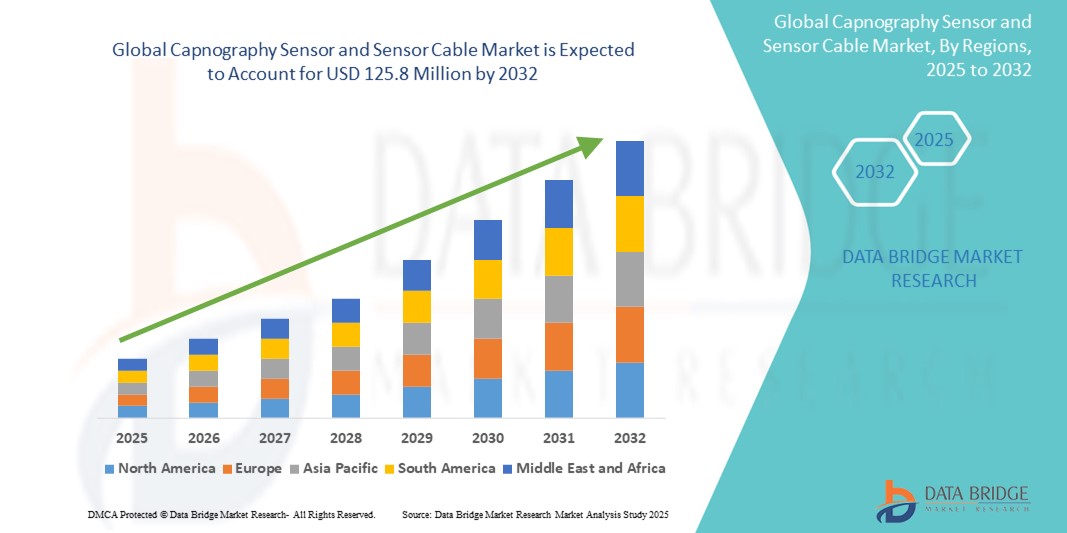
- The global capnography sensor and sensor cable market size was valued at USD 84.50 million in 2024 and is expected to reach USD 125.8 million by 2032, at a CAGR of 5.10% during the forecast period
- The market growth is primarily driven by the increasing prevalence of respiratory disorders, growing demand for non-invasive and continuous respiratory monitoring, and the expanding use of capnography in critical care and emergency settings
- In addition, advancements in sensor technology and miniaturization are enabling the development of more accurate, portable, and user-friendly capnography devices. These evolving trends are fueling the adoption of capnography sensors and cables across hospitals, ambulatory settings, and home care environments, thus supporting steady market expansion
Capnography Sensor and Sensor Cable Market Analysis
- Capnography sensors and sensor cables, essential for measuring the concentration of carbon dioxide in respiratory gases, are becoming increasingly critical in clinical and emergency settings due to their ability to provide continuous, non-invasive monitoring of patient ventilation and respiratory status
- The rising demand for capnography solutions is driven by the growing incidence of respiratory illnesses, increased surgical procedures requiring anesthesia, and the expanding use of patient monitoring in pre-hospital and critical care environments
- North America dominated the capnography sensor and sensor cable market with the largest revenue share of 39.4% in 2024, supported by advanced healthcare infrastructure, regulatory mandates for capnography in anesthesia monitoring, and strong adoption across hospitals and ambulatory surgical centers, particularly in the U.S.
- Asia-Pacific is projected to witness the fastest growth in the capnography market during the forecast period due to improving healthcare infrastructure, growing awareness of patient safety, and increasing healthcare investments across countries such as China and India
- Plug Type segment dominated the capnography sensor and sensor cable market with a market share of 41.7% in 2024, driven by its ease of connection, wide compatibility with standard medical equipment, and quick deployment in critical care and emergency settings
Report Scope and Capnography Sensor and Sensor Cable Market Segmentation
|
Attributes |
Capnography Sensor and Sensor Cable Key Market Insights |
|
Segments Covered |
|
|
Countries Covered |
North America
Europe
Asia-Pacific
Middle East and Africa
South America
|
|
Key Market Players |
|
|
Market Opportunities |
|
|
Value Added Data Infosets |
In addition to the insights on market scenarios such as market value, growth rate, segmentation, geographical coverage, and major players, the market reports curated by the Data Bridge Market Research also include in-depth expert analysis, pricing analysis, brand share analysis, consumer survey, demography analysis, supply chain analysis, value chain analysis, raw material/consumables overview, vendor selection criteria, PESTLE Analysis, Porter Analysis, and regulatory framework. |
Capnography Sensor and Sensor Cable Market Trends
“Miniaturization and Wireless Integration for Portable and Real-Time Monitoring”
- A major and emerging trend in the global capnography sensor and sensor cable market is the shift toward miniaturized, portable, and wirelessly integrated solutions, designed to meet the growing demand for real-time, continuous respiratory monitoring in a variety of care environments—from hospitals to home care settings
- For instance, Medtronic’s Microstream capnography technology enables compact capnography modules that can be integrated into patient monitors across critical care, transport, and emergency use cases. Similarly, Masimo offers capnography solutions with wireless connectivity to streamline respiratory data collection and improve mobility for both patients and clinicians
- The move toward miniaturization allows for capnography sensors to be embedded into lightweight, handheld, or wearable monitors, increasing their utility in ambulances, outpatient clinics, and even remote monitoring scenarios. Wireless sensor cables further eliminate physical obstructions, enhance patient comfort, and reduce the risk of disconnection or interference during care
- Moreover, advanced capnography systems are increasingly equipped with smart analytics and AI-based algorithms to detect respiratory abnormalities early, improving clinical decision-making. Real-time data transmission to electronic health records (EHR) systems or mobile devices supports better workflow and improved patient outcomes
- This trend is fundamentally transforming the capnography market from hospital-centric devices to broader, patient-centered technologies, as manufacturers such as Nihon Kohden and Mindray develop smart, portable capnography tools tailored for multiple care points
- With the rise in demand for mobility, efficiency, and high-acuity monitoring in varied healthcare settings, the push for compact, wireless, and intelligent capnography solutions is expected to continue shaping the market landscape
Capnography Sensor and Sensor Cable Market Dynamics
Driver
“Rising Demand for Respiratory Monitoring Amid Growing Prevalence of Respiratory Diseases”
- The increasing incidence of respiratory disorders such as COPD, asthma, and acute respiratory distress syndrome (ARDS), along with the global emphasis on early diagnosis and continuous respiratory monitoring, is a significant driver of growth for the capnography sensor and sensor cable market
- For instance, in March 2024, Philips launched a next-generation capnography module integrated into its IntelliVue monitors, designed to meet the surging demand for advanced respiratory monitoring in ICUs and perioperative settings
- Capnography offers a non-invasive, real-time method of assessing a patient's ventilatory status, making it a vital tool in operating rooms, emergency departments, and during procedural sedation. Increasing surgical volumes and the rise in anesthesia monitoring requirements further contribute to the market expansion
- In addition, the rising adoption of portable and point-of-care devices—especially in home healthcare and ambulatory environments reinforces the relevance of capnography as a routine monitoring modality
- The integration of capnography with multiparameter monitors, mobile apps, and cloud-based health platforms enhances its accessibility and operational efficiency across care settings, driving both clinical utility and commercial demand
Restraint/Challenge
“Technical Complexities and Cost Constraints in Emerging Economies”
- Despite its clinical importance, the adoption of capnography sensors and cables is constrained by technical limitations and cost-related challenges, particularly in low- and middle-income countries where access to advanced monitoring technologies remains limited
- In many developing regions, budget constraints and inadequate healthcare infrastructure hinder the deployment of capnography systems, especially in prehospital or rural care environments
- In addition, the requirement for calibration, proper sensor placement, and device maintenance adds a layer of complexity that may deter widespread use in non-specialized care settings
- Some healthcare providers also express concern over sensor variability and data interpretation in low-perfusion or high-humidity environments, potentially affecting accuracy.
- While companies such as Medtronic and Masimo are working on cost-effective, durable, and user-friendly solutions, the perception of capnography as a high-cost tool for limited use cases still limits its adoption outside high-resource settings
- To overcome these challenges, industry stakeholders must focus on affordability, training programs for healthcare staff, simplified device design, and increased awareness of capnography’s clinical benefits to ensure broader accessibility and sustained market growth
Capnography Sensor and Sensor Cable Market Scope
The market is segmented on the basis of rated voltage, connector type, jacket type, and end-use industry.
- By Rated Voltage
On the basis of rated voltage, the capnography sensor and sensor cable market is segmented into Up to 50 V, 50 V to 100 V, 100 V to 250 V, 250 V to 400 V, and Above 400 V. The Up to 50 V segment dominated the market with the largest revenue share of 34.8% in 2024, attributed to its suitability for low-power medical applications where patient safety and device portability are critical. These low-voltage sensors are favored in capnography systems used in ICUs, emergency departments, and portable monitors, where minimal electrical exposure is essential.
The 100 V to 250 V segment is projected to grow at the fastest rate from 2025 to 2032, owing to increasing deployment in advanced multiparameter monitoring systems and surgical settings that require higher-powered sensor integration for enhanced signal processing and data accuracy.
- By Connector Type
On the basis of connector type, the capnography sensor and sensor cable market is segmented into Plug Type, Socket Type, and Flange Type. The Plug Type segment held the largest market share of 41.7% in 2024, driven by its widespread use in hospital-grade equipment due to ease of connection, quick interchangeability, and reliable performance in high-usage medical environments. Its compatibility with most monitoring systems and reduced risk of disconnection makes it the preferred choice for critical care.
The Flange Type segment is expected to witness the fastest growth rate over the forecast period, especially in OEM applications where permanent and secure sensor mounting is necessary, such as in surgical machines or integrated diagnostic devices.
- By Jacket Type
On the basis of jacket type, the capnography sensor and sensor cable market is segmented into PUR (Polyurethane), PVC (Polyvinyl Chloride), TPE (Thermoplastic Elastomer), and Others. The PUR segment dominated the market in 2024 with a revenue share of 38.7%, owing to its superior flexibility, chemical resistance, and abrasion durability—making it ideal for hospital use where repeated handling, disinfection, and durability are key.
The TPE segment is anticipated to register the highest CAGR from 2025 to 2032, due to its eco-friendliness, softness, and enhanced biocompatibility, which make it suitable for next-gen wearable and patient-friendly capnography devices in both hospital and home care settings.
- By End-Use Industry
On the basis of end-use industry, the capnography sensor and sensor cable market is segmented into manufacturing industry, material handling industry, packaging industry, food and beverages, electronics industry, and others. The Electronics Industry segment held the dominant share in 2024, accounting for 33.4% of the market, as capnography sensor integration in medical electronics and diagnostic devices continues to rise. The growing demand for compact, real-time monitoring devices in both OEM and aftermarket medical solutions is driving adoption in this segment.
The Food and Beverages industry is expected to witness the fastest growth during the forecast period, driven by increasing use of gas detection and monitoring systems during packaging and storage to ensure CO₂ levels remain within safety standards, where capnography cables are being adapted for broader gas sensing applications.
Capnography Sensor and Sensor Cable Market Regional Analysis
- North America dominated the capnography sensor and sensor cable market with the largest revenue share of 39.4% in 2024, supported by advanced healthcare infrastructure, regulatory mandates for capnography in anesthesia monitoring, and strong adoption across hospitals and ambulatory surgical centers, particularly in the U.S.
- Healthcare providers in the region prioritize accurate, non-invasive respiratory monitoring tools to enhance patient safety across surgical, emergency, and intensive care environments
- This widespread usage is further supported by ongoing technological advancements, increasing prevalence of respiratory disorders, and growing investments in telehealth and portable monitoring devices, positioning capnography sensors and cables as essential components in modern clinical settings
U.S. Capnography Sensor and Sensor Cable Market Insight
The U.S. capnography sensor and sensor cable market captured the largest revenue share of 79.4% in 2024 within North America, driven by the country’s advanced healthcare infrastructure, widespread adoption of non-invasive monitoring, and strong regulatory support for capnography in clinical settings. The growing focus on patient safety during surgeries and critical care, along with the integration of capnography into multi-parameter monitors, continues to support market growth. In addition, high demand for portable and wireless capnography solutions in ambulatory and home care settings is further expanding the market.
Europe Capnography Sensor and Sensor Cable Market Insight
The Europe capnography sensor and sensor cable market is projected to expand at a substantial CAGR during the forecast period, supported by increasing surgical volumes, rising awareness about respiratory monitoring, and compliance with medical safety standards. Growing emphasis on perioperative monitoring and the prevalence of respiratory disorders are encouraging hospitals and clinics to adopt capnography systems. Integration with existing monitoring platforms and the rise of digital health initiatives are also driving broader use across healthcare environments, including emergency response and post-anesthesia care.
U.K. Capnography Sensor and Sensor Cable Market Insight
The U.K. capnography market is anticipated to grow at a noteworthy CAGR over the forecast period, fueled by the NHS’s focus on improving patient safety, early detection of respiratory issues, and real-time monitoring in clinical settings. The rise in procedural sedation across dental and outpatient practices, as well as growing awareness of CO₂ monitoring among healthcare professionals, is supporting market expansion. In addition, advancements in portable capnography technology are enabling wider adoption across mobile and community healthcare units.
Germany Capnography Sensor and Sensor Cable Market Insight
The Germany capnography sensor and sensor cable market is expected to expand at a considerable CAGR, driven by increasing use of monitoring technologies in critical care and anesthesia. The country’s focus on digital healthcare infrastructure, along with rising surgical procedures and elderly patient population, boosts the demand for continuous respiratory monitoring. Germany’s well-established medical device industry also fosters local innovation and integration of advanced capnography components in ICU and operating room environments.
Asia-Pacific Capnography Sensor and Sensor Cable Market Insight
The Asia-Pacific capnography sensor and sensor cable market is poised to grow at the fastest CAGR of 25.2% during the forecast period of 2025 to 2032, driven by increasing healthcare investments, rising incidence of respiratory illnesses, and expansion of critical care services in countries such as China, India, and Japan. Regional governments are emphasizing quality care and diagnostic efficiency, leading to higher adoption of monitoring technologies. Local production and affordability of capnography systems are also making these tools more accessible across varied healthcare settings.
Japan Capnography Sensor and Sensor Cable Market Insight
The Japan capnography market is gaining momentum due to its advanced healthcare infrastructure, growing elderly population, and high emphasis on safety in clinical practice. Capnography is increasingly being adopted in anesthesia and emergency care settings, supported by the country’s shift towards digitized and minimally invasive monitoring solutions. Integration with mobile and AI-enabled health devices is also contributing to growth, particularly in home care and outpatient monitoring.
India Capnography Sensor and Sensor Cable Market Insight
The India capnography market accounted for the largest revenue share in Asia Pacific in 2024, owing to rising healthcare awareness, increasing demand for surgical procedures, and improved access to advanced patient monitoring technologies. India's ongoing healthcare modernization, strong growth in private hospital networks, and government initiatives supporting critical care expansion are key growth drivers. The presence of domestic medical device manufacturers offering affordable capnography solutions is further accelerating adoption across Tier I and Tier II cities.
Capnography Sensor and Sensor Cable Market Share
The capnography sensor and sensor cable industry is primarily led by well-established companies, including:
- GENERAL ELECTRIC COMPANY (U.S.)
- TOSHIBA CORPORATION (Japan)
- Koninklijke Philips N.V. (Netherlands)
- Carestream Health (U.S.)
- Shenzhen Mindray Bio-Medical Electronics Co., Ltd. (China)
- Ziehm Imaging GmbH (Germany)
- Canon Inc. (Japan)
- FUJIFILM Holdings Corporation (Japan)
- GMM Pfaudler (India)
- Danaher Corporation (U.S.)
- PLANMECA OY (Finland)
- VATECH INDIA PVT. LTD. (India)
- Villa Sistemi Medicali Spa. (Italy)
- Midmark Corporation (U.S.)
- Apteryx Imaging Inc. (Canada)
- Varian Medical Systems, Inc. (U.K.)
- Hamamatsu Photonics K.K. (Japan)
- KA Imaging (Canada)
What are the Recent Developments in Global Capnography Sensor and Sensor Cable Market?
- In April 2023, Philips Healthcare expanded its patient monitoring portfolio with the introduction of a next-generation capnography module integrated into its IntelliVue MX series. Designed for critical and perioperative care, the upgraded module offers improved CO₂ measurement accuracy and enhanced alarm algorithms. This development highlights Philips’ focus on delivering precise, real-time respiratory monitoring solutions to improve patient safety and clinical outcomes in high-acuity settings
- In March 2023, Masimo Corporation announced the global release of its Radius PCG, a portable, Bluetooth-enabled capnograph featuring real-time EtCO₂ monitoring and compatibility with the Masimo Root® platform. The device supports flexible use in emergency, transport, and home care environments. This innovation underscores Masimo’s commitment to advancing wireless monitoring technology that enhances mobility and responsiveness in respiratory care
- In February 2023, Medtronic plc launched a new line of Microstream capnography accessories designed for expanded use in low-resource settings and mobile clinics. The updated sensor cables and filter lines are optimized for durability, cost-efficiency, and compatibility with portable monitors, reinforcing Medtronic’s effort to make advanced respiratory monitoring more accessible in underserved healthcare systems
- In February 2023, Nihon Kohden unveiled its Smart Cable Cap-ONE® series enhancement, which integrates capnography measurement into a single, lightweight cable for use with multi-parameter monitors. The new model allows for faster setup and easier maintenance in surgical and critical care environments. This update demonstrates the company’s commitment to streamlining clinical workflows and improving real-time respiratory assessments
- In January 2023, Mindray Medical International announced enhancements to its BeneVision N-Series patient monitors, including improved capnography modules featuring automatic calibration and adaptive sampling rates. These improvements aim to boost monitoring precision and user efficiency across ICU and anesthesia departments. Mindray’s innovation reflects a broader industry trend towards smarter, more intuitive monitoring systems

- Interactive Data Analysis Dashboard
- Company Analysis Dashboard for high growth potential opportunities
- Research Analyst Access for customization & queries
- Competitor Analysis with Interactive dashboard
- Latest News, Updates & Trend analysis
- Harness the Power of Benchmark Analysis for Comprehensive Competitor Tracking
Data collection and base year analysis are done using data collection modules with large sample sizes. The stage includes obtaining market information or related data through various sources and strategies. It includes examining and planning all the data acquired from the past in advance. It likewise envelops the examination of information inconsistencies seen across different information sources. The market data is analysed and estimated using market statistical and coherent models. Also, market share analysis and key trend analysis are the major success factors in the market report. To know more, please request an analyst call or drop down your inquiry.
The key research methodology used by DBMR research team is data triangulation which involves data mining, analysis of the impact of data variables on the market and primary (industry expert) validation. Data models include Vendor Positioning Grid, Market Time Line Analysis, Market Overview and Guide, Company Positioning Grid, Patent Analysis, Pricing Analysis, Company Market Share Analysis, Standards of Measurement, Global versus Regional and Vendor Share Analysis. To know more about the research methodology, drop in an inquiry to speak to our industry experts.
Data Bridge Market Research is a leader in advanced formative research. We take pride in servicing our existing and new customers with data and analysis that match and suits their goal. The report can be customized to include price trend analysis of target brands understanding the market for additional countries (ask for the list of countries), clinical trial results data, literature review, refurbished market and product base analysis. Market analysis of target competitors can be analyzed from technology-based analysis to market portfolio strategies. We can add as many competitors that you require data about in the format and data style you are looking for. Our team of analysts can also provide you data in crude raw excel files pivot tables (Fact book) or can assist you in creating presentations from the data sets available in the report.













