


Cationic Surfactants Market Overview
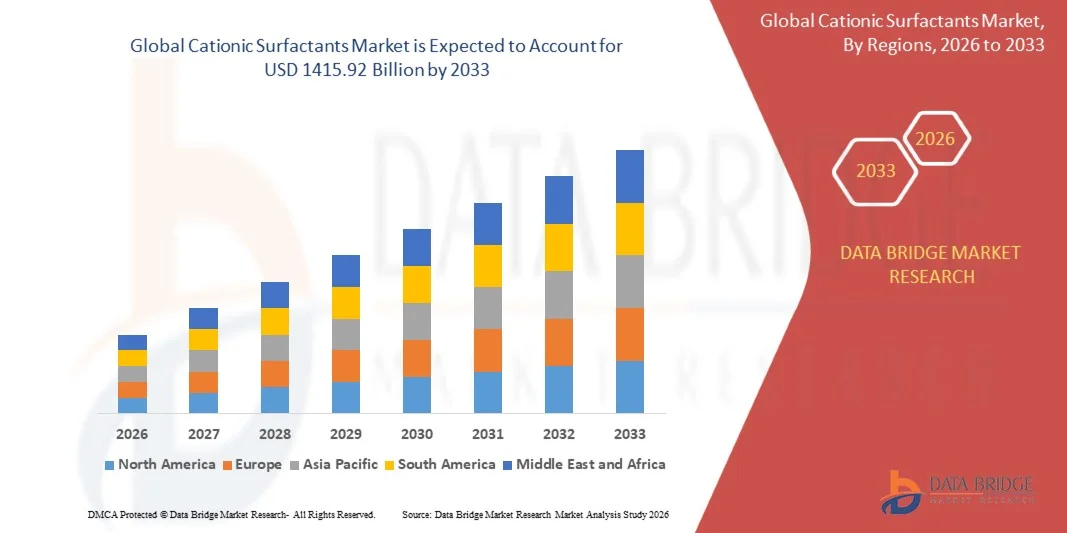
As per Data Bridge Market Research Analysis, the Cationic Surfactants Market was valued at USD 1006.39 billion in 2025 and is projected to reach USD 1415.92 billion by 2033, growing at a CAGR of 4.36% from 2026 to 2033. The market is experiencing robust growth driven by increasing demand from personal care, home care, and industrial cleaning sectors, where cationic surfactants serve as key ingredients due to their antimicrobial, conditioning, and emulsifying properties.
Cationic surfactants are surface-active agents with a positive charge on their hydrophilic heads, offering unique properties including antistatic effects, antimicrobial activity, and excellent conditioning capabilities. These versatile compounds are widely used in hair conditioners, fabric softeners, disinfectants, and industrial cleaning formulations. Their ability to reduce static, improve texture, and provide antimicrobial effects makes them essential across multiple end-use industries. The market is witnessing a strong shift toward sustainable and bio-based formulations, with manufacturers increasingly investing in eco-friendly alternatives using renewable raw materials.
Key Market Trends & Insights
- Asia-Pacific dominated the Cationic Surfactants Market with the largest revenue share of approximately 45% in 2025, driven by robust demand from personal care, home care, and textile industries in China, India, and Japan. The region's rapid urbanization, rising disposable incomes, and expanding personal care and home care industries are fueling market growth.
- North America accounted for a significant market share of around 35% in 2025, due to strong demand from personal care, home care, and industrial & institutional cleaning applications. Europe follows as another key market, driven by stringent environmental regulations and increasing preference for sustainable formulations.
- The Quaternary Ammonium Compounds segment dominated the product type category with a market share of 45.5% in 2025, due to strong antimicrobial performance and wide usage in personal care, home care, and industrial cleaning applications.
- The Personal Care segment emerged as the largest application category, with hair conditioner accounting for over 67% of the market share. The growing demand for premium, multifunctional, and specialized personal care products is driving the adoption of cationic surfactants.
- The shift toward bio-based and sustainable cationic surfactants is accelerating, driven by regulatory pressures and growing consumer preference for eco-friendly products. Manufacturers are developing ultra-clean formulations for electronics and pharmaceuticals, and investing in AI and automation to fast-track the creation of safer and more efficient surfactants.
Market Size & Forecast
- Global Market Value (2025): USD 1006.39 Billion
- Expected Market Value (2033): USD 1415.92 Billion
- Forecast CAGR (2026–2033): 4.36%
- Leading Region in 2025: Asia-Pacific
- Fastest Growing Region: Asia-Pacific
Report Scope and Cationic Surfactants Market Segmentation
|
Attributes |
Cationic Surfactants Key Market Insights |
|
Segments Covered |
|
|
Countries Covered |
North America · U.S. · Canada · Mexico Europe · Germany · France · U.K. · Netherlands · Switzerland · Belgium · Russia · Italy · Spain · Turkey · Rest of Europe Asia-Pacific · China · Japan · India · South Korea · Singapore · Malaysia · Australia · Thailand · Indonesia · Philippines · Rest of Asia-Pacific Middle East and Africa · Saudi Arabia · U.A.E. · South Africa · Egypt · Israel · Rest of Middle East and Africa South America · Brazil · Argentina · Rest of South America |
|
Key Market Players |
· BASF SE (Germany) · Evonik Industries AG (Germany) · Clariant AG (Switzerland) · Croda International Plc (U.K.) · Stepan Company (U.S.) · Solvay S.A. (Belgium) · Kao Corporation (Japan) · Huntsman Corporation (U.S.) · Ashland Inc. (U.S.) · Lubrizol Corporation (U.S.) · Akzo Nobel N.V. (Netherlands) · Dow Inc. (U.S.) · Nouryon (Netherlands) · Zanyu Technology (China) · Lion Corporation (Japan) · Sasol (South Africa) · Resun-Auway (China) · Miwon Commercial (South Korea) · Thor Personal Care (U.K.) · JEEN International (U.S.) · Innospec Inc. (U.S.) · KCI (South Korea) |
|
Market Opportunities |
· Development of bio-based and sustainable cationic surfactant formulations · Integration of AI and automation in surfactant development and production · Expansion of clean-label and eco-friendly personal care products · Growing demand for multifunctional surfactants combining conditioning, antimicrobial, and emulsifying properties · Increasing adoption in water treatment and enhanced oil recovery applications · Rising focus on green chemistry and biodegradable surfactant systems |
|
Value Added Data Infosets |
In addition to the insights on market scenarios such as market value, growth rate, segmentation, geographical coverage, and major players, the market reports curated by the Data Bridge Market Research also include import export analysis, production capacity overview, production consumption analysis, price trend analysis, climate change scenario, supply chain analysis, value chain analysis, raw material/consumables overview, vendor selection criteria, PESTLE Analysis, Porter Analysis, and regulatory framework. |
Cationic Surfactants Market Trends
Trend: Shift Toward Sustainable and Bio-Based Surfactants
As environmental awareness grows among consumers and regulators, there is a strong movement to reduce the ecological footprint of chemical products. Traditional cationic surfactants, while effective, often raise concerns due to their poor biodegradability and potential toxicity to aquatic life. In response, manufacturers are investing in research and development to create eco-friendly formulations using renewable raw materials, such as plant-based oils and natural fatty amines. These bio-based surfactants meet stricter environmental standards and align with the values of environmentally conscious consumers. Bio-based cationic surfactants derived from vegetable oils and starches are gaining market share due to regulatory pressures.
Cationic Surfactants Market Dynamics
Key Market Driver: Growth in Personal Care and Cosmetic Industry
The growing personal care and cosmetic industry is a significant driver of the cationic surfactants market growth. These surfactants are key ingredients in products such as hair conditioners, skin creams, and lotions due to their excellent emulsifying, conditioning, and antimicrobial properties. As consumer preferences shift toward more premium, multifunctional, and specialized personal care products, manufacturers are increasingly using cationic surfactants to enhance both product performance and user experience. Furthermore, rising disposable incomes, urbanization, and increased awareness of grooming, particularly in emerging economies, are boosting the demand for these products. This consistent growth in the personal care sector directly drives the need for high-quality surfactant solutions.
Key Restraint/Challenge: Environmental and Regulatory Concerns
Despite their usefulness, many conventional cationic surfactants pose environmental risks due to their low biodegradability and toxicity to aquatic life. Regulatory agencies, such as the U.S. Environmental Protection Agency (EPA) and the European Chemicals Agency (ECHA), have established strict regulations regarding the use and discharge of these substances. Complying with these regulations increases production complexity and costs, as manufacturers may need to reformulate their products or invest in cleaner alternatives. These environmental and legal constraints limit the use of certain cationic surfactants and restrict market growth.
Key Market Opportunity: Development of Bio-Based and Sustainable Surfactants
The growing demand for bio-based and sustainable cationic surfactants presents a significant market opportunity. As industries and consumers become increasingly focused on sustainability and environmental concerns, manufacturers are creating bio-based and eco-friendly surfactants using renewable raw materials. Companies that invest in bio-based surfactant technologies and secure early patents in this space are well-positioned to capture a significant share of the premium segment.
Cationic Surfactants Market Scope
The cationic surfactants market is segmented on the basis of product type, application, and end-user.
By Product Type
On the basis of product type, the Cationic Surfactants Market is segmented into quaternary ammonium compounds, amine oxides, and others.
The Quaternary Ammonium Compounds segment dominated the market with a market share of 45.5% in 2025, due to strong antimicrobial performance and wide usage in personal care, home care, and industrial cleaning applications. Their conditioning, disinfecting, and antistatic properties support consistent demand across multiple industries. Chemical stability and formulation compatibility further strengthen large-scale adoption. Regulatory acceptance in hygiene products also supports sustained market leadership.
The Amine Oxides segment is expected to witness steady growth, driven by extensive use as mild and gentle surfactants in personal care and home care products. Amine oxides are gaining traction due to their effective cleansing properties and versatility in formulation.
By Application
On the basis of application, the Cationic Surfactants Market is segmented into personal care, home care, industrial & institutional cleaning, oil & gas, agriculture, and others.
The Personal Care segment dominated the market, with hair conditioner accounting for over 67% of the market share. Cationic surfactants are essential ingredients in hair conditioners, shampoos, skin creams, and lotions due to their excellent emulsifying, conditioning, and antimicrobial properties.
The Home Care segment is expected to register significant growth, driven by growing demand for fabric softeners, disinfectants, and sanitizers. The Industrial & Institutional Cleaning segment continues to drive steady demand for cationic surfactants due to their antimicrobial properties.
The Oil & Gas segment is gaining traction, supported by the surge in oil exploration activities and demand for stable surfactants in harsh environments. Cationic surfactants are used in enhanced oil recovery operations, drilling fluids, and corrosion inhibitors.
The Agriculture segment is driven by the need for adjuvants in agrochemical formulations. Cationic surfactants help improve the wetting, spreading, and penetration of pesticides and fertilizers on plant surfaces.
By End-User
On the basis of end-user, the Cationic Surfactants Market is segmented into cosmetics, pharmaceuticals, food & beverage, textile, and others.
The Cosmetics segment dominated the market, driven by rising consumer spending and increasing disposable income. The Textile segment is a significant end-user, driven by the use of cationic surfactants in dye-fixation and softening purposes. The Pharmaceuticals segment is gaining traction due to the use of cationic surfactants as emulsifiers and stabilizers in pharmaceutical formulations.
Cationic Surfactants Market Regional Analysis
Asia-Pacific Cationic Surfactants Market Insight
Asia-Pacific dominated the Cationic Surfactants Market with the largest revenue share of approximately 45% in 2025, driven by robust demand from personal care, home care, and textile industries in China, India, and Japan. The region's rapid urbanization, rising disposable incomes, and expanding personal care and home care industries are fueling market growth. Asia-Pacific, especially India and China, is driving bulk consumption due to growth in cosmetics and textiles.
China Cationic Surfactants Market Insight
The China cationic surfactants market is the largest in the Asia-Pacific region, driven by the country's massive personal care industry, growing textile sector, and expanding industrial cleaning applications. China's rapid urbanization and rising disposable incomes are fueling demand for personal care products, household cleaners, and textile processing chemicals. The country is also a major producer of cationic surfactants, with domestic manufacturers expanding their production capacities.
India Cationic Surfactants Market Insight
The India cationic surfactants market is experiencing rapid growth, driven by a personal care boom, expanding textile industry, and increasing demand for high-performance surfactants. The country's growing population and rising disposable incomes are fueling demand for personal care products, detergents, and agrochemicals. India is emerging as a key market for cationic surfactants manufacturers.
Japan Cationic Surfactants Market Insight
The Japan cationic surfactants market is characterized by high demand for premium personal care products and advanced industrial applications. Japanese consumers prefer high-quality, multifunctional ingredients in skincare and haircare products, driving demand for advanced cationic surfactant formulations.
North America Cationic Surfactants Market Insight
North America accounted for a significant market share of around 35% in 2025, due to strong demand from personal care, home care, and industrial & institutional cleaning applications. The United States represents a mature and innovation-driven market, supported by advanced chemical manufacturing capabilities and strong demand from personal care and industrial sectors.
U.S. Cationic Surfactants Market Insight
The U.S. cationic surfactants market is experiencing significant growth driven by increased demand for eco-conscious personal care products, industrial cleaning, and advanced coatings. The country's mature personal care industry and strong R&D capabilities support market expansion. Regulatory focus on ingredient safety encourages the use of mild surfactant systems.
Europe Cationic Surfactants Market Insight
Europe is a key market for cationic surfactants, driven by stringent environmental regulations and increasing preference for sustainable formulations. Germany accounts for approximately 9% of Europe's market, while the United Kingdom accounts for approximately 7%.
Germany Cationic Surfactants Market Insight
The Germany cationic surfactants market is a key market in Europe, driven by its strong industrial cleaners sector and stringent environmental regulations. German manufacturers are at the forefront of developing sustainable and bio-based cationic surfactant formulations.
U.K. Cationic Surfactants Market Insight
The United Kingdom cationic surfactants market is witnessing steady growth, supported by rising demand for personal care products and increasing adoption of sustainable formulations.
Middle East and Africa Cationic Surfactants Market Insight
The Middle East and Africa cationic surfactants market is gradually emerging, supported by increasing industrial investments and a shift toward cleaner production technologies. The region's oil and gas industry presents opportunities for cationic surfactants used in enhanced oil recovery and drilling fluid applications.
South America Cationic Surfactants Market Insight
The South America cationic surfactants market is expanding, driven by the region's growing personal care industry, increasing agricultural activities, and rising construction spending. Brazil is the largest market in the region.
Cationic Surfactants Market Share
The Cationic Surfactants industry is primarily led by well-established companies, including:
- BASF SE (Germany)
- Evonik Industries AG (Germany)
- Clariant AG (Switzerland)
- Croda International Plc (U.K.)
- Stepan Company (U.S.)
- Solvay S.A. (Belgium)
- Kao Corporation (Japan)
- Huntsman Corporation (U.S.)
- Ashland Inc. (U.S.)
- Lubrizol Corporation (U.S.)
- Akzo Nobel N.V. (Netherlands)
- Dow Inc. (U.S.)
- Nouryon (Netherlands)
- Zanyu Technology (China)
- Lion Corporation (Japan)
- Sasol (South Africa)
- Resun-Auway (China)
- Miwon Commercial (South Korea)
- Thor Personal Care (U.K.)
- JEEN International (U.S.)
- Innospec Inc. (U.S.)
- KCI (South Korea)
Latest Developments in Cationic Surfactants Market
- In March 2026, BASF initiated the first commercial production of biomass balance polyether polyols in North America at its Geismar, Louisiana Verbund site. These new grades contain renewable bio-circular materials replacing a portion of fossil-based feedstocks, helping customers reduce the product carbon footprint of flexible foam formulations used in countless industrial applications.
- In March 2026, Evonik moved its Slovakia facility into high-output operations, establishing it as the world's first industrial-scale rhamnolipid production plant. The company simultaneously launched its Innovation Factory, a dedicated platform to accelerate commercialization and reduce time-to-market for biosurfactants to under five years.
- In March 2025, Evonik entered an exclusive agreement with Sea-Land Chemical Company to distribute its bio-based cleaning solutions across the United States. The partnership focuses on replacing fossil-derived surfactants in industrial and institutional cleaning formulations with biodegradable alternatives.
- In February 2026, BASF reported €6.6 billion EBITDA for 2025, with its Nutrition & Care segment identified as a key earnings driver for 2026. Under its "Winning Ways" strategy, BASF is prioritizing bio-based surfactants and specialty care chemicals, leveraging its Zhanjiang Verbund site to meet rising demand for sustainable home care and personal care formulations across Asia.
- In November 2025, Stepan Company and Belgian biotech innovator AmphiStar announced an exclusive distribution partnership for bio-based surfactants across Europe, the Middle East and Africa, with a focus on the Home Care and Industrial & Institutional cleaning markets. AmphiStar develops upcycled biosurfactants designed to deliver robust cleaning performance with a significantly decreased product carbon footprint compared to conventional alternatives.
- In November 2025, Clariant completed an $88 million investment to expand its Care Chemicals facilities at Daya Bay, China. The facility's output now includes high-performance surfactants, water-based coatings that cut VOC emissions, synthetic lubricants, and crop protection additives.
- In October 2025, BASF delivered its first shipment of biomass-balanced BMBCert 3-(dimethylamino)propylamine in Asia Pacific to Galaxy Surfactants of India. Galaxy Surfactants plans to use BASF's BMBCert DMAPA to produce Galaxy CAPB SB for personal care applications, aiming for a reduction in CO₂ emissions compared to its existing products.
- In January 2025, OpenGate Capital announced the acquisition of Solvay's North American and European amphoteric surfactant manufacturing business, including three main production sites in the United States, United Kingdom, and Germany. The acquisition reinforces OpenGate Capital's position in the specialty chemicals sector.

- Interactive Data Analysis Dashboard
- Company Analysis Dashboard for high growth potential opportunities
- Research Analyst Access for customization & queries
- Competitor Analysis with Interactive dashboard
- Latest News, Updates & Trend analysis
- Harness the Power of Benchmark Analysis for Comprehensive Competitor Tracking
Global Cationic Surfactants Market, Supply Chain Analysis and Ecosystem Framework
To support market growth and help clients navigate the impact of geopolitical shifts, DBMR has integrated in-depth supply chain analysis into its Global Cationic Surfactants Market research reports. This addition empowers clients to respond effectively to global changes affecting their industries. The supply chain analysis section includes detailed insights such as Global Cationic Surfactants Market consumption and production by country, price trend analysis, the impact of tariffs and geopolitical developments, and import and export trends by country and HSN code. It also highlights major suppliers with data on production capacity and company profiles, as well as key importers and exporters. In addition to research, DBMR offers specialized supply chain consulting services backed by over a decade of experience, providing solutions like supplier discovery, supplier risk assessment, price trend analysis, impact evaluation of inflation and trade route changes, and comprehensive market trend analysis.
Data collection and base year analysis are done using data collection modules with large sample sizes. The stage includes obtaining market information or related data through various sources and strategies. It includes examining and planning all the data acquired from the past in advance. It likewise envelops the examination of information inconsistencies seen across different information sources. The market data is analysed and estimated using market statistical and coherent models. Also, market share analysis and key trend analysis are the major success factors in the market report. To know more, please request an analyst call or drop down your inquiry.
The key research methodology used by DBMR research team is data triangulation which involves data mining, analysis of the impact of data variables on the market and primary (industry expert) validation. Data models include Vendor Positioning Grid, Market Time Line Analysis, Market Overview and Guide, Company Positioning Grid, Patent Analysis, Pricing Analysis, Company Market Share Analysis, Standards of Measurement, Global versus Regional and Vendor Share Analysis. To know more about the research methodology, drop in an inquiry to speak to our industry experts.
Data Bridge Market Research is a leader in advanced formative research. We take pride in servicing our existing and new customers with data and analysis that match and suits their goal. The report can be customized to include price trend analysis of target brands understanding the market for additional countries (ask for the list of countries), clinical trial results data, literature review, refurbished market and product base analysis. Market analysis of target competitors can be analyzed from technology-based analysis to market portfolio strategies. We can add as many competitors that you require data about in the format and data style you are looking for. Our team of analysts can also provide you data in crude raw excel files pivot tables (Fact book) or can assist you in creating presentations from the data sets available in the report.













