


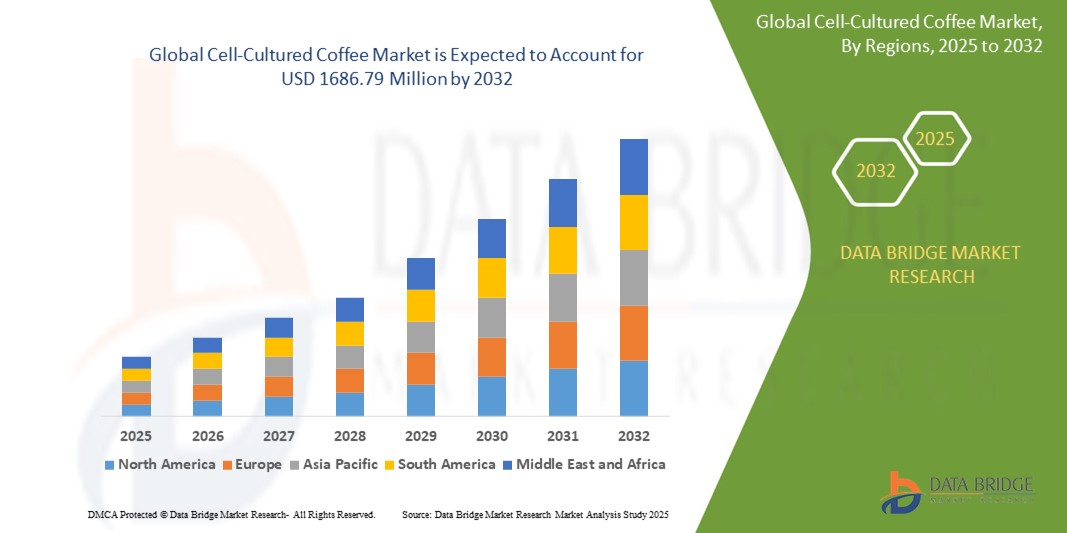
What is the Global Cell-Cultured Coffee Market Size and Growth Rate?
- The global cell-cultured coffee market size was valued at USD 361.80 million in 2024 and is expected to reach USD 1686.79 million by 2032, at a CAGR of 21.22% during the forecast period
- The cell-cultured coffee market encompasses the development, commercialization, and consumption of lab-grown coffee produced through cellular agriculture techniques. Known for its potential to reduce environmental impact and resource consumption, cell-cultured coffee offers a sustainable alternative to traditional coffee farming without compromising flavor or aroma
What are the Major Takeaways of Cell-Cultured Coffee Market?
- The market includes a wide range of cell-cultured coffee formats, such as ready-to-drink beverages, freeze-dried powders, and specialty roasts, catering to eco-conscious consumers, specialty coffee lovers, and tech-forward beverage segments
- Growth is driven by rising concerns over climate change, deforestation, and water use in conventional coffee farming, along with increasing investments in food tech innovation and sustainable production methods
- Market expansion is further supported by evolving consumer preferences for traceable, ethical, and environmentally friendly products, alongside advancements in fermentation techniques and scalable biomanufacturing processes
- North America dominated the cell-cultured coffee market with the largest revenue share of 41.2% in 2024, driven by strong consumer interest in sustainable, tech-enabled food and beverage alternatives
- Asia-Pacific is projected to grow at the fastest CAGR of 11.8% during the forecast period from 2025 to 2032, fueled by increasing awareness of sustainability issues, changing consumer behavior, and the region’s long-standing coffee culture, especially in countries such as South Korea, Japan, and China
- The Arabica-Derived Cells segment held the largest market revenue share of 46.7% in 2024, driven by its globally favored mild flavor profile, lower bitterness, and rich aroma
Report Scope and Cell-Cultured Coffee Market Segmentation
|
Attributes |
Cell-Cultured Coffee Key Market Insights |
|
Segments Covered |
|
|
Countries Covered |
North America
Europe
Asia-Pacific
Middle East and Africa
South America
|
|
Key Market Players |
|
|
Market Opportunities |
|
|
Value Added Data Infosets |
In addition to the insights on market scenarios such as market value, growth rate, segmentation, geographical coverage, and major players, the market reports curated by the Data Bridge Market Research also include in-depth expert analysis, pricing analysis, brand share analysis, consumer survey, demography analysis, supply chain analysis, value chain analysis, raw material/consumables overview, vendor selection criteria, PESTLE Analysis, Porter Analysis, and regulatory framework. |
What is the Key Trend in the Cell-Cultured Coffee Market?
“Premiumization and Sustainable Innovation”
- A prominent trend in the global cell-cultured coffee market is the increasing consumer shift toward premium, sustainable, and tech-forward coffee alternatives. Cell-cultured coffee is gaining traction as a high-quality, lab-grown alternative that eliminates the environmental downsides of conventional coffee farming, such as deforestation, pesticide use, and water scarcity
- Leading companies are launching single-origin, ethically sourced, and functional coffee products enhanced with adaptogens, vitamins, or nootropics to cater to modern, health-aware consumers. For instance, Atomo Coffee and Compound Foods are developing molecular coffee products with rich aroma and flavor, minus the bean
- The market is also experiencing growth in RTD (Ready-to-Drink) and cold brew formats, providing on-the-go convenience without compromising quality. This aligns with rising urban demand for clean-label, performance-enhancing beverages
- Sustainable packaging solutions such as compostable pods, recyclable bottles, and minimal-waste refill systems are being widely adopted to appeal to climate-conscious consumers
- As consumers prioritize ethical sourcing, environmental responsibility, and personalized nutrition, cell-cultured coffee is positioned to lead the next wave of innovation in the global coffee industry
What are the Key Drivers of Cell-Cultured Coffee Market?
- Growing environmental concerns related to traditional coffee cultivation such as excessive water use, carbon emissions, and land degradation are pushing consumers and investors toward eco-friendly coffee alternatives
- Increasing demand for consistent-quality, lab-controlled beverages is also fueling the rise of cell-cultured coffee, particularly in premium cafes, wellness stores, and tech-enabled retail platforms
- For instance, in 2024, Voyage Foods (U.S.) began scaling beanless coffee production, marketing it as a sustainable alternative to conventional brews while maintaining familiar taste and aroma
- Health-conscious consumers are also drawn to the lower acidity and customizable caffeine levels of lab-grown coffee, which reduces risks of digestive discomfort or caffeine crashes
- Government funding and private investments in cellular agriculture and sustainable food technologies are further supporting market expansion, especially in North America and Western Europe
Which Factor is challenging the Growth of the Cell-Cultured Coffee Market?
- A key challenge to market growth is low consumer awareness and limited product familiarity, especially in developing regions where traditional coffee holds cultural and emotional significance
- Despite technological breakthroughs, taste perception and skepticism toward lab-grown beverages remain barriers, particularly among purist coffee consumers in Europe and Latin America
- For instance, while Atomo’s beanless brews are gaining popularity in U.S. urban centers, they face hesitation in conventional retail spaces where consumers still expect traditional origins and authenticity
- Another hurdle is the high cost of production and limited scalability of current bioreactor technologies, which may delay mass-market penetration and price competitiveness
- To overcome these challenges, companies must focus on transparent branding, storytelling, and sampling strategies, while also investing in flavor optimization, regulatory approvals, and global distribution networks to ensure long-term growth
How is the Cell-Cultured Coffee Market Segmented?
The market is segmented on the basis of cultivation source, production technology, roast type, caffeine content, packaging type, and distribution channel.
- By Cultivation Source
On the basis of cultivation source, the cell-cultured coffee market is segmented into Arabica-Derived Cells, Robusta-Derived Cells, Liberica-Derived Cells, and Others. The Arabica-Derived Cells segment held the largest market revenue share of 46.7% in 2024, driven by its globally favored mild flavor profile, lower bitterness, and rich aroma. Arabica-based cell cultures are preferred for premium and specialty blends, making them highly desirable for luxury and health-conscious beverage lines.
The Robusta-Derived Cells segment is expected to register the fastest CAGR from 2025 to 2032, due to its higher caffeine content and increasing adoption in functional beverages and energy drinks.
- By Production Technology
On the basis of production technology, the market is segmented into Cell-Based Cultivation and Hybrid Production. In 2024, Cell-Based Cultivation dominated the market with a revenue share of 58.1%, attributed to its ability to replicate traditional coffee components without environmental strain, appealing strongly to eco-conscious consumers and investors.
The Hybrid Production segment is projected to grow at the fastest pace during the forecast period, as manufacturers combine traditional fermentation with lab-cultured extracts to enhance flavor complexity and reduce costs.
- By Roast Type
On the basis of roast type, the cell-cultured coffee market is segmented into Light Roast, Medium Roast, and Dark Roast. The Medium Roast segment accounted for the largest market share of 39.5% in 2024, driven by its balanced flavor, moderate acidity, and widespread consumer preference across both North America and Asia.
The Light Roast segment is anticipated to grow at the highest CAGR, as it retains more original coffee characteristics and bioactive compounds, making it popular among health-oriented and specialty coffee consumers.
- By Caffeine Content
On the basis of caffeine content, the market is segmented into Caffeinated and Decaffeinated. The Caffeinated segment dominated the market in 2024 with a revenue share of 70.8%, due to high consumer demand for energy-boosting beverages and natural stimulants.
The Decaffeinated segment is set to grow at a robust CAGR from 2025 to 2032, supported by rising demand for low-stimulant alternatives among older adults, pregnant women, and individuals with caffeine sensitivity.
- By Packaging Type
On the basis of packaging type, the cell-cultured coffee market is segmented into Bottles, Pouches, Tins, Coffee Pods & Capsules, and Others. The Coffee Pods & Capsules segment led the market in 2024, accounting for 34.2% of the total revenue, owing to their convenience, portion control, and compatibility with home brewing systems.
The Pouches segment is projected to experience the fastest growth, as flexible packaging gains popularity for its lower environmental footprint and cost-effective logistics.
- By Distribution Channel
On the basis of distribution channel, the market is segmented into Online and Offline. The Offline segment dominated the market in 2024 with a share of 61.4%, led by traditional retail formats including cafés, supermarkets, and specialty coffee shops that offer in-store experiences and product sampling.
The Online segment is forecasted to grow at the fastest CAGR, driven by the global rise of e-commerce platforms, direct-to-consumer brand strategies, and the growing availability of premium cell-cultured coffee offerings through digital channels.
Which Region Holds the Largest Share of the Cell-Cultured Coffee Market?
- North America dominated the cell-cultured coffee market with the largest revenue share of 41.2% in 2024, driven by strong consumer interest in sustainable, tech-enabled food and beverage alternatives. The region’s emphasis on ethical sourcing, transparency, and clean-label ingredients has created fertile ground for the growth of cell-cultured coffee
- The U.S. and Canada are leading adoption through early-stage investments, consumer curiosity about food-tech innovations, and a shift toward climate-resilient agriculture. Brands are rapidly launching beanless coffee options in RTD and ground formats, backed by growing media attention and influencer marketing
- The region also benefits from a robust e-commerce infrastructure, growing café culture, and a widespread health and wellness movement, all of which are propelling the mainstream acceptance of cell-cultured coffee
U.S. Cell-Cultured Coffee Market Insight
The U.S. cell-cultured coffee market captured the largest share in North America in 2024, led by a surge in demand for low-carbon-footprint, sustainable coffee alternatives. Backed by growing investor confidence and consumer openness to functional beverages, U.S. companies such as Atomo Coffee and Voyage Foods are pioneering lab-grown coffee offerings. The market benefits from a strong startup ecosystem, rising popularity of bean-free innovations, and a large base of environmentally conscious millennials and Gen Z buyers.
Canada Cell-Cultured Coffee Market Insight
In Canada, the cell-cultured coffee market is emerging steadily, supported by government incentives for agri-tech innovation and increasing consumer awareness of ethical food sourcing. The demand is further fueled by the popularity of alternative beverages in urban centers such as Toronto and Vancouver. Canadian consumers are showing interest in traceable, science-backed coffee options that reduce environmental strain and ensure consistent quality.
Which Region is the Fastest Growing Region in the Cell-Cultured Coffee Market?
Asia-Pacific is projected to grow at the fastest CAGR of 11.8% during the forecast period from 2025 to 2032, fueled by increasing awareness of sustainability issues, changing consumer behavior, and the region’s long-standing coffee culture, especially in countries such as South Korea, Japan, and China. With growing urbanization and disposable incomes, consumers in Asia-Pacific are open to novel, eco-friendly beverage experiences. Government support for food-tech innovation, coupled with demand for premium, traceable products, is accelerating market penetration in the region. Startups and global brands are actively expanding into Asia-Pacific through specialty retail, online platforms, and café partnerships, making it a key region for future growth.
Japan Cell-Cultured Coffee Market Insight
The Japan market is experiencing early traction, with consumers drawn to the scientific precision, sustainability, and convenience of cell-cultured coffee. Tech-savvy and quality-conscious, Japanese consumers are showing a preference for cold brew and RTD beanless coffees. Innovations in packaging, vending machine distribution, and functional product offerings are helping brands gain visibility in a traditionally tea-dominant market.
China Cell-Cultured Coffee Market Insight
China is emerging as a key frontier for cell-cultured coffee due to its large consumer base and growing café culture. The younger demographic, in particular, is showing enthusiasm for lab-grown products that align with climate and wellness trends. Although domestic production is still nascent, international brands are entering through digital retail channels such as Tmall and JD.com, supported by strong e-commerce integration and influencer-driven marketing.
Europe Cell-Cultured Coffee Market Insight
Europe is witnessing rising interest in the cell-cultured coffee market, with consumers increasingly focused on sustainability, plant-based diets, and low-emission food systems. Countries such as the U.K., Germany, and the Netherlands are at the forefront, adopting beanless coffee products as ethical, high-quality alternatives. The market is supported by regulatory advancements in food innovation and public awareness around climate change and food security.
U.K. Cell-Cultured Coffee Market Insight
In the U.K., growing demand for sustainable beverages and a strong specialty café culture are fostering a favorable environment for cell-cultured coffee. Health-conscious, environmentally aware consumers are gravitating toward functional beverages that blend innovation with flavor. Premium RTD formats and subscription models are helping drive trial and retention among urban professionals.
Germany Cell-Cultured Coffee Market Insight
Germany is emerging as one of Europe’s most receptive markets for cell-cultured coffee due to its focus on eco-conscious consumption, organic certification, and product traceability. German consumers are willing to pay a premium for lab-grown products that support carbon neutrality and animal-free production. Innovations in bioreactor efficiency and local partnerships are helping startups expand their reach across retail and foodservice channels.
Which are the Top Companies in Cell-Cultured Coffee Market?
The cell-cultured coffee industry is primarily led by well-established companies, including:
- Atomo Coffee (U.S.)
- Voyage Foods (U.S.)
- Compound Foods (U.S.)
- Minus Coffee (U.S.)
- Stem (Australia)
- Northern Wonder (Netherlands)
- Prefer (U.S.)
- Fooditive Group (Netherlands)
- xCaffeine (Germany)
- Better Nature (U.K.)
- Cult Food Science (Canada)
- NEXE Innovations (Canada)
- Heirloom Coffee Roasters (U.S.)
- Bio-T (Israel)
- Caffeine Inc. (Japan)
- Sci-Fi Foods (U.S.)
- CellulaREvolution (U.K.)
- New Wave Foods (U.S.)
- NotCo (Chile)
- Infinite Roots (Germany)
What are the Recent Developments in Global Cell-Cultured Coffee Market?
- In May 2025, California Cultured, in partnership with CULT Food Science, advanced from laboratory experiments to full-scale, food-grade bioreactor production of both cocoa and coffee at Pow.Bio’s 25,000 sq ft fermentation facility in Alameda, California. This scale-up showcases technological maturity in key areas such as media optimization, oxygen regulation, and downstream processing. This development signals a pivotal step toward mass-market readiness of cell-cultured coffee
- In April 2025, Another Food, a Singapore-based company, announced its plan to launch large-scale cell-cultured coffee across Asia, using bioreactor farms capable of producing crops every 14 days—20 times faster than traditional farming methods. The company targets rapid scalability across Singapore, Thailand, Malaysia, and later into China and Japan to overcome supply chain constraints. This move marks one of the most ambitious expansions in the Asian cell-cultured coffee landscape
- In March 2024, Pluri Inc., based in Israel, introduced its proprietary lab-grown coffee through the PluriAgtech vertical, emphasizing a 98% reduction in water use and 95% less land usage compared to conventional farming methods. The innovation seeks to address environmental and pricing volatility in the global coffee market. This launch demonstrates how cellular agriculture can tackle the climate crisis while meeting global demand
- In December 2023, VTT Technical Research Centre of Finland published its full method for lab-grown coffee in the Journal of Agriculture and Food Chemistry, including cultivation from Coffea arabica leaves, bioreactor expansion, freeze-drying, and roasting processes. The resulting brew closely mirrored the aroma and flavor of traditionally grown coffee. This achievement validates the sensory potential of cell-based coffee alternatives
- In 2023, researchers at Coffeesai, a Belgium-based lab, unveiled a breakthrough 3D cell-expansion system capable of generating biomass equal to 1,000 coffee trees in just three weeks. The technology emphasizes rapid biomass production and efficient scalability in controlled environments. This innovation paves the way for industrial-level production of lab-grown coffee with reduced ecological impact

- Interactive Data Analysis Dashboard
- Company Analysis Dashboard for high growth potential opportunities
- Research Analyst Access for customization & queries
- Competitor Analysis with Interactive dashboard
- Latest News, Updates & Trend analysis
- Harness the Power of Benchmark Analysis for Comprehensive Competitor Tracking
Global Cell Cultured Coffee Market, Supply Chain Analysis and Ecosystem Framework
To support market growth and help clients navigate the impact of geopolitical shifts, DBMR has integrated in-depth supply chain analysis into its Global Cell Cultured Coffee Market research reports. This addition empowers clients to respond effectively to global changes affecting their industries. The supply chain analysis section includes detailed insights such as Global Cell Cultured Coffee Market consumption and production by country, price trend analysis, the impact of tariffs and geopolitical developments, and import and export trends by country and HSN code. It also highlights major suppliers with data on production capacity and company profiles, as well as key importers and exporters. In addition to research, DBMR offers specialized supply chain consulting services backed by over a decade of experience, providing solutions like supplier discovery, supplier risk assessment, price trend analysis, impact evaluation of inflation and trade route changes, and comprehensive market trend analysis.
Data collection and base year analysis are done using data collection modules with large sample sizes. The stage includes obtaining market information or related data through various sources and strategies. It includes examining and planning all the data acquired from the past in advance. It likewise envelops the examination of information inconsistencies seen across different information sources. The market data is analysed and estimated using market statistical and coherent models. Also, market share analysis and key trend analysis are the major success factors in the market report. To know more, please request an analyst call or drop down your inquiry.
The key research methodology used by DBMR research team is data triangulation which involves data mining, analysis of the impact of data variables on the market and primary (industry expert) validation. Data models include Vendor Positioning Grid, Market Time Line Analysis, Market Overview and Guide, Company Positioning Grid, Patent Analysis, Pricing Analysis, Company Market Share Analysis, Standards of Measurement, Global versus Regional and Vendor Share Analysis. To know more about the research methodology, drop in an inquiry to speak to our industry experts.
Data Bridge Market Research is a leader in advanced formative research. We take pride in servicing our existing and new customers with data and analysis that match and suits their goal. The report can be customized to include price trend analysis of target brands understanding the market for additional countries (ask for the list of countries), clinical trial results data, literature review, refurbished market and product base analysis. Market analysis of target competitors can be analyzed from technology-based analysis to market portfolio strategies. We can add as many competitors that you require data about in the format and data style you are looking for. Our team of analysts can also provide you data in crude raw excel files pivot tables (Fact book) or can assist you in creating presentations from the data sets available in the report.













