


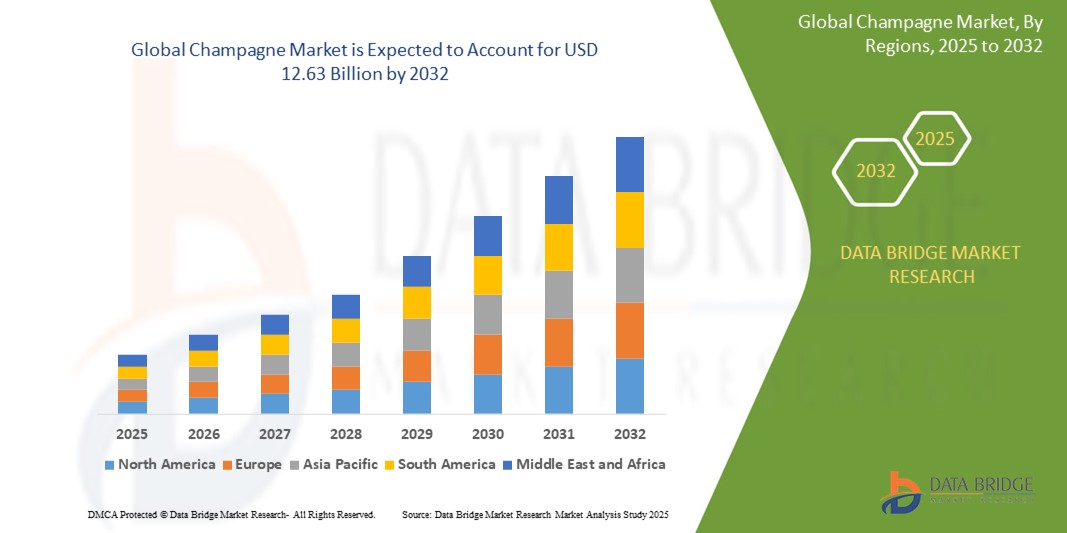
Champagne Market Size
- The global champagne market size was valued at USD 7.75 billion in 2024 and is expected to reach USD 12.63 billion by 2032, at a CAGR of 6.30% during the forecast period
- The market growth is largely fueled by the rising global preference for premium and luxury alcoholic beverages, supported by increasing disposable incomes and evolving consumer lifestyles across emerging and developed economies
- Furthermore, champagne’s strong association with celebrations, status, and fine dining experiences is enhancing its demand across social events, hospitality, and travel sectors. These factors collectively are accelerating consumption patterns and premiumization trends, thereby significantly boosting the industry's growth
Champagne Market Analysis
- Champagne is a sparkling wine produced in the Champagne region of France. It is made using specific grape varieties, primarily Pinot Noir, Pinot Meunier, and Chardonnay, and is fermented using the traditional method, which involves a second fermentation in the bottle to create its characteristic bubbles. Champagne is known for its association with celebrations and luxury, and it is protected by French law, which dictates that only sparkling wines produced in the Champagne region can be labeled as Champagne
- The escalating demand for champagne is primarily fueled by increasing disposable incomes, growing social and corporate event culture, and the rising global trend toward premiumization and experiential consumption
- Europe dominated the champagne market with a share of 66.5% in 2024, due to region's historical significance, established production standards, and global recognition of French champagne
- Asia-Pacific is expected to be the fastest growing region in the champagne market during the forecast period due to rising affluence, growing Western influence, and the increasing popularity of luxury lifestyles
- Prestige Cuvée segment dominated the market with a market share of 44.6% in 2024, due to premiumization trends, rising disposable incomes, and the cultural association of champagne with affluence and prestige. Luxury offerings often emphasize heritage, limited editions, and exclusive packaging, attracting affluent consumers in developed and developing economies
Report Scope and Champagne Market Segmentation
|
Attributes |
Champagne Key Market Insights |
|
Segments Covered |
|
|
Countries Covered |
North America
Europe
Asia-Pacific
Middle East and Africa
South America
|
|
Key Market Players |
|
|
Market Opportunities |
|
|
Value Added Data Infosets |
In addition to the insights on market scenarios such as market value, growth rate, segmentation, geographical coverage, and major players, the market reports curated by the Data Bridge Market Research also include in-depth expert analysis, pricing analysis, brand share analysis, consumer survey, demography analysis, supply chain analysis, value chain analysis, raw material/consumables overview, vendor selection criteria, PESTLE Analysis, Porter Analysis, and regulatory framework. |
Champagne Market Trends
“Rising Innovation in Product Offerings”
- A significant and accelerating trend in the global champagne market is the rising innovation in product offerings, with producers exploring new blends, sustainable practices, and packaging formats to attract evolving consumer preferences
- For instance, Moët & Chandon introduced “Moët & Chandon Ice Impérial,” the first champagne designed to be served over ice, targeting younger, lifestyle-oriented consumers seeking unconventional luxury experiences. Similarly, Veuve Clicquot launched the eco-friendly “Naturally Clicquot” packaging made from potato starch and recycled paper
- Champagne houses are also experimenting with limited-edition cuvées, aged vintages, and terroir-specific blends to differentiate their portfolios and appeal to connoisseurs. For instance, Louis Roederer’s “Cristal Vinothèque” offers rare, long-aged champagnes released in small quantities to cater to collectors and premium wine markets
- These innovations are reshaping traditional perceptions of champagne, helping brands extend reach into new demographics and consumption occasions, including casual gatherings, poolside lounges, and travel retail. This diversification strengthens brand equity while aligning with premiumization and personalization trends
- Companies such as Piper-Heidsieck are also embracing bold flavor profiles and collaborations, such as its “Essentiel” range, which targets gastronomy enthusiasts and sustainability-conscious consumers with lower dosage and organic production methods
- The demand for novel, experiential, and responsibly produced champagne variants is growing rapidly, as consumers increasingly seek authenticity, uniqueness, and purpose-driven luxury in their beverage choices
Champagne Market Dynamics
Driver
“Innovative Marketing to Change Consumer Perceptions”
- The increasing emphasis on innovative marketing strategies aimed at reshaping consumer perceptions is a significant driver for the growing demand in the champagne market
- For instance, in March 2024, Piper-Heidsieck partnered with the Miami Open as its Official Champagne, creating an immersive Champagne Garden experience to introduce its Rosé, Cuvée Brut, and Riviera labels to a broader lifestyle-oriented audience. Such high-visibility partnerships are helping brands engage new demographics and shift the perception of champagne beyond traditional celebratory use
- As consumers, especially millennials and Gen Z, seek authentic and experiential consumption, champagne brands are leveraging pop culture, social media, and lifestyle events to present champagne as a symbol of casual luxury, accessible indulgence, and personal celebration
- Furthermore, campaigns emphasizing sustainability, diversity, and modern luxury—such as Moët & Chandon's collaborations with fashion houses and digital influencers—are enhancing relevance among younger consumers and repositioning champagne as a versatile, everyday choice
- These strategic marketing efforts by key players are expanding champagne’s presence in non-traditional segments such as music festivals, rooftop bars, and travel lounges, thereby driving sustained market growth across diverse consumer groups
Restraint/Challenge
“High Production Costs”
- The high production costs associated with champagne pose a significant challenge to broader market accessibility and profitability. Champagne production requires strict adherence to traditional methods, such as the méthode champenoise, extended aging periods, and manual labor-intensive processes, all of which drive up operational expenses
- For instance, companies such as Moët & Chandon and Louis Roederer must invest significantly in vineyard maintenance, premium grape selection, and cellar aging to meet quality standards and AOC regulations, resulting in elevated costs per bottle compared to other sparkling wines
- Maintaining consistency in taste, quality, and vintage across global markets adds further logistical and cost pressures. From temperature-controlled storage to specialized packaging for international distribution, every step increases the overall cost of production
- These high costs limit the potential for price competitiveness, especially in emerging markets where cost-sensitive consumers may opt for more affordable alternatives such as Prosecco or Cava
- Overcoming these challenges will depend on innovations in production efficiency, scaling sustainable practices, and targeted marketing that reinforces champagne’s premium value proposition to justify its higher price point
Champagne Market Scope
The market is segmented on the basis of product, distribution channel, grade type, flavour, price point, and sales channel.
• By Product
On the basis of product, the champagne market is segmented into Prestige Cuvée, Blanc De Noirs, Blanc De Blancs, Rosé Champagne, and Others. The Prestige Cuvée segment accounted for the largest market revenue share of 35.1% in 2024, attributed to its association with premium quality, limited production, and heritage branding by renowned houses such as Moët & Chandon and Dom Pérignon. Consumers often perceive Prestige Cuvée as a symbol of luxury and celebration, contributing to high demand during festive and ceremonial events.
The Rosé Champagne segment is expected to witness the fastest growth rate from 2025 to 2032, driven by its rising popularity among younger demographics and its appeal in social occasions and upscale dining. Its vibrant appearance, fruit-forward palate, and food-pairing versatility support increasing consumption across global markets, particularly in urban nightlife settings.
• By Distribution Channel
On the basis of distribution channel, the champagne market is segmented into Supermarkets/Hypermarkets, Specialty Stores, and Online Stores. Supermarkets/Hypermarkets dominated the market revenue share in 2024, due to their broad consumer reach, competitive pricing, and strong supply chain networks that ensure product availability in both urban and suburban areas.
Online Stores are projected to register the fastest CAGR from 2025 to 2032, bolstered by the growth of e-commerce, digital marketing, and the convenience of home delivery. Online platforms also enable better consumer education through reviews, virtual tastings, and detailed product information, making them a preferred choice among tech-savvy and premium wine consumers.
• By Grade Type
On the basis of grade type, the champagne market is segmented into Pinot Meunier, Pinot Noir, and Chardonnay. The Pinot Noir segment held the largest revenue share in 2024, owing to its role in contributing structure, richness, and aging potential in champagne blends. Its cultivation in the Montagne de Reims and Aube regions is integral to many renowned house styles.
Chardonnay is anticipated to grow at the fastest CAGR from 2025 to 2032, favored for its crispness, elegance, and potential for aging. The demand for Blanc de Blancs champagne, made exclusively from Chardonnay grapes, is increasing in both traditional and emerging markets due to its refined taste profile and suitability for pairing with seafood and light cuisines.
• By Flavour
On the basis of flavour, the champagne market is segmented into Fruity and Brut. The Brut segment dominated the market in 2024, supported by consumer preference for drier profiles with low sugar content, aligning with modern health and taste trends. Brut champagnes are highly versatile for toasting, gifting, and gastronomy, driving their widespread demand across demographics.
The Fruity segment is projected to witness the highest growth from 2025 to 2032, driven by the rising appeal of sweeter, approachable champagne styles among first-time drinkers and younger consumers. Their easy-drinking nature and pairing adaptability with desserts and Asian cuisine are expanding their market footprint globally.
• By Price Point
On the basis of price point, the champagne market is segmented into Economy, Mid-range, and Luxury. The Luxury segment held the largest market share 44.6% in 2024, driven by premiumization trends, rising disposable incomes, and the cultural association of champagne with affluence and prestige. Luxury offerings often emphasize heritage, limited editions, and exclusive packaging, attracting affluent consumers in developed and developing economies.
The Mid-range segment is expected to grow at the fastest CAGR from 2025 to 2032, supported by the growing middle-class population, especially in Asia-Pacific. Consumers are increasingly seeking quality champagne experiences without the premium price tag, making this segment a strategic focus for both global brands and emerging players.
• By Sales Channel
On the basis of sales channel, the champagne market is segmented into Offline Sales Channel and Online Sales Channel. Offline channels accounted for the largest market share in 2024, owing to the dominant presence of physical retail outlets, specialty wine stores, and duty-free shops. In-store promotions and the opportunity for personal recommendations play a key role in offline sales.
The Online Sales Channel is projected to witness the fastest CAGR from 2025 to 2032, fueled by digital transformation, rising smartphone usage, and the increasing trust in online alcohol delivery services. Enhanced user experience, curated selections, and data-driven marketing are expected to propel the growth of online champagne sales.
Champagne Market Regional Analysis
- Europe dominated the champagne market with the largest revenue share of 66.5% in 2024, driven by the region's historical significance, established production standards, and global recognition of French champagne
- The presence of renowned champagne houses in France, coupled with strong export demand and a mature domestic consumer base, supports Europe's market leadership
- Consumer preference for authenticity, premium quality, and traditional winemaking methods continues to drive demand across the region. Regulatory frameworks such as AOC (Appellation d'Origine Contrôlée) ensure high product standards, reinforcing Europe’s dominance in both production and consumption
France Champagne Market Insight
France accounted for the largest revenue share within the European champagne market in 2024, driven by its status as the origin and exclusive producer of authentic champagne. The concentration of world-renowned producers such as Moët & Chandon, Veuve Clicquot, and Bollinger sustains high production and global exports. The domestic market benefits from strong cultural associations with champagne consumption during celebrations, weddings, and national events. France's dominance is further strengthened by ongoing tourism in the Champagne region and a strong distribution network across global luxury channels.
North America Champagne Market Insight
The North America champagne market is expected to expand at a steady CAGR during the forecast period, driven by increasing demand for premium alcoholic beverages and evolving consumer tastes. Rising disposable incomes and greater exposure to European wine culture have contributed to the growing popularity of champagne. Social events, luxury dining, and celebratory occasions continue to drive consumption. North America also benefits from a strong presence of imported champagne labels in major cities and affluent markets.
U.S. Champagne Market Insight
The U.S. champagne market held the largest revenue share in North America in 2024, supported by a growing trend toward premiumization and the increasing popularity of sparkling wines among millennials and Gen Z. The holiday season, weddings, and entertainment culture are major drivers of champagne consumption. The U.S. also shows rising interest in sustainable and organic champagne varieties, and e-commerce expansion has made premium bottles more accessible to a broader audience.
Asia-Pacific Champagne Market Insight
The Asia-Pacific champagne market is projected to grow at the fastest CAGR from 2025 to 2032, driven by rising affluence, growing Western influence, and the increasing popularity of luxury lifestyles. Demand is growing rapidly in countries such as China, Japan, and South Korea, where champagne is often viewed as a status symbol. Global producers are targeting APAC through celebrity endorsements, premium packaging, and limited-edition product launches to attract younger and high-income consumers.
China Champagne Market Insight
China captured the largest revenue share in the Asia-Pacific champagne market in 2024, propelled by the rising middle class, expanding luxury retail sector, and the popularity of imported wines in urban areas. Champagne consumption is particularly high during weddings, corporate events, and festivals. Digital platforms and cross-border e-commerce have significantly boosted accessibility and awareness, while domestic influencers and KOL marketing play a critical role in driving sales among younger consumers.
Japan Champagne Market Insight
Japan’s champagne market is steadily expanding, supported by strong wine culture, an affinity for high-quality imports, and the influence of French gastronomy. The market benefits from a stable high-income population and sophisticated retail landscape. Champagne is commonly associated with fine dining, romantic celebrations, and business gifting, with a notable preference for brut and rosé varieties. Japan’s refined palate and appreciation for craftsmanship align well with the values of traditional champagne houses.
Champagne Market Share
The champagne industry is primarily led by well-established companies, including:
- LANSON-BCC (France)
- Champagne GH Martel (France)
- Taittinger (France)
- Moet Hennessy USA, Inc (U.S.)
- Vranken - Pommery Monopole (France)
- Pernod Ricard (France)
- Louis Roederer (France)
- Veuve Clicquot (France)
- Pommery (France)
- Piper-Heidsieck (France)
- Andre Champagne Cellars (U.S.)
- Alumiceal (U.S.)
- Centre Vinicole – Champagne Nicolas Feuillatte (France)
- G.H. Mumm et Cie (France)
- Bollinger (France)
- Artwinery (Ukraine)
Latest Developments in Global Champagne Market
- In May 2024, Pernod Ricard and ecoSPIRITS announced a new phase in their relationship by entering into a five-year global licensing agreement. This partnership will facilitate the distribution of Pernod Ricard’s spirits brands using ecoSPIRITS’ circular packaging technology to on-trade venues worldwide
- In March 2024, Piper-Heidsieck entered a three-year partnership to become the Official Champagne of the Miami Open. Throughout the two-week tournament, guests at the Champagne Garden enjoyed offerings such as Piper-Heidsieck’s Rosé, Cuvée Brut, and Riviera selections
- In September 2023, Laurent-Perrier partnered with the leading department store Selfridges to launch its new Laurent-Perrier Cuvée Rosé “Petals” robe, available both in-store and online. Champagne Laurent-Perrier has introduced its latest artistic edition, “Petals.” This vibrant new robe adds a splash of color and an extra layer of indulgence, serving as a perfect table centerpiece that can be reused to encase future bottles
- In August 2023, Global Airlines formed a partnership with Laurent Perrier through a signed Memorandum of Understanding (MOU), aiming to enhance the in-flight experience. As part of the collaboration, Laurent Perrier champagne is served on all Global Airlines transatlantic flights beginning in 2024
- In October 2022, Societe Jacques Bollinger SA commemorated 40 years of collaboration with 007 by launching a limited edition champagne, "Special Cuvee, The Bollinger Style." The champagne, packaged in a distinctive gift box featuring James Bond's silhouette and his iconic Aston Martin DB5, pays homage to the longstanding collaboration and the sophistication associated with both the brand and the fictional character

- Interactive Data Analysis Dashboard
- Company Analysis Dashboard for high growth potential opportunities
- Research Analyst Access for customization & queries
- Competitor Analysis with Interactive dashboard
- Latest News, Updates & Trend analysis
- Harness the Power of Benchmark Analysis for Comprehensive Competitor Tracking
Global Champagne Market, Supply Chain Analysis and Ecosystem Framework
To support market growth and help clients navigate the impact of geopolitical shifts, DBMR has integrated in-depth supply chain analysis into its Global Champagne Market research reports. This addition empowers clients to respond effectively to global changes affecting their industries. The supply chain analysis section includes detailed insights such as Global Champagne Market consumption and production by country, price trend analysis, the impact of tariffs and geopolitical developments, and import and export trends by country and HSN code. It also highlights major suppliers with data on production capacity and company profiles, as well as key importers and exporters. In addition to research, DBMR offers specialized supply chain consulting services backed by over a decade of experience, providing solutions like supplier discovery, supplier risk assessment, price trend analysis, impact evaluation of inflation and trade route changes, and comprehensive market trend analysis.
Data collection and base year analysis are done using data collection modules with large sample sizes. The stage includes obtaining market information or related data through various sources and strategies. It includes examining and planning all the data acquired from the past in advance. It likewise envelops the examination of information inconsistencies seen across different information sources. The market data is analysed and estimated using market statistical and coherent models. Also, market share analysis and key trend analysis are the major success factors in the market report. To know more, please request an analyst call or drop down your inquiry.
The key research methodology used by DBMR research team is data triangulation which involves data mining, analysis of the impact of data variables on the market and primary (industry expert) validation. Data models include Vendor Positioning Grid, Market Time Line Analysis, Market Overview and Guide, Company Positioning Grid, Patent Analysis, Pricing Analysis, Company Market Share Analysis, Standards of Measurement, Global versus Regional and Vendor Share Analysis. To know more about the research methodology, drop in an inquiry to speak to our industry experts.
Data Bridge Market Research is a leader in advanced formative research. We take pride in servicing our existing and new customers with data and analysis that match and suits their goal. The report can be customized to include price trend analysis of target brands understanding the market for additional countries (ask for the list of countries), clinical trial results data, literature review, refurbished market and product base analysis. Market analysis of target competitors can be analyzed from technology-based analysis to market portfolio strategies. We can add as many competitors that you require data about in the format and data style you are looking for. Our team of analysts can also provide you data in crude raw excel files pivot tables (Fact book) or can assist you in creating presentations from the data sets available in the report.













